
The most common erectile dysfunction causes are physical: diabetes, clogged arteries, high blood pressure, obesity, low testosterone and nerve damage from surgery. Medicines such as antidepressants and blood pressure pills, stress, depression, smoking and heavy drinking also play a part. About 40% of men have some ED at 40. Because ED can be an early sign of heart disease, see a doctor.
Erectile dysfunction causes fall into four groups: diseases that harm blood vessels, nerves or hormones; medicines; mental health strain; and daily habits. We read the NIDDK pages on erectile dysfunction (ED), the MedlinePlus summary, the NIH StatPearls chapter, an NCCIH page and seven studies, following our research and fact-checking process.[1][2][6][7]
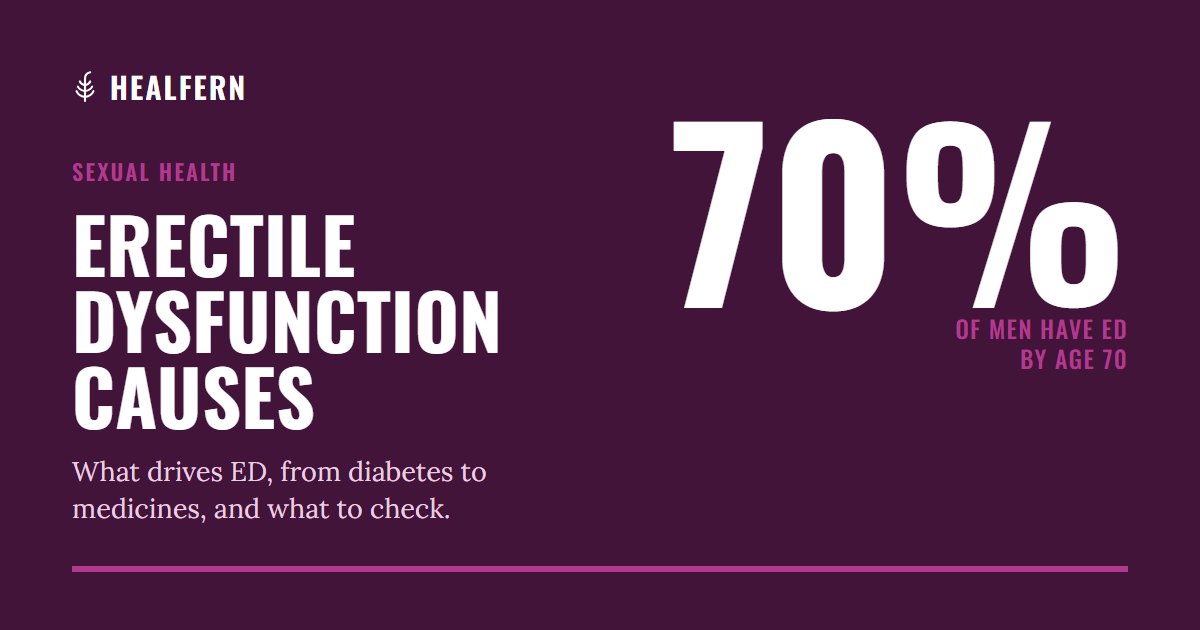
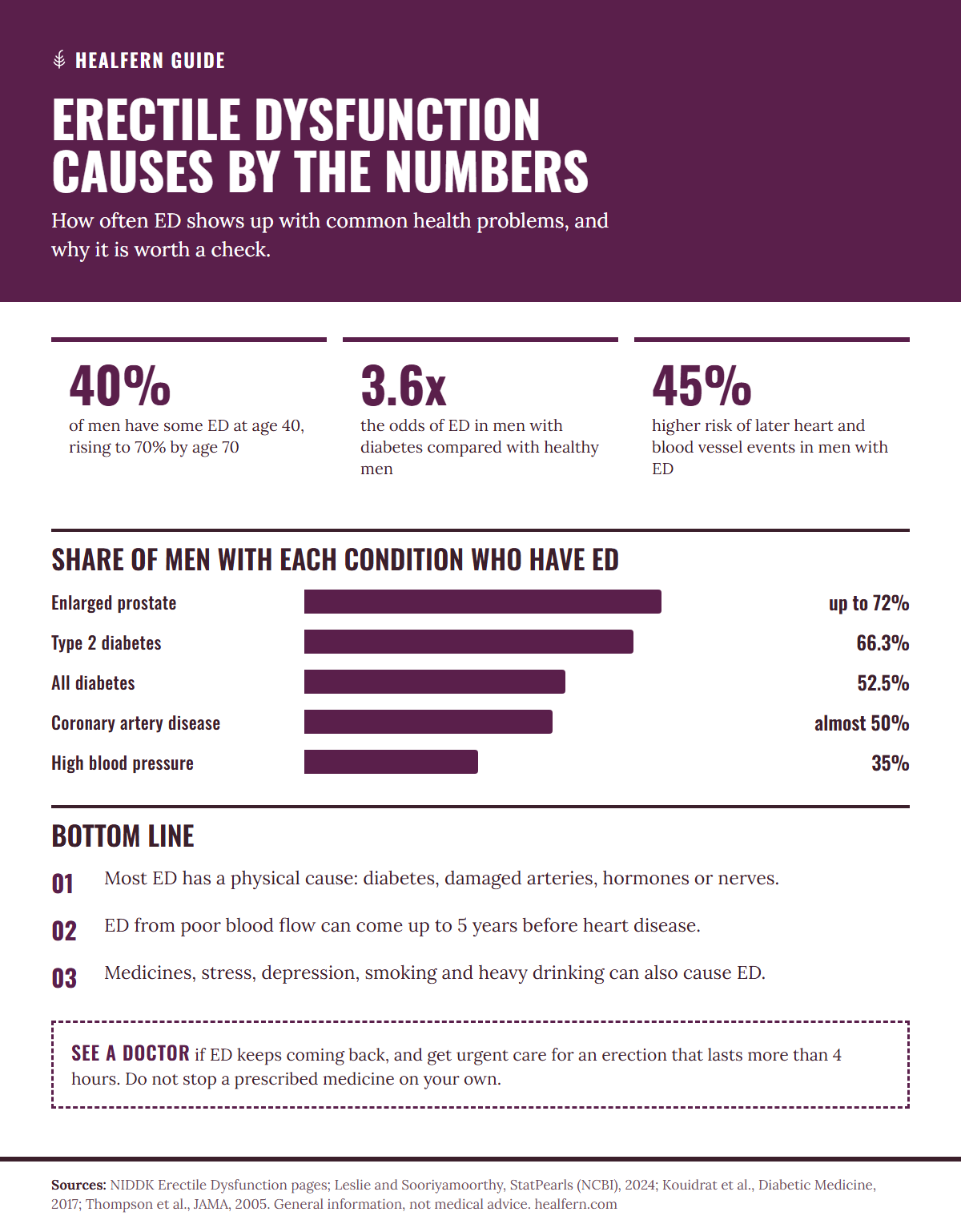
Most ED has a physical cause, usually a disease that damages blood vessels, nerves or hormones, such as diabetes or heart disease.[2][7] About 40% of men have some ED at age 40, and 70% do by age 70, yet ED is not a normal part of aging.[1]
| What it is | Trouble getting or keeping an erection firm enough for sex[1] |
|---|---|
| How common | 30 million to 50 million men in the U.S.; about 40% at age 40 and 70% by age 70[1] |
| Main physical causes | Diabetes, clogged arteries, high blood pressure, obesity, low testosterone, nerve damage, prostate problems[2] |
| Medicine causes | Antidepressants, blood pressure pills and water pills, antihistamines, opioid pain relievers, sedatives[2] |
| Mind and habits | Anxiety, depression, stress, smoking, heavy drinking, too little exercise, drug use[2] |
| Warning sign | Men with ED have more heart attacks and strokes later, so ED can be an early clue to heart disease[7][9] |
| First step | A doctor visit to find and treat the cause; most men with ED never need surgery[4] |
What are the most common erectile dysfunction causes?
The most common erectile dysfunction causes are diseases that affect blood vessels, nerves or hormones, led by diabetes, heart disease, high blood pressure and obesity.[2] Medicines, anxiety, depression, smoking, heavy drinking and too little exercise also play a part, and many men have more than one cause at once.[2][7]
Doctors sort causes into physical (organic), psychological (psychogenic) and mixed. StatPearls notes that most men with ED have a physical cause, while a purely psychological cause is more likely in younger men.[7]
| Cause group | Examples | Key number |
|---|---|---|
| Diabetes | Type 1 and type 2 | 52.5% of men with diabetes have ED[8] |
| Blood vessel disease | Atherosclerosis, high blood pressure, stroke | 35% of men with high blood pressure have ED[7] |
| Hormones | Low testosterone, thyroid imbalance | Up to 35% of men with ED have low testosterone[7] |
| Nerve damage | Multiple sclerosis, spinal cord injury, pelvic surgery | 85% have ED after prostate removal surgery[7] |
| Mind | Depression, anxiety, stress | Depression raises the odds of ED by 39%[12] |
| Habits and weight | Smoking, alcohol, inactivity, obesity | Obesity is linked to 50% more ED[7] |
How does erectile dysfunction happen?
An erection depends on extra blood flowing into the penis, nerve signals that start the process, and hormones such as testosterone. ED appears when one or more of these breaks down. NIDDK names diseases of the blood vessels, nerves and hormones as the main physical routes to ED.[2]
Narrowed arteries are a common problem. StatPearls explains that the arteries feeding the penis are small, so plaque can narrow them earlier than the larger arteries of the heart.[7] That is why ED from poor blood flow often appears years before a heart problem.
Nerve damage from diabetes, multiple sclerosis, a spinal cord injury or pelvic surgery can interrupt the signal.[2] Hormone problems such as low testosterone or a thyroid imbalance can also weaken erections.[2]
Symptoms vary from man to man. NIDDK describes getting an erection only some of the time, losing it before sex is over, or not getting one at all.[2]
Can erectile dysfunction be caused by diabetes?
Yes, diabetes is one of the strongest causes of ED, and more than half of men with diabetes develop it. High blood sugar damages both the blood vessels and the nerves an erection needs. Men with diabetes also tend to get ED 10 to 15 years earlier than men without it.[5]
A 2017 meta-analysis of 145 studies and 88,577 men found ED in 52.5% of men with diabetes.[8] The rate was 66.3% with type 2 diabetes and 37.5% with type 1. Men with diabetes had about 3.6 times the odds of ED compared with healthy men.[8]
ED can also be the first hint of diabetes. StatPearls reports undiagnosed diabetes in 28% of men with ED, against 10% of men with normal erections.[7] NIDDK says good blood sugar control may help with ED caused by nerve and blood vessel damage.[5]
Is erectile dysfunction related to heart disease?
Yes, ED and heart disease share the same root problem of damaged arteries, and ED often shows up first. Almost 50% of men with proven coronary artery disease have significant ED. ED from poor blood flow can come up to 5 years before a heart attack or stroke.[7]
The Prostate Cancer Prevention Trial followed 9,457 men aged 55 and older. After adjusting for age, blood pressure, cholesterol, diabetes and smoking, men with ED had a 45% higher risk of later heart and blood vessel events.[9] A pooled analysis of 14 studies with more than 90,000 men found 44% more cardiovascular events and 62% more heart attacks in men with ED.[7]
These studies show an association and cannot prove that ED causes heart disease. Still, a man with ED has good reason to get his heart risk checked.
High blood pressure is part of the same picture. About 40% of men with ED have high blood pressure, and about 35% of men with high blood pressure have ED.[7] If you have not had a reading in a while, read our guide to the symptoms of high blood pressure.
Can erectile dysfunction be caused by low testosterone?
Low testosterone can contribute to ED, though it is rarely the only cause. Up to 35% of men with ED also have low testosterone, called hypogonadism, and about 6% have an abnormal thyroid.[7] Blood tests can check both, and NIDDK lists thyroid tests among the lab work doctors use for ED.[3]
Low testosterone often travels with other causes. StatPearls notes that about one third of men with diabetes have low testosterone, which may partly explain why diabetes and ED are so closely linked.[7]
When a man has both ED and low testosterone, NIDDK says doctors may prescribe testosterone together with an ED pill. It adds that a healthy weight can improve testosterone levels.[4] Our guide on how to increase testosterone naturally looks at the habits that affect those levels.
Which medicines can cause erectile dysfunction?
Many common prescription and over-the-counter medicines can cause ED as a side effect. NIDDK lists antidepressants, blood pressure pills, water pills, antihistamines, opioid pain relievers, sedatives, ulcer medicines and some cancer and hormone drugs. Never stop a prescribed medicine on your own without talking to your doctor first.[2][4]
- Antidepressants[2]
- Blood pressure medicines and diuretics, also called water pills[2]
- Antihistamines taken for allergies or heartburn[2]
- Pain relievers, including NSAIDs, codeine and oxycodone[2]
- Sedatives and appetite suppressants[2]
- Chemotherapy, hormone medicines and ulcer medicines[2]
If ED started soon after a new prescription or a dose change, tell the doctor who prescribed it. NIDDK says they may lower the dose or switch you to another medicine.[4]
Can erectile dysfunction be caused by stress?
Yes, stress, anxiety and depression can cause ED or make it worse, and ED can in turn feed low mood. NIDDK lists stress, anxiety, depression, loneliness and low self-esteem among the causes.[2] A 2018 meta-analysis found that depression raised the odds of ED by 39%.[12]
Men with ED were also more likely to become depressed. In the same analysis of 49 publications, men with ED had almost 3 times the odds of developing depression.[12] StatPearls adds that performance anxiety and depression can add to ED even when a physical cause is present.[7]
Normal erections at night or on waking point toward a mental cause. A healthy man has 3 to 6 erections during sleep. Men with a purely psychological cause usually keep them, while men with a physical cause often do not.[7] Counseling, sometimes with a partner, is a standard treatment for this kind of ED.[4]
What causes erectile dysfunction in young men?
In men under 40, ED is more often linked to smoking, recreational drug use and psychological causes, though physical disease still needs to be ruled out. An Italian clinic study found that 26% of men seeking help for new ED were 40 or younger, and their ED was often just as severe.[10]
In that 2013 study of 439 men, the younger group had fewer health problems, lower body weight and higher testosterone than the older men. They smoked and used illicit drugs more often.[10] Severe ED showed up in 48.8% of the younger men and 40% of the older men.[10]
A young man with ED should still be checked for physical causes. StatPearls reports that younger men with unexplained ED may face up to a 50-fold rise in later cardiovascular risk compared with men of the same age.[7]
Can erectile dysfunction be caused by prostate problems?
Yes, an enlarged prostate and prostate cancer treatment are both linked to ED. Up to 72% of men with a symptomatic enlarged prostate also have ED. After surgery to remove the prostate for cancer, about 85% of men have ED, compared with about 25% after radiation therapy.[7]
Pelvic surgery can damage the nerves that start an erection, which is why NIDDK lists it among the nerve-related causes.[2] NIDDK also names Peyronie’s disease, a curve in the penis, as a reproductive cause of ED.[2]
A prostate exam and prostate blood tests are part of the standard ED workup, so these causes are usually checked at the first visit.[3]
Is erectile dysfunction reversible?
ED is often treatable, and some cases improve a lot once the cause is fixed. NIDDK says doctors treat the underlying cause whenever possible.[4] Trials show that weight loss, more exercise and quitting smoking can improve erections, though results vary from man to man and the studies are small.[7][11][14]
| Study | Who and how long | Change made | Result |
|---|---|---|---|
| Esposito, JAMA 2004 (randomized trial)[11] | 110 obese men aged 35 to 55, 2 years | Weight loss diet; exercise rose from 48 to 195 minutes a week | Erection scores improved; about one third of men regained normal function |
| Silva, BJSM 2017 (meta-analysis)[14] | 7 trials, 478 men, 8 weeks to 2 years | Aerobic or pelvic exercise | Erection score rose 3.85 points on average; trials at moderate to high risk of bias |
| Bauer, JAMA Netw Open 2020 (cohort)[13] | 21,469 U.S. men, about 11 years | Mediterranean-style diet | 22% lower risk of new ED in men under 60 |
| StatPearls summary[7] | Smokers who quit | Stopped smoking | Erection quality 25% better after one year |
Only the first is a randomized trial of a full lifestyle program. The diet data come from an observational study and show only a link.[13] StatPearls notes that apart from therapy for purely psychological ED, treatments manage ED rather than cure it, so finding the cause still matters for your overall health.[7]
How can you tell which cause is behind your ED?
The pattern of your symptoms gives your doctor useful clues, but only an exam and tests can confirm the cause. NIDDK says diagnosis uses your medical, sexual and mental health history, a physical exam and blood tests, sometimes with an ultrasound of blood flow or a nighttime erection test.[3]
The table is meant to help you prepare for the appointment. It cannot diagnose you.
| If you notice | Possible cause to raise | Check a doctor may use |
|---|---|---|
| ED came on slowly and night erections have faded | Blood vessel or nerve problem | Blood tests, ultrasound of penile blood flow[3][7] |
| Night and morning erections are normal, but problems happen with a partner | Stress, anxiety or relationship strain | Sexual and mental health history[3][7] |
| ED started after a new medicine or dose | Medicine side effect | Review of all your medicines[2][4] |
| ED along with diabetes, high blood pressure or high cholesterol | Artery damage | Blood sugar tests and a heart risk check[5][7] |
| ED with less interest in sex | Low testosterone or thyroid problem | Hormone and thyroid blood tests[3][7] |
| ED after pelvic surgery or a spine injury | Nerve damage | Physical exam of the nerves[2][3] |
| A new curve in the penis | Peyronie’s disease | Physical exam[2][3] |
When should you see a doctor about erectile dysfunction?
See a doctor if erection problems keep coming back or worry you, because ED can be an early sign of diabetes or heart disease. MedlinePlus warns that ED may mean clogged blood vessels or nerve damage from diabetes, and those problems go untreated if you never mention it.[6]
See a doctor right away if:
- An erection lasts longer than 4 hours, a condition called priapism[4]
- You have vision or hearing loss after taking an ED pill[4]
- ED shows up together with other signs of diabetes, including bladder problems[5]
Be careful with ED pills sold online or as supplements. NIDDK says to talk with a health care professional before using any supplement or ordering ED medicine online, because these products can interact with other medicines.[4] NCCIH says there is not enough research to show yohimbe helps ED, and yohimbine has been linked to irregular heartbeat, heart attacks and seizures.[15] If you are weighing a supplement, our article on L-arginine for erectile dysfunction looks at the research on that one.
What do doctors use first for erectile dysfunction?
Doctors start by treating the cause and changing habits, then add medicine if needed. NIDDK lists quitting smoking, cutting back on alcohol, more activity, a healthy weight and eating plan, and counseling. PDE5 inhibitor pills, which improve blood flow to the penis, are the usual medicine. Most men never need surgery.[4]
Other options include injections, a small suppository placed in the urethra, a vacuum device and, when nothing else works, a penile implant.[4] MedlinePlus notes that for many men a pill is enough, and that exercise, weight loss or stopping smoking may also help.[6]
Choosing a treatment is a personal decision, and NIDDK suggests that men with a partner talk it through together.[4] You can find related guides in our sexual health section.
Checklist before your appointment
A few notes made ahead of time help your doctor narrow down the cause faster. NIDDK says the visit covers your medicines, vitamins and supplements, your sexual function and your mental health, so having answers ready keeps a likely cause from being missed.[3]
- Note when the problem started and whether it came on suddenly or slowly.[3]
- Notice whether you still get erections at night or on waking.[7]
- List every medicine, vitamin and supplement you take, with doses.[3]
- Track smoking, alcohol and exercise; NIDDK suggests at least 150 minutes of moderate activity a week.[4]
- Ask whether you need a blood sugar test and a heart risk check.[5][7]
- Bring your partner if you like; the doctor may ask them about your relationship.[3]
What is the bottom line on erectile dysfunction causes?
Most ED has a physical cause, and the usual ones are diabetes, damaged arteries, high blood pressure, excess weight, certain medicines and smoking. Stress and depression often play a part too, especially in younger men. Several causes often overlap in the same man, so one fix may not be enough.[2][7]
For most men, a doctor visit with blood tests and a blood pressure check is a better first step than a supplement. ED can be the first sign of heart disease or diabetes, and treating either one helps your long-term health as well as your erections.[7][9]
Questions people also ask
Does erectile dysfunction happen suddenly?
It can. ED that starts soon after a new medicine may be a side effect, and ED with normal night erections often has a psychological cause. Damage to arteries and nerves usually builds up over time. A doctor can work out which pattern fits you.
Is erectile dysfunction a sign of prostate cancer?
ED is not a known early sign of prostate cancer. It is very common after prostate cancer treatment, affecting about 85% of men after surgery and about 25% after radiation. An enlarged prostate is also linked to ED.
Does erectile dysfunction affect fertility?
ED can make it hard to get a partner pregnant because sex may not be possible, and NIDDK lists this as a complication. ED itself is a problem with erections, so a separate semen test is needed to check sperm.
Can drinking alcohol cause erectile dysfunction?
Yes. NIDDK lists drinking too much alcohol among the lifestyle habits that can lead to ED, and StatPearls reports a higher risk of ED in heavy drinkers. Cutting back or stopping is one of the first changes doctors suggest.
Is erectile dysfunction genetic?
The main drivers of ED are age, diseases such as diabetes and heart disease, medicines, mental health and habits. Some of those conditions run in families, so a family history of diabetes or heart disease is worth telling your doctor about.
Sources
- Definition & Facts for Erectile Dysfunction, NIDDK, National Institutes of Health, 2024
- Symptoms & Causes of Erectile Dysfunction, NIDDK, National Institutes of Health, 2024
- Diagnosis of Erectile Dysfunction, NIDDK, National Institutes of Health, 2024
- Treatment for Erectile Dysfunction, NIDDK, National Institutes of Health, 2024
- Diabetes, Sexual, & Bladder Problems, NIDDK, National Institutes of Health
- Erectile Dysfunction, MedlinePlus, National Library of Medicine
- Erectile Dysfunction (StatPearls), Leslie and Sooriyamoorthy, NCBI Bookshelf, 2024
- High prevalence of erectile dysfunction in diabetes: a systematic review and meta-analysis of 145 studies, Kouidrat et al., Diabetic Medicine, 2017
- Erectile dysfunction and subsequent cardiovascular disease, Thompson et al., JAMA, 2005
- One patient out of four with newly diagnosed erectile dysfunction is a young man, Capogrosso et al., Journal of Sexual Medicine, 2013
- Effect of lifestyle changes on erectile dysfunction in obese men: a randomized controlled trial, Esposito et al., JAMA, 2004
- Erectile Dysfunction and Depression: A Systematic Review and Meta-Analysis, Liu et al., Journal of Sexual Medicine, 2018
- Association of Diet With Erectile Dysfunction Among Men in the Health Professionals Follow-up Study, Bauer et al., JAMA Network Open, 2020
- Physical activity and exercise for erectile dysfunction: systematic review and meta-analysis, Silva et al., British Journal of Sports Medicine, 2017
- Yohimbe, National Center for Complementary and Integrative Health, NIH
This article is general information, not medical advice. These statements have not been evaluated by the FDA, and supplements are not intended to diagnose, treat, cure or prevent any disease. Talk to your doctor or pharmacist before you start a supplement. How we research.
