The clearest low testosterone symptoms are sexual: less desire, fewer morning erections and weaker erections. Tiredness, low mood, lost muscle and less body hair can also appear, but they have many other causes. Symptoms alone cannot confirm it. Doctors need at least two fasting blood tests drawn between 7 and 10 AM, and the cause, such as obesity or a medicine, shapes treatment.
Low testosterone symptoms are easy to blame on stress or getting older, so it helps to know which ones carry real weight. We read the Endocrine Society guideline and its patient page, the MedlinePlus lab test guide, the AndroGel prescribing label on DailyMed, and three large studies: EMAS, the Testosterone Trials and TRAVERSE.[1][2][3][5][6][7][8] You can see how we research and check sources on a separate page.
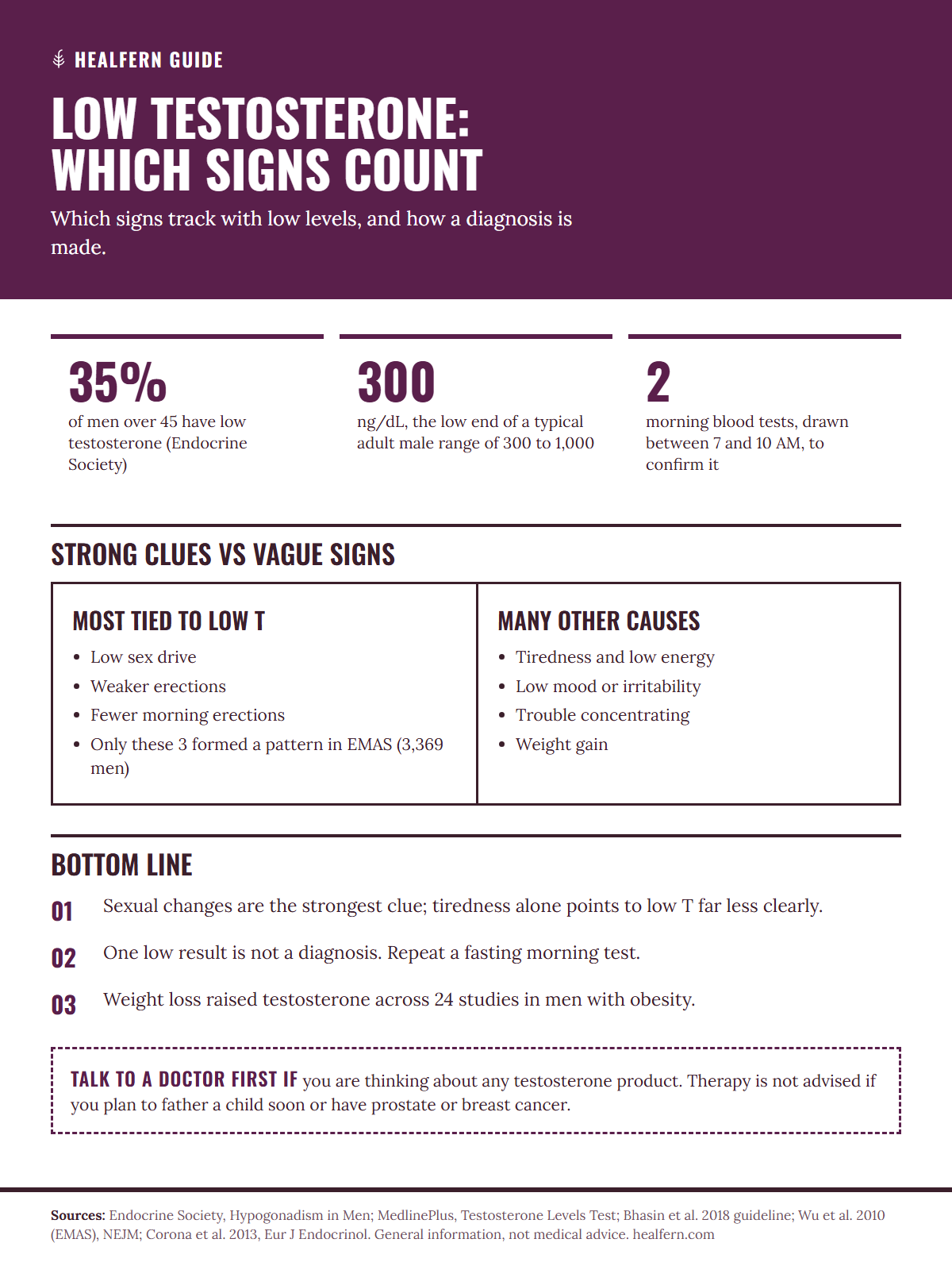
The signs most closely tied to low testosterone are sexual: lower desire, fewer morning erections and erection trouble, and a diagnosis needs at least two low early-morning blood tests.[5][2] About 35% of men over 45 meet the medical definition of low testosterone.[2]
| What it is | The body makes too little testosterone, a condition doctors call hypogonadism[2] |
|---|---|
| Main signs in men | Low sex drive, erection problems, fewer morning erections, tiredness, low mood, loss of muscle and body hair[1][5] |
| How common | About 35% of men over 45, and 30% to 50% of men with obesity or type 2 diabetes[2] |
| Typical adult range | Roughly 300 to 1,000 ng/dL, depending on the lab[2] |
| How it is confirmed | Symptoms plus two fasting blood tests drawn between 7 and 10 AM[1][3] |
| Standard care | Treat the cause, such as excess weight, and prescription testosterone for confirmed cases[3][9] |
| Who should not take testosterone | Men planning to father a child soon, and men with prostate or breast cancer[3] |
What are low testosterone symptoms in men?
Low testosterone symptoms in men fall into three groups: sexual changes, body changes, and shifts in mood or energy. The sexual signs are the most reliable clue, led by low desire, weaker erections and fewer morning erections.[5] Mood and body changes have many other causes, so they point to low testosterone less clearly.[2][5]
The European Male Ageing Study (EMAS) checked 3,369 men aged 40 to 79 in eight European centers. Of all the symptoms it tested, only the three sexual ones formed a pattern that matched low hormone levels.[5] Here is the fuller list from MedlinePlus and the Endocrine Society.
- Sexual: less interest in sex, erections that are harder to get or keep, fewer morning erections, and fertility problems.[1][5]
- Body: loss of muscle, less face or body hair, enlarged breast tissue, shrinking testes and thinning bones.[1][2]
- Blood: anemia, a low red blood cell count that can add to tiredness.[1]
- Energy and mood: reduced energy, irritability, trouble concentrating and a depressed mood.[2]
- Very low levels: hot flashes, which are unusual in men and tend to appear only when levels fall a long way.[2]
If tiredness or low mood is your only complaint, expect your doctor to look at other causes as well. In EMAS, fatigue and depression had a weaker link to testosterone than the sexual symptoms did.[5]
Can low testosterone cause anxiety, brain fog or weight gain?
Low testosterone can bring irritability, poor concentration and a low mood, and it is closely tied to extra body fat. Anxiety itself is not a well-established sign; the major medical sources list irritability and depressed mood instead.[2] Obesity is a common cause, and weight loss tends to raise levels.[2][9]
What people call brain fog shows up in the Endocrine Society list as an inability to concentrate, next to reduced energy.[2] Treatment does not fix every one of these complaints. In the Testosterone Trials, a year of gel in 790 men aged 65 and older gave some benefit for mood but no benefit for vitality.[6]
Between 30% and 50% of men with obesity or type 2 diabetes have low testosterone.[2] A 2013 analysis of 24 studies found that losing weight raised both bound and free testosterone, and bigger losses brought bigger rises.[9] Weight loss surgery raised levels more than low-calorie diets did.[9]
Sleep problems mostly run in the other direction in the research we read. In a 2011 lab study, 10 healthy young men who slept 5 hours a night for one week saw daytime testosterone fall by 10% to 15%.[10] Sleep disorders appear on the Endocrine Society list of causes.[2]
What causes low testosterone in men, including young men?
Low testosterone comes from either a problem in the testes or a problem with the pituitary gland, which tells the testes to make the hormone. Common triggers include obesity, type 2 diabetes, opioid pain medicines, steroid use and some genetic conditions.[1][2] Age matters less: levels fall about 1% a year after 30.[2]
- Weight and blood sugar: obesity and type 2 diabetes.[2]
- Medicines and drugs: opiate painkillers, corticosteroids, and current or past anabolic steroid use.[2]
- Testicle problems: injury, and genetic conditions such as Klinefelter syndrome.[1][14]
- Pituitary and hormone problems: pituitary disorders and high prolactin levels.[1][2]
- Other illness: liver or kidney disease, HIV, hemochromatosis (iron overload), sleep disorders and alcohol use disorder.[1][2]
For men in their 20s and 30s, the slow age-related decline explains very little, so a clearly low result points toward one of the causes above.[2] Klinefelter syndrome is one example. A male is born with an extra X chromosome, and MedlinePlus notes that many of its adult signs, such as smaller testes, less body hair, weaker bones and lower energy, come from low testosterone.[14] It is not inherited; it starts with a random error when a sperm or egg forms.[14]
Some of these causes can be undone. The Endocrine Society says low testosterone linked to obesity can be reversible without testosterone therapy.[2]
How do you tell if you have low testosterone?
You cannot tell from symptoms alone. A diagnosis needs symptoms plus at least two low blood tests, drawn in the morning between 7 and 10 AM.[1][2] The Endocrine Society guideline asks for a fasting morning total testosterone test, repeated to confirm, before a doctor calls it hypogonadism.[3]
A single low number calls for a retest.[3] Labs in the U.S. usually report total testosterone in ng/dL. The Endocrine Society gives a typical adult male range of 300 to 1,000 ng/dL.[2] A 2017 study that pooled 9,054 men from four cohorts set a harmonized range of 264 to 916 ng/dL for healthy, non-obese men aged 19 to 39.[4] The range printed on your own report is the one to compare against.
If your total result sits near the low end, or a condition changes the protein that carries testosterone in the blood (SHBG), the guideline suggests also measuring free testosterone.[3]
Decision table: what your symptoms and results suggest
This table turns the guideline rules into next steps. Use it to plan the talk with your doctor.[3]
| If you have | What it suggests | Sensible next step |
|---|---|---|
| Low desire or weaker erections, no test yet | Low testosterone is one possible cause; blood vessel disease, diabetes and medicines are others[15] | Ask for a morning testosterone test and a general checkup |
| One low morning result | Not enough for a diagnosis[3] | Repeat the fasting test on another morning |
| Two low results plus symptoms | Meets the guideline definition of hypogonadism[3] | Look for the cause, then discuss treatment |
| Low results but no symptoms | The guideline does not diagnose hypogonadism without symptoms[3] | Review medicines, weight and sleep; no routine therapy |
| Tiredness only, normal results | Low testosterone is unlikely to be the reason[5] | Ask about other causes of fatigue |
What did the large testosterone studies find?
Three large studies shape how doctors read low testosterone symptoms. EMAS showed which symptoms match low levels, while the Testosterone Trials and TRAVERSE tested what treatment does and how safe it is.[5][6][7] Treatment helped sexual function most, and it did not raise major heart events in men who already had higher heart risk.[6][7]
| Study | Who and how many | What was tested | Result |
|---|---|---|---|
| EMAS, 2010 | 3,369 men aged 40 to 79 | Which symptoms match low levels | Only 3 sexual symptoms formed a pattern; cutoff was total testosterone under 11 nmol/L (about 320 ng/dL) plus low free testosterone[5] |
| Testosterone Trials, 2016 | 790 men 65 and older, levels under 275 ng/dL | Gel or placebo for 1 year | Moderate gain in sexual function, some in mood, none in vitality or walking distance[6] |
| TRAVERSE, 2023 | 5,246 men aged 45 to 80 with heart disease or high risk, levels under 300 ng/dL | Gel or placebo | Major heart events 7.0% vs 7.3%; more atrial fibrillation, acute kidney injury and pulmonary embolism with testosterone[7] |
| Corona review, 2013 | 24 studies of men with obesity | Weight loss by diet or surgery | Testosterone rose, and more weight lost meant a bigger rise[9] |
TRAVERSE was funded in part by AbbVie, which makes AndroGel. In July 2025 the AndroGel label removed its general cardiovascular risk warning and added warnings about blood clots and blood pressure, citing a 1.5 mm Hg rise in systolic pressure in TRAVERSE.[7][8]
What are low testosterone symptoms in women?
Women make far less testosterone than men, and low levels are normal for them. No blood test cutoff separates women with low-testosterone problems from women without them.[1][13] The only use with good evidence is low sexual desire that causes distress after menopause, a condition called hypoactive sexual desire disorder (HSDD).[13]
MedlinePlus notes that extremely low levels in women can point to a problem with the adrenal glands, pituitary gland or ovaries.[1] The 2019 global consensus statement, signed by several medical societies, found too little data to support testosterone for women before menopause, and it advised against oral forms.[13]
Prescription testosterone gels in the U.S. are labeled for men. The AndroGel label lists primary and secondary hypogonadism in males as its uses.[8] A woman with low desire, tiredness or mood changes around menopause is better served by a full menopause visit than by a testosterone test, because the test alone cannot explain those symptoms.[13]
How is low testosterone treated, and can it be reversed?
Treatment depends on the cause. When obesity, a medicine or a sleep problem is behind the drop, fixing that cause can bring levels back up without testosterone therapy.[2][9] For confirmed hypogonadism, doctors prescribe testosterone, such as a daily skin gel, and aim for the middle of the normal range.[3][8]
The Endocrine Society says testosterone therapy is not FDA approved for strength, athletic performance, appearance or normal aging.[2] The AndroGel label also states that its safety and benefit in men with age-related low testosterone have not been established.[8] So a man in his 60s with tiredness and a borderline result is a weak candidate, while a man with two clearly low results and sexual symptoms is a stronger one.[3][6]
What about testosterone booster supplements?
Over-the-counter boosters have little research behind them. A 2020 review of 50 booster products found that 90% claimed to raise testosterone, yet only 24.8% of those claims had data to back them, and 10.1% of the ingredients had data showing a decrease.[11] Thirteen products went over the safe upper limit for nutrients such as zinc.[11]
Some products contain hidden drugs. An FDA database review found 776 tainted supplements from 2007 to 2016, and steroids or steroid-like ingredients turned up in 89.1% of the tainted muscle-building products.[12] If you want to read about one herb, our guide to tongkat ali benefits walks through what the trials show. Our article on how to increase testosterone naturally covers sleep, weight and exercise, and if erections are the main worry, see L-arginine for erectile dysfunction.
Who should avoid testosterone therapy, and when should you see a doctor?
Testosterone therapy is not safe for every man, and gels carry a risk for the people you live with. The Endocrine Society advises against therapy for men planning to father a child soon and for men with prostate or breast cancer.[3] Gel can rub off onto children and partners.[8]
The guideline also lists a PSA above 4 ng/mL, a high red blood cell count, untreated severe sleep apnea, uncontrolled heart failure, and a heart attack or stroke in the past 6 months.[3]
The AndroGel label has a boxed warning that children who touch treated skin can develop signs of male puberty, so the gel area must stay covered and hands washed.[8] The label also asks doctors to check blood pressure regularly.[8]
See a doctor right away if
- You use testosterone and get leg pain or swelling, or sudden shortness of breath, which can signal a blood clot.[7][8]
- A child or partner who has touched your gel shows new body hair, acne or genital changes.[8]
- Erection problems appear along with signs of heart or blood vessel disease, since ED can be a symptom of another health problem.[15]
- You notice new breast growth or a sharp loss of body hair or muscle.[1]
- Hot flashes start along with a fading sex drive, a pattern that tends to appear only when levels fall very low.[2]
Checklist before your appointment
- Write down each symptom, how long it has lasted, and whether it is sexual, physical or mood related.[5]
- List every medicine, especially opioid painkillers, steroids and any past anabolic steroid use.[2]
- Book the blood draw between 7 and 10 AM, and fast beforehand.[1][3]
- If the first result is low, ask for a repeat test before any treatment starts.[3]
- Bring any sexual enhancement or muscle-building supplements you take; these groups had the most tainted products in the FDA data.[12]
- Say whether you hope to have children, because that changes the treatment plan.[3]
Bottom line
Of all the low testosterone symptoms, sexual changes, especially less desire and fewer morning erections, have the strongest research link.[5] Tiredness and low mood matter, but on their own they point to low testosterone far less clearly. Two morning blood tests answer the question far better than any online quiz.[3]
For most men carrying extra weight, losing weight is the better first step, because it raised testosterone across the 24 studies Corona’s team pooled and carries none of the risks of therapy.[9] Testosterone therapy makes most sense when clear symptoms and two low results line up and your doctor has looked for a cause.[3] Browse our men’s health guides for related topics.
Questions people also ask
Does low testosterone cause hair loss?
Scalp hair loss is not listed as a sign of low testosterone in the sources we read. MedlinePlus and the Endocrine Society do list less face and body hair, which can show up as slower beard growth or thinner body hair over time.
Can low testosterone cause infertility?
Yes. MedlinePlus lists infertility among the signs of low testosterone in men. The Endocrine Society guideline also advises against testosterone therapy for men who plan to father a child soon, so tell your doctor early if children are part of your plans.
What is a normal testosterone level for a man?
The Endocrine Society gives 300 to 1,000 ng/dL as a typical adult range. A 2017 study of 9,054 men set 264 to 916 ng/dL for healthy, non-obese men aged 19 to 39. Labs differ, so use the range on your report.
At what age does testosterone start to drop?
Levels begin a slow fall around age 30, by about 1% a year, according to the Endocrine Society. Because the drop is gradual, a clearly low result in a younger man usually prompts a search for another cause, such as obesity or medicines.
Can low testosterone cause erectile dysfunction?
It can. NIDDK lists low testosterone among the hormone problems that can lead to erectile dysfunction. Diabetes, blood vessel disease, nerve damage and some medicines are also common causes, so a full checkup matters more than a hormone test alone.
Sources
- Testosterone Levels Test, MedlinePlus, National Library of Medicine
- Hypogonadism in Men, Endocrine Society, 2022
- Testosterone Therapy in Men With Hypogonadism: An Endocrine Society Clinical Practice Guideline (Bhasin et al.), J Clin Endocrinol Metab, 2018
- Harmonized Reference Ranges for Circulating Testosterone Levels in Men of Four Cohort Studies (Travison et al.), J Clin Endocrinol Metab, 2017
- Identification of Late-Onset Hypogonadism in Middle-Aged and Elderly Men (EMAS, Wu et al.), N Engl J Med, 2010
- Effects of Testosterone Treatment in Older Men (Testosterone Trials, Snyder et al.), N Engl J Med, 2016
- Cardiovascular Safety of Testosterone-Replacement Therapy (TRAVERSE, Lincoff et al.), N Engl J Med, 2023
- AndroGel 1.62% (testosterone gel) prescribing information, DailyMed, National Library of Medicine, 2025
- Body Weight Loss Reverts Obesity-Associated Hypogonadotropic Hypogonadism: A Systematic Review and Meta-Analysis (Corona et al.), Eur J Endocrinol, 2013
- Effect of 1 Week of Sleep Restriction on Testosterone Levels in Young Healthy Men (Leproult, Van Cauter), JAMA, 2011
- Testosterone Boosting Supplements Composition and Claims Are Not Supported by the Academic Literature (Clemesha et al.), World J Mens Health, 2020
- Unapproved Pharmaceutical Ingredients Included in Dietary Supplements Associated With US FDA Warnings (Tucker et al.), JAMA Netw Open, 2018
- Global Consensus Position Statement on the Use of Testosterone Therapy for Women (Davis et al.), J Clin Endocrinol Metab, 2019
- Klinefelter Syndrome, MedlinePlus, National Library of Medicine
- Symptoms and Causes of Erectile Dysfunction, NIDDK, National Institutes of Health
This article is general information, not medical advice. These statements have not been evaluated by the FDA, and supplements are not intended to diagnose, treat, cure or prevent any disease. Talk to your doctor or pharmacist before you start a supplement. How we research.