
Diabetes is the most common cause of neuropathy in the feet, and up to half of people with diabetes have it. Other causes include low vitamin B12 (often from metformin), heavy drinking, chemotherapy, kidney disease, an underactive thyroid and too much vitamin B6. In 20 to 30% of cases no cause is found. The long nerves to the toes are damaged first.
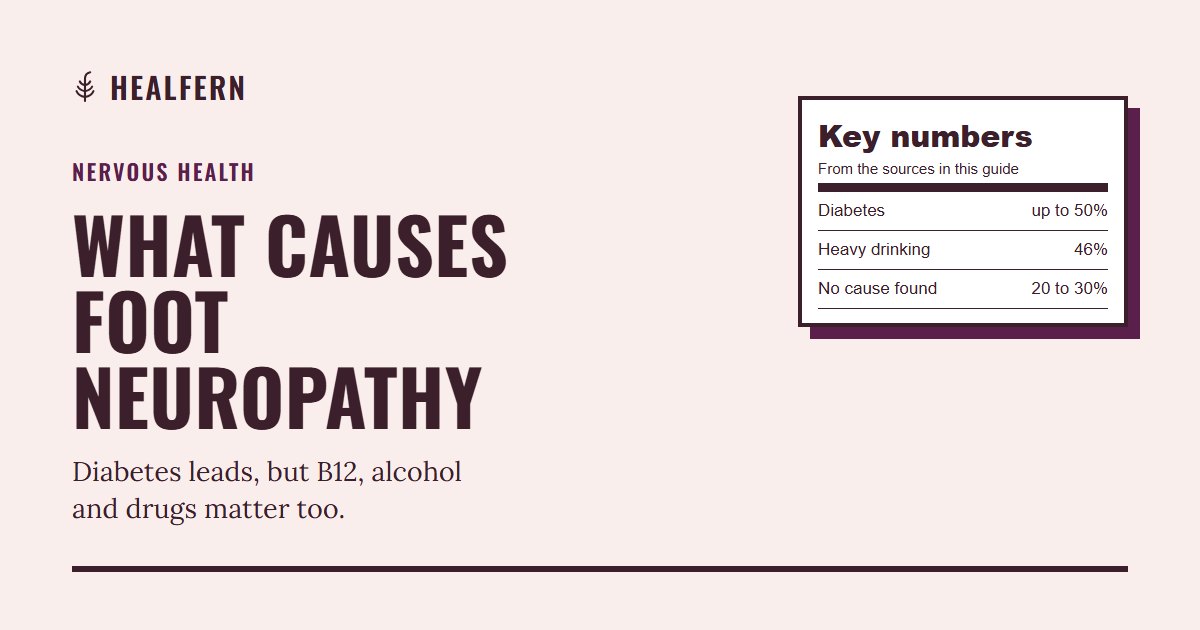
What causes neuropathy in feet is usually a medical condition that slowly damages the long nerves running to your toes. We read the NINDS and NIDDK pages on peripheral neuropathy, the MedlinePlus summary, two NIH vitamin fact sheets, the 2022 American Academy of Neurology treatment guideline and four research reviews on specific causes.[1][2][4][8]
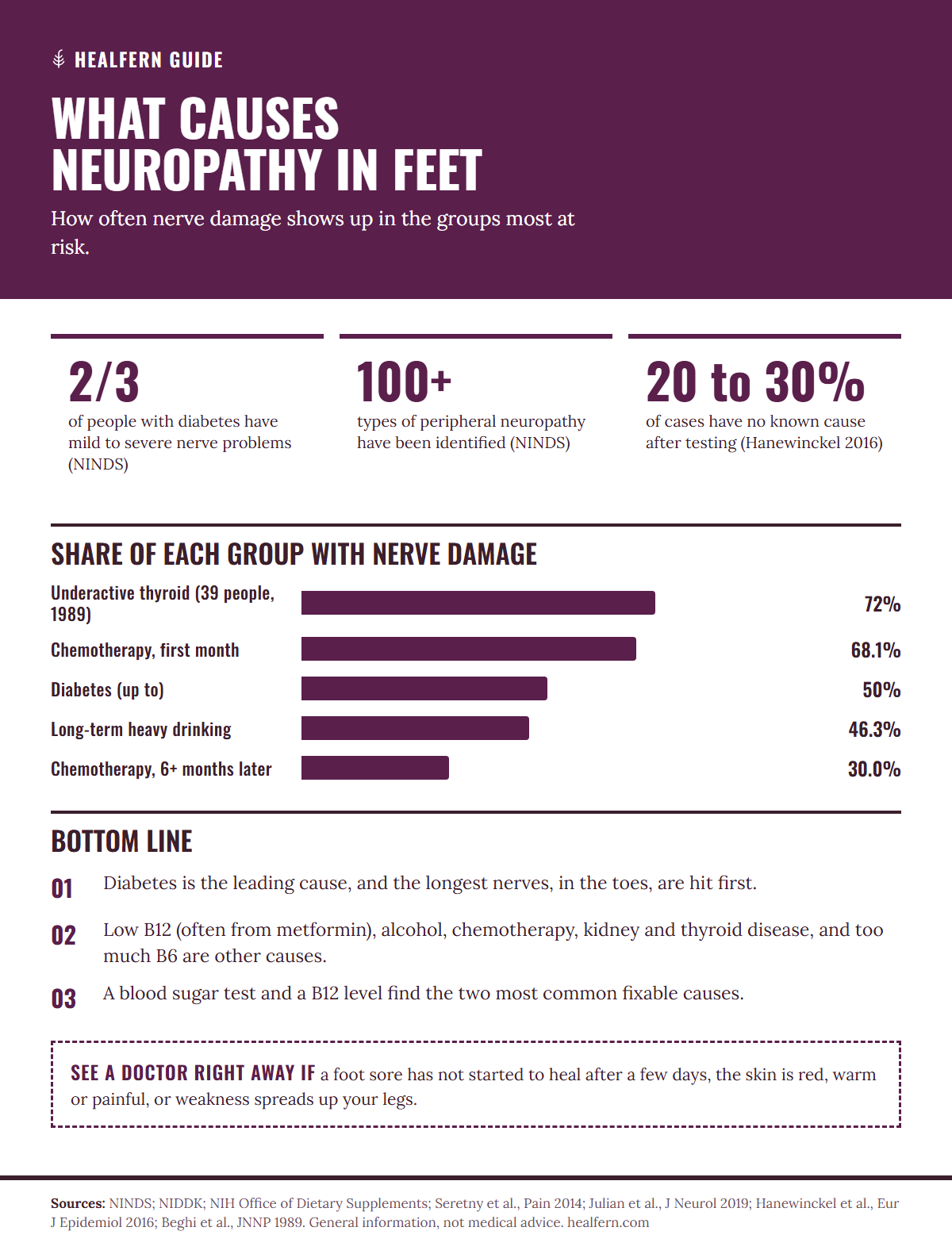
Diabetes is the leading cause of neuropathy in the feet in the U.S., and up to half of people with diabetes have it.[1][2] Low vitamin B12, heavy drinking, chemotherapy, kidney disease and an underactive thyroid are other common causes, and 20 to 30% of cases have no clear cause.[11]
| What it is | Damage to the peripheral nerves, which carry signals between the spinal cord and the rest of the body. There are more than 100 types.[1] |
|---|---|
| How it feels | Burning, tingling, numbness, pain or weakness, usually in both feet and often worse at night[2] |
| Most common cause | Diabetes; about two thirds of people with diabetes have mild to severe nerve problems[1] |
| Other causes | Low vitamin B12, alcohol use disorder, chemotherapy, kidney or liver disease, too much vitamin B6, infections, autoimmune disease, toxins, inherited conditions[1][4] |
| No cause found | About 20 to 30% of cases in population studies[11] |
| First-line care | Find and correct the cause, protect the feet, and use proven pain medicines if needed[1][8] |
| Biggest risk | Unnoticed cuts and sores that turn into infections or ulcers[2][3] |
What causes neuropathy in feet?
Neuropathy in the feet happens when something damages the peripheral nerves, and the longest nerves, which end in the feet, tend to fail first. NINDS lists diabetes, vitamin problems, alcohol, toxins, some medicines, kidney and liver disease, infections, autoimmune disease and inherited conditions as causes.[1]
Most of these problems affect nerves in a “length-dependent” way. The damage shows up where the nerve fibers are longest, so the toes and soles go first. Later it can creep up the legs and reach the fingertips, which is why many people notice their feet and hands at the same time.[1]
Polyneuropathy affects about 1% of the general population and up to 7% of older adults, according to a 2016 review of 29 population studies.[11] In Western countries the causes linked to it most often were diabetes, alcohol, cancer drugs and heart and blood vessel disease.[11]
Why is diabetes the most common cause?
Over time, high blood sugar and high blood fats such as triglycerides damage the nerves and the small blood vessels that feed them. NIDDK says up to 50% of people with diabetes have peripheral neuropathy, and it usually starts in the feet and legs.[2]
If your feet tingle or burn and you also notice thirst, frequent urination or blurry vision, read about the early symptoms of high blood sugar and ask for a blood sugar test. NINDS notes that blood tests can detect diabetes.[1]
Numbness does the most harm. If you cannot feel your feet, a small cut or blister can go unnoticed and become infected. NIDDK lists sores, infections, Charcot foot and even the loss of a toe, foot or part of a leg as possible results.[2] That is why people with diabetes should have a full foot exam at least once a year.[2][3]
What causes neuropathy in feet without diabetes?
Without diabetes, the most common causes to check are low vitamin B12, heavy alcohol use, chemotherapy and other medicines, kidney disease and an underactive thyroid. MedlinePlus also lists infections such as HIV and Lyme disease, autoimmune diseases, lead or mercury, smoking and inherited conditions such as Charcot-Marie-Tooth disease.[4]
Low vitamin B12, including from metformin
Your body needs vitamin B12 to keep nerves healthy. The NIH Office of Dietary Supplements says low B12 can cause numbness and tingling in the hands and feet, even before any anemia shows up, so early testing matters to avoid lasting damage.[5] Between 3% and 43% of older adults living at home may be low.[5]
Metformin, the most common diabetes pill, is one known cause of low B12, and so are acid-reducing drugs such as proton pump inhibitors.[5] NIDDK notes that metformin can usually be continued with B12 supplements if a deficiency is found.[2] So a person with diabetes can have two causes at once.
Alcohol
Researchers are still unsure whether alcohol harms nerves directly or through another factor, such as the poor nutrition that often comes with heavy drinking.[10][1] A 2019 review of 87 studies found neuropathy, confirmed on nerve tests, in 46.3% of people with long-term heavy alcohol use.[10] The biggest risk factor was the total amount of alcohol a person had drunk over their lifetime.[10]
Chemotherapy and other medicines
Some cancer drugs damage nerves, though not every chemotherapy drug does and not everyone who gets one is affected.[1] A 2014 analysis of 31 studies with 4,179 patients found chemotherapy-induced neuropathy in 68.1% of people in the first month after treatment and in 30.0% six months or more later.[9] NINDS also lists some drugs for HIV, heart and blood pressure problems, infections and seizures.[1]
Kidney disease
When the kidneys or liver fail, toxins build up in the blood and can damage nerve tissue. NINDS says most people on dialysis develop some form of peripheral neuropathy.[1]
Underactive thyroid
NIDDK lists a thyroid blood test among the checks doctors use to rule out other causes.[2] The research here is thin. In a small 1989 study of 39 people with an underactive thyroid, nerve tests showed polyneuropathy in 72% of them, though it was usually mild.[12]
Too much vitamin B6
Vitamin B6 is unusual because both too little and too much can hurt nerves. NINDS calls excess B6 one of the best-known vitamin-related causes of neuropathy.[1] Taking 1 to 6 grams a day for 12 to 40 months has caused severe nerve damage, and cases have been reported at less than 500 mg a day.[6] The adult upper limit is 100 mg a day.[6] We cover how much vitamin B6 is too much for your nerves in a separate guide.
| Cause | Study | Who was studied | Finding |
|---|---|---|---|
| Diabetes | NIDDK and NINDS summaries | People with diabetes in the U.S. | Up to one-half have peripheral neuropathy; about two thirds have some nerve problems[1][2] |
| Chemotherapy | Seretny, 2014 meta-analysis | 31 studies, 4,179 patients | 68.1% in the first month, 60.0% at 3 months, 30.0% at 6 months or more[9] |
| Alcohol | Julian, 2019 systematic review | 87 studies of long-term heavy drinkers | 46.3% had neuropathy on nerve tests[10] |
| Underactive thyroid | Beghi, 1989 | 39 outpatients | 72% had polyneuropathy on nerve tests, mostly mild; a small, old study[12] |
| Unknown cause | Hanewinckel, 2016 review | 29 population studies | 20 to 30% of cases remained idiopathic[11] |
What causes neuropathy in feet to flare up?
Neuropathy pain often feels worse at night, and some people feel pain from things that should not hurt, like the touch of bedsheets. NINDS describes both patterns.[1] We found no NIH page that lists flare triggers, so take the points below to your doctor as questions.
The same things that cause nerve damage can make symptoms worse. Blood sugar that stays high, more drinking, pressure from tight shoes, and a newly started medicine are worth checking when symptoms change.[1][2] A bed cradle that keeps sheets off the feet is one practical step NIDDK mentions.[2]
Leg discomfort at night is not always neuropathy. An urge to move the legs that eases when you walk around is a different pattern, so it helps to know what causes restless leg syndrome.
How do doctors find the cause?
Doctors find the cause with a medical history, a foot and nerve exam, blood tests and sometimes nerve studies. NINDS says blood tests can detect diabetes, vitamin deficiencies and liver or kidney problems, and nerve conduction studies, electromyography or a skin biopsy can show what kind of nerve damage is present.[1]
The foot exam often uses a tuning fork and a thin nylon filament to test feeling, along with checks of how you walk and your balance.[2] Your doctor will also ask about alcohol, toxins at work, medicines and family history.[1]
We put together the table below to show which cause each clue points toward. Use it to prepare for your visit; only your doctor can make the diagnosis.
| If this sounds like you | Cause to ask about | Usual test |
|---|---|---|
| You have diabetes or prediabetes, or high blood sugar runs in your family | Diabetic neuropathy | Blood sugar test, yearly foot exam[1][2] |
| You take metformin or an acid reducer, eat no animal foods, or are an older adult | Low vitamin B12 | Vitamin B12 blood test[2][5] |
| You drink heavily or have for years | Alcohol-related neuropathy | History, exam, vitamin levels[1][10] |
| You had or are having chemotherapy | Chemotherapy-induced neuropathy | Tell your cancer team before the next dose[1][9] |
| You have kidney disease or are on dialysis | Kidney-related neuropathy | Kidney blood tests[1][2] |
| You have a thyroid condition or think you might | Underactive thyroid | Thyroid blood test[2][12] |
| You take a B6 or B-complex supplement every day | Too much vitamin B6 | Check the B6 dose on every supplement label[6] |
What if no cause is found?
When tests do not show a cause, doctors call the neuropathy idiopathic, which simply means the cause is unknown. In population studies, 20 to 30% of polyneuropathy cases stayed idiopathic after testing.[11] MedlinePlus also notes that in some cases the cause is not known.[4]
The same foot care and pain treatments still apply. If new symptoms appear, ask about repeating the tests, since a cause such as diabetes can show up later.[1][4]
What do doctors use first for neuropathy in the feet?
The first step is to correct the cause, because NINDS says neuropathy can sometimes resolve as nerves recover and regrow once the cause is fixed. For diabetes, that means keeping blood glucose, blood pressure and cholesterol in your target range.[1][2]
For pain, the 2022 American Academy of Neurology guideline tells doctors to offer one of four drug classes: tricyclic antidepressants, SNRIs such as duloxetine, gabapentinoids such as pregabalin and gabapentin, or sodium channel blockers.[8] Their effects were similar in size, so the choice depends on side effects, cost and your other conditions. If the first drug does not help, the guideline says to try a different class, and it advises against opioids.[8]
NIDDK points out that these medicines ease pain but do not change the nerve damage itself.[2] Lidocaine patches, capsaicin cream, physical therapy and well-fitted orthopedic shoes can help too.[1] The guideline also asks doctors to check for mood and sleep problems, which often travel with nerve pain.[8]
Do supplements help neuropathy in the feet?
Only one supplement has a modest body of research for diabetic nerve pain, and vitamin B12 helps only when you are actually low. NIDDK notes that diabetes experts have not made special recommendations about supplements.[2]
Alpha-lipoic acid is the most studied. NCCIH says it might help reduce diabetic nerve pain, but the studies have limits. One 2022 review of 8 studies with about 1,500 people found improvement in 3 of them, and another review of 9 studies with 2,062 people found it might reduce pain.[7] NCCIH advises talking with your health care provider before you try it.[7]
Vitamin B12 makes sense when a blood test shows a deficiency. The adult recommended amount is 2.4 mcg a day, and B12 has no set upper limit because it has low potential for harm.[5] We found no good evidence that extra B12 helps nerves in people with normal levels. Be careful with “nerve support” blends that also contain B6, since long-term high doses can cause the very numbness you want to fix.[6]
When should you see a doctor right away?
See a doctor promptly for any new numbness, burning or weakness in the feet, and the same day for foot wounds that are not healing. Early diagnosis is the best way to limit damage, and some causes, such as low B12, can leave lasting harm if missed.[5] Contact a doctor right away if you notice:
- A cut, blister or sore on your foot that has not started to heal after a few days[3]
- Skin on your foot that is red, warm or painful, which can mean infection[3]
- A callus with dried blood inside it[3]
- A foot infection that turns black and smells[3]
- Weakness that spreads up your legs, or new trouble walking; Guillain-Barré syndrome, an immune attack on the nerves, is one cause doctors rule out[1]
- New tingling or numbness during chemotherapy, before your next dose[1][9]
Some prescription drugs can cause neuropathy,[1] but do not stop one on your own. Ask the prescriber whether a switch or a dose change makes sense.
Daily foot care checklist
These steps from NIDDK protect numb feet whatever the cause.[3]
- Check both feet every day for cuts, blisters, redness or swelling.[3]
- Wash your feet in warm water between 90 and 95 degrees F, and do not soak them.[3]
- Do not put lotion between your toes.[3]
- Wear shoes and socks at all times, and check inside your shoes before putting them on.[3]
- Do not use heating pads or hot water bottles on your feet.[3]
- Trim toenails straight across, and do not cut corns or use corn plasters.[3]
- Ask for a foot check at every visit and a full foot exam at least once a year.[2][3]
- Limit alcohol and do not smoke, since both are linked to nerve damage.[4]
- If you are over 50, ask about the shingles vaccine, since shingles can damage nerves.[1]
Bottom line
Most neuropathy in the feet comes from diabetes, and many of the other causes, such as low B12, alcohol or too much B6, can be found with simple tests and a good history. The damage tends to start in the toes because those nerves are the longest. You can read more in our nervous health guides, and see how we research and fact-check health topics.
For most people, a blood sugar test and a B12 level are the best first step, because they find the two most common fixable causes. Supplements come after that, and only for a proven deficiency or after a talk with your doctor.
Questions people also ask
Can neuropathy in feet be reversed?
Sometimes. NINDS says that when the underlying cause is corrected, such as low B12 or poorly controlled blood sugar, neuropathy can resolve as nerves recover and regrow. Damage that has gone on for a long time may not fully heal, so early testing matters.
Why does neuropathy affect both feet and hands?
Most neuropathies damage the longest nerves first, so symptoms start in the toes. As the damage moves up the legs, the nerve endings in the fingertips, which are about as far from the spine, start to show symptoms too.
What causes nerve damage in only one foot?
The common causes, such as diabetes or low B12, usually affect both feet evenly. Symptoms in one foot point more toward pressure on or injury to a single nerve, so a doctor should examine that leg and back directly.
What vitamin deficiency causes neuropathy in feet?
Low vitamin B12 is the best-known one. It can cause numbness and tingling in the feet even before anemia shows up. Older adults, vegans and people taking metformin or acid reducers are more likely to be low, and a simple blood test checks it.
Does walking help neuropathy in the feet?
Regular exercise supports healthier nerves and helps control blood sugar, according to NINDS and MedlinePlus. Wear well-fitted shoes and socks, check your feet after each walk, and ask about physical therapy if balance is a problem.
Sources
- Peripheral Neuropathy, National Institute of Neurological Disorders and Stroke, NIH
- Peripheral Neuropathy (diabetes), NIDDK, National Institutes of Health
- Diabetes and Foot Problems, NIDDK, National Institutes of Health
- Peripheral Nerve Disorders, MedlinePlus, National Library of Medicine
- Vitamin B12: Fact Sheet for Health Professionals, NIH Office of Dietary Supplements
- Vitamin B6: Fact Sheet for Health Professionals, NIH Office of Dietary Supplements
- Diabetes and Dietary Supplements, NCCIH, National Institutes of Health
- Oral and Topical Treatment of Painful Diabetic Polyneuropathy: Practice Guideline Update Summary, Price et al., American Academy of Neurology, Neurology, 2022
- Incidence, prevalence, and predictors of chemotherapy-induced peripheral neuropathy: a systematic review and meta-analysis, Seretny et al., Pain, 2014
- Alcohol-related peripheral neuropathy: a systematic review and meta-analysis, Julian et al., Journal of Neurology, 2019
- The epidemiology and risk factors of chronic polyneuropathy, Hanewinckel et al., European Journal of Epidemiology, 2016
- Hypothyroidism and polyneuropathy, Beghi et al., Journal of Neurology, Neurosurgery and Psychiatry, 1989
This article is general information, not medical advice. These statements have not been evaluated by the FDA, and supplements are not intended to diagnose, treat, cure or prevent any disease. Talk to your doctor or pharmacist before you start a supplement. How we research.

