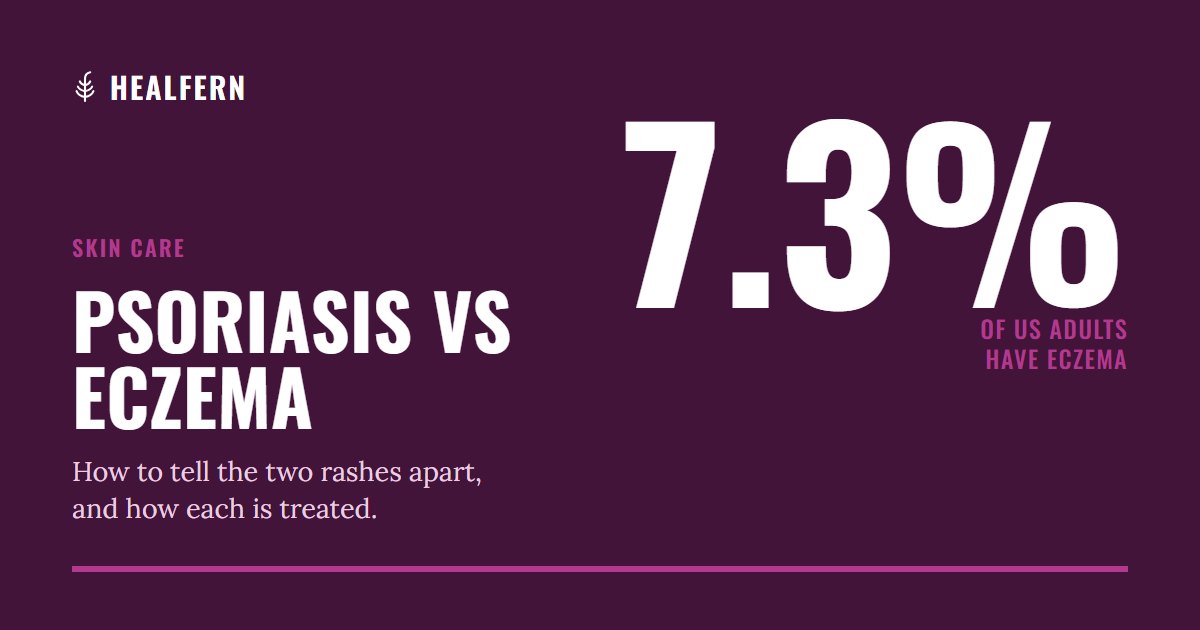
Psoriasis is an immune-mediated disease that speeds up skin cell growth and builds thick, silvery plaques, often on the scalp, elbows, knees and lower back. Eczema, usually atopic dermatitis, starts with a weak skin barrier and intense itch, often in the bends of the elbows and knees. About 3% of US adults have psoriasis and 7.3% have eczema. Neither is contagious.
Psoriasis vs eczema is a common question, because both cause red, dry, itchy patches that flare and settle. We read the NIAMS pages on psoriasis and atopic dermatitis, the American Academy of Dermatology (AAD) patient guides, MedlinePlus and four large studies on how common each one is and how it is treated. Our research process explains how we choose and check sources.
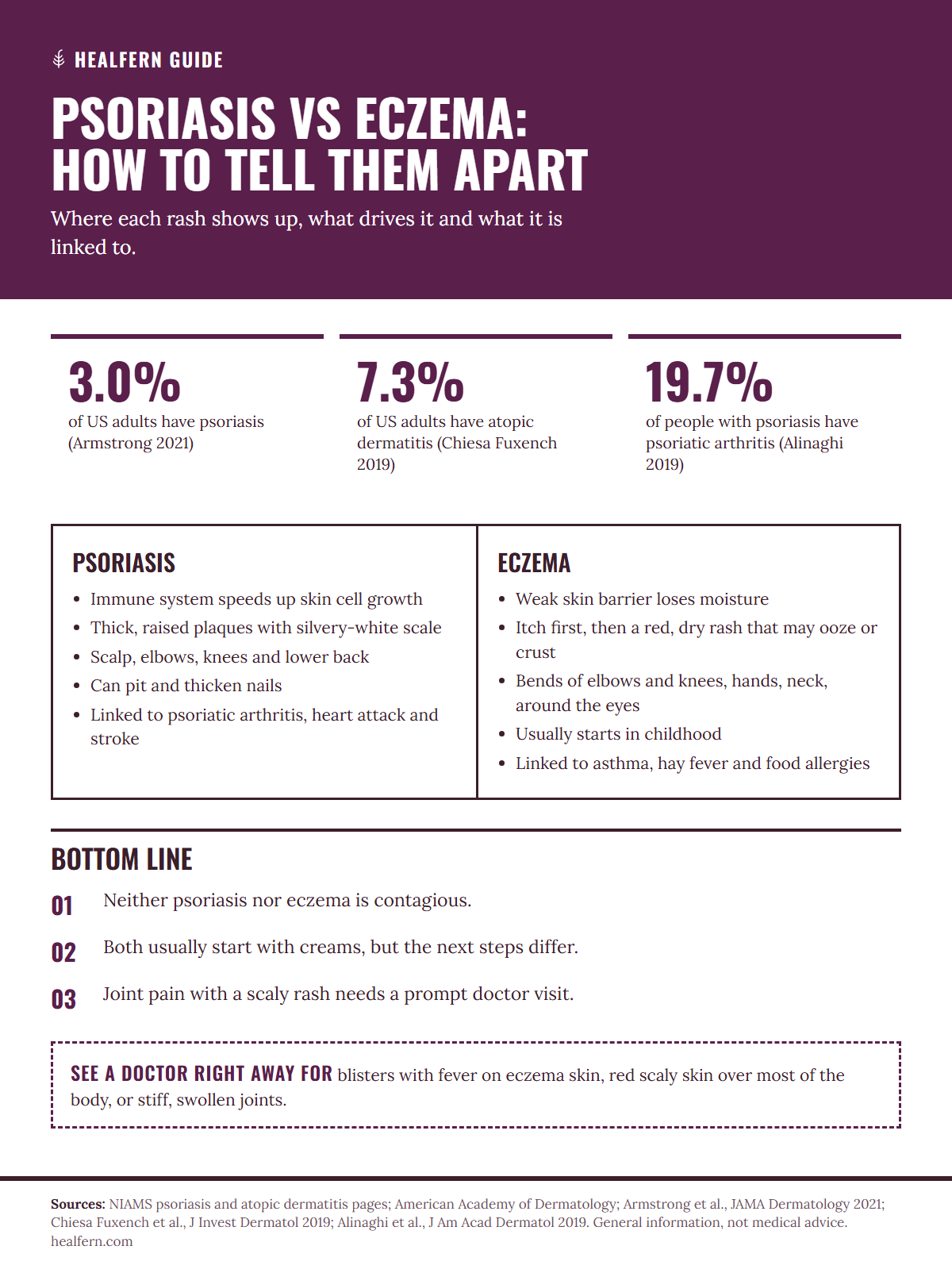
The short answer: psoriasis is an immune-mediated disease that builds thick, scaly plaques, often on the scalp, elbows and knees, while eczema starts with a leaky skin barrier and intense itch, often in skin creases.[1][3] About 3.0% of US adults have psoriasis and 7.3% have atopic dermatitis.[12][13]
| Feature | Psoriasis | Eczema (atopic dermatitis) |
|---|---|---|
| What it is | An immune-mediated disease in which skin cells multiply too quickly[1] | A chronic inflammation in which the skin barrier loses moisture[3] |
| Typical look | Raised, red patches with silvery-white scale; 80% to 90% of people have the plaque type[1][7] | Red, dry patches that may ooze clear fluid, crust or bleed when scratched[3] |
| Common spots | Scalp, elbows, knees and lower back[7] | Face and scalp in babies; bends of the elbows and knees, neck and hands later on[3] |
| Main feeling | Itch, burning or stinging[7] | Itch, often severe, which can start before the rash[3][9] |
| Who gets it | More common in adults; 3.0% of US adults[1][12] | Usually starts in childhood; 7.3% of US adults[3][13] |
| Linked conditions | Psoriatic arthritis, heart attack and stroke[1] | Asthma, hay fever and food allergies[3][10] |
| Contagious? | No[8] | No[3] |
Psoriasis vs eczema: what is the main difference?
The main difference is where the problem starts: psoriasis comes from an overactive immune system that speeds up skin cell growth, while eczema starts with a weak skin barrier that lets moisture out and irritants in. Both are long-lasting conditions that flare and settle, and neither is contagious.[1][3][8]
In psoriasis, the body makes new skin cells in days rather than weeks.[7] The extra cells pile up on the surface and form plaques. The AAD explains that T-cells, a type of white blood cell, attack skin cells by mistake and drive this fast turnover.[8]
In eczema, the outer layer of skin acts like a brick wall with gaps in it.[10] Moisture escapes and the skin dries out. Dust mites, fragrances and germs slip through the gaps and set off inflammation.[3][10]
Eczema is an umbrella term for several kinds of skin inflammation, also called dermatitis, and atopic dermatitis is the most common type.[6] When people compare psoriasis and eczema, they nearly always mean atopic dermatitis, so that is the form this guide covers.
Where do psoriasis and eczema show up on the body?
Location is one of the better clues: in older children and adults, eczema tends to sit in the bends of the elbows and knees, on the hands, the neck and around the eyes. Psoriasis plaques most often form on the scalp, elbows, knees and lower back. Either one can appear anywhere, though.[3][7]
Eczema also moves with age. Babies up to 2 years old usually get it on the face, the scalp and the skin around bending joints.[3] Between age 2 and puberty it shifts to the elbow and knee creases, the neck and the ankles.[3]
Hands, feet, skin folds and nails
Adults with eczema are more likely than children to have it on their hands, and sometimes the hands are the only place it shows.[9] Psoriasis can also affect the palms and soles. A form called pustular psoriasis causes pus-filled bumps, usually on the hands and feet.[1]
Inverse psoriasis forms smooth, red patches in skin folds, such as the armpits, the groin and under the breasts, and rubbing and sweating make it worse.[1] That can look a lot like eczema in a skin crease, which is one reason a doctor’s exam matters.
Thick, ridged or pitted nails are a listed symptom of psoriasis.[1] The scalp is one of the most common places for psoriasis plaques.[7] Adults with eczema, by contrast, often get thickened, darker skin around the eyes.[9] Some people with eczema also have an extra fold of skin under the eye, called a Dennie-Morgan fold.[3]
Is psoriasis or eczema more itchy?
Both conditions itch, but in eczema the itch is the leading symptom and can start before any rash appears. The AAD calls atopic dermatitis the itch that rashes, because scratching itchy skin is what creates the rash. In psoriasis, the thick plaque is the main sign, and it tends to itch, burn or sting.[3][7][9]
With eczema, NIAMS says the itch can be severe.[3] Scratching then leads to redness, swelling, cracking, weeping and crusting. Years of scratching can leave patches of thick, leathery skin that look darker or lighter than the skin around them.[3][9]
NIAMS lists sleep loss as a complication of eczema and notes it can lead to behavior problems in children.[3] It also lists poor sleep quality among common psoriasis symptoms.[1]
With psoriasis, the AAD says the itch can become intense without treatment.[7] For eczema, NIAMS advises against scratching or rubbing, because it irritates the skin, raises inflammation and can make the itch worse.[4]
What causes psoriasis and eczema?
Neither condition has one known cause; both come from a mix of genes, the immune system and the environment. NIAMS describes psoriasis as immune-mediated, meaning immune cells overreact and speed up skin growth. In eczema, gene changes that weaken the skin barrier combine with an overactive immune response to cause inflammation.[1][3]
Both run in families. If a parent, grandparent, brother or sister has psoriasis, your risk is higher.[8] About 70% of people with atopic dermatitis have a blood relative with eczema or an allergic disease such as asthma or hay fever.[10]
Eczema is also tied to allergies. About one-third of children with atopic dermatitis later develop asthma, and two-thirds get hay fever.[10] The AAD calls this pattern the atopic march.[10]
Psoriasis flares are linked to stress, skin injuries such as a cut or bad sunburn, strep throat, cold and dry weather, tobacco and heavy drinking.[8] Some medicines can trigger it too, including lithium, prednisone and hydroxychloroquine.[8]
Eczema flares are tied to tobacco smoke, air pollution, fragrances in soaps and skin products, and very dry skin.[3] Wool, overheating and stress can also set it off.[4]
How do doctors diagnose psoriasis vs eczema?
Doctors diagnose both conditions mainly by examining the skin, scalp and nails and asking about your health and family history. If the rash could be something else, the doctor may take a small skin sample to look at under a microscope. Blood tests are sometimes used to rule out other causes of a rash.[2][4]
For psoriasis, expect questions about itchy or burning skin, recent illness or severe stress, your medicines, relatives with the disease and joint tenderness.[2] For eczema, questions cover allergies, asthma or hay fever, sleep problems, foods that seem to trigger hives, and contact with soaps, perfumes or cigarette smoke.[4]
Eczema can take more than one visit to pin down. NIAMS notes a doctor may need to see you several times to rule out other conditions.[4]
Clues that point one way or the other
| What you notice | Leans toward |
|---|---|
| Thick, raised patches with silvery-white scale[1] | Psoriasis |
| Itchy rash in the bend of the elbows or knees in a child[3] | Eczema |
| Thick, ridged or pitted nails[1] | Psoriasis |
| Itch first, then a rash that oozes or crusts after scratching[3][9] | Eczema |
| Small red dots on the torso after strep throat in a child or young adult[1] | Guttate psoriasis |
| Family history of asthma or hay fever[3] | Eczema |
| Stiff, swollen or painful joints, or heel pain[1][5] | Psoriasis with psoriatic arthritis |
Treat this table as a set of clues to bring to your appointment. Other skin conditions can look like psoriasis, which is why NIAMS says a doctor may check a small skin sample before naming it.[2]
How is treatment different for psoriasis and eczema?
Both usually start with steroid creams or ointments, but the next steps differ. Psoriasis care adds vitamin D creams, coal tar and drugs such as methotrexate, while eczema care leans on daily moisturizers and calcineurin inhibitor creams. Severe cases of either may use light therapy, pills or biologic injections.[2][4]
For mild to moderate psoriasis, creams and ointments with corticosteroids are the most common first step.[2] Other skin treatments include vitamin D-based medicines, retinoids, coal tar, anthralin and PDE4 inhibitor creams.[2]
Moderate to severe psoriasis may need methotrexate, oral retinoids, oral PDE4 or TYK2 inhibitors, biologic injections or light therapy.[1][2] Before a biologic, blood tests and tuberculosis testing are typically required, because serious infection is the main safety concern.[11]
What doctors use first for eczema
The 2023 AAD guideline for adults made 12 recommendations. It gave strong support to moisturizers, steroid creams, calcineurin inhibitor creams, and PDE-4 and JAK inhibitor creams, and it leaned against topical antimicrobials, antiseptics and antihistamines.[15]
For severe eczema, doctors may add light therapy, JAK inhibitor pills or a biologic injection.[4] They do not usually prescribe oral steroids, because the rash can rebound worse after the pills stop.[4] Our guide on how to get rid of eczema walks through each step in more detail.
Daily skin care checklist for either condition
- Bathe in lukewarm water; with eczema, limit baths to once a day.[2][4]
- Use a mild, unscented soap or a non-soap cleanser.[4]
- Pat dry, then apply a thick moisturizer while the skin is still damp.[2][4]
- Pick creams and ointments over thin lotions with high water or alcohol content.[4]
- Wear soft fabrics and skip wool.[4]
- For psoriasis, keep a healthy weight, cut back on alcohol and get help to quit smoking.[2]
- Ask your doctor before trying bleach baths, wet wraps or home light therapy.[2][4]
None of the sources we read lists a supplement as a treatment for either condition. NIAMS does note that a Mediterranean diet helped in several psoriasis studies.[2] If you are weighing skin supplements for other reasons, our guide to collagen supplements for skin covers what they were studied for.
Which is worse, psoriasis or eczema?
Neither is simply worse, because severity varies from person to person. Psoriasis carries more links to problems beyond the skin, such as psoriatic arthritis, heart attack and stroke. Eczema is more common, often starts in childhood, and raises the risk of skin infections, poor sleep, anxiety and depression.[1][3][13]
| Study | Who and how many | Key finding |
|---|---|---|
| Armstrong et al., 2021, JAMA Dermatology | 12,625 people in a US national survey, 2011 to 2014 | 3.0% of adults had psoriasis, about 7.55 million people; 3.2% of women and 2.8% of men[12] |
| Chiesa Fuxench et al., 2019 | 1,278 US adults | 7.3% had atopic dermatitis; 60.1% mild, 28.9% moderate and 11% severe[13] |
| Alinaghi et al., 2019, meta-analysis | 266 studies, 976,408 people with psoriasis | 19.7% had psoriatic arthritis; 3.3% of children did[14] |
| Sidbury et al., 2023, AAD guideline | Review of randomized trials in adults with eczema | 12 recommendations; strong support for moisturizers and 4 kinds of prescription cream[15] |
Psoriatic arthritis is the big extra risk with psoriasis. It usually starts about 7 to 10 years after the skin symptoms, and early treatment is linked to better outcomes and less joint damage.[5] NIAMS also lists higher risks of diabetes, obesity, metabolic syndrome and Crohn’s disease.[1]
In the 2019 eczema study, 6.6 million US adults met criteria for moderate to severe disease.[13] Bacterial skin infections are common and can make the disease harder to control.[3]
When should you see a doctor about psoriasis or eczema?
See a doctor when a rash keeps coming back, disturbs your sleep or does not improve with gentle skin care, because the right treatment depends on which condition you have. Joint pain alongside a scaly rash deserves a prompt visit, since untreated psoriatic arthritis can cause damage that cannot be reversed.[1][2][4]
See a doctor right away if:
- Blisters appear on eczema skin along with fever, tiredness and swollen glands. This can be eczema herpeticum, which can be life-threatening in babies, children and people with weak immune systems.[9]
- Golden or yellow crusts form on the rash, which often signal a staph infection.[9]
- Red, scaly skin spreads over most of your body. This can be erythrodermic psoriasis, which is rare but can be very serious.[1]
- Pus-filled bumps spread across large areas of skin.[1]
- Your joints turn stiff, swollen or painful, or you develop heel or back pain alongside psoriasis.[1][5]
Lithium, prednisone and hydroxychloroquine can trigger psoriasis, so tell your doctor about everything you take.[8] Biologics raise the risk of serious infection.[11] People with eczema should not get the smallpox vaccine and should avoid close contact with someone who just had it.[4]
Bottom line
Thick, silvery plaques on the scalp, elbows, knees or nails point toward psoriasis, while intense itch in skin creases, especially with asthma or hay fever in the family, points toward eczema.[1][3] Neither one spreads to other people, and both can be kept under control with the right treatment.
For most people, a visit to a dermatologist or primary care doctor is the better first step than trying remedies at home, because the treatments differ and psoriasis needs a check for joint problems.[2][5] Until then, gentle bathing and a thick moisturizer help either condition. More guides live in our skin care section.
Questions people also ask
Is psoriasis or eczema contagious?
No. Neither condition spreads from person to person, and NIAMS and the AAD both say so plainly. Infections that start in scratched eczema skin are a separate problem, so see a doctor about golden crusts or blisters.
Can psoriasis be cured?
No cure exists, according to NIAMS, and most people who get psoriasis have it for life. Treatment can control symptoms well. The one exception the AAD notes is guttate psoriasis in some children, which can clear and never return.
Does eczema go away on its own?
Often it does in children. NIAMS says many children outgrow atopic dermatitis before their teenage years, though some keep it into adulthood and some adults get it for the first time. Flares can also stop for a while and return.
Can stress cause psoriasis or eczema flares?
Yes, stress is a listed trigger for both. The AAD names intense stress as a common psoriasis trigger, and NIAMS suggests stress management and relaxation techniques to lower the chance of eczema flares. Triggers differ from person to person.
Is psoriasis an autoimmune disease?
NIAMS calls psoriasis an immune-mediated disease, meaning the immune system overreacts and speeds up skin cell growth, and lists it with its autoimmune disease resources. Eczema also involves the immune system, though a weak skin barrier plays a central role.
Sources
- Psoriasis: Overview, Symptoms and Causes, NIAMS, National Institutes of Health, 2023
- Psoriasis: Diagnosis, Treatment, and Steps to Take, NIAMS, National Institutes of Health, 2023
- Atopic Dermatitis: Overview, Symptoms and Causes, NIAMS, National Institutes of Health, 2022
- Atopic Dermatitis: Diagnosis, Treatment, and Steps to Take, NIAMS, National Institutes of Health, 2022
- Psoriatic Arthritis, NIAMS, National Institutes of Health
- Eczema, MedlinePlus, National Library of Medicine
- Psoriasis: Overview, American Academy of Dermatology
- Psoriasis: Who Gets and Causes, American Academy of Dermatology
- Atopic Dermatitis: Signs and Symptoms, American Academy of Dermatology
- Atopic Dermatitis: Who Gets and Causes, American Academy of Dermatology
- Psoriasis Treatment: Biologics, American Academy of Dermatology
- Psoriasis Prevalence in Adults in the United States (Armstrong et al.), JAMA Dermatology, 2021
- Atopic Dermatitis in America Study (Chiesa Fuxench et al.), Journal of Investigative Dermatology, 2019
- Prevalence of Psoriatic Arthritis in Patients With Psoriasis: Systematic Review and Meta-analysis (Alinaghi et al.), Journal of the American Academy of Dermatology, 2019
- Guidelines of Care for the Management of Atopic Dermatitis in Adults With Topical Therapies (Sidbury et al.), Journal of the American Academy of Dermatology, 2023
This article is general information, not medical advice. These statements have not been evaluated by the FDA, and supplements are not intended to diagnose, treat, cure or prevent any disease. Talk to your doctor or pharmacist before you start a supplement. How we research.