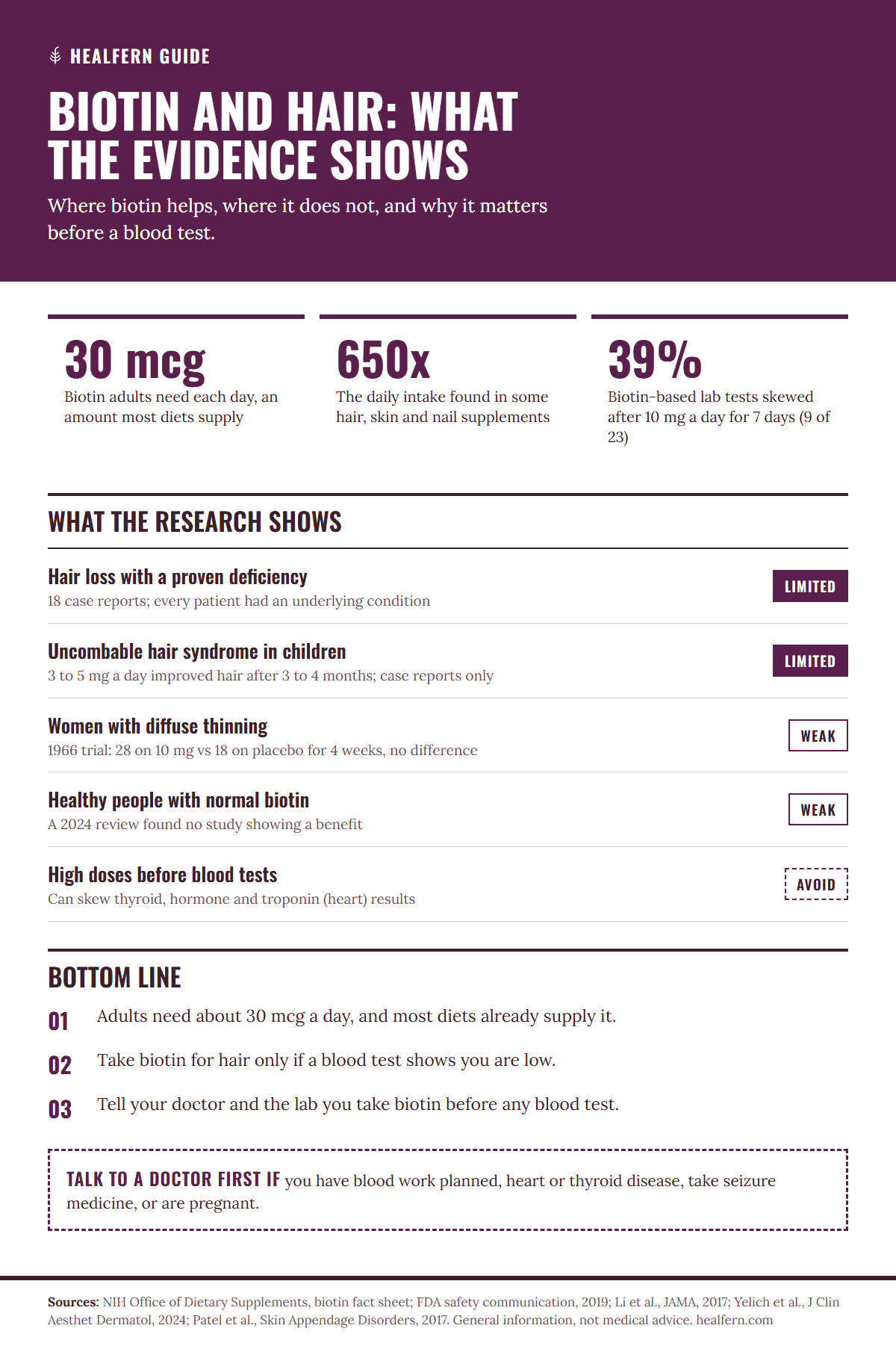
Biotin for hair growth works mainly when you are truly low in biotin, and that is rare in people who eat a normal diet. Adults need about 30 mcg a day, while hair supplements often hold 5 to 10 mg. The only placebo trial found no difference, and the FDA warns that high doses can cause false thyroid and heart test results.
Biotin for hair growth is one of the most popular supplement buys, so before writing this we read the NIH fact sheet on biotin, two FDA safety notices, three reviews of the hair research, a JAMA lab study and the American Academy of Dermatology (AAD) hair loss guides.[1][2][5][11] Our guide to how we research health topics explains how we choose and check sources.
Biotin helps hair mainly in people who lack it, and few people do. In the only placebo-controlled trial we found, 28 women taking 10 mg a day did no better than 18 women on a placebo after 4 weeks.[1][5]
| What it is | Biotin (vitamin B7), a water-soluble B vitamin found in eggs, meat, fish, seeds and some vegetables[1] |
|---|---|
| Daily need | 30 mcg for adults; 35 mcg while breastfeeding[1] |
| Typical hair supplement | 5 to 10 mg, and some products hold up to 650 times the daily intake[2][5] |
| Best evidence for hair | Case reports in people with a deficiency or a rare hair disorder; no proof in healthy people[1][6] |
| Safety | No known toxic dose, but high doses can skew thyroid, hormone and heart (troponin) tests[1][2] |
| Check with a doctor first if | You have blood work coming up, heart or thyroid disease, take seizure medicine, or are pregnant[1][2][8] |
Does taking biotin for hair growth work?
For most people, no trial shows that biotin for hair growth works unless the body is short on it. A 2024 review found only three relevant studies, and none showed a benefit in healthy people. The NIH says the support for hair rests on case reports, all of them in children.[5][1]
Placebo trials are scarce. A 1966 trial gave 28 women with diffuse thinning 10 mg of biotin a day and 18 women a placebo. After four weeks both groups had improved, with no significant difference between them.[5]
A 2017 review found 18 published cases in which biotin helped hair or nails. Every one of those patients had an underlying problem, such as an inherited disorder or a deficiency, and the authors saw too little evidence to back biotin for healthy people.[6]
What the studies found
| Study | Who and how many | Dose and length | Result |
|---|---|---|---|
| Placebo trial, 1966 | 46 women with diffuse thinning (28 biotin, 18 placebo) | 10 mg a day, 4 weeks | No significant difference from placebo[5] |
| Aksac et al., 2021 | 60 people on isotretinoin, 30 of whom also took biotin | 10 mg a day, 4 months | Shift toward growing-phase hairs; not blinded[5] |
| Sen et al., 2021 | 112 women after weight-loss surgery, 22 of them low in biotin | 1 mg a day | 23% of low-biotin and 38% of normal-biotin women reported improvement[5] |
| Case reports (NIH summary) | Children with uncombable hair syndrome | 3 to 5 mg a day, 3 to 4 months | Hair improved; no control group[1] |
In the Sen study, women with normal biotin levels reported improvement more often than women who were low, so time and recovery from surgery likely explain more than the pill does.[5]
Can low biotin cause hair loss?
Yes, a true biotin deficiency can thin hair and, in severe cases, lead to loss of all body hair. But deficiency is rare. The NIH notes that severe deficiency has never been reported in healthy people eating a normal mixed diet, and most Western diets supply 35 to 70 mcg a day.[1]
The AAD lists too little biotin, iron, protein or zinc among the causes of hair loss, and says hair can regrow once the body gets enough of the missing nutrient.[9] Some groups run low more often:
- People with chronic alcohol use. Plasma biotin is low in 15% of them.[1]
- Pregnant women. At least a third develop a mild (marginal) deficiency despite normal intake.[1]
- People on long-term seizure medicines such as carbamazepine, phenytoin, primidone or phenobarbital. A study of 264 people with epilepsy found lower biotin after a year or more of treatment.[1]
- People who eat raw egg whites often. A protein called avidin binds biotin and blocks absorption, but cooking breaks it down.[1]
- Babies with biotinidase deficiency, an inherited disorder that newborn screening checks for.[1]
One clinic in Switzerland found low biotin in 38% of women who came in with hair loss. Even so, its author warned against giving biotin to every woman with thinning hair unless a deficiency is shown first.[7]
How much biotin for hair growth per day?
Adults need about 30 mcg of biotin a day, an amount most diets already supply. Hair supplements often contain 5 to 10 mg, which is 5,000 to 10,000 mcg. The FDA has seen products with up to 650 times the daily intake, and no trial shows that a bigger dose grows more hair.[1][2][5]
| Amount | What it means |
|---|---|
| 30 mcg | Adequate intake for adults, and the Daily Value on labels[1] |
| 35 mcg | Adequate intake while breastfeeding[1] |
| 30 to 60 mcg | Typical multivitamin dose, believed not to disturb lab tests[5] |
| 2.5 mg | Dose used in small brittle nail studies without a placebo group[1] |
| 5 to 10 mg | Common in hair, skin and nail products; enough to skew some tests[5] |
| 20 mg to 100 mg | Found in some single pills, according to the FDA[2] |
Food covers the daily need easily. A cooked egg has 10 mcg, 3 ounces of cooked beef liver has 30.8 mcg, 3 ounces of canned pink salmon has 5 mcg, and a quarter cup of roasted sunflower seeds has 2.6 mcg.[1] Half a cup of cooked sweet potato adds 2.4 mcg.[1]
How long does biotin take to work for hair?
No trial gives a timeline for healthy people, because no trial has shown a benefit in them. In children with a rare hair shaft disorder, 3 to 5 mg a day improved hair after 3 to 4 months. When a real deficiency is corrected, the AAD says hair can regrow once the missing nutrient is back.[1][9]
Hair changes slowly, so any effect takes months to judge. Shedding 50 to 100 hairs a day is normal.[10] Heavy shedding after childbirth, a high fever, surgery or major stress usually stops on its own, and hair tends to regain its fullness within 6 to 9 months.[10]
This makes any supplement hard to judge. If you start biotin during a shedding phase, the hair may recover anyway and the pill gets the credit. The 1966 trial showed this pattern: the biotin group and the placebo group both improved.[5]
Thinning that keeps going, a widening part or bald patches need a diagnosis, not a longer course of pills.[11] Our hair loss guides cover the common types and what each one needs.
Why does the FDA warn about biotin and lab tests?
High-dose biotin can make some blood tests read falsely high or falsely low, and the error may go unnoticed. The FDA first warned in 2017 and updated the warning in November 2019. It was most concerned about falsely low troponin results, a key blood test used to spot heart attacks.[2]
Many lab tests use biotin in their chemistry, because it binds tightly to a protein called streptavidin. Extra biotin in a blood sample can disrupt that reaction.[2][4] The FDA says a falsely low troponin “may lead to a missed diagnosis,” and it kept receiving reports of this after its first warning.[2] It also published a list of troponin tests whose makers had not yet fixed the problem.[3]
Which tests can biotin affect?
In a 2017 JAMA study, 6 healthy adults took 10 mg of biotin a day for 7 days. Biotin interfered with 9 of 23 (39%) tests built on biotin chemistry, and with none of the 14 tests that were not.[4] Some results came out falsely high and others falsely low.[4]
The tests checked included TSH and thyroid hormones, parathyroid hormone, prolactin, vitamin D, PSA and ferritin.[4] The NIH adds that a single 10 mg dose has disturbed thyroid tests taken within 24 hours.[1] A 2026 review says doses of 5 to 20 mg a day can mimic an overactive thyroid, with high T3 and T4 and low TSH.[8]
Thyroid disease can thin hair, and over 40% of people with alopecia areata have thyroid antibodies, so the people most likely to take biotin are also likely to need thyroid tests.[8][9]
How long should you stop biotin before a blood test?
A 2024 dermatology review advises stopping biotin two days before planned lab work, and up to a week after very high doses.[5] A 2026 review says 24 to 72 hours is often enough for store-bought doses.[8] The FDA says there is not enough information to know whether any pause prevents wrong results.[2]
So ask the doctor who ordered the test, and tell the lab you take biotin. In an emergency, tell the staff, because there is no time for a pause.[5]
Who should avoid biotin or check with a doctor first?
Biotin has no known toxic dose, so the main risk is a wrong test result rather than poisoning. Studies of 10 to 50 mg a day found no side effects. Still, check with a doctor first if you get regular blood work, have heart or thyroid disease, take seizure medicine, or are pregnant.[1][2]
- Anyone with planned blood work, especially thyroid, hormone or heart tests.[2][4]
- People at risk of heart disease, since a falsely low troponin could hide a heart attack.[2]
- People with thyroid disease or alopecia areata, where test results guide treatment.[8][12]
- Pregnant or breastfeeding women. Prenatal vitamins already contain biotin, so check the total before adding more.[2]
- People on seizure medicines, who may need their biotin status checked by a doctor.[1]
See a doctor soon if:
- Round, smooth bald patches appear, which can be alopecia areata.[12]
- Hair thins along with other new symptoms, since thyroid disease can cause hair loss.[9]
- You have chest pain while taking high-dose biotin. Get emergency care and say you take biotin.[2][5]
Biotin vs minoxidil: what do dermatologists use first?
Dermatologists start by finding the cause, then use treatments with stronger evidence, such as minoxidil for hereditary thinning. The AAD advises taking biotin, iron or zinc only when a blood test shows a deficiency. It warns that supplements can be harmful when your levels are already normal.[11]
Hereditary hair loss is the most common cause of hair loss worldwide, in both men and women.[9] Minoxidil usually takes about 6 to 12 months to show regrowth, and finasteride takes about 4 months for men to notice a change.[11] In one study of 166 women taking spironolactone, 42% reported mild improvement.[11]
If you are weighing the drug, our guide to minoxidil side effects covers what to expect in the first months. Some readers try oils as well, and we reviewed the trials on rosemary oil for hair growth separately.
For alopecia areata, NIAMS notes there is no cure, but treatments can help hair grow back more quickly.[12]
Should you take biotin for hair? A decision table
Take biotin only when there is a reason to think you are low, and confirm it first. The table below matches common situations to a sensible next step, based on the NIH, FDA and AAD guidance we read. Use it to prepare for a visit, since it cannot replace an exam.[1][2][11]
| If | Then |
|---|---|
| You eat a varied diet and have no risk factors | Biotin is unlikely to help; look for the cause of thinning[1][11] |
| A blood test confirmed a deficiency | Follow your doctor’s dose; hair can regrow once levels recover[9][11] |
| You have blood work in the next few days | Tell your doctor and the lab, and ask whether to pause[2][5] |
| Your nails are brittle | Small studies used 2.5 mg a day without a placebo; evidence is weak[1] |
| Hair falls out in round patches | See a dermatologist; this may be alopecia areata[12] |
| You are pregnant or breastfeeding | Use your prenatal vitamin and ask before adding more biotin[1][2] |
Nail changes have their own list of causes, which we cover in our guide to white spots on nails.
Label and lab checklist
- Find biotin on the Supplement Facts panel and note whether the amount is in mcg or mg.[1]
- Add up biotin from every product, including multivitamins, prenatal vitamins and hair, skin and nail blends.[2]
- Compare the total with the 30 mcg adult Daily Value.[1]
- Tell every doctor and lab that you take biotin, even before urgent tests.[2][5]
- Ask about pausing before planned tests; one review suggests two days.[5]
- If thinning continues, ask for an exam and blood tests rather than a higher dose.[11]
Bottom line
Biotin for hair growth makes sense when a doctor has confirmed a real shortage of the vitamin. For everyone else the research is thin, built on case reports and small studies, and the one placebo trial found no difference.[1][5][6]
For most people with thinning hair, a dermatology visit is the better first step, because hereditary loss, shedding and thyroid problems each need a different fix. If you take biotin anyway, keep the dose modest and tell your doctor before any blood test.[2][11]
Questions people also ask
Can biotin cause hair loss?
We found no study showing that biotin causes hair loss. The bigger risk is indirect: high doses can skew thyroid tests, which may hide or mimic a thyroid problem that itself thins hair. Tell your doctor that you take it.
How long does biotin take to leave your system?
It depends on the dose. A 2026 review says 24 to 72 hours is often enough for store-bought doses, and a 2024 review suggests stopping two days before lab work, or up to a week after very high doses.
Is biotin good for hair and nails?
The nail evidence is a little better than the hair evidence, but still weak. In one study, 41 of 45 people taking 2.5 mg a day had firmer nails, yet none of the nail studies used a placebo group.
Does biotin help hair growth postpartum?
No trial has tested it. Shedding after childbirth is common, peaks around four months and usually settles within 6 to 9 months. Pregnancy can lower biotin, so ask your doctor before adding a high-dose product while breastfeeding.
What foods are high in biotin?
Cooked beef liver is the richest common source, with 30.8 mcg in 3 ounces. A cooked egg has 10 mcg, canned pink salmon has 5 mcg per 3 ounces, and roasted sunflower seeds have 2.6 mcg per quarter cup.
Does biotin help hair growth in men?
There is no good evidence that it helps men who are not deficient. Male pattern hair loss, the most common type, has far better evidence for minoxidil and finasteride. A dermatologist can confirm the cause before you spend money.
Sources
- Biotin: Fact Sheet for Health Professionals, NIH Office of Dietary Supplements
- UPDATE: The FDA Warns that Biotin May Interfere with Lab Tests, U.S. Food and Drug Administration, 2019 (archived copy)
- Biotin Interference with Troponin Lab Tests: Assays Subject to Biotin Interference, U.S. Food and Drug Administration, 2022
- Association of Biotin Ingestion With Performance of Hormone and Nonhormone Assays in Healthy Adults, Li et al., JAMA, 2017
- Biotin for Hair Loss: Teasing Out the Evidence, Yelich et al., J Clin Aesthet Dermatol, 2024
- A Review of the Use of Biotin for Hair Loss, Patel et al., Skin Appendage Disorders, 2017
- Serum Biotin Levels in Women Complaining of Hair Loss, Trueb, International Journal of Trichology, 2016
- The implications of biotin supplementation on multiple sclerosis, hair loss conditions, and thyroid disorders, Bhimireddy et al., Mult Scler Relat Disord, 2026
- Hair loss: Who gets and causes, American Academy of Dermatology
- Do you have hair loss or hair shedding?, American Academy of Dermatology
- Hair loss: Diagnosis and treatment, American Academy of Dermatology
- Alopecia Areata, NIAMS, National Institutes of Health
This article is general information, not medical advice. These statements have not been evaluated by the FDA, and supplements are not intended to diagnose, treat, cure or prevent any disease. Talk to your doctor or pharmacist before you start a supplement. How we research.