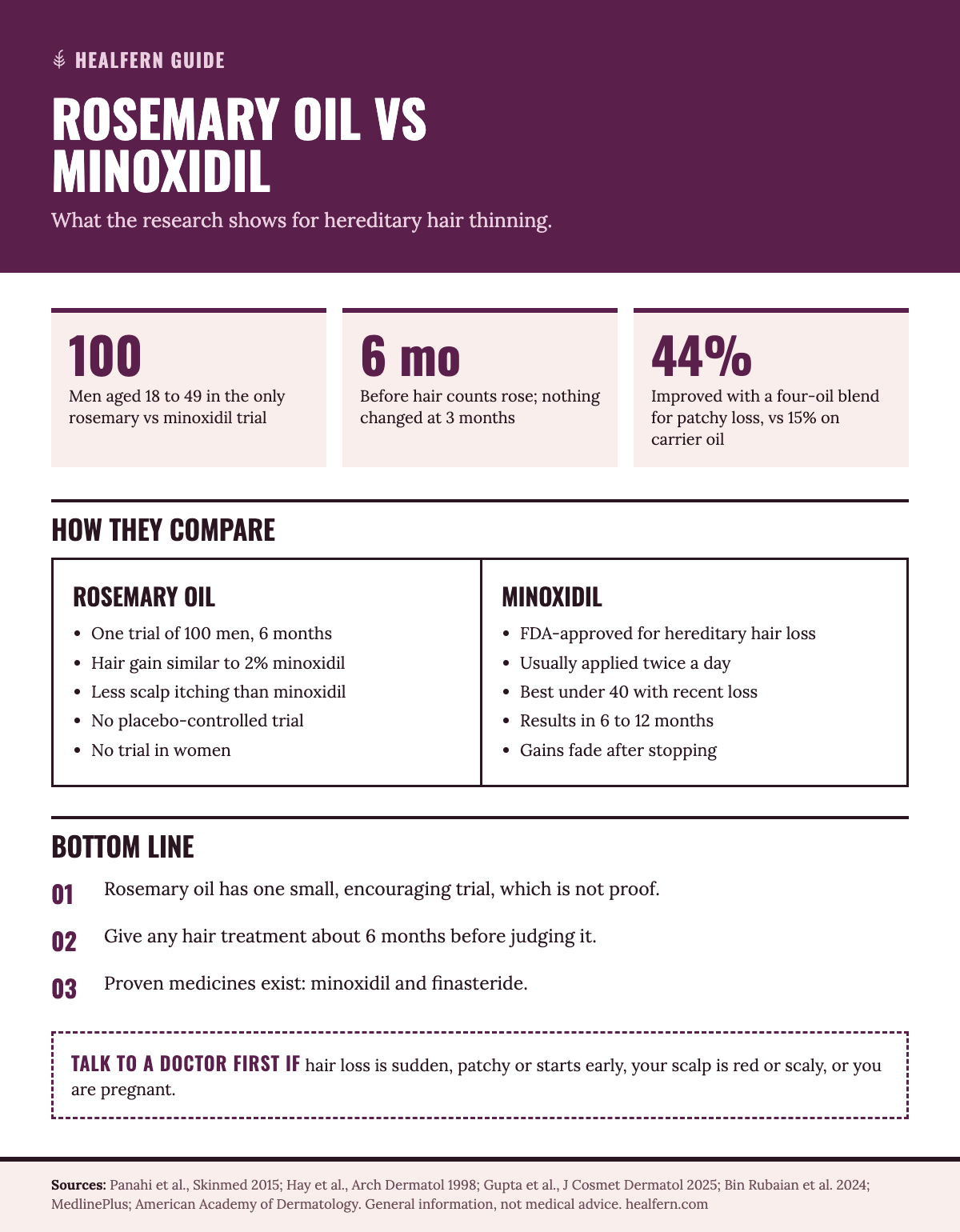
Rosemary oil may help hereditary hair thinning a little, but the evidence is thin. In the only head-to-head trial, 100 men using rosemary oil or 2% minoxidil twice daily both gained hair at 6 months, with less scalp itching on rosemary. There was no placebo group and no trial in women. Minoxidil and finasteride remain the proven options.
We read the 2015 trial that compared rosemary oil with minoxidil, two 2025 reviews that ranked non-prescription hair loss products, the 1998 aromatherapy trial for patchy hair loss, the mouse study often quoted online, and hair loss guidance from MedlinePlus, NIAMS and the American Academy of Dermatology.
The short answer: rosemary oil might help hereditary hair thinning a little, but the human evidence is one 100-person trial against a low-strength minoxidil, so it is worth trying only as an experiment.[1][4]
| What it is | An essential oil from the rosemary plant (Rosmarinus officinalis), applied to the scalp.[4] |
|---|---|
| Used for | Hereditary hair thinning (androgenetic alopecia), the most common type of hair loss.[3] |
| How it was studied | Applied to the scalp twice daily for 6 months in the main trial.[1][2] |
| Best evidence | One trial of 100 men: hair counts rose at 6 months, similar to minoxidil 2%.[1][4] |
| Safety | Scalp itching was reported; contact allergy has been described for 80 essential oils.[1][12] |
| Proven alternatives | Minoxidil and finasteride are the only FDA-approved medicines for this type of hair loss.[4] |
| Check with a doctor if | Hair loss is sudden, patchy, early, or comes with a red or scaly scalp.[9][8] |
Does rosemary oil really grow hair?
Possibly, for hereditary thinning, but the proof is thin. One randomized trial found that men who applied rosemary oil for 6 months had more hair than when they started, about as much gain as men using 2% minoxidil.[1] No larger trial has confirmed it, and that one trial compared rosemary oil with minoxidil rather than with a placebo.[1][2][4]
The idea spread online faster than the research did. A 2024 review that set out to examine rosemary oil found its human evidence came from a single study in men, with the rest from a study in mice, and concluded that “further research is required.”[4]
A 2025 review of non-prescription hair loss products reached a similar place. It included 13 investigator-blinded controlled trials across eight products, rosemary oil among them, and said more robust trials and long-term safety data are needed.[3]
One encouraging trial is enough reason to try rosemary oil if you are curious. If keeping your hair matters a lot to you, it is too little to choose it over medicines with years of evidence behind them.
Is it hair loss or hair shedding?
The difference matters because the two behave differently. Excess shedding (telogen effluvium) usually follows a stressful event and stops on its own, while hereditary hair loss keeps going without treatment. Rosemary oil has only been tested for hereditary thinning and, as part of a blend, for patchy hair loss.[15][1][6]
Signs of excess shedding
The AAD puts normal shedding at 50 to 100 hairs a day.[15] Heavy shedding is common after losing 20 pounds or more, giving birth, a high fever, an operation, a stretch of intense stress, or stopping birth control pills.[15]
It tends to show up a few months after the trigger. New mothers often notice it about 2 months after birth, it peaks around 4 months, and hair usually regains its normal fullness within 6 to 9 months.[15] If the stress continues, though, shedding can last a long time.[15]
Signs of hereditary thinning
Men with hereditary hair loss tend to develop a receding hairline or a bald patch in the center of the scalp, and women notice gradual thinning.[15] In women it shows mainly on the top and crown, often starting as a widening center part, while the front hairline stays in place.[14]
Timing can fool you here. Shedding that is about to stop by itself can make any oil started during it look like it worked. A dermatologist can tell you which one you have, and some people have both.[15]
What did the rosemary oil vs minoxidil trial find?
Hair counts went up in both groups at 6 months, and the groups did not differ. In the 2015 trial, 100 people with hereditary hair loss used rosemary oil or minoxidil 2% for 6 months; neither group changed at 3 months, and both improved by 6 months.[1]
| Study | Who and how many | What they used, how long | Result |
|---|---|---|---|
| Panahi et al., Skinmed 2015[1] | 100 men aged 18 to 49 with hereditary hair loss[4] | Rosemary oil or minoxidil 2%, twice daily, 6 months[2] | No change at 3 months; hair count up in both groups at 6 months, no difference between groups |
| Hay et al., Arch Dermatol 1998[6] | 86 people with alopecia areata | Rosemary, thyme, lavender and cedarwood oils in carrier oils, massaged daily, 7 months | 44% improved vs 15% with carrier oils alone |
| Gupta et al., network meta-analysis 2025[2] | 24 trials of hair loss treatments in men | Compared medicines and 7 non-prescription products at 24 weeks | Confirmed minoxidil, finasteride and dutasteride; rosemary data came from the 2015 trial only |
Side effects pointed in rosemary’s favor. Scalp itching increased in both groups, but it was more frequent with minoxidil at both check-ups.[1] Dry hair, greasy hair and dandruff did not change in either group.[1]
Nothing changed at 3 months in either group, which fits MedlinePlus guidance that minoxidil needs at least 4 months, and possibly up to a year, before you see an effect.[1][7]
Why is one trial not enough?
Because a single small study can easily overstate a result, and this one has several limits. It had 100 participants, lasted 6 months, compared rosemary with the weaker 2% strength of minoxidil, and had no placebo group, so we cannot tell how much of the gain would have happened anyway.[1][4]
The participants were young men. The 2025 network meta-analysis lists their average age at about 24 to 25 years, and a review describes them as men aged 18 to 49.[2][4] We found no trial of rosemary oil in women with thinning hair, so results may not apply to them.
Women do have options with some evidence. The AAD describes spironolactone, a prescription pill, for female pattern hair loss: in one study of 166 women taking it, 42% reported mild improvement and 31% reported thicker hair.[10] It can cause birth defects, so dermatologists pair it with birth control when pregnancy is possible.[10]
The authors of the network meta-analysis also flagged that trials of alternative products tend to be much smaller than the large trials behind conventional medicines.[2] Small trials are more likely to produce results that later shrink or disappear.
Finally, the abstract does not describe the product’s strength or how much oil was used, so there is no tested recipe to copy.[1] If you see a precise “rosemary oil protocol” online, it did not come from this trial.
What are the options for women with thinning hair?
Women have one FDA-approved medicine for pattern thinning, minoxidil, and we found no rosemary oil trial in women. MedlinePlus says women should use the 2% solution or 5% foam, and that it may help hair grow in about 1 in 4 or 5 women and slow or stop loss in most.[14]
Female pattern baldness is the most common type of hair loss in women. Its cause is not well understood, but it may be linked to aging, changes in androgen hormones, family history, heavy menstrual bleeding and some medicines, such as estrogen-containing birth control pills.[14]
A visit is worth it because other causes look similar. Doctors check for thyroid disease and low iron, and for signs of too much androgen, such as new facial hair, changes in periods or new acne.[14]
- Untreated, the loss is permanent, though it is usually mild to moderate. You do not need treatment if you are comfortable with how your hair looks.[14]
- Minoxidil has to be used long term. When you stop, hair loss starts again and the hair it helped grow falls out.[14]
- If minoxidil does not help, doctors may suggest spironolactone, birth control pills, ketoconazole shampoo, platelet-rich plasma injections or laser treatment.[14]
- A new hairstyle, hair weaving or a hairpiece is often the least expensive and safest option.[14]
Rosemary oil can sit alongside these as an extra if your scalp tolerates it. Without a trial in women, it is hard to justify as the only plan.
How might rosemary affect hair follicles?
Nobody knows for sure. The most cited lab work comes from a 2013 study in mice, which found that a rosemary leaf extract improved hair regrowth in mice given testosterone and blocked an enzyme called 5-alpha-reductase in a lab dish.[5] That enzyme turns testosterone into a stronger hormone, dihydrotestosterone, which shrinks hair follicles in hereditary hair loss.[4]
In that study, the extract blocked the enzyme by 82.4% and 94.6% at the two concentrations tested, and the mice received 2 mg of extract a day on their skin.[5] The study used a leaf extract, which differs from the essential oil sold in stores, and results in mice and test tubes often do not carry over to people.[5]
Other proposed effects are anti-inflammatory, antioxidant and antifungal actions, but the 2025 network meta-analysis described these as what rosemary oil “is thought to” do, not as proven mechanisms.[2]
For comparison, finasteride is a pill that interferes with the production of that same hormone and has been tested in large human trials.[8][2]
Does rosemary oil help patchy hair loss (alopecia areata)?
There is one older trial of a blend that included rosemary. In 1998, 86 people with alopecia areata massaged a mix of thyme, rosemary, lavender and cedarwood oils in jojoba and grapeseed oil into the scalp daily; after 7 months, 19 of 43 (44%) improved, compared with 6 of 41 (15%) using carrier oils alone.[6]
Because four oils were combined, the trial cannot tell us whether rosemary did anything on its own.[6] It has also not been repeated at scale in the sources we read.
Alopecia areata happens when the immune system attacks hair follicles, usually causing coin-sized bald patches.[11] NIAMS notes that hair often regrows on its own within a few months, though new patches can appear, which makes any remedy hard to judge without a control group.[11]
NIAMS also states there is no cure, but there are treatments that help hair grow back more quickly.[11] Patchy hair loss is a reason to see a dermatologist rather than self-treat with oils.
What do newer rosemary studies and blends show?
Newer studies mostly test rosemary mixed with other oils, so they cannot show what rosemary does on its own. The largest recent trial, published in 2025 with 90 adults, was paid for by the company that makes the blend, and independent reviews still call for better research.[17][18]
The 2025 blend trial
Ninety adults aged 18 to 55, described as healthy participants, were randomly assigned to a rosemary and lavender oil, a rosemary and castor oil, or coconut oil for 90 days.[17] The authors reported that both rosemary blends beat coconut oil on growth rate, thickness, density and hair fall. In the rosemary and lavender group, growth rate rose from 0.22 to 0.34 mm a day.[17]
Read those numbers with care. The trial was funded by the blend’s maker and one author works there, the abstract does not say participants had been diagnosed with hereditary hair loss, 90 days is short for hair, and a correction to the paper was published in 2026.[17]
What the wider reviews say
A 2025 systematic review of 16 randomized trials of herbal hair loss remedies, covering rosemary, green tea, ginseng, aloe vera, olive and saw palmetto, described the results as promising.[18] It also said study design limits and inconsistent outcome measures mean more rigorous, standardized research is needed.[18]
That matches the 2024 rosemary review and the 2025 review of non-prescription products, which both asked for larger and longer trials.[4][3] We found no trial of rosemary shampoos or rosemary water in the sources we read.
Is rosemary oil safe on your scalp?
For most people it seems well tolerated, but it is not risk free. In the 2015 trial, scalp itching rose in the rosemary group, though less than with minoxidil.[1] Essential oils can also cause allergic skin reactions; a dermatology review found contact allergy described for 80 different essential oils.[12]
- Use it diluted. NCCIH notes that essential oils are usually inhaled or applied to the skin in diluted form, and the 1998 trial mixed its oils into carrier oils.[13][6]
- Stop using it if your scalp becomes red, itchy or flaky, since allergic reactions to essential oils are well described.[12]
- We found no safety data on rosemary oil in pregnancy or breastfeeding, so ask your doctor first.
See a doctor right away if you lose hair rapidly or in handfuls, hair loss starts in your teens or twenties, your scalp is red, scaly or painful, or hair loss comes with fatigue, weight gain, feeling cold, acne, facial hair or irregular periods.[9] MedlinePlus also advises a visit if hair loss begins after you start a new medicine.[8]
Who should skip rosemary oil, and what happens if you stop?
Skip it if your skin has reacted to rosemary or thyme before, and check with a doctor first if you are pregnant or your hair loss is patchy or sudden. If you stop, nobody has measured what happens to any gains, while minoxidil gains are known to fade within months.[16][10]
Who should skip it or take extra care
A review of published case reports found that both rosemary extracts and the raw plant can cause allergic contact dermatitis. A compound in the plant called carnosol has been blamed, and cross-reactions between rosemary and thyme have been reported.[16]
The authors added that these reactions may be more common than reported, because they can be misdiagnosed.[16] If your scalp turns red or itchy after you start using rosemary oil, mention it to your doctor.
- People who have reacted to thyme or to rosemary in foods, cosmetics or creams.[16]
- Anyone with patchy, sudden or painful hair loss, who needs a diagnosis first.[9]
- Children: the trials of rosemary oil for hereditary thinning enrolled only adults.[4][17]
What happens when you stop
Minoxidil gains fade within a few months of stopping, and in women the hair it helped grow falls out.[10][14] For rosemary oil, the main trial lasted 6 months and did not follow people after they stopped.[1] If you see a benefit, plan to keep going and judge it again at regular intervals.
What do doctors use first for hair loss?
Doctors start by finding the cause. The AAD says effective treatment “begins with finding the cause,” since stress, illness, childbirth, medicines, low iron and hereditary thinning all need different approaches.[10][9] For hereditary thinning, minoxidil and finasteride are the only FDA-approved medicines.[4]
Minoxidil is applied to the scalp, usually twice a day, and works best in people under 40 whose hair loss is recent.[7] Results usually take 6 to 12 months, and the gains fade within a few months of stopping.[10][7]
Finasteride is a daily pill for men that slows hair loss and works slightly better than minoxidil, according to MedlinePlus; dutasteride is a related medicine.[8] Improvement usually takes about 4 months to notice.[10]
Dermatologists also use add-ons. In one study the AAD cites, more than 200 men and women with hereditary hair loss used a laser comb or a look-alike sham device 3 times a week for 26 weeks, and some laser users saw thicker, fuller hair, though not everyone regrew hair.[10] Microneedling combined with 5% minoxidil produced more growth than minoxidil alone after 12 weeks in another study.[10]
Supplements help only in specific cases. The AAD advises taking biotin, iron or zinc only when a blood test shows a deficiency, because too much can cause harm, including iron poisoning.[10] For a deeper look at nutrient pills, see what large trials show about multivitamins.
Normal shedding is 50 to 200 hairs a day, and about 80% of men show some male pattern baldness in their lifetime, so some loss is expected.[9]
How to try rosemary oil sensibly
If you want to try it, treat it as a 6-month experiment with a clear way to judge results. This checklist follows the trial design and the safety points above.
- Get a diagnosis first if your hair loss is patchy, sudden or comes with scalp symptoms.[8][9]
- Read the label: look for 100% Rosmarinus officinalis oil and the bottle size, and avoid products that promise regrowth. Our label reading guide explains what to check.
- Dilute it in a carrier oil and try it on a small patch of skin before using it on your whole scalp.[13][12]
- Apply consistently; the trial used it twice daily.[2]
- Take photos in the same light at the start, at 3 months and at 6 months. The trial saw no change at 3 months.[1]
- Do not stop a prescription treatment to switch to rosemary oil without talking to your doctor, since minoxidil gains fade after stopping.[7]
- If you see no difference at 6 months, talk to a dermatologist about proven options.[10]
More hair guides are in our hair loss section, and our research method explains how we weigh studies like these. For another popular plant oil with similarly thin evidence, see our review of toenail fungus remedies, including tea tree oil.
Our verdict on rosemary oil for hair growth
Rosemary oil is a fairly low-risk thing to try for mild hereditary thinning, and one trial suggests it may do about as much as 2% minoxidil over 6 months.[1] That trial was small, short, limited to young men and lacked a placebo, so it is a hint rather than an answer.[1][2][4]
If you are early in hair loss and care a lot about keeping what you have, we would start with a proven medicine and a dermatologist visit. Use rosemary oil as an extra if you like the routine, not as your only plan.[10][7]
Questions people also ask
Does rosemary oil work as well as minoxidil?
In one 2015 trial of 100 men, rosemary oil and 2% minoxidil produced similar hair count gains at 6 months. The trial was small, had no placebo group and used the weaker minoxidil strength, so it is not settled.
How long does rosemary oil take to work for hair?
In the main trial, neither rosemary oil nor minoxidil changed hair counts at 3 months. Both groups showed gains at 6 months, so plan on at least 6 months of twice-daily use before judging.
Can rosemary oil regrow a bald spot?
No trial shows rosemary oil alone regrows bald patches. A 1998 trial of a four-oil blend that included rosemary helped 44% of people with alopecia areata versus 15% on carrier oil, but patchy loss needs a dermatologist.
Is rosemary oil safe to put on your scalp?
Most people in the trial tolerated it, though scalp itching rose slightly. Essential oils can cause allergic skin reactions, so dilute it in a carrier oil, test a small patch first and stop if your scalp gets red or itchy.
Does rosemary oil work for women with thinning hair?
Nobody knows yet. The only trial of rosemary oil for hereditary thinning enrolled men aged 18 to 49. Women with thinning hair should see a doctor, since several medical causes and proven medicines apply.
Does rosemary oil help hair shedding after pregnancy?
No rosemary trial has studied it. The AAD says shedding after birth usually peaks around 4 months and hair tends to regain its normal fullness within 6 to 9 months, so most of it recovers without any product.
Sources
- Rosemary oil vs minoxidil 2% for the treatment of androgenetic alopecia: a randomized comparative trial, Skinmed, 2015
- Relative efficacy of conventional monotherapies and select nonconventional, over-the-counter products for male androgenetic alopecia: a network meta-analysis, Journal of Cosmetic Dermatology, 2025
- Do non-prescription products help in managing androgenic alopecia?, Skin Appendage Disorders, 2025
- An overview of commonly used natural alternatives for the treatment of androgenetic alopecia, with special emphasis on rosemary oil, Clinical, Cosmetic and Investigational Dermatology, 2024
- Promotion of hair growth by Rosmarinus officinalis leaf extract, Phytotherapy Research, 2013
- Randomized trial of aromatherapy: successful treatment for alopecia areata, Archives of Dermatology, 1998
- Minoxidil Topical, MedlinePlus, National Library of Medicine
- Male pattern baldness, MedlinePlus, reviewed 2025
- Hair loss, MedlinePlus, reviewed 2025
- Hair loss: Diagnosis and treatment, American Academy of Dermatology
- Alopecia areata, NIAMS, National Institutes of Health
- Essential oils, Part I: Introduction, Dermatitis, 2016
- Aromatherapy, National Center for Complementary and Integrative Health
- Female pattern baldness, MedlinePlus Medical Encyclopedia, National Library of Medicine
- Do you have hair loss or hair shedding?, American Academy of Dermatology
- Rosmarinus officinalis L. as cause of contact dermatitis, Allergologia et Immunopathologia, 2014
- Rosmagain as a Natural Therapeutic for Hair Regrowth and Scalp Health: A Double-Blind, Randomized, Three-Armed, Placebo-Controlled Clinical Trial, Cureus, 2025 (funded by the product's maker)
- Pathophysiology, conventional treatments, and evidence-based herbal remedies of hair loss with a systematic review of controlled clinical trials, Naunyn-Schmiedeberg's Archives of Pharmacology, 2025
This article is general information, not medical advice. These statements have not been evaluated by the FDA, and supplements are not intended to diagnose, treat, cure or prevent any disease. Talk to your doctor or pharmacist before you start a supplement. How we research.