For most healthy adults, not in the ways people hope. The two largest trials, with 14,641 men over 11 years and 21,442 older adults over 3.6 years, found no drop in heart disease or deaths and mixed cancer results. A multivitamin does raise nutrient intake, so it can help people with specific needs, such as pregnancy, a vegan diet or age over 50.
We read the two largest randomized trials of daily multivitamins, the Physicians’ Health Study II and COSMOS, along with the 2022 US Preventive Services Task Force recommendation, a 2024 National Cancer Institute analysis of 390,124 adults, and the NIH Office of Dietary Supplements fact sheet.[1][2][3][5][7]
For a healthy adult with a reasonable diet, a daily multivitamin has not been shown to lower the risk of heart disease or early death, and its cancer and memory signals are small and each comes from a single trial. It does help people with specific needs fill specific gaps.[2][3][4][5][6]
| What it is | A pill with several vitamins and minerals, most near the Daily Value. Formulas differ by age, sex and life stage.[1] |
|---|---|
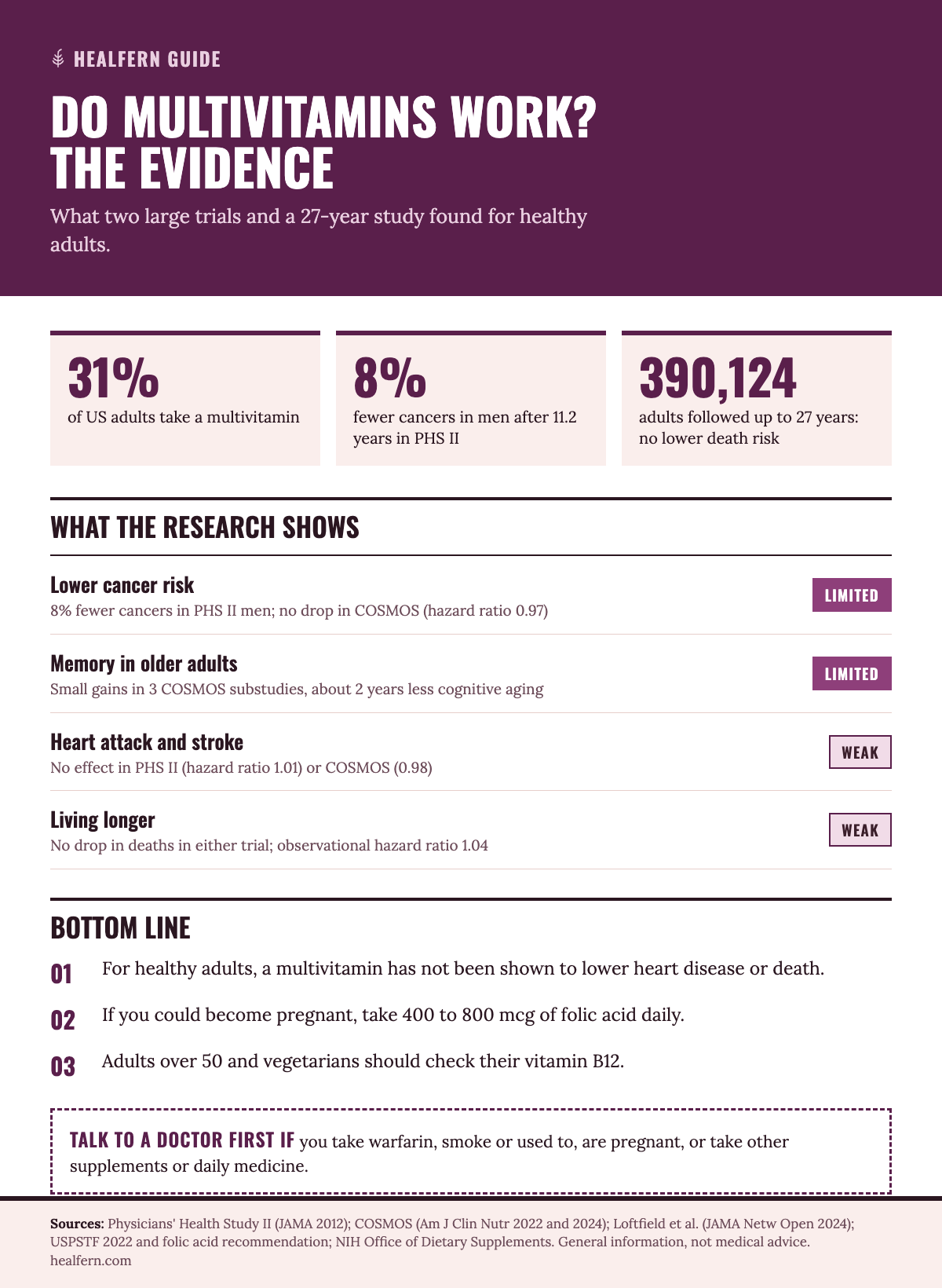
| Who takes one | About 31% of US adults.[2] |
| Typical amounts | Basic products give most nutrients at or near 100% of the Daily Value. “High potency” products can exceed the upper limit for some nutrients.[1] |
| Best evidence | Physicians’ Health Study II (14,641 men, 11.2 years) and COSMOS (21,442 older adults, 3.6 years): no heart benefit, mixed cancer results.[3][4][5] |
| Expert view | The USPSTF found the evidence insufficient to judge benefits and harms for heart disease or cancer prevention.[2] |
| Safety | A basic multivitamin near recommended intakes should be safe for healthy people.[1] |
| Check first | People on warfarin (vitamin K), smokers (beta-carotene and vitamin A) and anyone pregnant or planning a pregnancy.[1][11] |
Do multivitamins work?
They raise nutrient intake, which helps if your diet falls short. In large trials, though, daily multivitamins did not reduce heart attacks, strokes or deaths, and the cancer and memory benefits were modest and each came from one trial.[1][3][4][5][6] The USPSTF calls the evidence insufficient to recommend them for heart disease or cancer.[2]
The ODS also notes that multivitamin users often already get more nutrients from food than nonusers, and the groups most likely to fall short are the least likely to take one.[1]
We grade each claim with four plain levels. Moderate means several pooled trials with a small, consistent effect. Limited means some trials, but small, short or low quality. Weak means pilot studies only, or reviews that found no benefit. Avoid means no evidence plus a safety problem. By that scale, cancer and memory claims are Limited, and heart and lifespan claims are Weak.
| Study | Who and how long | Design | Main result |
|---|---|---|---|
| Physicians’ Health Study II, cancer (JAMA 2012) | 14,641 US male doctors aged 50+, median 11.2 years | Randomized, daily multivitamin vs placebo | Total cancer 8% lower (hazard ratio 0.92); no change in prostate or colorectal cancer[3] |
| Physicians’ Health Study II, heart (JAMA 2012) | Same 14,641 men | Randomized, daily multivitamin vs placebo | No effect on major cardiovascular events (hazard ratio 1.01)[4] |
| COSMOS (Am J Clin Nutr 2022) | 21,442 adults (women 65+, men 60+), median 3.6 years | Randomized, daily multivitamin vs placebo | No effect on invasive cancer (0.97) or cardiovascular events (0.98)[5] |
| COSMOS cognition (Am J Clin Nutr 2024) | 573 in-person participants, plus a meta-analysis of 3 substudies | Randomized substudies | Small gains in overall thinking and episodic memory[6] |
| Loftfield (JAMA Netw Open 2024) | 390,124 adults, up to 27 years | Observational, self-reported use | No lower death risk; hazard ratio 1.04 in the first analysis[7] |
How does your body use the vitamins in a multivitamin?
It depends on the vitamin. The four fat-soluble vitamins (A, D, E and K) are stored in the liver, fatty tissue and muscles. The nine water-soluble vitamins (vitamin C and the B group) are not stored, and any extra leaves the body in urine.[15]
Fat-soluble vitamins: A, D, E and K
MedlinePlus says these four are absorbed more easily when there is some fat in the meal.[15] If you take a multivitamin, taking it with a meal that has some fat fits that advice.
Because the body keeps these vitamins, extra amounts can build up. MedlinePlus warns that high doses of certain vitamins can be toxic, and that more is not always better.[15]
Water-soluble vitamins: C and the B group
These need to come in regularly, since the body keeps little in reserve. Vitamin B12 is the exception, because the liver can store it for many years.[15] Not being stored does not make large doses harmless. Among multivitamin users, 48% to 61% had excessive niacin intakes, and taking other supplements and fortified foods on top raises the odds of going over upper limits.[1]
A multivitamin also carries minerals, and those amounts are often smaller than people expect. Many products contain only small amounts of calcium, magnesium and potassium, so the ODS advises checking the label before assuming the pill covers them.[1]
Do multivitamins lower cancer risk?
The evidence is mixed. In the Physicians’ Health Study II, men who took a daily multivitamin for a median of 11.2 years had 8% fewer cancers than men on placebo, 17.0 versus 18.3 cases per 1,000 person-years.[3] The newer COSMOS trial found no drop in invasive cancer.[5]
The PHS II result did not hold for any single cancer type. It did not reduce prostate cancer, colorectal cancer or any other single cancer type, and the drop in cancer deaths (hazard ratio 0.88) was not statistically significant.[3]
COSMOS gave 21,442 older adults a daily multivitamin or placebo for a median of 3.6 years. Invasive cancer occurred in 518 people on the multivitamin and 535 on placebo, a hazard ratio of 0.97.[5] Lung cancer was lower (hazard ratio 0.62), but that was a secondary result, not the main question the trial set out to answer.[5]
The evidence review behind the 2022 USPSTF statement concluded that multivitamins may give a small benefit against cancer.[1] The task force still judged the evidence insufficient to weigh benefits against harms.[2] The American Institute for Cancer Research recommends against supplements for cancer prevention.[1]
Do multivitamins protect your heart or help you live longer?
No trial has shown either. PHS II found no effect on major cardiovascular events after more than a decade (hazard ratio 1.01), and COSMOS found none after 3.6 years (hazard ratio 0.98).[4][5] Neither trial found a significant drop in deaths from any cause.[4][5]
A hazard ratio of 1.0 means no difference between groups. In PHS II, heart attack, stroke and cardiovascular death rates were all close to placebo.[4] COSMOS logged 429 cardiovascular events on the multivitamin and 437 on placebo.[5] The American Heart Association advises against multivitamins for heart disease prevention.[1]
The 2024 National Cancer Institute study followed 390,124 adults without major chronic disease for up to 27 years, during which 164,762 died.[7] Daily multivitamin use was linked to a 4% higher death risk in the first analysis (hazard ratio 1.04), and the authors concluded it was “not associated with a mortality benefit.”[7]
That study was observational, so it cannot prove cause. Daily users were more often female and college educated, and less often smokers.[7] NCCIH sums up: “Most research shows that taking multivitamins doesn’t result in living longer.”[8]
Can a multivitamin help memory as you age?
Possibly a little, in older adults, but the evidence comes from one trial. Three COSMOS substudies found small gains in memory or overall thinking with a daily multivitamin, while PHS II found no effect on cognitive decline in men.[1][6] NCCIH still lists slowing cognitive decline among the benefits most research has not shown.[8]
COSMOS-Mind tested 2,262 participants (average age 73) by phone each year for 3 years. COSMOS-Web tested 3,562 (average age 71) online. COSMOS-Clinic gave 573 people detailed in-person tests over 2 years.[1] In the clinic group, episodic memory improved, but executive function and attention did not.[1]
A 2024 meta-analysis pooled the three substudies. The effect on overall thinking was small, and the authors estimated it as equal to about 2 years less cognitive aging.[6] All three groups came from the same trial and took the same product (Centrum Silver), so an independent trial would make the finding firmer.[1]
If memory trouble is new, our guide to brain fog causes covers common reasons and when to get checked.
Do older adults need a multivitamin?
Not automatically, but needs shift after 50. The National Institute on Aging says people over 50 may need more of some vitamins and minerals than younger adults, and names calcium, vitamin D, vitamin B6 and vitamin B12. It still puts food first and suggests asking a doctor or dietitian before adding a supplement.[12]
Use climbs with age. In national survey data, 39.4% of adults aged 60 and over had taken a multivitamin in the past 30 days, compared with 24.0% of adults aged 20 to 39.[1]
| Nutrient | Daily amount | Upper limit noted |
|---|---|---|
| Vitamin B12 | 2.4 mcg[12] | None listed |
| Calcium | Women 1,200 mg. Men 1,000 mg at 51 to 70, then 1,200 mg[12] | 2,000 mg[12] |
| Vitamin D | 600 IU at 51 to 70, 800 IU after 70[12] | 4,000 IU[12] |
| Vitamin B6 | Men 1.7 mg, women 1.5 mg[12] | None listed |
Why B12 gets extra attention
Older adults need as much B12 as younger adults, but some have trouble absorbing the B12 that occurs naturally in food. The NIA says a doctor may suggest fortified cereals or a B12 supplement, and that people on acid reflux medicine may need a different form.[12] The Dietary Guidelines add that proton pump inhibitors can lower B12 absorption from food.[1]
Medicines, doses and quality marks
The NIA warns that a supplement can make a prescribed medicine weaker or stronger, that taking too many supplements or very concentrated ones can be harmful, and that money spent on unneeded products is wasted.[12] Basic multivitamins rarely interact with medicines, with warfarin and vitamin K the main exception.[1]
The NIA suggests looking for the USP Verified mark, which checks a product’s identity, quality, strength and purity.[12] That mark is about what is in the bottle. The NIA separately advises checking that any health claim rests on scientific proof.[12]
Who may benefit from a multivitamin or a single nutrient?
People with higher needs or limited diets benefit most, and often one nutrient is what they need. Anyone who could become pregnant should take 400 to 800 mcg of folic acid a day, and adults over 50 are advised to get vitamin B12 from fortified foods or supplements.[11][1]
The USPSTF gives folic acid its highest grade, A. It advises starting at least 1 month before conception and continuing through the first 2 to 3 months of pregnancy.[11] Its multivitamin statement does not apply to people who are pregnant, chronically ill, hospitalized or known to have a nutrient deficiency.[2]
MedlinePlus notes that people who eat a vegetarian diet may need a vitamin B12 supplement.[9] Adults over 50 may absorb less of the B12 that occurs naturally in food.[1]
The ODS lists pregnant and breastfeeding women, people with low incomes, and people who are underweight or overweight among those at higher risk of low intake.[1] Senior formulas often contain little or no iron and more calcium, vitamin D and B12.[1] If your doctor recommends vitamin D on its own, our vitamin D2 vs D3 guide compares the two forms.
What should a prenatal vitamin contain?
Folic acid and iron come first. MedlinePlus advises a prenatal vitamin with folic acid, iron and the other vitamins and minerals women need, sold over the counter or given by prescription. The USPSTF advises 400 to 800 mcg of folic acid a day for anyone who could become pregnant.[16][11]
MedlinePlus explains that the baby needs iron for its blood supply, and that the mother needs it to avoid anemia.[16] The World Health Organization recommends iron and folic acid supplements throughout pregnancy.[1]
The CDC recommends 400 mcg a day for women and teens who could become pregnant, from fortified foods, supplements or both, and the ODS notes that enough folic acid around conception lowers the risk of neural tube defects in newborns.[1] Nearly half of US pregnancies are unplanned, which is why the USPSTF advice covers anyone who could become pregnant.[11]
Most prenatal formulas provide no vitamin A in the retinol form.[1] High doses of vitamin A can cause birth defects.[2]
- Folic acid: confirm 400 to 800 mcg on the label.[11]
- Iron: check that it is listed, and ask your provider how much you need.[16]
- Vitamin A: avoid adding a separate vitamin A product unless your provider advises it.[1][2]
- Diet gaps: if you eat a vegetarian or vegan diet, ask about iron, vitamin B12, choline, iodine, EPA and DHA.[1]
- Totals: count fortified cereals and any other supplements so you stay under upper limits.[1]
Should children take a multivitamin?
Most healthy children do not need one. The American Academy of Pediatrics says children who eat a normal, well-balanced diet do not need vitamins beyond the recommended dietary allowances. Breastfed babies are the main exception, with 400 IU of vitamin D a day starting in the first few days after birth.[13][1]
Many children take one anyway. About one in four children and teens use a multivitamin, including 34.6% of children aged 2 to 5 and 17.3% of teens aged 12 to 19.[1] Most children’s products provide age-appropriate amounts.[1]
The AAP lists 400 IU of vitamin D a day for infants under 1 and 600 IU after age 1.[13] The Dietary Guidelines note that young children may need to keep taking vitamin D after 12 months, because it is hard to get enough from food.[1]
Megadoses and iron are the main risks
The AAP warns that megadoses of vitamins A, C or D can cause toxic symptoms, ranging from nausea, rashes and headaches to more serious problems.[13] It advises talking with your pediatrician before giving any vitamin supplement.[13]
Iron is the bigger danger in the house. Federal rules require every iron-containing supplement to carry this warning: “Accidental overdose of iron-containing products is a leading cause of fatal poisoning in children under 6.”[14] That applies to adult and prenatal bottles too, so keep all of them out of reach.[14]
Are multivitamins safe?
A basic multivitamin with amounts near recommended intakes should be safe for healthy people, according to the NIH Office of Dietary Supplements.[1] NCCIH calls a multivitamin “unlikely to pose any health risks.”[8] Problems tend to come from high-dose formulas, or from stacking products on top of fortified foods.[1]
Among multivitamin users, 10% to 15% had excessive intakes of vitamin A, iron and zinc, and 48% to 61% had excessive intakes of niacin.[1] Moderate doses of vitamin A may reduce bone density, and high doses can harm the liver or cause birth defects.[2]
Smokers, and possibly former smokers, should avoid products with large amounts of beta-carotene or vitamin A. In a trial of 29,133 Finnish male smokers, 20 mg a day of beta-carotene led to 18% more lung cancer.[1] The USPSTF recommends against beta-carotene and vitamin E supplements for heart disease or cancer prevention.[2] High-potency B vitamin products carry their own risks, covered in our guide to vitamin B6 and nerve symptoms.
The FDA does not approve dietary supplements before they are sold, and companies generally do not have to show the agency evidence of safety.[10]
Talk to your doctor before starting if you
- Take warfarin or a similar blood thinner. Vitamin K in multivitamins can make it less effective.[1]
- Smoke or used to smoke, because of beta-carotene and vitamin A.[1]
- Are pregnant, breastfeeding or trying to conceive. Many supplements have not been tested in these groups.[8]
- Have surgery coming up. Some supplements raise bleeding risk or affect anesthesia.[8]
- Take other supplements or prescription medicines, which can interact.[8]
What do doctors recommend instead of a daily multivitamin?
Food first, then a targeted supplement for a known need. MedlinePlus says you can usually get all your vitamins from the foods you eat, and that the best way is a balanced diet with a variety of foods.[9] It also suggests asking your provider before taking vitamin supplements.[9]
The ODS adds that multivitamins cannot take the place of the variety of foods that matter for health, because foods carry other useful nutrients and compounds.[1] For healthy, nonpregnant adults, the USPSTF advises against beta-carotene and vitamin E and gives no recommendation either way on multivitamins for heart disease or cancer.[2]
When a blood test or a life stage points to a real need, such as low B12 after 50 or a planned pregnancy, a single nutrient at a set dose is the usual answer.[1][11]
One high-dose formula has a specific medical use. In the Age-Related Eye Disease Study, 4,757 people aged 55 to 80 took high doses of vitamin C, vitamin E, beta-carotene, zinc and copper, or a placebo.[1] Over about 6.3 years, the supplement cut the risk of moving from intermediate to advanced macular degeneration by 28%, but it did not stop the disease from starting or change cataract risk.[1] That formula is for people an eye doctor has diagnosed with macular degeneration.
How do you choose a multivitamin if you take one?
Pick a basic product made for your age, sex and life stage, with most nutrients near 100% of the Daily Value. The ODS advises matching the product to your life stage and checking labels, since many multivitamins carry only small amounts of calcium, magnesium and potassium.[1]
- Choose a formula for your life stage: prenatal, adult or 50+.[1]
- Check the % Daily Value column and skip “high potency” products that go far above the upper limits.[1] Our label reading guide explains each column.
- Add up every source, including other supplements and fortified cereals or drinks.[1]
- If you smoke, avoid products with large amounts of beta-carotene or vitamin A.[1]
- If you could become pregnant, confirm the folic acid amount is 400 to 800 mcg.[11]
- Do not read “standardized,” “verified” or “certified” as a quality guarantee.[8] The FDA does not approve supplements before sale.[10]
- Show the bottle to your doctor or pharmacist if you take warfarin or other daily medicines.[1][8]
Verdict: should you take a multivitamin?
If you eat a varied diet and feel well, a daily multivitamin is unlikely to change your risk of heart disease, cancer or early death, based on trials that lasted a median of 3.6 to 11.2 years.[2][3][4][5] At basic doses it is also unlikely to hurt you.[1]
Our judgment call: most healthy adults can skip it and put the effort into food, while people with a clear need (pregnancy, a vegan diet, or low B12 after 50) should take the specific nutrient their doctor advises.[1][9][11] If you are 60 or older and already take one, the COSMOS memory results are a fair, if unconfirmed, reason to keep going.[6] More guides are in our supplements section, and how we research explains our grades.
Questions people also ask
Do multivitamins actually do anything?
They raise your intake of vitamins and minerals, which helps if your diet falls short. In large trials they did not lower heart disease or death, and cancer and memory benefits were small and each came from a single trial.
Do multivitamins reduce cancer risk?
Results are mixed. The Physicians' Health Study II found 8% fewer cancers in men after 11.2 years, but no drop in any single cancer type. The COSMOS trial found no reduction in invasive cancer after 3.6 years.
Do multivitamins help you live longer?
No trial has shown that. Neither PHS II nor COSMOS found a significant drop in deaths, and a 2024 study of 390,124 adults found no mortality benefit, with a 4% higher death risk in its first analysis.
Who should take a multivitamin?
People with specific needs may benefit, often from one nutrient. Anyone who could become pregnant should take 400 to 800 mcg of folic acid daily. Adults over 50 and vegetarians may need vitamin B12.
Can taking a multivitamin be harmful?
A basic product near recommended amounts should be safe for healthy people. Risks come from high-dose formulas and stacking products. Smokers should avoid large amounts of beta-carotene, and people on warfarin should check vitamin K first.
Do multivitamins improve memory?
Possibly a little in older adults. Three COSMOS substudies found small gains, estimated at about 2 years less cognitive aging, but all came from one trial. The Physicians' Health Study II found no effect on cognitive decline.
Sources
- Multivitamin/mineral Supplements: Health Professional Fact Sheet, NIH Office of Dietary Supplements, updated 2024 (archived copy)
- Vitamin, Mineral, and Multivitamin Supplementation to Prevent Cardiovascular Disease and Cancer: Recommendation, US Preventive Services Task Force, 2022
- Multivitamins in the prevention of cancer in men: the Physicians' Health Study II randomized controlled trial, JAMA (Gaziano et al.), 2012
- Multivitamins in the prevention of cardiovascular disease in men: the Physicians' Health Study II randomized controlled trial, JAMA (Sesso et al.), 2012
- Multivitamins in the prevention of cancer and cardiovascular disease: the COSMOS randomized clinical trial, American Journal of Clinical Nutrition (Sesso et al.), 2022
- Effect of multivitamin-mineral supplementation versus placebo on cognitive function: COSMOS-Clinic and meta-analysis of 3 cognitive studies within COSMOS, American Journal of Clinical Nutrition (Vyas et al.), 2024
- Multivitamin Use and Mortality Risk in 3 Prospective US Cohorts, JAMA Network Open (Loftfield et al., National Cancer Institute), 2024
- Using Dietary Supplements Wisely, National Center for Complementary and Integrative Health
- Vitamins, MedlinePlus, National Library of Medicine
- Questions and Answers on Dietary Supplements, U.S. Food and Drug Administration (archived copy)
- Folic Acid Supplementation to Prevent Neural Tube Defects: Recommendation, US Preventive Services Task Force, 2023
- Dietary Supplements for Older Adults, National Institute on Aging
- Where We Stand: Vitamin Supplements for Children, American Academy of Pediatrics (HealthyChildren.org), updated 2025
- 21 CFR 101.17: Food labeling warning, notice, and safe handling statements, Electronic Code of Federal Regulations
- Vitamins (Medical Encyclopedia), MedlinePlus, National Library of Medicine
- Eating right during pregnancy, MedlinePlus Medical Encyclopedia, reviewed 2024
This article is general information, not medical advice. These statements have not been evaluated by the FDA, and supplements are not intended to diagnose, treat, cure or prevent any disease. Talk to your doctor or pharmacist before you start a supplement. How we research.