Brain fog is a symptom, not a diagnosis, and it usually has an ordinary cause. Short or poor sleep is the best-proven one. Stress, depression, anxiety, medicine side effects, alcohol, low vitamin B12, thyroid problems, perimenopause, long COVID and cancer treatment are other common causes. NIA says these problems usually ease once the cause is treated. See a doctor if fog lasts more than a few weeks.
We read the National Institute on Aging’s guide to memory problems, MedlinePlus, the National Cancer Institute’s page on treatment-related fog, NIH ODS guidance on vitamin B12, and the trials behind the most common causes: a 14-day sleep restriction study, the 9,764-person RECOVER long COVID cohort and the SWAN menopause study.
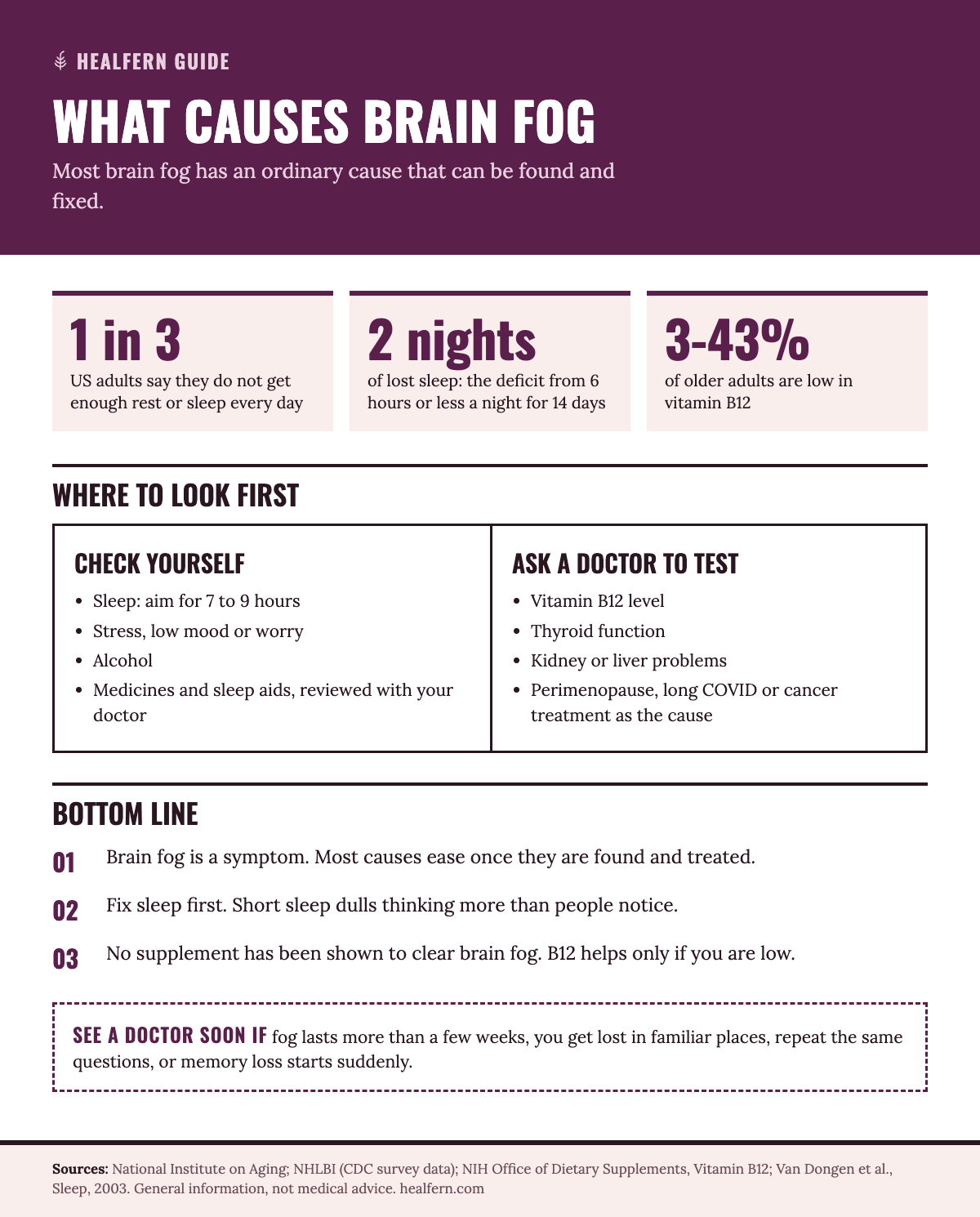
The short answer: brain fog is usually caused by something ordinary and fixable, most often short sleep, stress or low mood, a medicine side effect, low vitamin B12, a thyroid problem, the menopause transition, or recovery from an illness or cancer treatment.[1][2][5]
| What it is | An everyday phrase for slow, fuzzy thinking and poor focus. Cancer doctors call one version “mental fog” or chemo brain.[5] |
|---|---|
| Common everyday causes | Sleep problems, stress, depression, anxiety, alcohol and medicine side effects.[1] |
| Medical causes worth testing | Low vitamin B12, thyroid disease, and kidney or liver problems.[1][2] |
| Life stages and illness | Perimenopause, cancer treatment and long COVID can all bring trouble focusing.[5][6][7] |
| Best evidence | Sleeping 6 hours or less for two weeks caused thinking deficits equal to up to 2 nights without sleep.[4] |
| Supplements | None has been shown to clear brain fog. B12 helps only if you are low; ginkgo’s effect in healthy people is uncertain.[9][11] |
| See a doctor if | Memory problems last more than a few weeks, or you get lost in familiar places or repeat the same questions.[1] |
What is brain fog?
Brain fog is not a medical diagnosis. It is a plain-language way to describe thinking that feels slow, cloudy or scattered, with trouble focusing, finding words or remembering why you walked into a room. Doctors treat it as a symptom and look for the cause behind it.[2][5]
The National Cancer Institute uses the phrase “mental fog” for the thinking and memory changes some people notice during or after cancer treatment.[5] The National Institute on Aging lists a long set of things that can disturb memory and focus, from sleep problems and depression to thyroid disease and medicine side effects.[1]
NIA also says these problems “usually go away once the condition is successfully treated.”[1] That makes finding the cause the first job.
MedlinePlus makes the same point from the doctor’s side: treatment depends on the cause, and the first step is a history and basic tests.[2] Normal aging can bring some slower recall, but it does not cause dramatic memory loss.[2] If you are older and worried about dementia, the NIA guide explains how everyday forgetfulness differs from it.[1]
Can poor sleep cause brain fog?
Yes, and it is the most common cause we found evidence for. Short or poor sleep slows learning, focus and reaction time, and people tend to underrate how impaired they are. About 1 in 3 US adults say they do not get enough rest or sleep every day.[3]
The National Heart, Lung, and Blood Institute says sleep deficiency can leave you with “trouble learning, focusing, and reacting.” It also estimates that 50 to 70 million Americans have a chronic sleep disorder, which can cut into sleep quality even when time in bed looks fine.[3]
The clearest trial is a 2003 University of Pennsylvania study of 48 healthy adults aged 21 to 38. They were assigned to 4, 6 or 8 hours in bed for 14 nights. Those limited to 6 hours or less built up thinking deficits equal to up to 2 nights of total sleep loss.[4]
Their own sleepiness ratings barely rose after the first few days. The researchers wrote that subjects were “largely unaware” of their growing deficits.[4] If you feel only a little tired but your thinking is off, sleep is still the first thing to check. NIA suggests most adults aim for seven to nine hours.[12]
Can sleep apnea cause brain fog even if you sleep 8 hours?
Yes. Sleep apnea breaks sleep up with pauses in breathing, so you can spend eight hours in bed and still wake unrested. NHLBI says untreated sleep apnea can lead to problems with concentrating, making decisions and remembering things. It is found with a sleep study, not a blood test.[15]
The signs while you sleep are breathing that starts and stops, frequent loud snoring, and gasping for air. NHLBI notes that “you may not know you have these symptoms until someone tells you.”[16] The daytime signs are easier to spot: sleepiness and tiredness that lead to trouble learning, focusing and reacting, plus dry mouth, headache and waking often at night to urinate.[16]
Women often show a different pattern. Fatigue, headache and insomnia are more common in women, while loud snoring is more common in men. A woman who never snores can still have apnea that shows up mainly as fog and tiredness.[16]
Untreated apnea also raises the risk of stroke and heart attack, so it is worth finding. Standard treatment is a breathing device such as a CPAP machine plus lifestyle changes, with surgery held back for cases where those do not work.[15] NHLBI counts about 50 to 70 million Americans with a sleep disorder of some kind.[15]
If a partner reports snoring or gasping, or you wake with a dry mouth or headache and feel foggy despite a full night in bed, ask your doctor about a sleep study.[15][16]
Can stress, low mood or medicines cause brain fog?
Yes. Depression, anxiety and major stress can all cause memory and focus problems, and so can some prescription drugs, alcohol and other substances. These causes are common, and the fog usually lifts when the underlying problem is treated or the drug is changed.[1][2]
NIA notes that big life events, such as retiring or losing a spouse, can leave people “confused or forgetful,” and that these problems are usually temporary.[1] If worry is the main thing clouding your days, our guide to L-theanine for anxiety covers what that supplement can and cannot do, and what doctors try first.
On the medicine side, MedlinePlus names alcohol, prescription medicines and illegal drugs, and specifically the overuse of barbiturates, opioids and sleeping pills (hypnotics), as causes of memory loss.[2] NIA advises asking your health care provider about the medicines you take and their possible effects on memory, sleep and brain function.[12]
Do not stop a prescribed drug on your own. Bring a full list, including over-the-counter sleep aids and supplements, to your next visit and ask whether any of them could be playing a part.[12]
Which medicines are most linked to brain fog?
The most studied group is anticholinergic drugs, which block a brain chemical used for memory and attention. The group includes tricyclic antidepressants, older antihistamines and bladder medicines. Memory trouble from them is generally considered reversible once the drug stops, but heavy use over years has been tied to a higher dementia risk.[17]
The key study is Gray and colleagues, JAMA Internal Medicine, 2015. It followed 3,434 adults aged 65 and older in Seattle, none with dementia at the start, for a mean of 7.3 years, and used pharmacy records to add up ten years of anticholinergic use. The most common drugs were tricyclic antidepressants, first-generation antihistamines and bladder antimuscarinics.[17]
In all, 797 people (23.2%) developed dementia. Those with the heaviest use, more than 1,095 standardized daily doses over ten years, which is roughly three years of daily use, had a hazard ratio of 1.54 compared with nonusers (95% CI 1.21 to 1.96). Lighter use showed no clear increase.[17]
This was an observational cohort, so it shows a link, not proof of cause. Even so, the authors asked doctors and older adults to keep anticholinergic use as low as possible over time.[17]
Other drugs on the list
MedlinePlus names barbiturates, opioids and sleeping pills (hypnotics) as causes of memory loss when overused.[2] NIDDK adds a second route: certain heart medicines, bipolar disorder medicines and some newer cancer medicines can lower thyroid hormone, and an underactive thyroid slows thinking in turn.[13]
Do not stop any of these on your own. Ask a pharmacist to check your full list, including over-the-counter allergy and sleep products, for anticholinergic and sedative effects, and bring the answer to your doctor.[12][17]
Can low vitamin B12 or a thyroid problem cause brain fog?
Both can. Low vitamin B12 can cause poor memory, confusion and trouble concentrating, and thyroid problems are on NIA’s list of medical causes of memory trouble. Both are found with routine blood tests, which is why doctors often order them early.[1][2][9]
NIH’s Office of Dietary Supplements lists confusion and poor memory among the symptoms of B12 deficiency, and says it affects between 3% and 43% of older adults.[9] MedlinePlus adds that long-term deficiency can damage nerves, with problems concentrating among the signs.[10]
People more likely to run low include:
- Older adults, because many make too little stomach acid to absorb B12 from food.[9]
- People who have had weight-loss surgery or other stomach surgery.[9]
- Vegans and many vegetarians.[9]
- People taking metformin or stomach-acid reducers such as omeprazole (Prilosec), which may lower B12 levels.[9]
Adults need 2.4 mcg of B12 a day.[9] When a medical condition blocks absorption, treatment may be a B12 shot, often once a month.[10] For thyroid problems, MedlinePlus lists a thyroid blood test among the tests doctors use for memory complaints.[2]
Does alcohol cause brain fog?
Yes. NIAAA says alcohol interferes with the brain’s communication pathways and makes it harder for the areas that control balance, memory, speech and judgment to do their jobs. Long-term heavy drinking changes the neurons themselves, and at least some of that damage can improve with months away from alcohol.[14]
The most direct memory effect is the blackout. NIAAA describes blackouts as gaps in memory for events that happened while a person was drunk. They occur when alcohol temporarily blocks the transfer of memories from short-term to long-term storage in the hippocampus.[14] If you lose pieces of an evening, that is a sign the amount is high enough to disturb memory.
Over time the changes build. NIAAA says progressive changes in brain structure and function can drive the shift from occasional drinking to alcohol use disorder. Adolescent brains are more vulnerable than adult brains, and misuse during the teen years can alter brain development.[14]
The hopeful part: “a growing number of studies indicate that at least some AUD-induced brain changes,” along with the changes in thinking that go with them, “can improve and possibly reverse with months of abstinence.”[14] NIA and MedlinePlus both list alcohol among the everyday causes of memory and focus problems.[1][2]
A few weeks without alcohol is a cheap test if you drink most days and feel foggy. If you find it hard to stop, tell your doctor.[12][14]
Does menopause, long COVID or cancer treatment cause brain fog?
All three are linked to it. Forgetfulness and trouble concentrating are recognized menopause symptoms, brain fog is one of the core symptoms in the NIH long COVID definition, and the National Cancer Institute says chemotherapy, some brain radiation and immunotherapy can affect thinking.[5][6][7]
Menopause
NIA lists “forgetfulness, difficultly concentrating” among symptoms of the menopause transition.[7] The SWAN study followed 2,362 women for 4 years. During late perimenopause, women did not improve with repeated testing the way they did before. After menopause, learning bounced back, which suggests the problem “may be time-limited.”[8]
Long COVID
The NIH RECOVER study surveyed 9,764 adults at 85 sites. Brain fog was one of the symptoms that defined long COVID. Among 2,231 people first infected on or after December 1, 2021, 10% met the long COVID definition at 6 months.[6] It was an observational study, so it describes who had symptoms, not why.
Cancer treatment
NCI says thinking problems can start during or after treatment, and that treating poor nutrition, anxiety, depression, fatigue and insomnia may also help.[5]
What do the main studies show?
The strongest studies point to sleep loss, life stage and illness as real, measurable causes. The best supplement trial we found showed no protection. Here are the studies this article leans on.
| Study | Who and how long | What was tested | Result |
|---|---|---|---|
| Van Dongen, Sleep, 2003 | 48 healthy adults, 14 days | 4, 6 or 8 hours in bed per night | 6 hours or less matched up to 2 nights of total sleep loss[4] |
| SWAN, Neurology, 2009 | 2,362 midlife women, 4 years | Thinking tests across menopause stages | Learning stalled in late perimenopause, then recovered after menopause[8] |
| RECOVER, JAMA, 2023 | 9,764 adults, survey at 6 months or later | 44 symptoms after COVID-19 | Brain fog part of the long COVID definition; 10% of recent infections met it[6] |
| GEM ginkgo trial (NCCIH, NIA) | More than 3,000 people aged 75+, median 6 years | Ginkgo extract vs placebo | No difference in dementia rates[11] |
Read the RECOVER row with care. A survey cohort can show how often a symptom shows up, but it cannot prove what causes it.[6]
Do supplements help brain fog?
No supplement has been shown to clear brain fog in people who are otherwise healthy. Vitamin B12 helps when you are actually deficient. Ginkgo, the most studied “brain” herb, did not protect thinking in a large trial, and NIA warns that memory products can be unsafe, a waste of money, or both.[1][9][11]
For B12, ODS says most studies show low blood levels do not change the risk of cognitive decline in older people, and that more trials are needed.[9] MedlinePlus is blunter: there is no evidence B12 pills help dementia or other conditions such as heart disease.[10] The value of B12 is in fixing a deficiency that a blood test finds.
For ginkgo, the NCCIH-funded GEM study gave more than 3,000 people aged 75 or older ginkgo or placebo for a median of 6 years and found no difference in dementia rates. NCCIH says it is “uncertain” whether ginkgo affects thinking in healthy people.[11]
NIA’s advice is to talk with your doctor before buying pills, brain-training games or similar products that promise sharper thinking, since they may interfere with other treatment.[1] If you want a food-first approach, our MIND diet guide covers the eating pattern studied for brain health, and do multivitamins work looks at what the large multivitamin trials found.
Which tests should you ask for?
Ask about a vitamin B12 level and a thyroid blood test first. Both causes are common, found with one blood draw, and fixable. Depending on your story, a doctor may add a depression screen, a medicine review or a sleep study. None of these is exotic, and together they cover most of the causes in this article.[2][9][13][15]
| Test | What it looks for | Who it fits | Source |
|---|---|---|---|
| Vitamin B12 blood level | Deficiency, which causes confusion and poor memory | Over 60, vegan, on metformin or an acid reducer, past stomach surgery | NIH ODS[9] |
| Thyroid blood tests | Underactive thyroid; nearly 5 in 100 Americans aged 12 and older have it, most mild | Women, people over 60, family history, type 1 or 2 diabetes, celiac disease, pernicious anemia | NIDDK[13] |
| Sleep study | Sleep apnea, pauses in breathing that break up sleep | Loud snoring, gasping, morning headache or dry mouth, daytime sleepiness | NHLBI[15][16] |
| Medicine review | Anticholinergic and sedative drugs that cloud memory | Anyone on several prescriptions, older antihistamines or sleep aids | MedlinePlus, Gray 2015[2][17] |
| Depression and anxiety screen | Low mood or worry that disrupts focus | Fog that arrived with low mood or a big life change | NIA[1][12] |
The thyroid row deserves a note. NIDDK says a hypothyroidism diagnosis “can’t be based on symptoms alone” because its symptoms, fatigue, weight gain, feeling cold, depression and slowed thinking among them, overlap with so many other conditions. Hashimoto’s disease, where the immune system attacks the thyroid, is the most common cause.[13]
If the test is positive, treatment is levothyroxine, a pill identical to the hormone a healthy thyroid makes, with a repeat blood test about 6 to 8 weeks after starting to adjust the dose. NIDDK also lists pernicious anemia, a form of B12 deficiency, as a risk factor for hypothyroidism, which is one more reason the two tests are often ordered together.[13]
When should you see a doctor about brain fog?
See a doctor if fog or memory problems last more than a few weeks, keep getting worse, or get in the way of work, driving or daily tasks. NIA says persistent problems may point to something more serious, and finding the cause decides the treatment.[1]
See a doctor right away if
- You keep asking the same questions, or get lost in places you know well.[1]
- You have trouble following recipes or directions, or are confused about time, people and places.[1]
- Memory loss came on suddenly or after a head injury. MedlinePlus lists concussion, stroke and transient ischemic attack among causes of new memory loss.[2]
- Fog comes with numbness, tingling or balance problems, which can be signs of B12-related nerve damage.[10]
What a doctor usually checks first
Expect questions about when it started, whether it comes and goes, and what triggered it, plus a physical exam.[2] Blood tests often include vitamin B12 and thyroid levels.[2] Your doctor may also review your medicines, screen for depression and anxiety, and ask about sleep.[1][12]
Standard care treats the cause: a B12 shot or pills for deficiency, thyroid treatment, a medicine change, care for a sleep disorder, or treatment for depression or anxiety.[1][10] After cancer treatment, NCI suggests telling your care team and asking about specialists such as a neuropsychologist or occupational therapist.[5]
What can you do about brain fog?
Start with the causes you can check yourself, then bring the rest to a doctor. Sleep, alcohol, stress and your medicine list are the easiest places to begin, and each has clear backing in the sources above.[1][3][12]
- Give yourself seven to nine hours of sleep for two weeks and see whether your focus changes.[4][12]
- Write down every medicine, sleep aid and supplement you take, and ask your doctor or pharmacist whether any affect memory.[12]
- Cut back on alcohol.[12]
- Ask for a B12 and thyroid blood test if fog lasts more than a few weeks, especially if you are over 60, vegan, or take metformin or an acid reducer.[2][9]
- Use lists, calendars and a fixed spot for keys and phone, which NIA recommends for everyday memory slips.[1]
- Do demanding tasks at the time of day you feel sharpest, and keep naps under 1 hour, as NCI suggests.[5]
- If you buy a supplement anyway, read the label first. Our label reading checklist shows what to look for.
Verdict
Brain fog is a real symptom with a cause behind it. In the sources we read, the usual culprits are ordinary: not enough sleep, stress or low mood, a medicine, low B12, a thyroid problem, perimenopause, or recovery from illness or treatment.[1][4][8]
Our judgment call: spend the first two weeks on sleep and a medicine review before buying any “brain” supplement. If nothing changes, a basic blood panel is a better use of money than any capsule. More on how we pick sources is on our how we research page, and related guides are in memory and brain.
Questions people also ask
What is the most common cause of brain fog?
Poor or short sleep is the most common cause with strong evidence. In a 14-day trial, adults limited to 6 hours or less of sleep built up thinking deficits equal to up to 2 nights without sleep, and most did not notice how impaired they were.
Can low vitamin B12 cause brain fog?
Yes. NIH lists confusion and poor memory among B12 deficiency symptoms, and it affects between 3% and 43% of older adults. Older people, vegans, and people on metformin or acid reducers are more likely to run low. A blood test confirms it.
Is brain fog a sign of dementia?
Usually not. NIA says memory problems from sleep, stress, medicines, thyroid disease or low B12 usually go away once the cause is treated. Getting lost in familiar places, repeating questions or confusion about time are reasons to see a doctor soon.
How long does menopause brain fog last?
The SWAN study of 2,362 women found learning stalled in late perimenopause, then returned to premenopausal levels after menopause. The researchers concluded these thinking difficulties may be time-limited, though each woman's timeline differs.
Do brain supplements help brain fog?
No supplement has been shown to clear brain fog in healthy people. B12 helps only if you are deficient, and the large GEM trial found ginkgo did not lower dementia rates. NIA warns these products may be unsafe or a waste of money.
When should I see a doctor for brain fog?
See a doctor if fog lasts more than a few weeks, keeps getting worse or affects work and driving. Get help right away for sudden memory loss, confusion after a head injury, or numbness and balance problems that come with the fog.
Sources
- Memory Problems, Forgetfulness, and Aging, National Institute on Aging
- Memory loss, MedlinePlus Medical Encyclopedia
- What Are Sleep Deprivation and Deficiency?, National Heart, Lung, and Blood Institute
- The cumulative cost of additional wakefulness: dose-response effects on neurobehavioral functions and sleep physiology from chronic sleep restriction and total sleep deprivation, Van Dongen et al., Sleep, 2003
- Memory or Concentration Problems and Cancer Treatment, National Cancer Institute
- Development of a Definition of Postacute Sequelae of SARS-CoV-2 Infection, Thaweethai et al. (RECOVER), JAMA, 2023
- What Is Menopause?, National Institute on Aging
- Effects of the menopause transition and hormone use on cognitive performance in midlife women, Greendale et al. (SWAN), Neurology, 2009
- Vitamin B12: Fact Sheet for Consumers, NIH Office of Dietary Supplements (archived copy)
- Anemia caused by low vitamin B12 levels, MedlinePlus Medical Encyclopedia
- Ginkgo, National Center for Complementary and Integrative Health
- Cognitive Health and Older Adults, National Institute on Aging
- Hypothyroidism (Underactive Thyroid), National Institute of Diabetes and Digestive and Kidney Diseases
- Alcohol and the Brain: An Overview, National Institute on Alcohol Abuse and Alcoholism, updated December 2025
- What Is Sleep Apnea?, National Heart, Lung, and Blood Institute
- Sleep Apnea: Symptoms, National Heart, Lung, and Blood Institute
- Cumulative use of strong anticholinergics and incident dementia: a prospective cohort study, Gray et al., JAMA Internal Medicine, 2015
This article is general information, not medical advice. These statements have not been evaluated by the FDA, and supplements are not intended to diagnose, treat, cure or prevent any disease. Talk to your doctor or pharmacist before you start a supplement. How we research.