
MIND diet foods are leafy greens, other vegetables, berries, nuts, beans, whole grains, fish, poultry and olive oil, with limits on red meat, butter, cheese, sweets and fried food. Observational studies linked high scores to a 53% lower Alzheimer's rate, but a 3-year trial of 604 older adults found cognition improved about equally on the MIND diet and a control diet.
We read the 2023 New England Journal of Medicine trial of the MIND diet in full, the two 2015 Rush University studies that created the diet score, a 2025 meta-analysis of cohort studies, a 2025 systematic review, and the National Institute on Aging’s pages on diet and dementia. The food targets below come straight from the original scoring table.
The short answer: the MIND diet is a healthy way to eat built around leafy greens, berries, nuts, beans, whole grains, fish and olive oil, but in its only large trial it did not beat a standard calorie-cut diet for memory over three years.[2]
| What it is | A hybrid of the Mediterranean diet and the DASH diet, with extra weight on foods tied to brain health in earlier studies.[1] |
|---|---|
| Used for | Studied for slowing age-related cognitive decline and lowering dementia risk.[3][4] |
| Typical servings | Leafy greens 6 or more servings a week, berries 2 or more, nuts 5 or more, whole grains 3 or more a day, fish at least once a week.[3] |
| Best evidence | A 3-year randomized trial of 604 older adults found cognition improved about equally on the MIND diet and the control diet.[2] |
| Observational evidence | In 923 older adults, the highest MIND scores went with a 53% lower rate of Alzheimer’s disease.[4] |
| Safety | Built from everyday foods. The original score counts a daily glass of wine, which non-drinkers should not start for this reason.[3][10] |
| Who should check first | NIA advises talking with your health care provider before any dietary change, especially with a medical condition.[1] |
What foods are on the MIND diet?
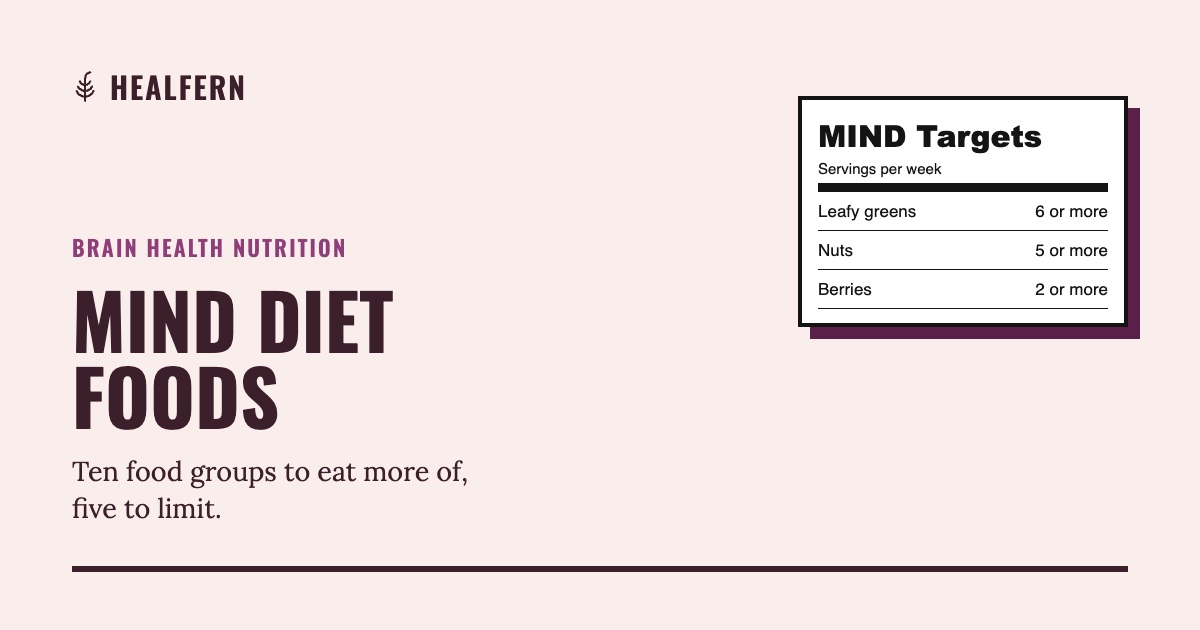
The MIND diet scores 10 brain-healthy food groups: green leafy vegetables, other vegetables, nuts, berries, beans, whole grains, fish, poultry, olive oil and wine.[3] Each group has a weekly or daily target, and you earn a full point for meeting it. Here are the targets from the 2015 scoring table by Martha Clare Morris and colleagues at Rush University.
| Food group | Target for a full point | Examples in the original study |
|---|---|---|
| Green leafy vegetables | 6 or more servings a week[3] | Kale, collards, spinach, lettuce or salad[3] |
| Other vegetables | 1 or more servings a day[3] | Peppers, carrots, broccoli, tomatoes, squash, green beans[3] |
| Berries | 2 or more servings a week[3] | Strawberries in the 2015 questionnaire[3]; the 2023 trial supplied blueberries[2] |
| Nuts | 5 or more servings a week[3] | Not itemized; the 2023 trial supplied mixed nuts[2] |
| Beans | More than 3 meals a week[3] | Beans, lentils, soybeans[3] |
| Whole grains | 3 or more servings a day[3] | Not itemized in the scoring table[3] |
| Fish, not fried | 1 or more meals a week[3] | Fresh fish as a main dish, tuna sandwich[3] |
| Poultry, not fried | 2 or more meals a week[3] | Chicken or turkey[3] |
| Olive oil | Your main cooking oil at home[3] | Olive oil[3] |
| Wine | 1 glass a day[3] | Optional; see the safety section[10] |
Fruit other than berries is not scored at all. The authors chose berries because studies of fruit overall found no link with cognitive decline, while animal studies and one large cohort pointed to berries specifically.[3]
Which foods does the MIND diet limit?
The diet scores five food groups to limit: red meat, butter and stick margarine, cheese, pastries and sweets, and fried or fast food.[3] You get a full point for staying under each limit, so the total score runs from 0 to 15.[3]
| Food group | Limit for a full point |
|---|---|
| Red meat and meat products | Fewer than 4 meals a week[3] |
| Butter and stick margarine | Less than 1 tablespoon a day[3] |
| Cheese | Less than 1 serving a week[3] |
| Pastries and sweets | Fewer than 5 servings a week[3] |
| Fried or fast food | Less than once a week[3] |
Partial credit exists for every group. Eating red meat 4 to 6 times a week, for example, earns half a point instead of zero.[3] In the Alzheimer’s study, people with middle scores also had a lower rate of the disease than people with the lowest scores.[4]
Why does the MIND diet single out berries and leafy greens?
Because the dementia research available in 2015 pointed at those two groups more than at fruit or vegetables in general. The Rush team built the score from foods with the most consistent links to slower cognitive decline, and fruit as a whole did not make the cut while berries did.[3]
The berry evidence comes mostly from one large cohort. In the Nurses’ Health Study, researchers measured cognition in 16,010 women aged 70 and older and compared it with diet records collected every four years since 1980. Women with the highest blueberry and strawberry intake declined more slowly, by an amount the authors equated to roughly 1.5 to 2.5 years of aging.[14] Higher intake of anthocyanidins, the pigments that make berries blue and red, tracked the same way.[14]
That is an observational finding in women only, and the authors described berries as appearing to delay cognitive aging, not proving it.[14] The 2023 trial took the idea seriously anyway and shipped 2.5 cups of blueberries a week to the MIND group, which is why berries sit in the diet at 2 servings a week rather than as a daily target.[2][3]
Leafy greens get the highest weekly target of any food group, 6 servings, and the scoring examples are ordinary ones: kale, collards, spinach, lettuce and salad.[3] Nothing exotic is required, and frozen spinach counts the same as fresh for scoring purposes.[3]
The general lesson is that MIND is specific on purpose. Where the Mediterranean pattern says fruit and vegetables, MIND names the two subgroups that had data behind them and leaves the rest unscored.[1][3]
How is the MIND diet different from the Mediterranean and DASH diets?
MIND borrows most of its foods from the other two but is more specific about a few of them. NIA describes it as a hybrid that features leafy greens, berries over other fruit, whole grains, beans, nuts, weekly fish and olive oil, and limits red meat, sweets, cheese, butter and fried food.[1]
DASH was designed to lower blood pressure. The NHLBI plan sets sodium at 2,300 mg a day and notes that 1,500 mg lowers blood pressure even further. It also allows 5 or fewer servings of sweets a week.[7] NIA notes that several studies suggest treating high blood pressure may help reduce dementia risk.[1]
The Mediterranean diet stresses fruit, vegetables, whole grains, legumes, seafood and olive oil, with little red meat or sweets.[1] MIND narrows the vegetable advice to leafy greens and the fruit advice to berries, based on the dementia research available in 2015.[3]
In a 2025 meta-analysis of 12 cohort studies, MIND was the only one of the three diets with a statistically clear link to lower dementia risk when the top and bottom adherence groups were compared.[5]
Does the MIND diet lower dementia risk? What did the trial find?
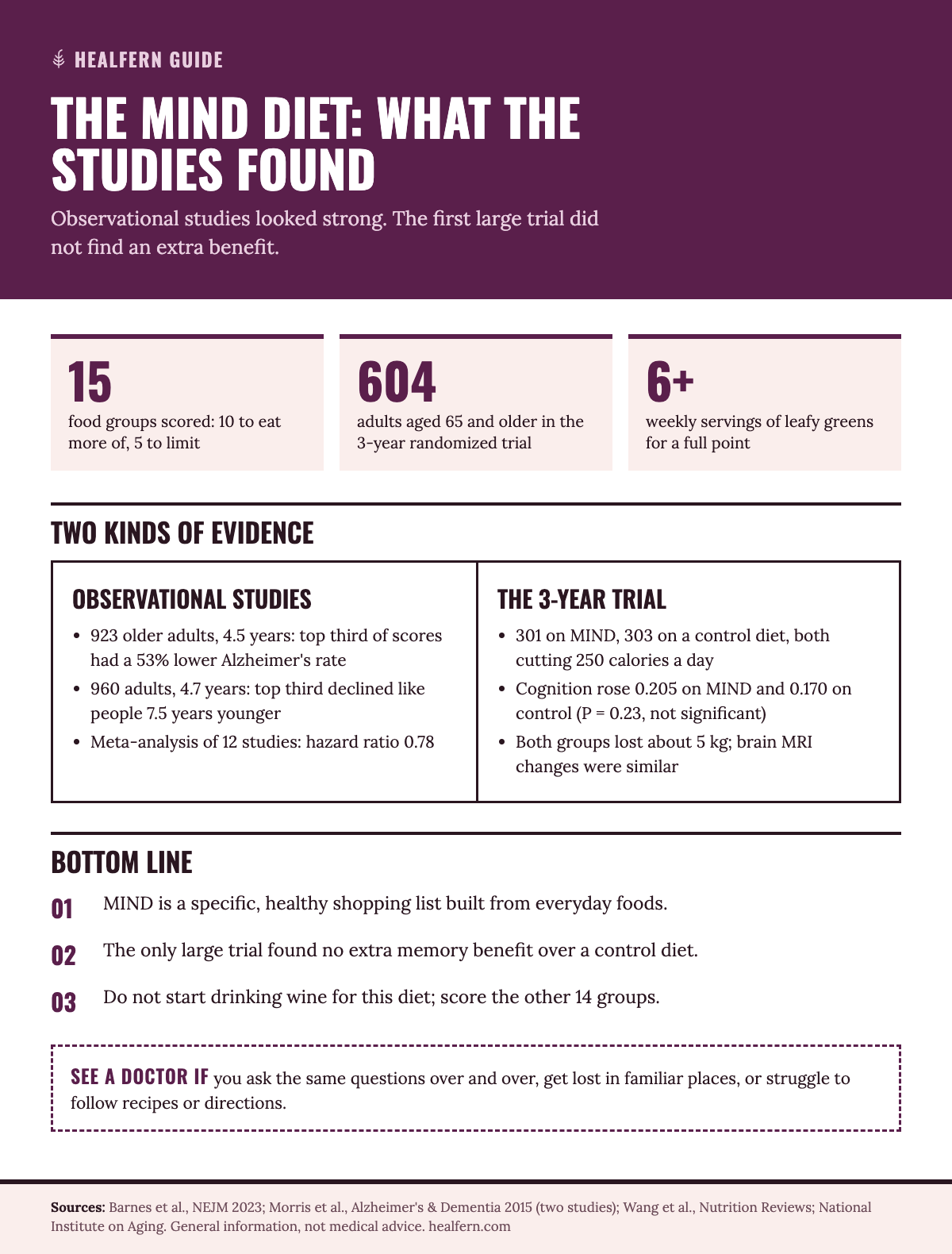
The one large randomized trial did not show an extra benefit. Over three years, people on the MIND diet and people on a control diet both improved slightly on memory and thinking tests, and the difference between the groups was too small to rule out chance.[2]
The trial, led by Lisa Barnes at Rush and published in the New England Journal of Medicine in 2023, enrolled 604 adults aged 65 or older. All were overweight, had a family history of dementia and ate a less healthy diet at the start. 301 were assigned to the MIND diet and 303 to a control diet, and both groups were asked to eat 250 fewer calories a day.[2]
The MIND group received weekly supplies of blueberries (2.5 cups), mixed nuts (5 oz) and extra virgin olive oil (14 tablespoons). Blood tests for carotenoids in a subgroup supported that they changed how they ate. 93.4% of participants finished.[2]
Global cognition scores rose by 0.205 units in the MIND group and 0.170 units in the control group. The difference, 0.035 units, was not statistically significant (P = 0.23). Brain MRI measures, including hippocampal volume, also changed about the same in both groups.[2]
Both groups lost weight, about 5.0 kg on MIND and 4.8 kg on the control diet.[2] Both groups also got diet counseling and support for weight loss, which may be part of why both improved. The authors noted that a longer period of adherence might be needed to see an effect.[2] NIA summarizes the result as small improvements similar to the control diet.[1]
Why did earlier studies look so much better?
The early MIND results came from observational studies, which can show a link but not prove cause. People who already eat well tend to differ in many other ways, and the trial was the first test that assigned the diet at random.[2][3]
In 2015, the Rush team followed 923 people aged 58 to 98 for an average of 4.5 years. Those in the top third of MIND scores had a 53% lower rate of Alzheimer’s disease than the bottom third, and the middle third had a 35% lower rate.[4] In 960 people followed for 4.7 years, the top third declined as if they were 7.5 years younger.[3] The authors wrote that a diet trial would be needed to confirm the finding.[3]
Later reviews kept finding links. A 2025 systematic review of 39 studies from 14 countries found 10 of 11 studies on dementia or Alzheimer’s risk showed a favorable association, but called trial results mixed.[6] NIA also describes an autopsy study of about 600 older adults, average age at death 91, in which people who had followed a MIND or Mediterranean diet showed less Alzheimer’s pathology.[1]
| Study | Who and how long | Design | Result |
|---|---|---|---|
| Barnes, 2023, NEJM | 604 adults 65 and older, 3 years | Randomized trial, MIND versus control, both with mild calorie cut | No significant difference in cognition or brain MRI[2] |
| Morris, 2015, Alzheimer’s study | 923 adults aged 58 to 98, 4.5 years | Observational cohort | Top third of scores: 53% lower Alzheimer’s rate[4] |
| Morris, 2015, decline study | 960 older adults, 4.7 years | Observational cohort | Top third declined like people 7.5 years younger[3] |
| Wang, 2025, meta-analysis | 12 studies, 14 cohorts; 18,328 people for MIND | Pooled cohort studies | Hazard ratio 0.78 for highest versus lowest adherence[5] |
Does the MIND diet hold up outside the United States?
Partly. The first test outside the US, a 12-year Australian cohort of 1,220 adults in Canberra, found that higher MIND scores went with less than half the odds of cognitive impairment (odds ratio 0.47), while two Mediterranean diet scores showed no link.[13] The authors called the result preliminary and asked for prospective studies in more diverse groups.[13]
The study has the same limits as the Rush cohorts. Diet was measured once, from a food questionnaire filled in between 2001 and 2002, and the confidence interval ran from 0.24 to 0.91, so the true effect could be much smaller than the headline number.[13]
The wider picture is mixed but leans the same way. The 2025 systematic review covered 39 studies from 14 countries and found favorable associations in most of the dementia studies, with trial results it described as mixed.[6] In the 2025 meta-analysis, MIND reached a hazard ratio of 0.78 for highest versus lowest adherence across 18,328 people.[5]
So the pattern repeats across countries, which argues against a quirk of one Chicago cohort. It still does not answer the question the trial raised, which is whether assigning people to the diet changes anything.[2][13]
Can the MIND diet help with mood, movement or anything beyond memory?
The data are observational and come mostly from the same Rush cohorts, but they point in a favorable direction. Higher MIND scores have been linked with fewer depressive symptoms over time and with a lower rate of parkinsonian signs in older adults. No trial has tested either outcome.[17][18]
Mood
In 709 older adults with an average age of 80, followed for about 6.5 years, people in the top third of MIND scores and the top third of DASH scores had lower rates of depressive symptoms than people in the bottom third. A Western-style diet went the other way.[18] The authors said a diet trial would be needed to sort out which foods matter.[18]
Movement
In 706 adults aged 59 to 97 who were free of parkinsonism at the start, higher MIND scores went with a lower risk of developing two or more parkinsonian signs over 4.6 years (hazard ratio 0.89) and a slower rate of progression. The DASH diet was not linked with either outcome, and the Mediterranean diet only marginally with progression.[17]
Everything else
A 2025 scoping review gathered 47 studies on MIND and outcomes other than cognition and heart disease, 46 of them observational, across 18 topics. About 65% reported a favorable association and about a third found none. One Italian study found that higher MIND adherence came with higher exposure to cadmium, a heavy metal that plant foods can absorb from soil.[19] The reviewers asked for more research on that exposure and on how to help people adopt the diet.[19]
Treat these as reasons the diet is unlikely to hurt and might help in several ways, not as a prescription for depression or Parkinson’s disease, which need a doctor.[9][18]
Is the MIND diet safe, and who should be careful?
For most adults the MIND diet is a set of ordinary, healthy foods, and the trial reported a similar number of adverse events in both groups: 127 on MIND and 153 on the control diet.[2] The main caution is the wine.
The original score gives a full point for one glass of wine a day and zero for none.[3] That does not mean non-drinkers should start. MedlinePlus defines moderate drinking as no more than 1 drink a day for women and 2 for men, with 5 oz of wine counting as one drink, and lists cancer, accident and heart risks from drinking. Drinking during pregnancy can harm the baby.[10] If you do not drink, skip that line and score the other 14.
Talk with your health care provider before a big change if you have a medical condition or a special diet, as NIA advises.[1]
See a doctor soon if memory problems show up as:[9]
- Asking the same questions over and over.[9]
- Getting lost in places you know well.[9]
- Trouble following recipes or directions.[9]
- Growing confusion about time, people and places, or not taking care of yourself.[9]
NIA notes that some memory problems come from treatable causes, including thyroid, kidney or liver problems, medication side effects, depression, sleep problems and low vitamin B12.[9] Our guide to brain fog causes covers several of these.
Who is the MIND diet for, and who should adjust it?
It suits most adults who want a clear shopping list, and it was built for people aged 58 and older in the original cohorts.[3][4] A few groups should adjust it: older adults who need more protein and vitamin B12, people watching iron or calcium, people trying not to gain weight, and anyone who should not drink.[10][15][16]
Older adults
NIA’s meal planning advice for older adults fits MIND well but adds two things the score ignores. To hold on to muscle, it suggests protein at each meal from seafood, dairy, fortified soy, beans, peas and lentils.[16] It also suggests foods fortified with vitamin B12, such as some cereals, or a talk with your doctor about a B12 supplement, since low B12 is one of the treatable causes of memory trouble NIA lists.[9][16] Seasoning with herbs and citrus instead of salt, drinking water through the day and skipping sugary drinks round out the list.[16]
Iron, calcium and weight
MedlinePlus flags three concerns with Mediterranean-style eating that apply to MIND too. Fats from olive oil and nuts can add weight if portions grow. Iron can run low with little red meat, so pair plant iron with vitamin C foods. Calcium can drop when dairy is cut, and MIND’s limit of less than one cheese serving a week pushes that way, so ask your provider whether you need a calcium source or supplement.[3][15]
In the trial, both groups were asked to cut 250 calories a day and both lost about 5 kg, so weight gain was not a problem there, but those participants had counseling and measured portions.[2]
Who should skip the wine line
MedlinePlus says to avoid wine if you are prone to alcohol overuse, pregnant, at risk for breast cancer, or have a condition alcohol could worsen.[15] That matches the advice above: score 14 groups and leave the fifteenth alone.[10]
What do doctors recommend first for brain health?
Diet is one piece. NIA says no approach has yet been proven to stop Alzheimer’s from developing, and a National Academies review found “encouraging but inconclusive” evidence for three steps: managing high blood pressure, staying physically active and cognitive training.[8]
For new or worsening memory trouble, the first step is a medical visit to look for causes that can be treated.[9] NIA also warns against pills or supplements sold as Alzheimer’s prevention, saying they may be unsafe, a waste of money, or both, and could interfere with prescribed treatment.[8]
A short note on supplements. NCCIH says ginkgo has not been shown to prevent or slow dementia; in the GEM study, more than 3,000 people aged 75 or older took ginkgo or a placebo for a median of 6 years with no difference in dementia rates.[11] For omega-3s, NCCIH says people who eat more seafood may have a lower risk of cognitive decline, and a 2022 review of 33 studies suggested a possible protective effect in healthy people, but no effect on cognition in people who already had Alzheimer’s.[12] That supports the fish in MIND more than a fish oil pill. Our look at whether multivitamins work covers the broader supplement question.
How do you start the MIND diet?
Start with the easiest swaps and count your points as you go. Partial credit counts, and middle scores were also linked with lower Alzheimer’s rates in the observational data.[3][4] A simple weekly checklist:
- Eat a leafy green salad or cooked greens most days, aiming for 6 servings a week.[3]
- Add a serving of berries at least twice a week.[3]
- Keep nuts on hand for 5 snack servings a week.[3]
- Plan beans or lentils into more than 3 meals a week.[3]
- Have fish that is not fried at least once a week, and poultry twice.[3]
- Make olive oil your main cooking oil, and keep butter under 1 tablespoon a day.[3]
- Cut fried or fast food to less than once a week, and cheese to less than once a week.[3]
- Check sodium on packaged foods; the DASH side of MIND aims for no more than 2,300 mg a day.[7] Our label reading guide shows where to look.
- Do not add wine if you do not drink.[10]
More food and brain guides are in our brain health nutrition archive and our memory and brain section. Our research method explains how we choose and weigh sources.
The verdict
The MIND diet is a sensible, well-defined way to eat, and the observational data behind it are consistent.[4][5][6] The one large trial, though, found it did no better for memory than a general calorie-cut diet with counseling over three years.[2]
Our judgment call: use MIND as a practical shopping list for healthy eating, especially if the specific targets help you stick with it, but do not expect it to protect your memory on its own. Blood pressure control, regular exercise and a doctor’s visit for real memory changes deserve at least as much of your attention.[8][9]
Questions people also ask
What foods can you eat on the MIND diet?
The diet scores 10 food groups to eat more of: green leafy vegetables, other vegetables, berries, nuts, beans, whole grains, fish, poultry, olive oil and wine. Full-point targets include 6 servings of leafy greens and 2 of berries a week.
What foods are not allowed on the MIND diet?
No food is banned, but five groups are limited: red meat under 4 meals a week, butter under 1 tablespoon a day, cheese and fried or fast food under once a week, and pastries and sweets under 5 servings a week.
Does the MIND diet prevent Alzheimer's disease?
It has not been shown to. Observational studies linked high scores to lower Alzheimer's rates, but a 3-year trial of 604 adults found cognition and brain MRI changes were about the same on the MIND diet and a control diet.
Do I have to drink wine on the MIND diet?
No. The original score counts one glass of wine a day, but MedlinePlus lists cancer, accident and heart risks from drinking. If you do not drink, do not start for this reason. Score the other 14 food groups instead.
How is the MIND diet different from the Mediterranean diet?
MIND combines the Mediterranean and DASH diets and is more specific. It singles out leafy greens among vegetables and berries among fruit, and adds firm limits on butter, cheese, sweets, red meat and fried or fast food.
Does the MIND diet help with depression?
It has been linked with fewer depressive symptoms, not tested for them. In 709 older adults followed for about 6.5 years, the top third of MIND scores had lower rates of depressive symptoms than the bottom third. The authors said a trial is needed, and depression needs a doctor.
Sources
- What do we know about diet and prevention of Alzheimer's disease?, National Institute on Aging (NIH), current page
- Trial of the MIND Diet for Prevention of Cognitive Decline in Older Persons (Barnes et al.), New England Journal of Medicine, 2023
- MIND diet slows cognitive decline with aging (Morris et al.), Alzheimer's and Dementia, 2015
- MIND diet associated with reduced incidence of Alzheimer's disease (Morris et al.), Alzheimer's and Dementia, 2015
- Dietary patterns and risk of dementia in elderly individuals: a systematic review and meta-analysis of cohort studies (Wang et al., abstract), Nutrition Reviews, 2025 online, 2026 issue
- The association between the MIND diet and cognitive health in middle-aged and older adults: a systematic review (Tse et al., abstract), Journal of Nutrition, Health and Aging, 2025
- DASH eating plan, National Heart, Lung, and Blood Institute (NIH), current page
- Preventing Alzheimer's disease: what do we know?, National Institute on Aging (NIH), current page
- Memory problems, forgetfulness, and aging, National Institute on Aging (NIH), current page
- Alcohol use and safe drinking, MedlinePlus, National Library of Medicine, current page
- Ginkgo, National Center for Complementary and Integrative Health, updated 2025
- Omega-3 supplements: what you need to know, National Center for Complementary and Integrative Health, current page
- MIND not Mediterranean diet related to 12-year incidence of cognitive impairment in an Australian longitudinal cohort study (Hosking et al., abstract), Alzheimer's and Dementia, 2019
- Dietary intakes of berries and flavonoids in relation to cognitive decline (Devore et al., abstract), Annals of Neurology, 2012
- Mediterranean diet, MedlinePlus, National Library of Medicine, current page
- Healthy Meal Planning: Tips for Older Adults, National Institute on Aging (NIH), current page
- MIND diet associated with reduced incidence and delayed progression of parkinsonism in old age (Agarwal et al., abstract), Journal of Nutrition, Health and Aging, 2018
- DASH and MIND diets are associated with fewer depressive symptoms over time (Cherian et al., abstract), Journals of Gerontology Series A, 2021
- Associations of the MIND diet with human health outcomes: a scoping review (Morgan et al., abstract), Nutrients, 2025
This article is general information, not medical advice. These statements have not been evaluated by the FDA, and supplements are not intended to diagnose, treat, cure or prevent any disease. Talk to your doctor or pharmacist before you start a supplement. How we research.