Brittle nails are usually caused by outside damage: repeated wetting and drying, detergents, nail polish remover and gel or acrylic nails. About 20% of people have them, and women get them twice as often as men. Less often the cause is psoriasis, nail fungus, thyroid disease, low iron or a medicine. Gloves, moisturizer and short nails come first; see a doctor for color changes or pain.
What causes brittle nails is usually outside damage to the nail: repeated wetting and drying, harsh removers and artificial nails. Less often the cause is a skin disease, a fungal infection, a thyroid problem or a medicine. We read a 2020 dermatology review of brittle nails, the NIH biotin fact sheet, three American Academy of Dermatology guides, the Mayo Clinic nail guide and five treatment studies, following how we research health topics.[1][10][4][7]
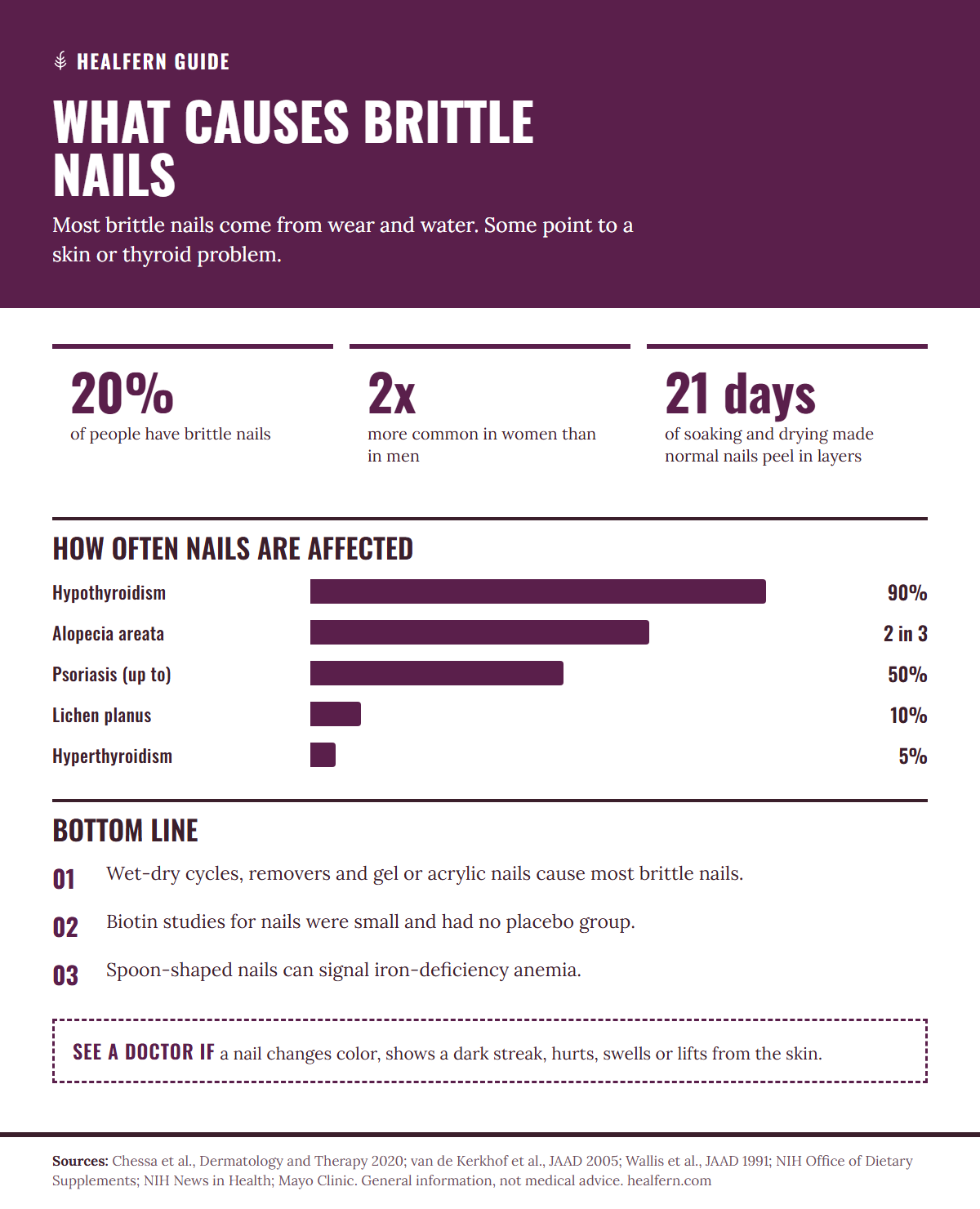
Brittle nails affect about 20% of people, and women get them about twice as often as men.[2] In most cases no disease is behind them, and the first fix is protecting the nail from water and chemicals.[15][1]
| What it is | Nails that split, peel, chip or break easily. Doctors call it brittle nail syndrome or nail fragility.[1] |
|---|---|
| How common | About 20% of people, twice as often in women, and most often in women over 50[2][1] |
| Most common causes | Repeated wetting and drying, detergents and solvents, nail polish remover, artificial nails and age[1][3][6] |
| Medical causes | Psoriasis, lichen planus, eczema, nail fungus, thyroid disease, anemia and some medicines[1] |
| Nutrition link | Low iron or zinc can play a part; biotin deficiency is rare[1][10] |
| First step | Gloves for wet work, moisturizer after washing, acetone-free remover and short nails[4][7][1] |
| See a doctor if | Color change, a dark streak, pain, swelling, a lifting nail or spoon-shaped nails[7][9] |
What causes brittle nails?
Most brittle nails come from damage to the nail plate after it has grown, through water, chemicals and daily wear. A smaller group starts at the nail matrix, the growing area under the cuticle, where skin disease, thyroid problems, poor circulation or some medicines produce a thinner, weaker nail.[1]
A 2020 review in Dermatology and Therapy sorts brittle nails into two groups.[1] The primary form, called idiopathic brittle nail syndrome, has no clear cause beyond age and wear. The secondary form has a cause you can name.
- Trauma and hydration changes: wet work, solvents, manicure products and using nails as tools[1][4]
- Inflammatory skin disease: psoriasis, lichen planus, eczema and alopecia areata[1]
- Infection: mainly nail fungus[1]
- Systemic illness: thyroid disease, chronic anemia and poor circulation[1]
- Medicines: cancer drugs, retinoids and antiretrovirals[1]
Nail problems make up about 10% of all skin conditions, and almost any nutritional deficiency can affect how nails grow.[14] Not every nail change is a warning sign. MedlinePlus says vertical ridges are harmless, and our guide to white spots on nails explains another common one.[8] You can find more in our nail health guides.
What does brittle nail syndrome look like?
Brittle nails usually show one of four patterns: layers peeling at the tip, lengthwise splits, rough white flaking on the surface, or edges that wear down. The pattern hints at the cause, so it helps to note which one you have before you see a doctor or change your routine.[1]
- Onychoschizia: the free edge splits into thin horizontal layers, like pages of a book. It comes from weak glue between nail cells.[1]
- Onychorrhexis: lengthwise splits and shallow grooves along the nail, common in middle-aged women. Deep splits can hurt.[1]
- Superficial granulation of keratin: rough, white, flaky patches on top of the nail, often after months of nail polish.[1]
- Worn-down nails: edges ground away by repeated friction or habits.[1]
Fingernails are affected more often than toenails.[1] A 2005 review found that many patients describe brittle nails as painful, and that they can get in the way of daily tasks and work.[2]
Which cause fits your nails?
The quickest way to narrow down the cause is to match what you see to the most likely trigger. Use the table below as a starting point, then confirm with a doctor if your nails show color changes, pain or skin changes, or if they do not improve after a few months of better care.[1][7]
| What you notice | Likely cause | First step |
|---|---|---|
| Layers peeling at the tip, worse with lots of handwashing | Repeated wetting and drying, detergents[3][1] | Gloves for wet work, moisturizer after washing[4][7] |
| Peeling or cracking after gel or acrylic nails | Filing, chemicals, acetone soaks and frequent fills[5] | A break from artificial nails; soak-off gel over acrylic[5] |
| Rough white patches after months of polish | Superficial granulation of keratin[1] | Polish-free weeks and an acetone-free remover[7] |
| Spoon-shaped nails that scoop inward | Possible iron-deficiency anemia[9] | A doctor visit and blood test before taking iron[1] |
| Thin, brittle, slow-growing nails | Possible thyroid disease or anemia[1][8] | Ask a doctor about a check-up[1] |
| Pits, rough nails or scaly skin nearby | Psoriasis, lichen planus, eczema or alopecia areata[1] | See a dermatologist[1] |
| White chalky spots or a thick, crumbly tip | Nail fungus[1] | Get the fungus confirmed before treating it[1] |
Why are my nails brittle and peeling?
Peeling nails are most often caused by repeated wetting and drying, which loosens the bonds between the layers of nail cells. Washing dishes, cleaning, frequent handwashing and jobs that keep hands wet all add to the damage over weeks and months, and the American Academy of Dermatology says too much water can make nails split, peel or break.[1][4]
In a 1991 lab study, researchers soaked and dried normal fingernail clippings over and over. After 21 days of that cycle, the clippings showed the same layered peeling seen in onychoschizia, and peeling appeared only after repeated soaking and drying.[3]
Hairdressers, nurses, cleaners and homemakers face the most wet work. Solvents used by painters, photographers and lab staff can dissolve the fats that hold nail cells together. Even wearing tight gloves over wet hands can leave nails split and fractured.[1]
Some researchers have proposed that brittle nails simply hold less water, under 16%. Other studies found no difference in water content between brittle and normal nails, so that idea is still debated.[1]
Why are my nails brittle after a gel manicure?
Gel and acrylic nails can weaken the natural nail, and the American Academy of Dermatology says gel nails can cause brittleness, peeling and cracking. The harm comes from roughening the surface so the product sticks, the chemicals involved, and the acetone soaks or filing used to take the nails off.[5]
Artificial nails need touch-ups every 2 to 3 weeks, and frequent touch-ups can seriously damage natural nails.[5] The AAD does not recommend artificial nails for people who already have brittle nails. It also warns that covering up brittle or damaged nails can make the problem worse.[6][5] If you still want gel nails, the AAD suggests soak-off gel over acrylic, since gel is more flexible.[5]
Plain polish does not change the nail’s acidity, which stays near pH 5.8. Months of polish layered over old coats can still leave rough white patches on the surface.[1] Most removers contain chemicals that dry the nail. The AAD suggests a moisturizer afterward, and Mayo Clinic suggests using remover less often and choosing one without acetone.[6][7]
Are brittle nails a sign of vitamin deficiency?
Brittle nails can come with low iron, zinc or biotin, but a deficiency is not the usual cause. The 2020 review describes brittle nails in deficiency and illness as a non-specific sign that sits alongside other symptoms, so a nail change alone does not tell you which nutrient, if any, is low; a blood test can.[1]
Iron
Nails that scoop inward like a spoon, called koilonychia, can be a sign of iron-deficiency anemia.[9] For ordinary brittle nails, studies tying them to low iron are rare. The review says iron plus vitamin C may help when ferritin, the body’s iron store, is below 10 ng/ml.[1] Get tested before you take iron.
Zinc
Zinc deficiency is a known cause of fragile nails. The review notes that 20 to 30 mg of zinc a day over a long period seems to help, but that evidence is small and old.[1]
Biotin
Brittle nails are one sign of biotin deficiency, which is rare.[10] The NIH says the biotin research for nails is three small studies with no placebo group. In one, 41 of 45 people (91%) taking 2.5 mg a day had firmer nails.[10] If you are weighing a general supplement instead, see our look at whether daily multivitamins work.
Are brittle nails a sign of hypothyroidism?
Brittle nails can be a sign of hypothyroidism, an underactive thyroid, but they are one clue among many and not a test for it. The 2020 review reports that nails are affected in 90% of people with hypothyroidism, and that they tend to be thin, brittle and slow-growing, often with lines running along or across them.[1]
An overactive thyroid can do it too. About 5% of people with hyperthyroidism get soft, brittle nails, and these often recover once the thyroid is treated.[1]
Other illnesses can show up in the nails. MedlinePlus notes that changes in nail growth can point to lung, heart, kidney and liver disease, diabetes and anemia.[8] Chronic anemia and poor circulation can cut blood flow to the nail matrix, which then makes a thinner nail.[1]
If your nails changed along with other new symptoms, ask your doctor whether a thyroid blood test makes sense. Tell them about any biotin you take, because a single 10 mg dose has interfered with thyroid test results.[10]
Can skin conditions or nail fungus cause brittle nails?
Yes. Psoriasis, lichen planus, eczema, alopecia areata and nail fungus can all make nails brittle, because they damage the nail as it forms or eat into its surface. These causes often leave other clues, such as pits, color changes, thickening or a rash on the skin nearby, which help a dermatologist tell them apart.[1]
How often each condition reaches the nails varies a lot, according to the 2020 review:[1]
- Psoriasis: up to 50% of patients have nail changes, often with pits and a brittle edge.
- Alopecia areata: about two in three patients have nail changes, including splitting and thinning.
- Lichen planus: about 10% have nail involvement, with thinning and splits.
- Eczema around the nails, from allergies or irritants, often comes with fragile nails.
Fungus is the other big one. Superficial white fungus leaves chalky, crumbly white spots on top of the nail, while fungus that starts at the tip makes the free edge brittle.[1] If thick or crumbly toenails are your main problem, our guide on how to get rid of toenail fungus covers the treatment options.
Why do nails get more brittle with age and menopause?
Nails tend to get more brittle with age, and women over 50 are affected most. The fats that hold nail cells together drop as you age, especially after menopause, and the bonds between nail cells are naturally weaker in women than in men, which helps explain why women report the problem about twice as often.[1][2]
Normal nails are about 5% fat. One of those fats, cholesterol sulfate, falls with age, most of all in women after menopause.[1] A 2012 review notes that brittle nails are common in older adults and that most cases have no other cause.[15]
Length matters too. Longer nails lose moisture faster, so keeping them short helps.[1] For this age-related form, protection and moisture are the main tools, since there is nothing else to treat.
What do doctors use first for brittle nails?
Doctors start by treating any cause they find, then protecting the nail, before they consider supplements. That means looking at the pattern of damage, your work and habits, your skin and your medicines, and checking for fungus, thyroid disease or low iron when other signs point that way.[1][7]
The standard advice in the 2020 review is to limit contact with water and detergents, avoid trauma and irritants, and use emollients regularly.[1] Moisturizers with urea or alpha-hydroxy acids may help the nail hold water. Nail lacquers and hardeners can improve the look of brittle nails, but more data are needed to prove they work. For stubborn cases, wrapping the tip of the nail can protect it.[1]
What the treatment studies show
Most brittle nail trials are small and short, and few have a true placebo group.
| Study | Who and how long | Treatment | Result |
|---|---|---|---|
| Chiavetta, 2019, randomized, assessor-blinded | 50 adults, mean age 64, 4 months | Chitosan nail lacquer, with or without biotin 10 mg | Half or better improvement in 53% (lacquer) vs 80% (lacquer plus biotin)[11] |
| Shemer, 2025, retrospective | 61 adults, 3 months of pills | Biotin 1 mg, pyridoxine 100 mg, or both | Full response 69.6% with both vs 10% biotin and 11.1% pyridoxine[12] |
| Biotin studies summarized by NIH | 45 and 35 patients, months of use | Biotin 2.5 mg a day | 91% and 63% improved; no placebo group[10] |
| Hexsel, 2017, open-label | 25 adults, 24 weeks | Collagen peptides 2.5 g a day | 42% fewer broken nails; no control group[13] |
None of these studies proves a supplement fixes brittle nails. They support a short trial at most, alongside the basics, and only after a doctor has ruled out a medical cause.
When should you see a doctor about brittle nails?
See a doctor when brittle nails come with color changes, pain, swelling or skin changes, or when careful nail care for a few months does not help. Mayo Clinic lists these nail changes as reasons to see your primary care doctor or a dermatologist, because they can point to a condition that needs its own treatment.[7]
See a doctor soon if you notice:
- A color change to the whole nail, or a dark streak under the nail[7]
- Nails that curl, change shape or scoop inward like a spoon[7][9]
- Nails that get thinner or thicker, or that stop growing[7]
- Pits or grooves in the nails[7]
- The nail pulling away from the skin, or bleeding, swelling or pain around it[7]
Check with a doctor before you take iron, zinc or high-dose biotin, especially if you are pregnant, take medicines or have a blood test coming up. Biotin can throw off lab results, and iron is only worth taking if your levels are low.[10][1]
Brittle nail care checklist
Daily habits that cut water, chemical and impact damage are the core of brittle nail care. Run through this list for a few months before you judge the results, because the damaged part of the nail has to grow out first.[1]
- Wear cotton-lined rubber gloves for dishes, cleaning and harsh chemicals.[7][1]
- Rub moisturizer into nails and cuticles after every handwash and after removing polish.[4][6]
- Choose an acetone-free remover and use it less often.[7]
- Keep nails short and file them smooth to stop snags.[1][4]
- Do not use your nails as tools to open cans or scrape labels.[4]
- Take breaks from gel and acrylic nails, and skip them while nails are brittle.[5][6]
- Do not cut or force back your cuticles.[6]
- Tell your doctor about any biotin before a blood test.[10]
Bottom line
Brittle nails are common, and most of the time the cause is the outside world: water, detergents, removers and artificial nails, made worse by age. A thyroid problem, a skin disease, nail fungus or low iron is behind a smaller share, and those usually leave other clues.[1][2]
For most people, gloves, moisturizer and short nails are the better first step than a biotin pill, because the evidence on wet-dry damage is consistent and the biotin studies had no placebo group.[3][10] If your nails change color, hurt or scoop inward, see a doctor before you try supplements.[7]
Questions people also ask
Can dehydration cause brittle nails?
No study we read shows that drinking more water strengthens nails. Researchers still debate whether brittle nails hold less water than normal nails. Outside water is the clearer problem: repeated soaking and drying makes nails peel in layers.
Can brittle nails be a sign of cancer?
Brittle nails on their own are not a known sign of cancer, though cancer drugs can make nails brittle. A dark streak under a nail is different. Mayo Clinic lists it as a reason to see a doctor or dermatologist promptly.
How long do brittle nails take to improve?
Expect months, not weeks, because the damaged part has to grow out. Treatment studies ran for 3 to 6 months before judging results. Keep up gloves, moisturizer and short nails for at least that long before deciding something has failed.
Does collagen help brittle nails?
Evidence is thin. One open-label study gave 25 adults 2.5 grams of collagen peptides daily for 24 weeks and reported 42% fewer broken nails. It had no control group, so the result may not hold up in a placebo-controlled trial.
Sources
- Pathogenesis, Clinical Signs and Treatment Recommendations in Brittle Nails: A Review, Chessa et al., Dermatology and Therapy, 2020
- Brittle nail syndrome: a pathogenesis-based approach with a proposed grading system, van de Kerkhof et al., Journal of the American Academy of Dermatology, 2005
- Pathogenesis of onychoschizia (lamellar dystrophy), Wallis et al., Journal of the American Academy of Dermatology, 1991
- Tips for healthy nails, American Academy of Dermatology
- Artificial nails: Dermatologists' tips for reducing nail damage, American Academy of Dermatology
- Manicure and pedicure safety, American Academy of Dermatology
- Fingernails: Do's and don'ts for healthy nails, Mayo Clinic
- Nail Diseases, MedlinePlus, National Library of Medicine
- Funky Fingertips? What Nails Say About Your Health, NIH News in Health, 2021
- Biotin: Fact Sheet for Health Professionals, NIH Office of Dietary Supplements
- Treatment of brittle nail with a hydroxypropyl chitosan-based lacquer, alone or in combination with oral biotin: a randomized, assessor-blinded trial, Chiavetta et al., Dermatologic Therapy, 2019
- Biotin or Pyridoxine Versus Combined Regimen in the Treatment of Onychoschizia, Shemer et al., Journal of Drugs in Dermatology, 2025
- Oral supplementation with specific bioactive collagen peptides improves nail growth and reduces symptoms of brittle nails, Hexsel et al., Journal of Cosmetic Dermatology, 2017
- Nutrition and nail disease, Muddasani et al., Clinics in Dermatology, 2021
- Management of simple brittle nails, Dimitris and Ralph, Dermatologic Therapy, 2012
This article is general information, not medical advice. These statements have not been evaluated by the FDA, and supplements are not intended to diagnose, treat, cure or prevent any disease. Talk to your doctor or pharmacist before you start a supplement. How we research.