Receding gums do not grow back on their own once gum tissue and bone are lost. Early gum inflammation can reverse with better brushing, flossing and cleanings. A deep cleaning can stop gum disease from pulling the gums back further. A periodontist can cover exposed roots with a gum graft or the pinhole technique. No supplement has been shown to regrow gum tissue.
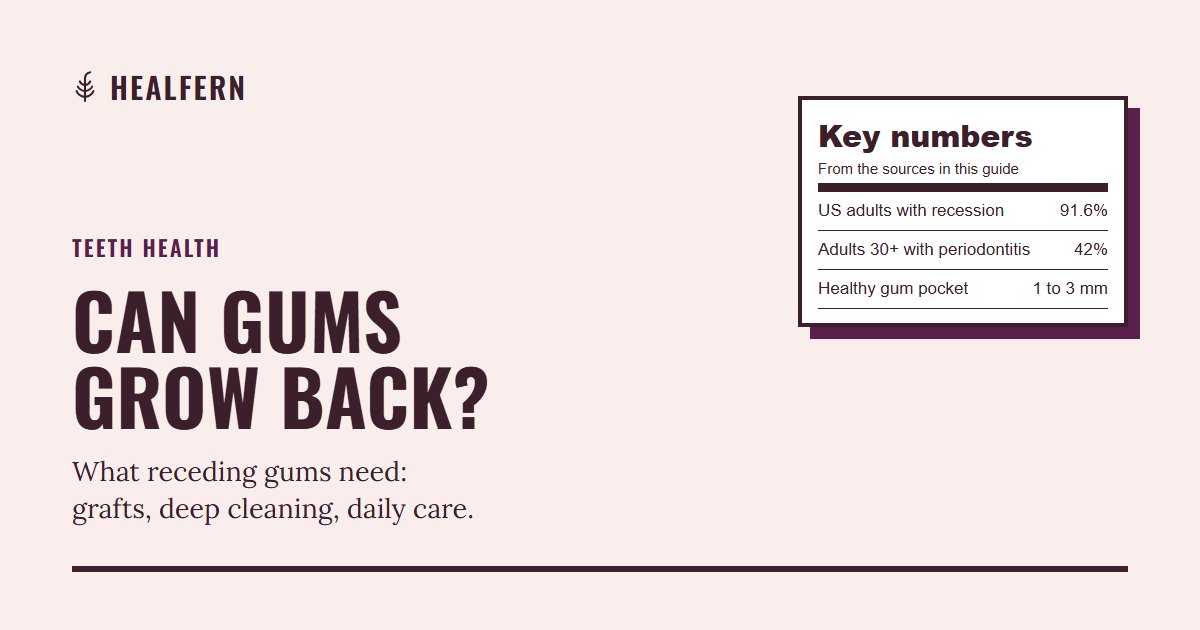
Can receding gums grow back? We read the National Institute of Dental and Craniofacial Research (NIDCR) page on gum disease, the American Academy of Periodontology (AAP) treatment pages, a 2018 Cochrane review of 48 trials, and recent studies on the pinhole technique and oral probiotics to answer that.
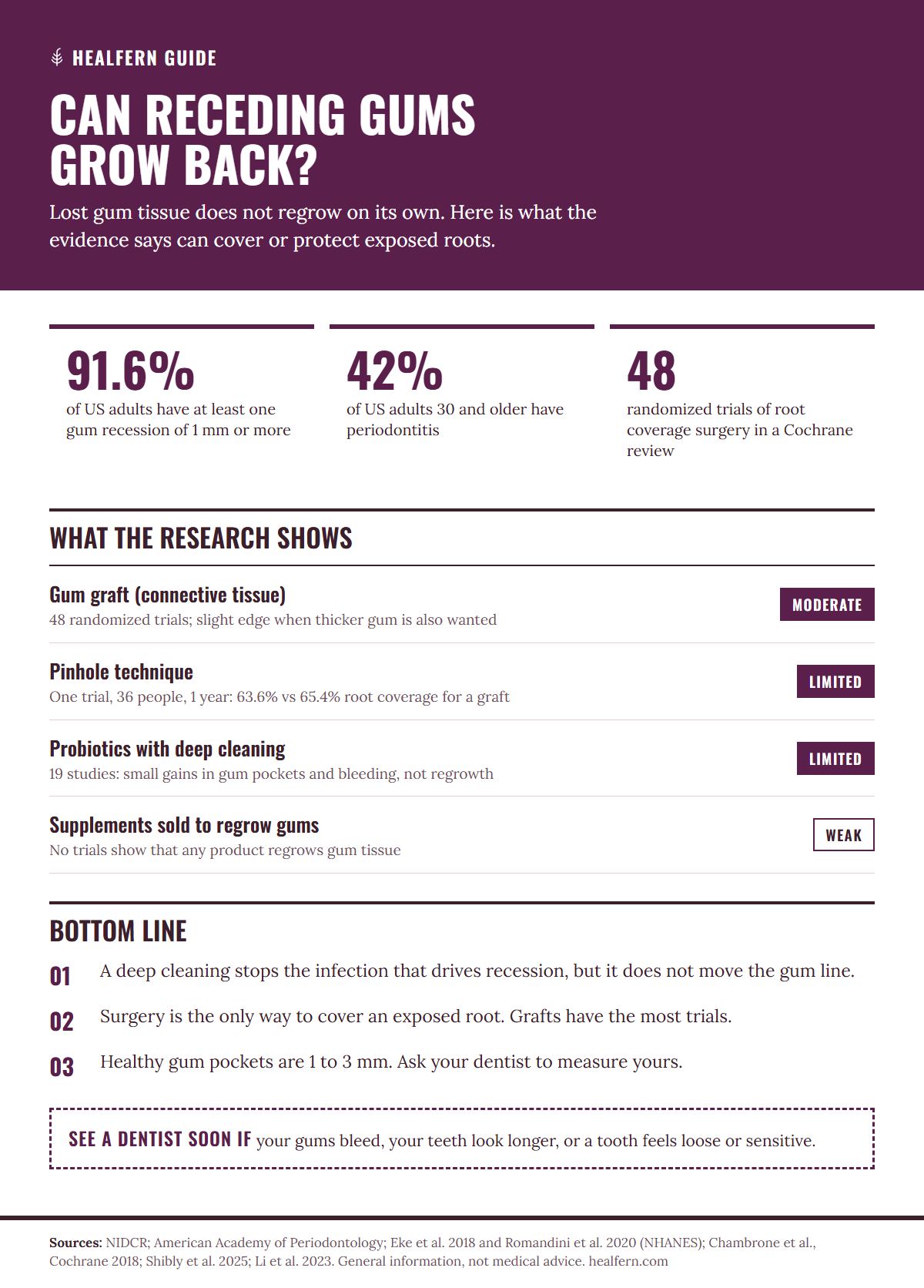
Gum tissue that has pulled back does not grow back on its own, but a periodontist can cover exposed roots with a graft, and good care can stop the recession from getting worse.[5][11]
| What it is | The gum pulls away from the tooth and exposes part of the root, so teeth look longer.[1] |
|---|---|
| How common | 91.6% of US adults had at least one spot of recession of 1 mm or more in national survey data.[8] |
| Main causes | Periodontitis, tobacco, genetics, a thin gum type, and possibly hard brushing.[1][6][9][10] |
| Does it regrow alone? | No. Early gum inflammation can reverse, but lost tissue needs surgery to be covered.[2][5] |
| Best evidence | Connective tissue grafts gave a slight edge in a Cochrane review of 48 trials.[11] |
| Supplements | Probiotics were only studied as an add-on to deep cleaning, with modest results.[13] |
| See a dentist if | Gums bleed, look longer, or teeth feel loose or sensitive.[1][3] |
Can receding gums grow back on their own?
Receding gums do not grow back on their own once the tissue and the bone under it are lost. What can reverse is gingivitis, the early, swollen stage of gum disease. MedlinePlus says you can usually reverse gingivitis with daily brushing, flossing and regular cleanings.[2]
Recession works differently. In periodontitis, the gums pull away from the teeth and form pockets. If it is not treated, the bone, gums and connective tissue that hold the teeth are destroyed.[2] Brushing cannot rebuild that tissue.
The AAP describes gum graft surgery as the way to cover an exposed root once recession has happened.[5] Without surgery, the gum line stays where it is.
What causes receding gums?
The most common driver of receding gums is periodontitis, a bacterial infection that destroys the tissue holding teeth in place. Plaque hardens into tartar, and only a dentist or hygienist can remove tartar.[1] About 42% of US adults aged 30 and older have periodontitis, and 7.8% have the severe form.[7]
Other factors add to the risk:
- Tobacco. NIDCR calls smoking or using tobacco the most significant risk factor. It also slows healing and makes treatment less successful.[1]
- Genetics. The AAP says some people may be more likely to get gum disease despite careful home care.[6]
- Thin gums. A 2018 workshop review found that people with a thin gum type are at greater risk of recession. Braces and fillings near the gum line might also add risk.[10]
- Grinding or clenching. Extra force on the teeth could speed up tissue loss.[6]
- Age. Over 70% of Americans aged 65 and older have some form of gum disease.[6]
Recession is also very common outside of disease. In an analysis of 10,676 adults from national survey data collected in 2009 to 2014, 91.6% had at least one recession of 1 mm or more. Most of the milder recessions measured 1 to 2 mm.[8]
Can receding gums grow back from brushing too hard?
Gums that receded from hard brushing do not grow back either, and the link between brushing and recession is less certain than most people think. A systematic review read 18 studies. Eight found that people who brushed more often had more recession, but none met all the quality criteria. The authors called the evidence inconclusive.[9]
The 2018 workshop review noted that recession shows up in people with both high and low standards of oral hygiene, so a very clean mouth can still have it.[10]
If you scrub hard with a stiff brush, switching to a gentler stroke costs nothing. It will not rebuild the gum line, though it may help keep it from moving further.
Can receding gums grow back naturally with home care?
Home care cannot regrow receded gum tissue, but it is the main thing that keeps recession from getting worse. NIDCR lists four habits: brush twice a day with fluoride toothpaste, clean between the teeth, see a dentist for checkups and cleanings, and quit all tobacco.[1]
For cleaning between teeth, NIDCR names floss, interdental brushes, wooden or plastic picks, or a water flosser recommended by a dental professional.[1]
Food matters too. The AAP says a diet low in key nutrients can weaken the immune response, and obesity may raise the risk of gum disease.[6] Our list of foods good for teeth and gums, and the ones to limit covers that side. Gum disease can also cause persistent bad breath,[1] which we cover in our guide on what causes bad breath and how to get rid of it.
The national data on recession found that people whose last dental visit was more than 6 months earlier were more likely to have recession.[8]
Can receding gums grow back without surgery?
No nonsurgical treatment regrows the gum line, but a deep cleaning called scaling and root planing can stop the infection that drives recession. In scaling, the dentist removes plaque and tartar from below the gum line. Root planing then smooths the root so plaque has a harder time sticking.[4]
The AAP says many patients need no further treatment after this, but most need ongoing maintenance visits to keep the gums healthy.[4] NIDCR adds that the dentist may also prescribe a medicine such as an oral rinse.[1]
Lasers are another option. The AAP says controlled studies show results similar to scaling and root planing alone, and that the wrong laser settings can damage tissue.[4] Neither approach is designed to move the gum margin back over the root.
For a small recession that is not causing problems, monitoring may be the right call. The 2018 workshop review said that when there is no disease, watching specific sites seems to be the proper approach.[10]
How does gum graft surgery cover receding gums?
A gum graft moves tissue from the roof of the mouth or another donor source to cover an exposed root. The AAP says the graft covers the root, helps prevent more recession and bone loss, and may reduce sensitivity and improve the look of the smile.[5] It can be done on one tooth or several.
The best evidence comes from a 2018 Cochrane review. It pooled 48 randomized trials of recessions 3 mm or deeper, followed for at least 6 months.[11] Several methods reduced recession. A connective tissue graft combined with a flap moved toward the crown gave a slight edge when the goal was both root coverage and thicker gum tissue.[11]
The review also had limits. Only one of the 48 trials was at low risk of bias, the evidence was rated low quality, and few trials asked patients what they preferred.[11]
When bone has also been lost to periodontitis, a periodontist may suggest a regenerative procedure. The AAP says membranes, bone grafts or tissue-stimulating proteins can encourage the body to regrow some lost bone and tissue.[5]
Does the pinhole technique work for receding gums?
The pinhole surgical technique matched a standard graft in one small trial, but the evidence base is thin. In this method, the surgeon works through a small hole in the gum and slides the tissue down over the root, instead of cutting a large flap.[12]
A 2025 split-mouth trial treated 36 people with recession on both sides. Each person got a standard flap and connective tissue graft on one side and the pinhole technique with a collagen membrane on the other.[12] After 1 year, recession shrank by 1.98 mm with the graft and 1.97 mm with pinhole. Root coverage averaged 65.4% and 63.6%.[12] The difference was not significant.
The trial was small, and one of its authors is the dentist who developed the pinhole method.[12] The graft side also gained more thick gum tissue.[12] Pinhole is a fair option to discuss with a periodontist, though it rests on far less evidence than grafting.
Do oral probiotics or gum regrowth supplements help receding gums?
No supplement, probiotic or oil has been shown to regrow receded gum tissue. The research on probiotics looks at a different question: whether they help when added to a professional deep cleaning for periodontitis.[13]
A 2023 meta-analysis of 19 studies found that probiotics taken with scaling and root planing were linked to better probing depth, attachment levels and bleeding scores. The authors said probiotics can somewhat improve outcomes and that more standardized trials are needed.[13]
Those were modest gains in people who also had the deep cleaning, which gives no support to products sold as a way to regrow gums without a dentist.
Be careful with home tray products too. The AAP notes that the FDA cleared tray delivery systems, but that clearance did not show any specific medicine used in them is a safe or effective treatment for gum disease.[4]
Which treatments have evidence for receding gums?
Surgical root coverage has the most trial evidence, while supplements have none for regrowing tissue. This table sums up the main studies we read.
| Study | Who and how many | What was compared | Result |
|---|---|---|---|
| Cochrane review, 2018[11] | 48 RCTs, recessions of 3 mm or more, 6 months or longer | Different root coverage surgeries | All can be used; connective tissue grafts slightly better when thicker gum is also wanted. Low quality evidence. |
| Shibly et al., 2025[12] | 36 adults, split mouth, 1 year | Pinhole with collagen membrane vs flap with connective tissue graft | 1.97 vs 1.98 mm less recession; 63.6% vs 65.4% root coverage; no significant difference |
| Li et al., 2023[13] | 19 studies, adults with chronic periodontitis | Probiotics plus deep cleaning vs deep cleaning alone | Small gains in probing depth, attachment and bleeding; more trials needed |
| Rajapakse et al., 2007[9] | 18 studies | Brushing habits and recession | Evidence inconclusive |
What should you do about receding gums? A decision guide
The right step depends on whether there is active gum disease and how much root is exposed. Use this table to prepare for a dental visit. It does not replace an exam.
| If this describes you | Likely next step |
|---|---|
| Red, swollen gums that bleed, with no recession yet | Better daily cleaning plus a professional cleaning. Gingivitis is usually reversible at this stage.[2][3] |
| Recession plus deep pockets, bleeding or bone loss on X-ray | Scaling and root planing first, then maintenance visits.[1][4] |
| Small, stable recession with no pain or sensitivity | Gentle brushing and monitoring of the site at checkups.[10] |
| Exposed root that is sensitive, growing or bothers you | Ask a periodontist about a gum graft.[5] |
| Bone loss from periodontitis around a tooth | Ask about regenerative procedures.[5] |
| You smoke or use tobacco | Quitting improves treatment results.[1] |
When should you see a dentist about receding gums?
See a dentist soon if your teeth look longer or your gums bleed, because gum disease is usually painless in its early stages. The ADA says you may not know you have it.[3]
Book a visit right away if you notice any of these:
- Gums that bleed easily or are red, swollen or tender[1][3]
- Gums that have pulled away from the teeth[3]
- Loose or sensitive teeth, or pain when you chew[1]
- A change in how your teeth fit together when you bite[3]
- Bad breath or a bad taste that will not go away[1][3]
Tell your dentist about your medicines. The ADA lists steroids, some anti-seizure drugs, some calcium channel blockers and oral contraceptives as factors that can raise gum disease risk.[3] Diabetes and pregnancy are on the list too.[3] Exposed roots can also become sensitive and are linked with root decay and wear near the gum line.[10]
What do dentists use first for receding gums?
Dentists treat the cause first, which usually means controlling infection with a deep cleaning and better daily care. NIDCR says the main goal of treatment is to control the infection. Advanced cases may need surgery, and any treatment depends on good home care.[1]
A dentist measures the pockets around each tooth with a small probe. Healthy pockets are usually 1 to 3 mm deep, and deeper pockets can point to periodontal disease. X-rays show any bone loss.[1]
Your dentist may refer you to a periodontist, a specialist in gum disease.[1] Surgery to cover roots comes after the infection is under control. A supplement is never a stand-in for this care. You can read how we check health claims in how we research our articles.
Practical checklist for receding gums
- Brush twice a day with fluoride toothpaste, using a soft brush and light pressure.[1]
- Clean between your teeth every day with floss, an interdental brush or a water flosser.[1]
- Get a checkup and cleaning at least every 6 months.[1][8]
- Ask your dentist to record pocket depths so you can track change over time.[1]
- Quit all tobacco, including smokeless forms.[1]
- Mention grinding or clenching to your dentist.[6]
- Skip products that promise to regrow gums. If you try a probiotic, use it alongside dental care, not in place of it.[13]
For more on keeping your mouth healthy, see our teeth health guides.
Bottom line
Receded gum tissue does not grow back on its own, and no supplement or rinse has been shown to change that. What you can control is whether recession keeps going, through a deep cleaning when there is infection, daily care, regular checkups and quitting tobacco.[1][4]
For most people, the better first step is a dental exam with pocket measurements, not a product. If a root stays exposed and bothers you, a gum graft has the strongest trial evidence, and the pinhole method is a reasonable option to discuss with a periodontist.[11][12]
Questions people also ask
Can gums grow back after gingivitis?
Gingivitis does not usually cause lasting gum loss, so there is nothing to regrow. The red, swollen gums of gingivitis can usually return to health with daily brushing, flossing and regular professional cleanings, according to MedlinePlus and the ADA.
How do you regrow receding gums at home?
You cannot regrow receded gum tissue at home. Home care can keep recession from getting worse: brush twice a day with fluoride toothpaste, clean between your teeth daily, avoid tobacco and keep regular dental cleanings. Covering an exposed root takes a periodontal procedure.
How common are receding gums?
Very common. In US national survey data from 2009 to 2014 covering 10,676 adults, 91.6% had at least one spot where the gum had receded 1 mm or more. Most milder recessions measured 1 to 2 mm.
Are receding gums always caused by gum disease?
No. Periodontitis is a major cause, but recession also shows up in people with very good oral hygiene. A thin gum type, past braces, fillings near the gum line, grinding and possibly hard brushing can all play a part.
Can receding gums grow back with treatment?
Surgery can cover exposed roots, which is the closest thing to regrowth. Gum grafts and the pinhole technique both reduced recession in trials, with root coverage averaging about 64% to 65% after one year in a 2025 study of 36 adults.
Sources
- Periodontal (Gum) Disease, National Institute of Dental and Craniofacial Research (NIH), reviewed 2026
- Gum Disease, MedlinePlus, National Library of Medicine
- Gum Disease, American Dental Association, MouthHealthy
- Non-Surgical Treatments, American Academy of Periodontology
- Surgical Procedures, American Academy of Periodontology
- Gum Disease Risk Factors, American Academy of Periodontology
- Periodontitis in US Adults: National Health and Nutrition Examination Survey 2009-2014, Eke et al., Journal of the American Dental Association, 2018
- Epidemiology of mid-buccal gingival recessions in NHANES according to the 2018 World Workshop Classification System, Romandini et al., Journal of Clinical Periodontology, 2020
- Does tooth brushing influence the development and progression of non-inflammatory gingival recession? A systematic review, Rajapakse et al., Journal of Clinical Periodontology, 2007
- Mucogingival conditions in the natural dentition: Narrative review, case definitions, and diagnostic considerations, Cortellini and Bissada, Journal of Periodontology, 2018
- Root coverage procedures for treating localised and multiple recession-type defects, Chambrone et al., Cochrane Database of Systematic Reviews, 2018
- Treatment of Gingival Recession Using the Pinhole Surgical Technique With Collagen Membrane Vs Coronally Advanced Flap Technique With Connective Tissue Graft: A Split-Mouth Randomized Clinical Trial, Shibly et al., Compendium of Continuing Education in Dentistry, 2025
- Probiotic adjuvant treatment in combination with scaling and root planing in chronic periodontitis: a systematic review and meta-analysis, Li et al., Beneficial Microbes, 2023
This article is general information, not medical advice. These statements have not been evaluated by the FDA, and supplements are not intended to diagnose, treat, cure or prevent any disease. Talk to your doctor or pharmacist before you start a supplement. How we research.