To get rid of bad breath, clean the places where odor-causing bacteria live: brush twice a day, floss daily and clean your tongue. In a study of 2,000 clinic patients, 76% had a mouth cause, mostly tongue coating and gum disease. Mouthwash only masks the smell for a while. A fruity or ammonia smell needs a doctor.
We read the 2019 Cochrane review of 44 halitosis trials, a study of 2,000 patients seen at a Belgian bad breath clinic, the MedlinePlus entry on breath odor, NIDCR pages on dry mouth and gum disease, and the American Dental Association’s advice for patients. We also checked a 2025 meta-analysis of probiotics.
The short answer: most bad breath starts in the mouth, mainly from bacteria on the tongue and around the gums, so the fix that works is cleaning those places every day and seeing a dentist if the smell lasts[1][3].
| What it is | An unpleasant breath odor, also called halitosis, usually from sulfur compounds made by mouth bacteria[1]. |
|---|---|
| How common | About 50% of adults have had bad breath at some point[2]. |
| Main causes | Tongue coating, gum disease, dry mouth, strong foods, tobacco and some medicines[2][3]. |
| First steps | Brush twice a day for two minutes, clean between teeth daily, and clean dentures every night[2][11]. |
| Best evidence | A Cochrane review of 44 trials found only low to very low certainty evidence for any single product[4]. |
| Safety | Long-term mouthrinse use can stain teeth and change taste[4]. |
| See a doctor if | The smell lasts with no clear cause, or comes with fever, cough or face pain[1]. |
What causes bad breath?
Bad breath usually comes from bacteria in the mouth. When food bits and dead cells are left behind, bacteria break them down and release sulfur compounds that smell foul[1][6]. MedlinePlus says bad breath is usually related to poor dental hygiene, especially skipping brushing and flossing[1].
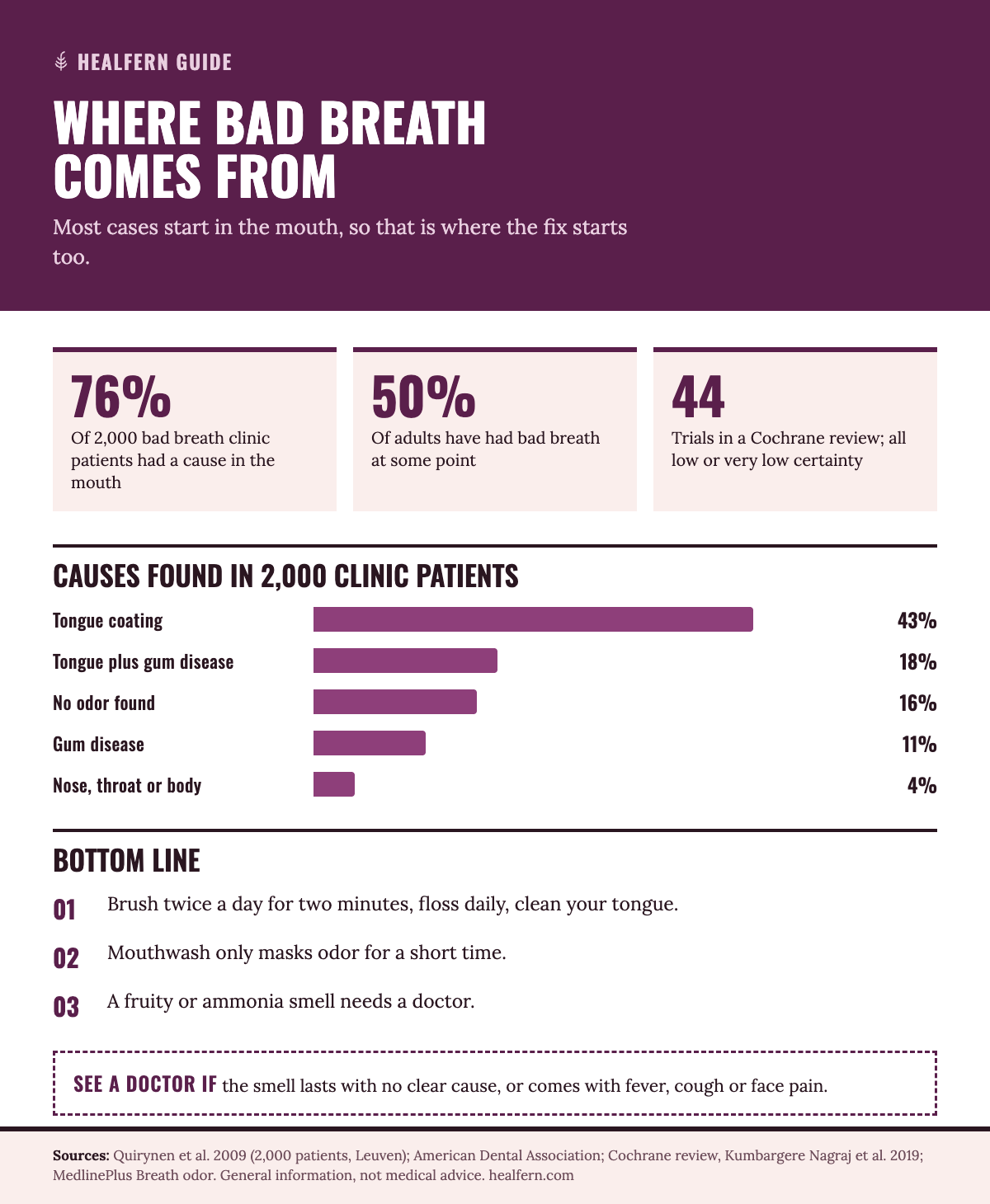
The best breakdown comes from a clinic in Leuven, Belgium, which studied 2,000 consecutive patients who came in about bad breath. An oral cause was found in 76% of them[3]:
- Tongue coating alone: 43%
- Tongue coating plus gum disease: 18%
- Gum disease alone: 11%
- Ear, nose and throat or other body causes: 4%
Another 16% had what doctors call pseudo-halitosis or halitophobia: they were sure their breath smelled, but the clinic found no real odor[3]. Many had lived with the worry for years, an average of 7[3].
Surveys from different countries report bad breath in anywhere from 22% to more than 50% of people. A 2008 review of that research put the share of cases with an oral cause at about 85%, so the mouth is the first place to look[6].
Why does my breath still smell after brushing?
The usual reason is the tongue. Its rough surface traps a coating of bacteria and debris that a toothbrush on the teeth never reaches, and tongue coating was the single biggest cause at the Belgian clinic[3]. Gum disease, dry mouth and tonsil crypts are the next places to check[1][3].
Gum disease
NIDCR lists persistent bad breath as a symptom of gum disease, along with red, swollen or bleeding gums, gums pulling away from the teeth, and loose teeth[8]. The ADA says bad breath that will not go away, or a constant bad taste, can be a warning sign of advanced gum disease[2].
Dry mouth
Saliva washes food away and keeps germs in check. When there is not enough of it, bad breath is one of the symptoms[7]. NIDCR says hundreds of medicines can reduce saliva, including some for high blood pressure, depression and bladder control[7]. Breathing through your mouth can dry it out as well[2].
Tonsils, sinuses and dentures
MedlinePlus lists tonsils with deep crypts and sulfur granules, sinus infections and throat infections as causes, along with dentures, cavities and an abscessed tooth[1]. In young children, an object stuck in one nostril can cause bad breath, often with a discharge from that side[1].
Can tonsil stones cause bad breath?
They can, in some people. Tonsil stones, or tonsilloliths, form in the pits of the tonsils. A 2008 Brazilian study of 49 people with chronic tonsil inflammation and bad breath found a tonsil stone in 75% of those with abnormal breath readings, compared with 6% of those whose readings were normal.[12]
MedlinePlus lists tonsils with deep crypts and sulfur granules among the causes of breath odor.[1] The Brazilian team measured sulfur gases with a meter and counted readings under 150 parts per billion as normal.[12]
What the tonsil study found
Only 8 of the 49 patients, or 16.3%, had abnormal readings, even though all had been referred with bad breath. Their readings were 5.2 times higher than those of the normal group.[12] The authors calculated that having a tonsil stone at the visit meant about a tenfold higher risk of an abnormal reading.[12]
The large share of normal readings echoes the Belgian clinic, where 16% of people who came in about bad breath had no detectable odor at all.[3]
How much weight to give it
This was a small study without a control group, and everyone in it had already been referred for laser treatment of their tonsils.[12] It tells us that tonsil stones and abnormal breath readings go together in that group. It does not tell us how often tonsil stones explain bad breath in the general population.
Ear, nose, throat and other body causes together made up only 4% of cases at the Belgian clinic, while the tongue and gums accounted for most of the rest.[3]
If careful brushing, flossing and tongue cleaning have not helped, ask your dentist or doctor to look at your tonsils and throat.[1][2]
Can food, smoking or medicines cause bad breath?
Yes. Garlic, onions, cabbage and coffee are well-known culprits, and tobacco both causes bad breath and dulls your sense of smell, so smokers may not notice it[1][2]. Tobacco also raises the risk of gum disease, which keeps the smell going[2].
Medicines can cause breath odor even when the mouth is clean. A 2020 systematic review of 34 studies grouped the drugs linked to it into 10 classes, including acid reducers, antidepressants, antihistamines, antifungals, chemotherapy drugs and some dietary supplements[9]. MedlinePlus also lists vitamin supplements, especially in large doses, as a cause[1]. If you take a lot of pills, our guide to whether multivitamins work may help you cut back on ones you do not need.
Do not stop a prescribed medicine because of breath odor. Ask the prescriber whether a change is possible, since NIDCR notes that doctors can sometimes switch drugs or adjust doses[7].
Alcohol use disorder is also on the MedlinePlus list of causes[1].
How do age, dentures and dry mouth affect bad breath?
For older adults, bad breath usually traces back to the same few causes: gum disease, dentures and dry mouth. The National Institute on Aging lists bad breath among the results of untreated periodontitis, and says dentures need daily cleaning to stay free of food that causes stains or bad breath.[15]
Dentures
Brush dentures every day with a denture-care product, soak them in water or a denture-cleansing liquid at night, and leave them out while you sleep to prevent swollen gums.[15] The ADA gives the same advice to take dentures out at night and clean them.[2] As gums change shape over time, dentures may need to be adjusted or replaced, and NIA says to let your dentist handle that.[15]
Dry mouth and medicines
Dry mouth raises the risk of tooth decay and fungal infections of the mouth, according to NIA.[15] NIDCR notes that hundreds of medicines can reduce saliva, so a long medicine list is worth reviewing with your doctor if your mouth feels dry.[7]
When brushing gets harder
Arthritis and other conditions that limit hand movement can make brushing and flossing difficult. NIA suggests an electric or battery-operated toothbrush, a brush with a larger handle, attaching the handle to your hand with a wide elastic band, or using a floss holder.[15]
NIA also advises lightly brushing the tongue or using a tongue scraper, and replacing your toothbrush every three to four months.[15] People living with Alzheimer’s disease or a related dementia often need help with mouth care, and NIDCR publishes tips for caregivers.[15]
How do you get rid of bad breath?
Clean the places where the bacteria live, every day. The ADA advises brushing twice a day for two minutes with fluoride toothpaste, cleaning between the teeth once a day, taking dentures out at night to clean them, and seeing a dentist regularly[2][11]. Add gentle tongue cleaning, because the tongue is the most common source[3].
Beyond that, the steps that help depend on the cause:
- Keep saliva flowing. Chew sugar-free gum, suck sugar-free candy, or eat crunchy foods like carrots and apples[2]. NIDCR suggests 8 to 12 cups of water a day for people with dry mouth[7].
- Quit tobacco. It removes one cause and lowers gum disease risk[2].
- Use a humidifier at night if you wake with a dry mouth[7].
- Freshen short term. MedlinePlus says fresh parsley or a strong mint is often an effective way to fight temporary bad breath[1].
Food choices matter too. Foods that need lots of chewing help saliva flow, and our guide to foods that are good for your teeth covers the rest.
If bad breath lasts despite careful cleaning, book a dental visit. A dentist can find gum disease, cavities or dry mouth and refer you to a doctor if your mouth looks healthy[2].
Do mouthwash, tongue scrapers and probiotics work?
They help a little, for a short time, and the evidence is weak. The 2019 Cochrane review pooled 44 randomized trials with 1,809 people and found only low to very low certainty evidence for every product tested. The reviewers could not say any one method was better than another[4].
Most of these trials scored breath in two ways: a trained judge smelling the breath, which researchers treat as the gold standard, and a meter that reads sulfur gases[4]. Most followed people for only one to four weeks, and just one tracked results for three months[4].
| Method | Evidence | Result |
|---|---|---|
| Tongue scraper or cleaner[5] | 2 trials, 40 people | Sulfur gases fell 40% to 42%, versus 33% with a toothbrush; the effect faded within 30 minutes |
| Tongue cleaning vs none[4] | 2 trials, 46 people | Small drop in odor scores; very low certainty |
| Brushing plus cetylpyridinium mouthwash[4] | 1 trial, 70 people | Better odor scores than brushing alone; low certainty |
| Probiotics[10] | 10 trials | Lower sulfur gases and better odor scores; no change in quality of life; possible publication bias |
Mouthwash has a clear limit. The ADA calls it a temporary solution, and MedlinePlus says mouthwashes do not treat the underlying problem[1][2]. Using a rinse for months can also cause tooth staining, mouth sores, taste changes and odd sensations in the mouth[4].
Probiotics are the main supplement studied. The 2025 meta-analysis found that probiotics worked best when added to standard cleaning, and warned that small trials and possible publication bias limit how much weight to put on the results[10].
Oil pulling, swishing oil around the mouth for up to 20 minutes, is popular online. The ADA says there are no reliable studies showing it improves oral health and does not recommend it[11].
Does treating gum disease get rid of bad breath?
It seems to help. In a 2025 Turkish study of 183 adults, people with periodontitis rated their own breath worst at the start, and four weeks after a nonsurgical deep cleaning their self-rated bad breath dropped significantly. Their sense of taste improved as well.[14]
The study split participants into three equal groups of 61: periodontitis, gingivitis and healthy gums.[14] Everyone was assessed with a visual rating scale before treatment and four weeks after.[14]
More plaque went with worse self-rated bad breath, and deeper gum pockets of 4 mm or more went with poorer taste.[14] After treatment, taste improved in all three groups along with gum health, and smell improved in the healthy and periodontitis groups.[14]
The limits of this study
Breath was rated by the patients themselves, with no trained odor judge and no sulfur meter, the two methods halitosis trials usually rely on.[14][4] The follow-up was also short, at four weeks.[14] The authors say oral hygiene plays an essential role in the improvements and that more research is needed.[14]
What gum treatment involves
NIDCR describes the first step as a deep cleaning called scaling and root planing, sometimes with a medicated rinse, and surgery only for advanced disease.[8] NIA notes that gingivitis can often be fixed with daily brushing and flossing, while periodontitis must be treated by a dentist.[15]
A dental cleaning goes after a cause of bad breath, while a rinse or mint only covers it for a while.[1][2]
Can bad breath come from your stomach?
Sometimes, though less often than many people assume. At the Belgian clinic, only 4% of cases traced to ear, nose, throat or other body causes.[3] Still, a 2016 meta-analysis linked bad breath with H. pylori, a common stomach infection, and found that clearing the infection went with less bad breath.[13]
H. pylori
The meta-analysis pooled 21 studies published in English and Chinese up to 2015.[13] People with bad breath had about four times the odds of having H. pylori in the stomach (odds ratio 4.03). People with the infection had 2.85 times the odds of bad breath.[13]
The most practical finding concerns treatment. Among infected people with bad breath, those whose infection was successfully cleared had much less halitosis afterward than those whose treatment failed (risk ratio 0.17).[13] The authors suggest eradication therapy may help people whose bad breath does not respond to other measures.[13]
These pooled studies show an association. They do not prove that the bacteria cause the smell, and only studies in two languages were included.[13]
Reflux and other stomach problems
The ADA lists gastric reflux among the conditions to check once a dentist has ruled out mouth causes.[2] MedlinePlus adds that breath smelling like feces can come with a bowel blockage and long bouts of vomiting, which needs prompt care.[1]
If your dentist finds a healthy mouth and you also have heartburn, stomach pain or indigestion, ask a doctor whether testing for reflux or H. pylori makes sense. Treatment to clear H. pylori is a decision for your doctor.[2][13]
When is bad breath a sign of something serious?
Most bad breath is harmless, but some odors point to illness elsewhere in the body. MedlinePlus says a fruity smell can be a sign of ketoacidosis in people with diabetes, a potentially life-threatening condition[1]. An ammonia or urine-like smell can occur with chronic kidney failure, and breath that smells like feces can come with a bowel blockage and long bouts of vomiting[1].
The ADA adds sinus problems, gastric reflux, diabetes, and liver or kidney disease to the list of conditions to check once a dentist has ruled out mouth causes[2]. MedlinePlus also lists lung infections, bronchiectasis and some cancers of the esophagus and stomach[1].
See a doctor right away if you notice:
- Fruity-smelling breath, especially if you have diabetes[1].
- Breath that smells like feces, especially with long bouts of vomiting[1].
- Bad breath with fever, cough, or face pain and discharge from the nose[1].
- A smelly, bloody or yellow discharge from one nostril in a child[1].
Make a regular appointment if the odor lasts and there is no obvious cause such as smoking or garlic[1].
What will a dentist or doctor do about bad breath?
Expect questions and an exam of your mouth and nose. MedlinePlus says the provider will ask what the odor smells like, what you have eaten, whether you smoke or take vitamins, and what oral care you already use[1]. A dentist will look for gum disease, cavities, dry mouth and tongue coating[2].
Treatment targets the cause. For gum disease, a dentist may do a deep cleaning called scaling and root planing, prescribe a medicated rinse, or in advanced cases recommend surgery[8]. For dry mouth caused by a medicine, the doctor may change the drug or the dose, or suggest a saliva substitute[7]. A throat culture may be taken for a sore throat, and antibiotics may be prescribed for some infections[1].
If your mouth looks healthy, the dentist may refer you to a primary care doctor[2]. In rare cases, the doctor may order blood tests for diabetes or kidney failure, an upper endoscopy, or chest and abdominal X-rays[1].
Sometimes no odor can be found at all. At the Belgian clinic, 16% of people fell into this group, and the authors concluded that clinics need a team approach that can recognize this as well as mouth, nose and throat causes[3].
For more on keeping teeth and gums healthy, browse our teeth health guides, and read how we research each topic.
Bad breath checklist
- Brush twice a day for two minutes with fluoride toothpaste[11].
- Clean between your teeth once a day with floss or another cleaner[2].
- Clean your tongue gently each day with a scraper or your toothbrush[3][5].
- Take dentures out at night and clean them before wearing again[2].
- Drink water through the day and chew sugar-free gum after meals[2][7].
- Quit tobacco, and limit garlic, onions and coffee before close contact[1][2].
- Treat mouthwash as a short-term freshener, not a fix[1].
- If you try a probiotic lozenge, read the label for the strain and amount, and keep up normal brushing (see our label reading notes)[10].
- Book a dentist visit if the smell lasts despite good cleaning[2].
Verdict: what actually gets rid of bad breath?
Bad breath is common and usually starts on the tongue or around the gums[2][3]. Daily brushing, flossing and tongue cleaning, plus treating gum disease and dry mouth, address the cause. Rinses, mints and probiotics only cover it for a while[1][4][10].
Our judgment: skip the shelf of breath products and spend that money on a dental cleaning. If your dentist says your mouth is healthy and the smell persists, or it smells fruity or like ammonia, see a doctor, because then the cause is probably not in your mouth[1][2].
Questions people also ask
What is the fastest way to get rid of bad breath?
Brush your teeth and clean your tongue, then drink water. Fresh parsley or a strong mint can mask odor for a while. For lasting results, brush twice a day, floss daily and treat any gum disease or dry mouth.
Why does my breath smell bad even though I brush?
The tongue is the most common source. In a study of 2,000 clinic patients, tongue coating alone explained 43% of cases. Gum disease, dry mouth from medicines, and tonsil or sinus problems can also keep odor going after brushing.
Does mouthwash cure bad breath?
No. Mouthwash can kill some bacteria or mask odor for a short time, but MedlinePlus says it does not treat the underlying problem. Long-term rinse use can stain teeth and change taste, so cleaning your teeth and tongue matters more.
Can bad breath come from the stomach?
Sometimes. The ADA lists gastric reflux among medical causes, but a study of 2,000 patients found 76% had a mouth cause and only 4% had an ear, nose, throat or other body cause. Check the mouth first.
When should I see a doctor about bad breath?
See a doctor if odor lasts without an obvious cause, comes with fever, cough or face pain, or smells fruity, like ammonia, or like feces. A fruity smell can signal ketoacidosis in people with diabetes, which needs urgent care.
Do probiotics help bad breath?
A 2025 meta-analysis of 10 trials found probiotics lowered sulfur gases and improved odor scores, mostly when combined with regular cleaning. The trials were small and may be affected by publication bias, so treat probiotics as an add-on.
Sources
- Breath odor, MedlinePlus Medical Encyclopedia, National Library of Medicine, reviewed 2026
- Bad Breath: 6 Causes (and 6 Solutions), American Dental Association, MouthHealthy
- Characteristics of 2000 patients who visited a halitosis clinic, Quirynen et al., Journal of Clinical Periodontology, 2009
- Interventions for managing halitosis, Kumbargere Nagraj et al., Cochrane Database of Systematic Reviews, 2019
- Tongue scraping for treating halitosis, Outhouse et al., Cochrane Database of Systematic Reviews, 2006
- Halitosis: a review of associated factors and therapeutic approach, Cortelli et al., Brazilian Oral Research, 2008
- Dry Mouth, National Institute of Dental and Craniofacial Research, reviewed 2024
- Gum Disease, National Institute of Dental and Craniofacial Research
- Drug-related halitosis: a systematic review, Mortazavi et al., Oral Health and Preventive Dentistry, 2020
- Efficacy and safety of probiotic therapy for halitosis: a systematic review and meta-analysis of randomized controlled trials, Yang et al., Journal of Breath Research, 2025
- Oil Pulling, American Dental Association, MouthHealthy
- Relationship between the presence of tonsilloliths and halitosis in patients with chronic caseous tonsillitis, Rio et al., British Dental Journal, 2008
- Halitosis and helicobacter pylori infection: a meta-analysis, Dou et al., Medicine (Baltimore), 2016
- Impact of non-surgical periodontal therapy on self-perceived halitosis, and the senses of smell and taste: a prospective clinical study, Tastan Eroglu et al., BMC Oral Health, 2025
- Taking Care of Your Teeth and Mouth, National Institute on Aging
This article is general information, not medical advice. These statements have not been evaluated by the FDA, and supplements are not intended to diagnose, treat, cure or prevent any disease. Talk to your doctor or pharmacist before you start a supplement. How we research.