Fish oil for dogs has fair support as an add-on for arthritis and allergic itch. Arthritis guidelines suggest at least 100 mg of EPA plus DHA per kg a day, staying under 370 mg times body weight in kg to the 0.75 power, about 3,499 mg for a 20 kg dog. Count the omega-3 in food, check human products for xylitol and ask your vet first.
Fish oil for dogs is mainly studied for two problems: stiff, painful joints from arthritis and itchy skin from allergies. We read the Merck Veterinary Manual, the 2023 COAST arthritis guidelines, five randomized dog trials, a veterinary review of side effects and the FDA’s xylitol warning. Our research process explains how we pick and check sources.
Fish oil gave small, real gains in several arthritis and allergy trials, and the arthritis guidelines suggest at least 100 mg of EPA plus DHA per kg of body weight a day, kept under a safe upper limit set by the National Research Council.[2]
| What it is | An oil rich in two omega-3 fats, EPA and DHA, used for their anti-inflammatory effects[8][9] |
|---|---|
| Studied for | Osteoarthritis and atopic dermatitis (allergic itchy skin)[1][6] |
| Arthritis dose in guidelines | At least 100 mg EPA plus DHA per kg a day; Merck lists 50 to 100 mg/kg of EPA[1][2] |
| Best evidence | A 78-dog trial at 69 mg/kg a day improved arthritis signs versus placebo over 84 days[3] |
| Upper limit | 370 mg EPA plus DHA times body weight in kg to the 0.75 power; about 3,499 mg a day for a 20 kg dog[2][9] |
| Common side effects | Stomach upset, weight gain, changes in platelet function and wound healing[8] |
| Check with a vet first if | Your dog has had pancreatitis, has surgery coming, takes other medicines or eats a joint or skin diet[8][9][11] |
What are the benefits of fish oil for dogs?
The main benefits of fish oil for dogs seen in trials are easier movement in dogs with arthritis and less itch in dogs with allergic skin disease.[3][7] Both effects come from EPA and DHA, the two omega-3 fats in fish oil. The gains are modest and take weeks to show.
Today’s Veterinary Practice, a journal of the North American Veterinary Community, notes that concentrated fish oil acts more like a medicine than a food nutrient, so it should be dosed and checked like one.[9] That also means side effects and interactions matter.[8]
Fish oil is not a calming product. If your dog’s main problem is panic when left alone, our guide to remedies for separation anxiety in dogs covers what behavior research supports. You can find more of our dog health guides on the pets page.
Is fish oil good for dogs with arthritis?
Yes, fish oil is one of the better-supported add-ons for canine arthritis: the Merck Veterinary Manual says EPA at 50 to 100 mg/kg a day improved gait and mobility and reduced how much pain medicine dogs needed.[1] Vets use it alongside standard care.
The COAST guidelines, written by an international group of veterinary specialists in 2023, put omega-3 fats ahead of other joint supplements for dogs with arthritis.[2] They advise a minimum of 100 mg/kg a day of EPA plus DHA, then step-by-step increases toward 310 times body weight in kg to the 0.75 power, never above the 370 limit.[2]
The trials back this up, with limits. In a 2016 trial of 78 dogs, an oil giving about 69 mg/kg a day of EPA plus DHA improved lameness and discomfort scores compared with placebo at day 84.[3] The lead author worked for a supplement company, so treat it as one positive trial rather than the final word.[3] A 2010 study of 127 dogs in 18 clinics used a high omega-3 diet, and owners reported their dogs could rise and play more easily by 6 weeks.[4]
Not every trial was positive. An independent Finnish trial of 77 dogs found no significant difference from corn oil on its main measures after 16 weeks, though the fish oil group improved from its own starting point.[5] The authors called this a true but small relief.[5] If you are weighing other joint products, our review of glucosamine for dogs with arthritis and what the trials found compares that evidence.
Does fish oil help dogs with itchy skin and allergies?
Fish oil may ease itch in dogs with atopic dermatitis, and in one 2024 trial it let owners cut their dog’s allergy medicine by more than half.[7] Atopic dermatitis is long-term allergic skin disease that causes scratching, licking and red skin. Here too, vets add it to the main treatment.
In a 2004 Colorado State University trial, 29 allergic dogs took either flax oil, a product giving 50 mg/kg of EPA and 35 mg/kg of DHA a day, or mineral oil for 10 weeks.[6] Skin scores improved with both active oils but not with placebo.[6]
The 2024 trial followed 22 dogs already on oclacitinib, a common allergy drug, for 16 weeks.[7] In the fish oil group, the average daily oclacitinib dose fell from 0.51 to 0.19 mg/kg, while the placebo group saw no significant drop.[7] Itch scores were also lower with fish oil, 2.8 versus 4.2, though a vet’s skin lesion score did not differ between groups.[7] No side effects were seen.[7]
What do the dog studies on fish oil show?
Across the trials we read, fish oil helped arthritis signs in most studies and helped itch in both allergy studies, but the trials were small and short.[3][5][6][7] The largest had 127 dogs and none ran past 6 months.[4]
| Trial | Dogs and length | Omega-3 given | Result |
|---|---|---|---|
| Mehler, 2016, arthritis | 78 enrolled, 84 days | About 69 mg/kg a day EPA plus DHA | Lameness and pain scores better than placebo[3] |
| Roush, 2010, arthritis | 127 dogs, 6 months | Diet with 31 times more omega-3 | Owners saw easier rising and play by 6 weeks[4] |
| Hielm-Bjorkman, 2012, arthritis | 77 dogs, 16 weeks | Deep sea fish oil vs corn oil | No significant difference on main measures[5] |
| Mueller, 2004, allergies | 29 dogs, 10 weeks | EPA 50 mg/kg plus DHA 35 mg/kg a day | Skin scores improved; placebo did not[6] |
| Schafer, 2024, allergies | 22 dogs, 16 weeks | Fish oil product vs paraffin oil | Oclacitinib dose cut from 0.51 to 0.19 mg/kg[7] |
The Roush study tested a therapeutic diet, not a capsule, so its results tell you more about joint foods than about adding oil to a bowl.[4]
How much fish oil should I give my dog per day?
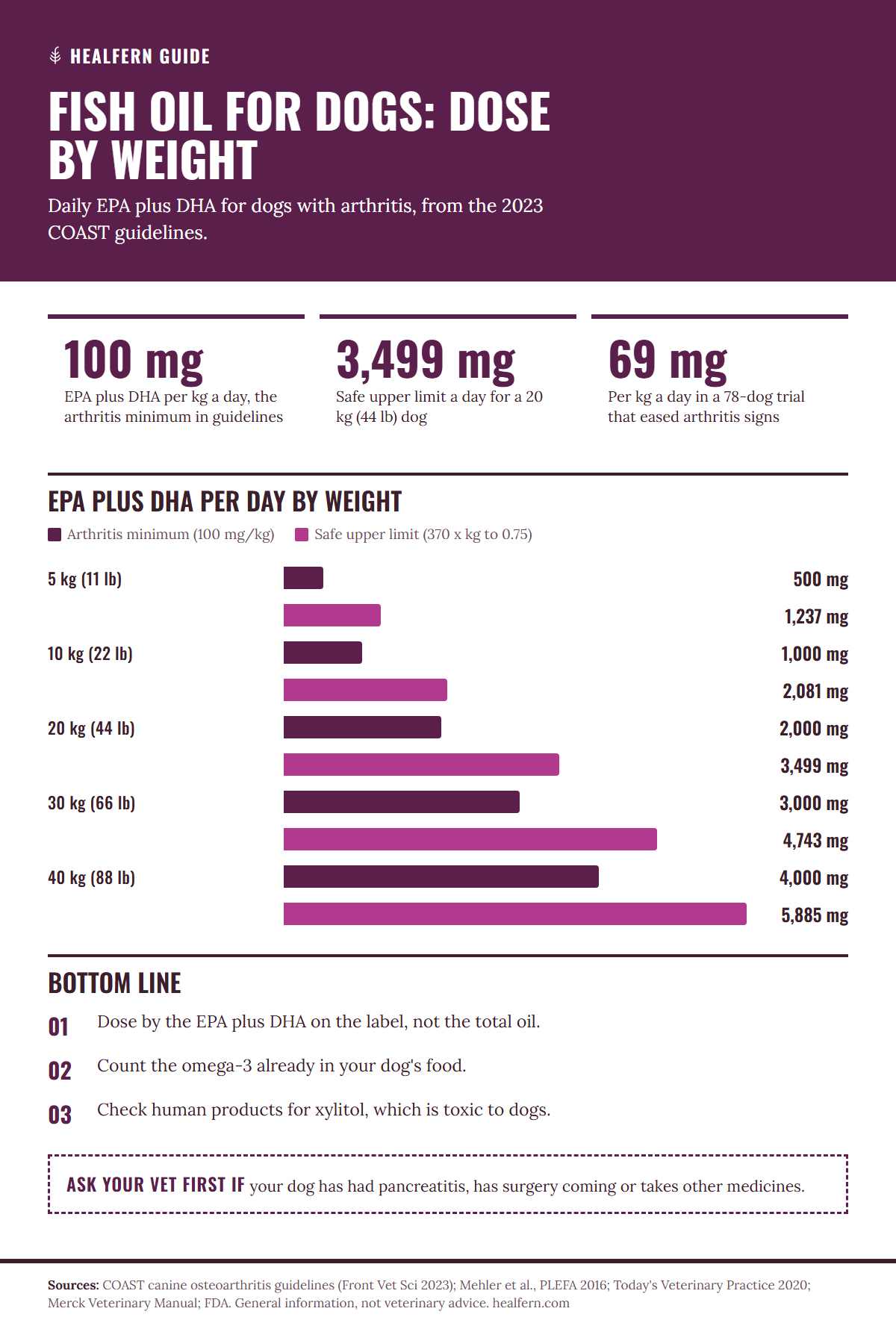
Dose fish oil for dogs by the EPA plus DHA it contains, not by the total oil: arthritis guidelines suggest at least 100 mg/kg a day, staying under 370 times body weight in kg to the 0.75 power.[2] Today’s Veterinary Practice gives a wider therapeutic range of 50 to 220 mg/kg.[9] Your vet sets the final number.
The table below uses only the COAST formulas.[2] We did the arithmetic for common weights. The middle columns are arthritis targets. The last column is the ceiling that should not be passed from food and supplements combined.[2][9]
| Dog weight | Arthritis minimum (100 mg/kg) | NRC arthritis level (310 x kg to 0.75) | Safe upper limit (370 x kg to 0.75) |
|---|---|---|---|
| 5 kg (11 lb) | 500 mg | 1,037 mg | 1,237 mg |
| 10 kg (22 lb) | 1,000 mg | 1,743 mg | 2,081 mg |
| 20 kg (44 lb) | 2,000 mg | 2,932 mg | 3,499 mg |
| 30 kg (66 lb) | 3,000 mg | 3,974 mg | 4,743 mg |
| 40 kg (88 lb) | 4,000 mg | 4,931 mg | 5,885 mg |
For a healthy adult dog, the National Research Council’s everyday allowance is much lower, at 30 times body weight in kg to the 0.75 power.[2] That works out to about 284 mg a day for a 20 kg dog. A complete and balanced dog food is built to cover basic needs, so most healthy dogs do not need extra.[12]
How do I work out my dog’s fish oil dose from the label?
Add the EPA and DHA per capsule or pump, then divide your target dose by that number; the total fish oil figure on the front of the bottle is not the dose.[9] Then count any omega-3 already in your dog’s food, because diet and supplement add together.[9]
The steps below follow a worked example from Today’s Veterinary Practice.[9]
- Weigh your dog. The example dog weighs 20 kg, about 44 lb.[9]
- Find the upper limit. For 20 kg it is about 3,499 mg of EPA plus DHA a day.[2][9]
- Check the food. A joint diet fed at 927 calories a day gave this dog 3,152 mg of EPA plus DHA.[9]
- Check the supplement. One typical pet capsule held 500 mg of EPA plus DHA.[9]
- Add them up. 3,152 mg plus 500 mg is 3,652 mg, which is over the limit.[9]
- Decide with your vet. In this case the authors suggested the extra capsule may be unnecessary.[9]
Pet joint diets in that review supplied 160 to 340 mg of EPA plus DHA per 100 calories, so a dog on one may already be near the target.[9] You may need to call the food maker to get the number.[9]
What are the side effects of fish oil in dogs?
The side effects of fish oil in dogs named in a veterinary review are stomach upset, weight gain, changes in platelet function, slower wound healing, fat oxidation and possible drug interactions.[8] Most are tied to high doses, which is why the upper limit matters.[2][8]
- Digestive upset is one of the effects the review lists.[8]
- Omega-3 fats can change how platelets work, so tell your vet before any surgery.[8]
- Fish oil is fat and adds calories, and AAFCO warns that fat supplements can cause weight gain.[8][12]
- The review also lists nutrient and drug interactions, so a dog on pain medicine should have its fish oil dosed by a vet.[8][9]
Is fish oil safe for dogs with pancreatitis?
Ask your vet first. Merck says a common trigger for pancreatitis in dogs is eating something they should not, and recovery depends on a low-fat diet with less than 20 g of fat per 1,000 calories.[11] Very high blood fats, around 500 mg/dL of triglycerides, are also a risk factor.[11] Any added fat, including fish oil, should be cleared with the vet treating your dog.
Can I give my dog human fish oil?
Only if your vet agrees and the label is checked. The FDA says xylitol turns up in many products made for people, and advises checking labels, especially on anything sold as sugar-free or low sugar.[10] The FDA warns that xylitol can drop a dog’s blood sugar within 10 to 60 minutes and can cause vomiting, weakness, staggering, collapse and seizures.[10] Signs can take 12 to 24 hours to appear, so call your vet or a poison control line right away if your dog eats it.[10] AAFCO also says human dietary supplements should not be used for drug purposes in pets.[12]
What do vets use first for arthritis and itchy skin?
For arthritis, vets start with weight control and NSAID pain medicine, which Merck calls the most predictably effective treatment.[1] Even modest weight loss helps overweight dogs with arthritis move better.[1] Fish oil is an add-on that may let some dogs need less pain medicine.[1]
The COAST guidelines stage arthritis and add treatments as it progresses, from diet and body weight to drugs and other care.[2] For allergic skin, the 2024 trial shows how fish oil fits: as a partner to prescription itch drugs.[7]
A joint or skin diet from your vet may already contain enough omega-3, and AAFCO notes that only a vet can supply these therapeutic diets.[9][12]
Practical checklist before you start fish oil
- Ask your vet what problem the oil is meant to help and how you will judge it.[1]
- Read the EPA and DHA per serving, not the total oil.[9]
- Count the omega-3 in your dog’s food, especially a joint, skin or kidney diet.[9]
- Stay under the safe upper limit for your dog’s weight.[2]
- Check every human product for xylitol before it goes near your dog.[10]
- Skip cod liver oil unless your vet approves it, since added vitamin D has a narrow safe range in dogs.[12]
- Give it 6 to 16 weeks, the length of the trials, before deciding if it helps.[4][7]
- Stop and call your vet if you see vomiting, diarrhea, unusual bruising or weight gain.[8]
Bottom line on fish oil for dogs
Fish oil has fair support as an add-on for dogs with arthritis or allergic itch, with small gains in most trials and one independent arthritis trial that found no clear difference from placebo.[3][5][7] It does most good next to standard care, such as weight control and the right pain or itch medicine.[1][7]
For most dogs with sore joints, weight control and a vet plan are the better first steps, because Merck rates NSAIDs as the most predictably effective treatment and even modest weight loss helps.[1] If you add fish oil, dose it by EPA and DHA, count what the food already gives and stay under the upper limit for your dog’s size.[2][9]
Questions people also ask
How long does fish oil take to work in dogs?
It takes weeks. In one large study, owners noticed easier rising and play after 6 weeks on a high omega-3 diet, and an allergy trial ran for 16 weeks. Give it at least that long before judging, and track changes with your vet.
Is cod liver oil the same as fish oil for dogs?
No. Cod liver oil comes from fish livers and also carries vitamins A and D. AAFCO warns that vitamin D has a small gap between the amount dogs need and a toxic amount, so ask your vet before using cod liver oil.
Can puppies have fish oil?
Puppies need DHA for growth, and AAFCO recommends that growth diets contain EPA plus DHA at 10 mg per 100 calories. A complete puppy food is built to supply this, so ask your vet before adding a separate fish oil.
Can I give my dog fish oil with an NSAID?
Often yes, under a vet's care. Merck says EPA can lower how much NSAID a dog with arthritis needs. A veterinary review also lists platelet effects and drug interactions, so your vet should set both doses together.
Does a healthy dog need fish oil?
Usually not. AAFCO says healthy dogs eating a complete and balanced diet for their life stage generally do not need supplements, and extra fat can cause weight gain. Fish oil is mostly studied for dogs with arthritis or allergic skin disease.
Sources
- Osteoarthritis in Dogs and Cats, Merck Veterinary Manual
- COAST Development Group's international consensus guidelines for the treatment of canine osteoarthritis, Frontiers in Veterinary Science, 2023
- A prospective, randomized, double blind, placebo-controlled evaluation of the effects of EPA and DHA in dogs with osteoarthritis, Prostaglandins, Leukotrienes and Essential Fatty Acids, 2016
- Multicenter veterinary practice assessment of the effects of omega-3 fatty acids on osteoarthritis in dogs, Journal of the American Veterinary Medical Association, 2010
- An un-commissioned randomized, placebo-controlled double-blind study to test the effect of deep sea fish oil as a pain reliever for dogs suffering from canine OA, BMC Veterinary Research, 2012
- Effect of omega-3 fatty acids on canine atopic dermatitis, Journal of Small Animal Practice, 2004
- A placebo-controlled, double-blind study evaluating the effect of orally administered polyunsaturated fatty acids on the oclacitinib dose for atopic dogs, Veterinary Dermatology, 2024
- Potential adverse effects of omega-3 fatty acids in dogs and cats, Journal of Veterinary Internal Medicine, 2013
- Fish Oil Dosing in Pet Diets and Supplements, Today's Veterinary Practice, NAVC, 2020
- Paws Off Xylitol; It's Dangerous for Dogs, U.S. Food and Drug Administration
- Pancreatitis in Dogs and Cats, Merck Veterinary Manual
- Supplements, Association of American Feed Control Officials
This article is general information, not medical advice. These statements have not been evaluated by the FDA, and supplements are not intended to diagnose, treat, cure or prevent any disease. Talk to your doctor or pharmacist before you start a supplement. How we research.