Probiotics for dogs have limited evidence. In the largest trial, a specific Enterococcus faecium paste cut sudden diarrhea from a median 47 hours to 32. Reviews still rate the benefit as small, and results for itchy skin and chronic gut disease are weak. Pick a dog-tested strain, avoid human chewables that may contain xylitol, and see your vet for blood, vomiting or weakness.
Probiotics for dogs are live bacteria or yeasts sold as powders, chews and pastes, mostly to firm up loose stools. We read two systematic reviews of canine trials, the 2026 ACVIM consensus on chronic gut disease, six randomized dog studies, a test of product labels and the Merck Veterinary Manual. Our research process explains how we choose and check sources.
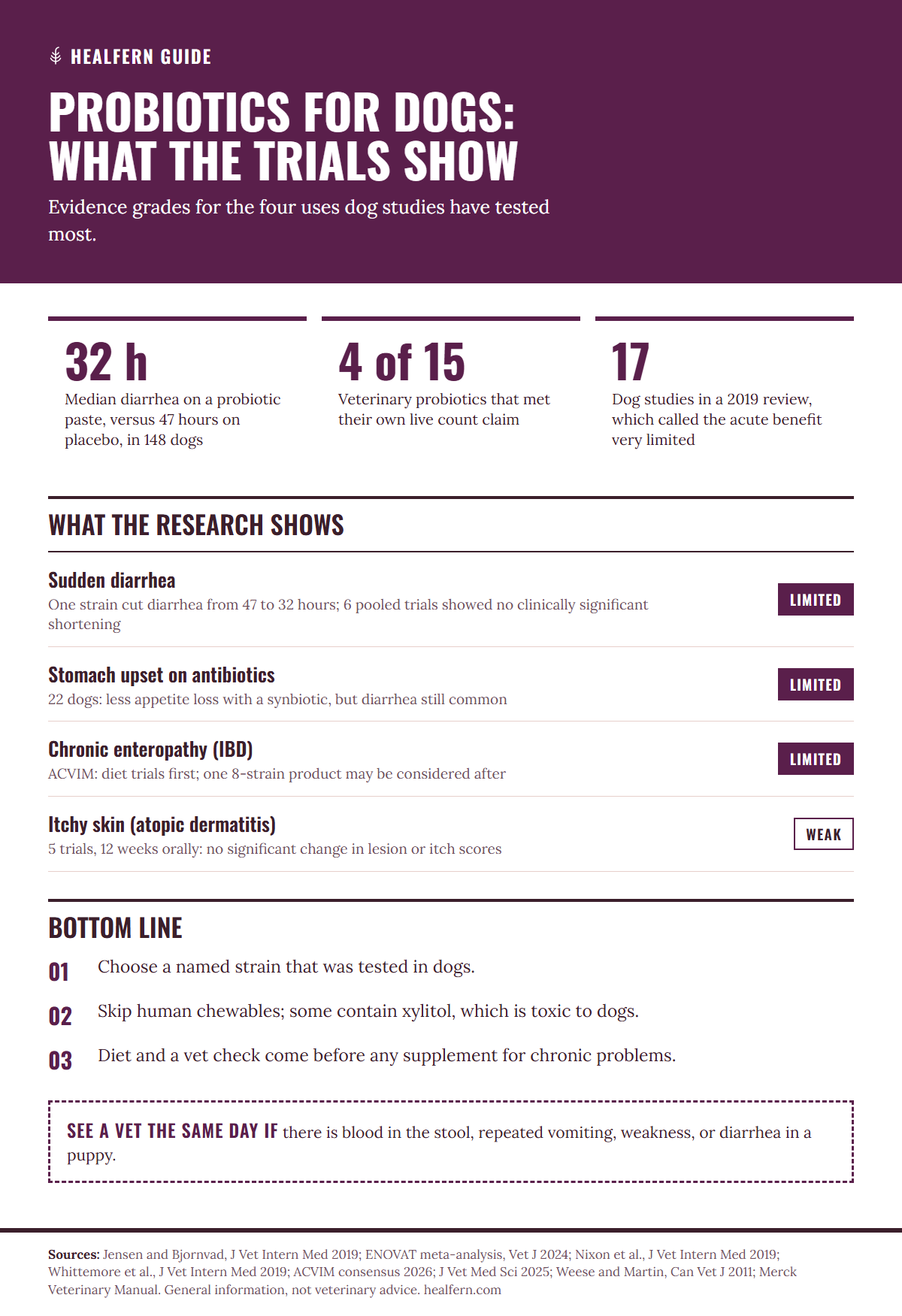
The short answer: a few specific strains helped dogs with sudden diarrhea recover a little faster, about 32 hours versus 47 hours in the largest trial, but reviews rate the overall benefit as small.[1][3]
| What they are | Live microorganisms that, given in adequate amounts, give the host a health benefit[1] |
|---|---|
| Mainly studied for | Sudden (acute) diarrhea, chronic gut inflammation and stomach upset from antibiotics[1][7][8] |
| Best evidence | A 148-dog placebo trial: diarrhea lasted a median 32 hours with an Enterococcus faecium paste versus 47 hours with placebo[3] |
| What reviews conclude | A very limited, possibly unimportant effect on acute diarrhea; diet matters more for chronic disease[1][2] |
| Typical amounts | Set by the product; one trial used 200 billion CFU per 10 kg a day for 14 days[5] |
| Safety | No adverse effects reported in six acute diarrhea trials; human chewables may contain xylitol, which is toxic to dogs[2][14] |
| See a vet first if | There is blood in the stool, repeated vomiting, weakness or diarrhea in a young puppy[13] |
What do probiotics for dogs do?
Probiotics for dogs add live microbes to the gut in the hope of rebalancing its bacteria and firming stools.[1] Most products contain Enterococcus, Lactobacillus, Bifidobacterium or the yeast Saccharomyces. Their effects depend on the exact strain, so results from one product do not carry over to another.[1]
Diarrhea, stress, a sudden diet change or a course of antibiotics can upset the mix of bacteria in a dog’s intestines, and a probiotic is meant to nudge that mix back toward normal.
In practice, most dog studies measure stool consistency and how many days the diarrhea lasts. A 2019 systematic review in the Journal of Veterinary Internal Medicine found 17 qualifying studies: 12 on acute gut disease and 5 on chronic disease. Most were small, and the risk of bias was moderate to high.[1]
Researchers also note that probiotics seem to be host specific. That is why many newer strains are isolated from dogs and cats for use in pets.[12] For how these microbes differ from the fibers that feed them, see our human guide to fermented foods for gut health.
Do probiotics for dogs help with diarrhea?
For sudden, uncomplicated diarrhea, a few strains shortened the illness by hours in trials, but pooled reviews call the benefit small.[1][2] A 2024 meta-analysis of six randomized trials, written for the European ENOVAT guidelines, found no clinically significant shortening of diarrhea. It also found no reported adverse effects.[2]
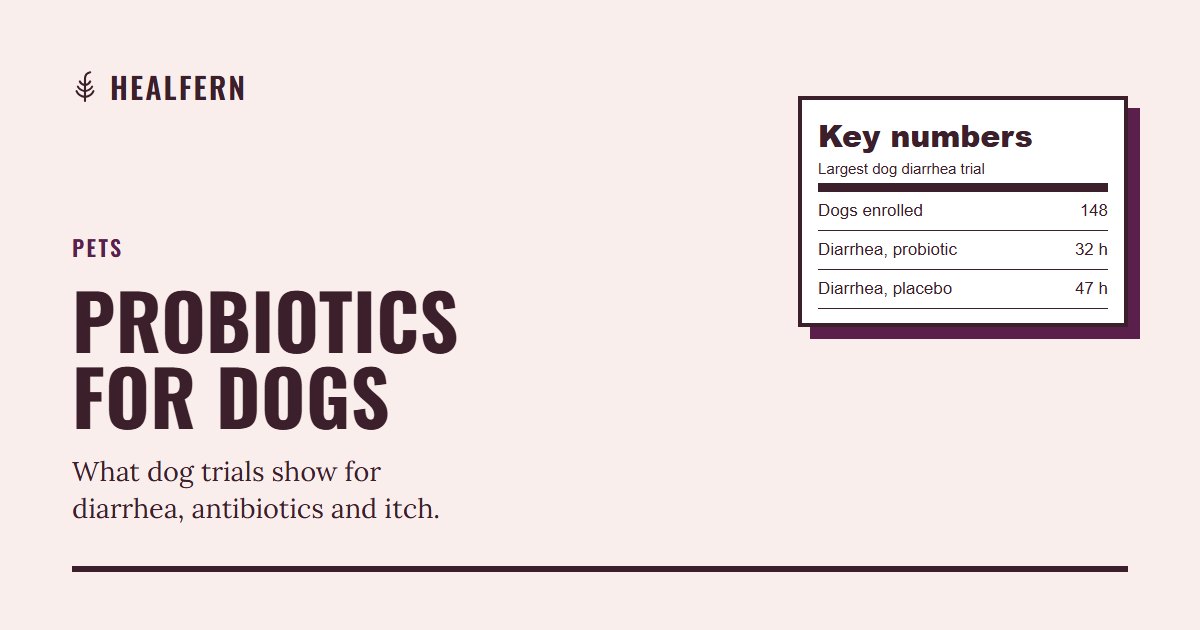
The strongest single trial, published in 2019, enrolled 148 dogs at 14 practices in the UK and Ireland. Dogs given a paste with Enterococcus faecium 4b1707 had diarrhea for a median 32 hours, compared with 47 hours on placebo. Only 3.5% needed extra treatment, against 14.8% on placebo.[3]
In 25 dogs with acute hemorrhagic diarrhea syndrome, both groups recovered fast without antibiotics. The probiotic group improved by day 3 and the placebo group by day 4.[4]
A 2025 review of conference abstracts found that 71% of positive probiotic studies reached a journal, compared with 20% of negative ones.[11] The published record may look better than reality.
What the dog trials found
| Study | Dogs and length | Product | Result |
|---|---|---|---|
| Nixon, 2019, acute diarrhea[3] | 148 client dogs, until recovery | Enterococcus faecium paste | Median 32 vs 47 hours of diarrhea |
| Ziese, 2018, bloody diarrhea[4] | 25 dogs, 21 days | Multi-strain powder | Recovery day 3 vs day 4; both groups did well |
| 2023, bloody diarrhea[5] | 18 dogs, 14 days | 200 billion CFU per 10 kg vs fecal transplant | No difference in length or severity of signs |
| Bybee, 2011, shelter[6] | 182 dogs, 4 weeks per period | Enterococcus faecium SF68 | No difference in dogs; diarrhea was uncommon |
| Whittemore, 2019, antibiotics[7] | 22 healthy dogs, 3 weeks | Bacteria and yeast synbiotic | Smaller appetite changes; diarrhea still common |
Read the table with sample size in mind. Only one trial enrolled more than 150 dogs, and most tested a single branded product.[1][3] A result for one strain says little about the different strains in a pet store blend. The 2019 review also judged most of these studies underpowered.[1]
How long do probiotics for dogs take to work?
In trials of sudden diarrhea, any gain showed up within a day or two, as a modestly shorter illness.[3][4] Dogs on the probiotic paste stopped having diarrhea about 15 hours sooner than dogs on placebo. In bloody diarrhea, the probiotic group improved one day earlier, though both groups recovered quickly.[3][4]
Chronic problems are slower. Skin trials gave oral probiotics for 12 weeks.[9] In chronic gut disease, the ACVIM panel asks vets to try at least 3 therapeutic diets, each fed alone for at least 2 weeks, before adding anything else.[8]
If sudden diarrhea in an otherwise bright dog has not clearly improved in a day or two, call your vet instead of waiting on the supplement. Merck notes that most dogs with gut upsets respond to supportive veterinary care.[13]
Should a dog on antibiotics take probiotics?
A synbiotic eased appetite loss in dogs on strong antibiotics, but it did not stop the diarrhea.[7] In a 2019 crossover trial, 22 healthy research dogs took enrofloxacin and metronidazole. Diarrhea hit 100% of them and vomiting 77%. Dogs on the synbiotic had smaller changes in food intake.[7]
In that study, the synbiotic was given 1 hour after each antibiotic dose. Spacing doses like this is common advice, because antibiotics can kill the bacteria in the supplement.[7]
The ENOVAT review also found high certainty evidence that antibiotics themselves had no clinically relevant benefit in dogs with mild or moderate acute diarrhea.[2] So the better question is often whether your dog needs the antibiotic at all. Ask your vet both questions before starting either product.
Do probiotics help dogs with IBD, itching or allergies?
For chronic gut inflammation and itchy skin, the evidence is weak, and diet or prescribed treatment comes first.[8][9] The 2026 ACVIM consensus says pre-, pro- and synbiotics have a limited role in chronic inflammatory enteropathy, though they seem well tolerated. Trials found no added benefit over an elimination diet alone.[8]
Chronic means signs that keep coming back or last for weeks, such as loose stools, weight loss or vomiting. Those dogs need a diagnosis before any supplement is chosen.
Chronic enteropathy (IBD)
One 8-strain product, the De Simone formulation, may be considered for dogs that have failed diet trials. The panel lists a dose of 112 to 225 times 10 to the 8th bacteria per kg once a day.[8] In one randomized trial, it brought scores down, but more slowly than prednisone with metronidazole.[8]
The panel also says a probiotic such as Saccharomyces boulardii might be added to immune-suppressing treatment, but rates that advice as weak. Merck notes that inflammatory bowel disease is diagnosed with tests such as fecal samples, imaging and biopsy, and that treatment depends on the cause.[8][13]
Itchy skin and allergies
A 2025 meta-analysis pooled 5 trials in dogs with atopic dermatitis. Oral probiotics given for 12 weeks did not significantly change lesion scores (P = 0.08) or itch scores (P = 0.85).[9] Scores did trend down in every trial, so the question stays open. The trials were small and used different strains, doses and outcome scales, which makes pooling them hard. For now, itch belongs with your vet’s allergy plan, much as joint pain does in our guide to glucosamine for dogs.
Can I give my dog human probiotics?
Plain human probiotic capsules are not known to be dangerous to dogs, but they were not tested in dogs, and some chewables contain xylitol.[14] Merck lists chewable vitamins and supplements among xylitol sources. In dogs, xylitol can cause severe low blood sugar, seizures and liver injury.[14]
Probiotic effects are strain specific, and every positive dog trial above used a defined product given to dogs.[1][3] Researchers also point to host specificity, which is why many pet strains are now isolated from dogs.[12]
Online dosage charts for human products by dog weight have no trial behind them that we could find. If you are tempted to use a human product, show the label to your vet first, and never use gummies or chewables without reading every ingredient.
Are probiotics safe for dogs?
In published dog trials, probiotics were well tolerated, and the 2024 ENOVAT review found no reported adverse effects in six trials.[2] The 148-dog paste trial described both the paste and placebo as well tolerated.[3] The ACVIM panel also notes that these products seem well tolerated in chronic gut disease.[8]
Product quality worries researchers more than side effects. When they tested 25 veterinary probiotics, only 4 of the 15 that claimed a live count met or beat it. Seven of 22 labels misspelled an organism.[10] Lactic acid bacteria can also lose activity during processing and storage.[12]
Healthy dogs fed a complete and balanced diet generally do not need supplements, AAFCO says.[15] A probiotic also cannot fix the cause of diarrhea, such as parvovirus, parasites or a swallowed object.[13]
See a vet right away if
Some signs mean the problem needs a vet, not a supplement. Do not wait to see whether a probiotic helps if you notice any of these:
- The diarrhea or vomit contains blood, or vomiting is sudden and repeated.[13]
- Your dog is weak, collapsing or seems in shock; hemorrhagic gastroenteritis can cause shock without fluids.[13]
- A puppy or an unvaccinated dog has diarrhea, since parvovirus causes severe bloody diarrhea.[13]
- Your dog may have eaten a product with xylitol.[14]
- Diarrhea comes back or lasts beyond a few days despite home care.[8][13]
What do vets recommend first for a dog with diarrhea?
Vets start with the cause, fluids when needed and a diet plan, and they treat probiotics as an optional add-on.[8][13] Merck describes fluid support, anti-nausea medicine and early feeding for severe gut upsets, and fiber for many dogs with colitis. For chronic disease, ACVIM puts therapeutic diets first.[8][13]
Antibiotics are no longer routine. The ENOVAT review found they did not help mild or moderate acute diarrhea in a clinically relevant way.[2] Stress can also upset the gut, which is one reason to plan ahead for a dog with separation anxiety before boarding or a move.
When a probiotic makes sense: a decision table
Owners often ask whether to keep a probiotic in the cupboard for the next upset. The answer depends on the situation. This table matches common cases to what the trials and guidelines say, so you can decide with your vet where a probiotic fits and where it does not.
| If your dog has | Evidence for probiotics | Sensible first step |
|---|---|---|
| Mild diarrhea, bright and eating | Small benefit in some trials[2][3] | Ask your vet; a tested product is a reasonable add-on |
| Bloody diarrhea or vomiting | Both groups recovered at a similar pace[4][5] | Vet visit the same day[13] |
| A course of antibiotics | Less appetite loss, diarrhea still common[7] | Ask whether the antibiotic is needed[2] |
| Chronic diarrhea or IBD | Limited role; one 8-strain product after failed diets[8] | Diet trials with your vet[8] |
| Itchy skin | No significant effect in a meta-analysis[9] | Allergy workup with your vet |
Label checklist before you buy
Pet probiotics vary widely in quality, so read the label as closely as you would for a medicine. Use these checks in the store or online:
- The genus, species and strain code are listed and spelled correctly.[10]
- A live count in CFU is guaranteed through the expiry date, not only at manufacture.[10][12]
- The same strain was tested in dogs, ideally in a placebo-controlled trial.[1][3]
- There is no xylitol in the ingredient list.[14]
- Storage directions are clear, and you follow them.[12]
- Your vet knows about it, especially if your dog takes antibiotics or is on a diet trial.[7][8]
Bottom line on probiotics for dogs
A specific, tested probiotic may shave several hours off a bout of simple diarrhea in an otherwise healthy dog, and it seemed safe in the published trials.[2][3] Reviews still rate the benefit as small, and results for itchy skin and chronic gut disease are weak.[1][8][9]
For most dogs, a vet check and the right diet are the better first step, because they deal with the cause. If you do buy a probiotic, pick one with a named strain and a dog trial behind it, and skip human chewables. More pet topics sit in our pets section.
Questions people also ask
How much probiotic should I give my dog?
Follow the product label or your vet, because doses are product specific. Trials used very different amounts, such as 200 billion CFU per 10 kg a day for 14 days in one study. No study shows that a bigger dose works better.
Is yogurt or kefir a good probiotic for dogs?
We found no dog trials of yogurt or kefir, so their strains and live counts are unknown for this use. Sweetened or sugar-free versions can contain xylitol, which is toxic to dogs. A tested product with a named strain is the safer choice.
Can dogs take probiotics every day long term?
Dog trials ran from a few days to about 12 weeks, and products seemed well tolerated. Long-term studies are lacking. If your dog needs one for months, that usually points to a problem your vet should diagnose and treat directly.
Do probiotics for dogs expire?
Yes. Live bacteria lose activity during processing and storage, and one test found only 4 of 15 products met their own live count claim. Check the expiry date, look for a count guaranteed until that date and follow the storage directions.
Sources
- Clinical effect of probiotics in prevention or treatment of gastrointestinal disease in dogs: A systematic review, Journal of Veterinary Internal Medicine, 2019
- Efficacy of antimicrobial and nutraceutical treatment for canine acute diarrhoea: A systematic review and meta-analysis for ENOVAT guidelines, The Veterinary Journal, 2024
- Efficacy of an orally administered anti-diarrheal probiotic paste (Pro-Kolin Advanced) in dogs with acute diarrhea, Journal of Veterinary Internal Medicine, 2019
- Effect of probiotic treatment on the clinical course, intestinal microbiome, and toxigenic Clostridium perfringens in dogs with acute hemorrhagic diarrhea, PLoS One, 2018
- Clinical response in dogs with acute hemorrhagic diarrhea syndrome following randomized probiotic treatment or fecal microbiota transplant, Frontiers in Veterinary Science, 2023
- Effect of the probiotic Enterococcus faecium SF68 on presence of diarrhea in cats and dogs housed in an animal shelter, Journal of Veterinary Internal Medicine, 2011
- Randomized, controlled, crossover trial of prevention of antibiotic-induced gastrointestinal signs using a synbiotic mixture in healthy research dogs, Journal of Veterinary Internal Medicine, 2019
- ACVIM-endorsed statement: consensus statement and systematic review on guidelines for the diagnosis and treatment of chronic inflammatory enteropathy in dogs, Journal of Veterinary Internal Medicine, ACVIM, 2026
- Probiotics as an adjunct in the treatment of canine atopic dermatitis: a systematic review and meta-analysis, Journal of Veterinary Medical Science, 2025
- Assessment of commercial probiotic bacterial contents and label accuracy, Canadian Veterinary Journal, 2011
- Evaluation of publication bias in the assessment of probiotic treatment for gastrointestinal disease in dogs and cats, Canadian Veterinary Journal, 2025
- Application of Probiotics in Cats and Dogs: Benefits and Mechanisms, Veterinary Sciences, 2025
- Disorders of the Stomach and Intestines in Dogs, Merck Veterinary Manual
- Xylitol Toxicosis in Dogs, Merck Veterinary Manual, 2025
- Supplements, Association of American Feed Control Officials
This article is general information, not medical advice. These statements have not been evaluated by the FDA, and supplements are not intended to diagnose, treat, cure or prevent any disease. Talk to your doctor or pharmacist before you start a supplement. How we research.