Most mucus in the lungs comes from a chest cold and clears within 2 to 3 weeks. To help it along, drink plenty of fluids, use a humidifier or steam, try honey in warm water for cough, and use the huff cough to bring mucus up. See a doctor for trouble breathing, a fever of 100.4°F or more, blood in the mucus, or a cough past 3 weeks.
To work out how to get rid of mucus in lungs, we read the NHLBI pages on bronchitis and bronchiectasis, two MedlinePlus health topics, two American Lung Association guides and five Cochrane reviews that together cover more than 17,000 people. We left out anything those sources do not support.
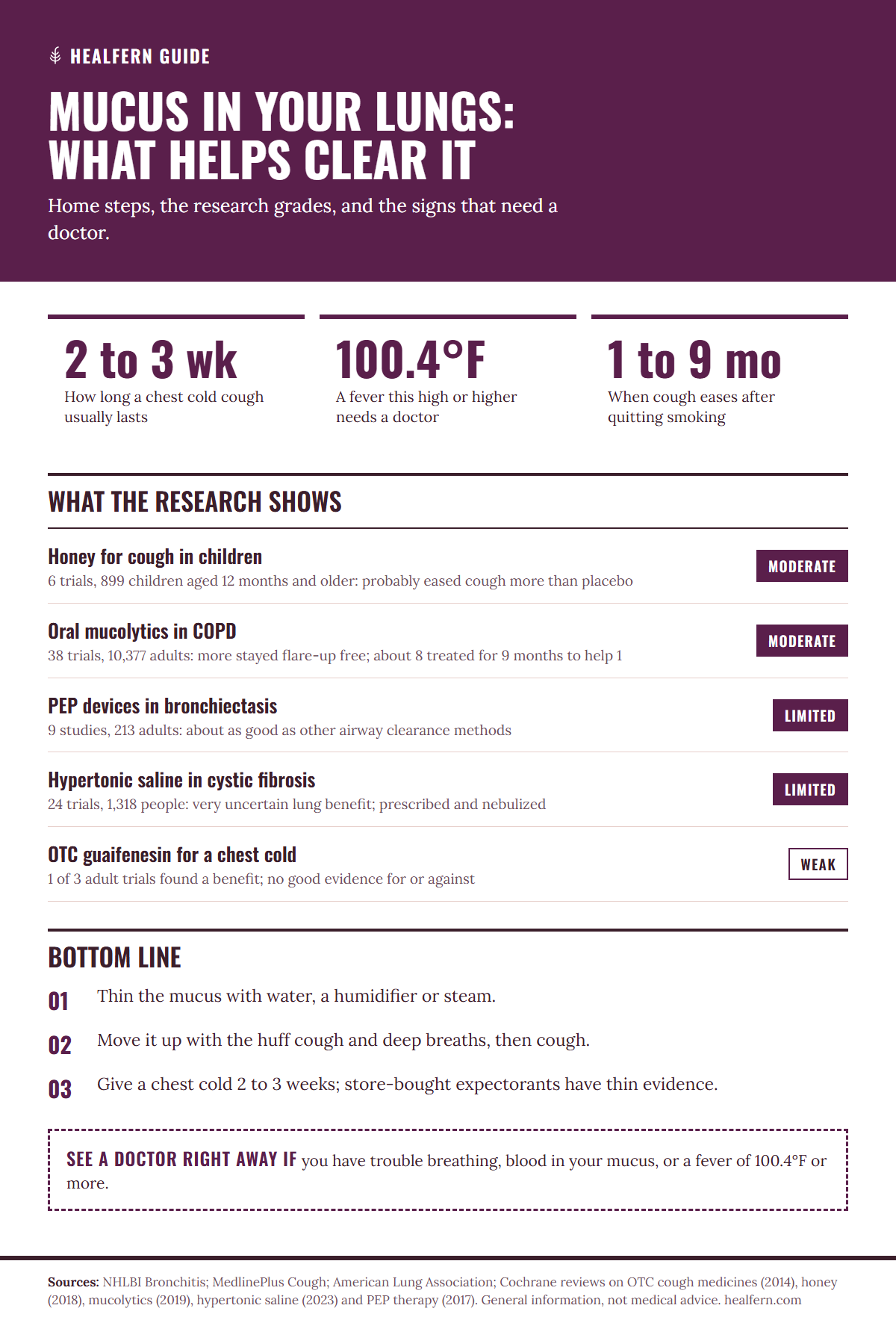
The short answer: drink fluids, keep the air moist, cough the mucus up with controlled huffs, and give a chest cold 2 to 3 weeks to clear before you see a doctor[1][4].
| What it is | Phlegm, a mostly water gel that traps germs and dust; tiny hairs called cilia push it up and out[5] |
|---|---|
| Most common cause | Acute bronchitis (a chest cold), usually from the same viruses that cause colds and flu[3] |
| How long it lasts | Acute coughs usually last no more than 2 to 3 weeks[4] |
| First steps at home | Fluids, a humidifier or steam, rest, and honey in hot water or tea[1][3] |
| Best evidence | Mucolytics in COPD: 38 trials, 10,377 people, fewer flare-ups[10] |
| Weakest evidence | Over-the-counter guaifenesin: 1 of 3 adult trials found a benefit[8] |
| See a doctor | Cough past 2 to 3 weeks, trouble breathing, fever of 100.4°F or more, or blood in the mucus[1][6] |
How to get rid of mucus in lungs fast at home: 7 steps
You loosen mucus with water and moist air, then move it up and out with controlled breathing and coughing. Thin, wet mucus is easier for the cilia and your cough to clear than thick, sticky mucus. NIH and the American Lung Association both put fluids and airway clearance first[2][6].
- Drink plenty of fluid, mostly water. NHLBI says good hydration keeps airway mucus “moist and slippery and easier to cough up”[2].
- Add moisture to the air. Run a humidifier or vaporizer, or sit in a steamy bathroom[4].
- Sip hot tea or water with honey. NHLBI lists it for acute bronchitis, and honey has the best trial data of any home cough remedy in children[1][9].
- Use the huff cough. Force out a couple of breaths, then breathe in a relaxed way, and cough once the mucus moves up. This is the forced expiration technique[2][6].
- Add deep breaths between huffs. Slow deep breaths plus huffing is the active cycle of breathing technique[2].
- Let gravity help. Lying on your side or front with your chest lower than your hips can drain mucus toward the upper airway. Then sit up and huff[6]. Skip this if it makes you short of breath.
- Rest, and stay away from smoke. Rest and fluids are standard care for a chest cold, and tobacco smoke and fumes can bring bronchitis on in the first place[3].
If you have a lung condition, ask your care team which routine they want you to use and how often.
What kills mucus in lungs?
Nothing kills mucus; medicines either thin it or loosen it so you can cough it out. Mucus is your lungs’ normal defense, so the aim is to clear the extra, thick mucus[5]. Evidence for the store-bought options is thin.
Guaifenesin is the expectorant in many cough products. NHLBI says it may “possibly” loosen mucus[1]. A Cochrane review of 29 trials in 4,835 people found that 1 of 3 adult guaifenesin trials showed a benefit, and it concluded there is “no good evidence for or against” over-the-counter cough medicines for acute cough[8].
Mucolytics such as N-acetylcysteine (NAC) and carbocysteine change mucus itself. Their best data come from long-term use in chronic bronchitis and COPD, covered below[10]. Our guide to NAC for lungs and mucus goes through those trials in detail.
| Option | Who was studied | Size | Result |
|---|---|---|---|
| Guaifenesin and other OTC cough medicines | Adults and children with acute cough | 29 trials, 4,835 people | No good evidence for or against[8] |
| Honey | Children 12 months to 18 years with acute cough | 6 trials, 899 children | Probably eased cough more than placebo[9] |
| Oral mucolytics (NAC, carbocysteine and others) | Adults with chronic bronchitis or COPD, 2 months to 3 years | 38 trials, 10,377 people | More people stayed flare-up free[10] |
| Nebulized hypertonic saline (3% to 7%) | Cystic fibrosis, ages 1 month to 56 years | 24 trials, 1,318 people | Very uncertain lung benefit; helped airway clearance in adult flare-ups[11] |
| PEP devices (Flutter, Acapella) | Adults with bronchiectasis | 9 studies, 213 people | Similar to other airway clearance methods[12] |
How to clear mucus from lungs naturally?
The natural steps with real support are water, moist air, honey for cough, and breathing techniques. They cost little and carry little risk. They make the mucus easier to bring up while your body clears the virus, though they do not shorten the infection[2][4].
Water works in two ways. Drinking it keeps the airway lining moist, and adding it to the air with a steamy shower or vaporizer can ease the cough[4]. Mucus is mostly water, so being dry makes it thicker[5].
Honey is the best-studied home remedy. In a 2018 Cochrane review of 6 trials with 899 children, honey probably reduced how often they coughed compared with placebo or no treatment, and it worked about as well as dextromethorphan[9]. Most children got honey for only one night, and the trials only included children aged 12 months and older[9].
If mucus is also dripping from your nose and sinuses, a saline spray or rinse helps clear it. Use only distilled, sterile or previously boiled water if you mix your own[5]. Our article on sinus infection symptoms and the home remedies that help covers that side.
We found no review-level evidence for ginger, eucalyptus, spicy food or salt-water gargles to clear mucus from the lungs, so we leave them out.
Will mucus in lungs go away on its own?
Yes, in most people with a chest cold, the mucus clears on its own within 2 to 3 weeks. Most cases of acute bronchitis improve within several days, though the cough can hang on for several weeks after the infection is gone[1][3].
Antibiotics will not speed this up when a virus is the cause, which it usually is[3]. Doctors prescribe them only if they find a bacterial infection[1].
A cough that lasts longer than 2 to 3 weeks counts as chronic. Common causes include chronic bronchitis, COPD, acid reflux (GERD) and smoking[4]. Chronic bronchitis means a cough with mucus that lasts at least 3 months and comes back at least 2 years in a row[1]. That kind of mucus needs a doctor to find the cause.
What does the color of lung mucus mean?
Mucus is normally clear. During a cold it often turns cloudy or yellow because of proteins from inflammation[5]. Green, brown or bloody mucus may point to a bacterial infection, but NIH notes “that’s not always the case,” and color alone cannot tell what is wrong[5]. Brown or black mucus is more common in heavy smokers[5].
How to clear mucus from lungs with COPD or bronchiectasis?
With a long-term lung condition, mucus clearance is a daily routine your care team prescribes: airway clearance techniques, devices, fluids and sometimes medicines. The American Lung Association advises doing mucus clearance techniques every day, not only when you feel worse[6].
The options NHLBI and the Lung Association describe include:
- Breathing techniques such as the forced expiration technique and the active cycle of breathing[2].
- Oscillating positive expiratory pressure (PEP) devices you breathe out through, which vibrate the airways to shake mucus loose[2][6].
- Chest physical therapy, which means clapping on the chest and back, done by a respiratory therapist, a trained family member or an electric vest[2][6].
- Inhaled mucus thinners, such as hypertonic saline or acetylcysteine turned into a mist, sometimes after a bronchodilator[2][6].
The trial data on these are modest. A Cochrane review of 9 studies in 213 adults with bronchiectasis found PEP devices worked about as well as other airway clearance methods for sputum, breathlessness and quality of life, with low-quality evidence[12]. For hypertonic saline in cystic fibrosis, a 2023 review of 24 trials was very uncertain about a lung function gain at 4 weeks and saw no difference at 48 weeks, though it did help as an add-on to physiotherapy during adult flare-ups[11].
For oral mucolytics in chronic bronchitis or COPD, the evidence is stronger. Across 38 trials with 10,377 people, those taking a mucolytic were more likely to stay free of flare-ups, and about 8 people needed treatment for roughly 9 months to keep 1 extra person flare-up free[10]. They also had 0.43 fewer days of disability a month. Newer and longer trials showed smaller benefits than older ones[10].
Does mucus from smoking clear after you quit?
Yes, for many people the cough and breathlessness ease within 1 to 9 months of quitting. The American Lung Association says the body starts to repair itself as soon as you stop[7]. Quitting smoking is also the first step NHLBI lists for chronic bronchitis[1].
Tobacco smoke, air pollution, dust and fumes can all set off bronchitis[3]. Removing whatever irritates your airways is often the quickest way to make less mucus.
If you smoke and have coughed up mucus most days for months, see a doctor even if you have quit. That pattern fits chronic bronchitis, which is treated with medicines and pulmonary rehabilitation, where you learn breathing methods such as pursed-lip breathing[1].
When should you see a doctor about mucus in your lungs?
See a doctor if your cough lasts longer than 2 to 3 weeks, gets worse, or comes with trouble breathing. That is the NHLBI rule for bronchitis[1]. A doctor may order tests to check your lungs and airways, because a cough can come from many conditions besides a chest cold[1].
See a doctor right away if you have:
- Trouble breathing or worsening shortness of breath[1][6]
- A high fever of 100.4°F or more with fast breathing or a fast heart rate, which can point to pneumonia[1]
- Blood in your mucus[6]
- More mucus than usual, a change in its color, fatigue or weight loss if you have a long-term lung condition[6]
Safety with cough and mucus medicines
Children under 4 should not have cough medicine, and older children need careful label reading[4]. In the Cochrane review, side effects were more common with products that contain antihistamines and dextromethorphan[8]. If you take prescription medicines or have other health conditions, talk to your doctor or pharmacist before using an over-the-counter product[1]. Decongestants can make things worse if you overuse them[5].
What doctors use first
For a chest cold, standard care is rest, fluids, a humidifier, and acetaminophen or aspirin (adults only) for fever[3]. If you are wheezing, you may get an inhaled medicine such as albuterol to open the airways[1][3]. For bronchiectasis and COPD, doctors combine airway clearance, bronchodilators, mucus thinners and, when needed, antibiotics[2][6]. Supplements are not a replacement for any of these.
Practical checklist
- Drink water through the day and keep a humidifier running[2][4].
- Practice the huff cough while you are sick[6].
- Try honey in warm water or tea for cough, but not for children under 12 months[9].
- Read cough product labels and check the active ingredients so you do not double up[4].
- Avoid smoke, fumes and dust while your airways recover[3].
- Mark the day the cough started; book a visit if it passes 3 weeks[1].
- Keep a list of red flags: blood, fever of 100.4°F or more, trouble breathing[1][6].
More guides on the airways sit in our lung health section. If your mucus came with a cold, our look at whether vitamin C helps with colds covers what the trials show. You can read how we research our health articles as well.
Bottom line
For most people, mucus in the lungs comes from a chest cold and clears in 2 to 3 weeks. Water, moist air, honey and the huff cough are the safest ways to help it along, and the evidence for store-bought expectorants is thin[1][8].
We would start with fluids and breathing techniques before buying a cough syrup. They help you bring the mucus up and carry almost no risk. If the cough lasts past 3 weeks, or you see blood, run a fever or struggle to breathe, a doctor visit is the right next step[1][6].
Questions people also ask
Can you get rid of mucus in lungs immediately?
No method clears it all at once. A few rounds of the huff cough, forcing out a couple of breaths and then breathing gently, can bring some mucus up right away. Fluids and moist air thin the rest over the following days.
Do antibiotics get rid of mucus in lungs?
Usually not. Most chest colds are caused by viruses, and antibiotics do not help a viral infection. Doctors prescribe them only when they find a bacterial infection, so they are not a routine fix for mucus.
How do you get rid of mucus in lungs for kids?
Use fluids, moist air and rest. Children under 4 should not have cough medicine, and older children need careful label reading. Honey eased cough in trials of children aged 12 months and older. Call a doctor for breathing trouble or high fever.
How do you clear mucus from lungs and throat at the same time?
Mucus in the throat often comes from post-nasal drip, which is a common cause of cough. A saline nasal spray or rinse clears the nose, while fluids, steam and the huff cough help with mucus deeper in the chest.
Is mucus in the lungs always a sign of infection?
No. Your lungs make mucus all the time to trap germs and dust, and cilia move it out. You notice it when you make too much, for example with a cold, allergies, smoking or a long-term lung condition.
Sources
- Bronchitis, National Heart, Lung, and Blood Institute (NIH), 2022
- Bronchiectasis: Treatment, National Heart, Lung, and Blood Institute (NIH)
- Acute Bronchitis, MedlinePlus, National Library of Medicine
- Cough, MedlinePlus, National Library of Medicine
- Marvels of Mucus and Phlegm, NIH News in Health, 2020
- Treating and Managing Bronchiectasis, American Lung Association
- Benefits of Quitting, American Lung Association
- Over-the-counter (OTC) medications for acute cough in children and adults in community settings, Cochrane Database of Systematic Reviews, 2014
- Honey for acute cough in children, Cochrane Database of Systematic Reviews, 2018
- Mucolytic agents versus placebo for chronic bronchitis or chronic obstructive pulmonary disease, Cochrane Database of Systematic Reviews, 2019
- Nebulised hypertonic saline for cystic fibrosis, Cochrane Database of Systematic Reviews, 2023
- Positive expiratory pressure therapy versus other airway clearance techniques for bronchiectasis, Cochrane Database of Systematic Reviews, 2017
This article is general information, not medical advice. These statements have not been evaluated by the FDA, and supplements are not intended to diagnose, treat, cure or prevent any disease. Talk to your doctor or pharmacist before you start a supplement. How we research.