
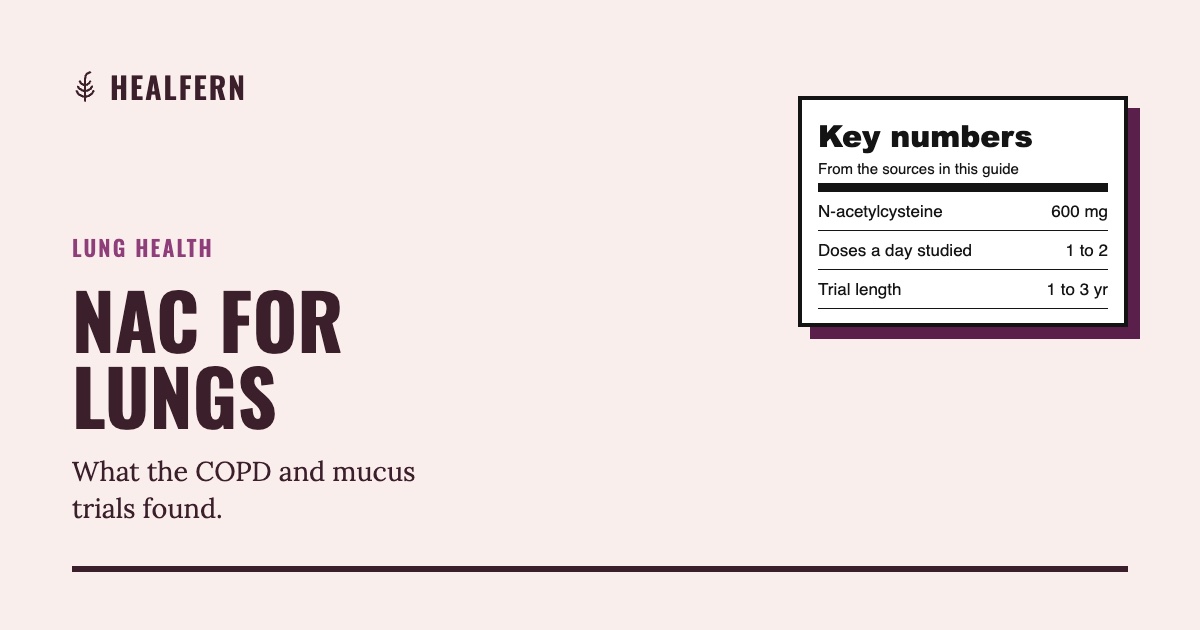
NAC (N-acetylcysteine) thins mucus. In people with chronic bronchitis or COPD, a Cochrane review of 38 trials found mucolytics like NAC lead to a small drop in flare-ups, with side effects similar to placebo. NAC did not slow lung function decline over three years and did not help pulmonary fibrosis. Trials used 600 mg once or twice daily, as an add-on to inhalers.
We read the 2019 Cochrane review of mucolytics (38 trials, 10,377 people), the PANTHEON, BRONCUS and HIACE trials of NAC in COPD, a 13-study meta-analysis, the NIH-funded PANTHER trial in pulmonary fibrosis, a 1997 flu trial, the MedlinePlus drug page for inhaled acetylcysteine and the FDA’s 2022 policy notice on NAC. We also checked NHLBI and MedlinePlus for standard COPD care.
The short answer: in people with chronic bronchitis or COPD, oral NAC and similar mucus thinners lead to a small drop in flare-ups, but they do not slow the loss of lung function, did nothing for pulmonary fibrosis, and belong on top of prescribed COPD care.
| What it is | N-acetylcysteine, a mucolytic drug that thins mucus so it is easier to cough up.[1] |
|---|---|
| Main lung use studied | Fewer flare-ups (exacerbations) in chronic bronchitis and COPD.[3] |
| Amounts studied | 600 mg once a day (BRONCUS) or 600 mg twice a day (PANTHEON, HIACE).[4][5][6] |
| Best evidence | Cochrane, 38 trials: a small reduction in flare-ups, little effect on lung function or quality of life.[3] |
| Where it failed | No slowing of lung function decline over 3 years, and no benefit in pulmonary fibrosis.[5][8] |
| Safety | Oral NAC was well tolerated in trials; inhaled NAC can cause nausea, throat irritation and, rarely, wheezing.[4][1] |
| Talk to a doctor first if | You have asthma, are pregnant or breastfeeding, or take other medicines.[1] |
What is NAC and what does it do in the lungs?
NAC (N-acetylcysteine) is a mucolytic, a medicine that thins mucus in the airways so it is easier to cough up. In the US it is a prescription drug when inhaled through a nebulizer, used with other treatments to relieve chest congestion from thick mucus in asthma, emphysema, bronchitis and cystic fibrosis.[1]
The same molecule is sold as an oral capsule labeled as a dietary supplement. Most lung trials used oral NAC tablets, so those are the results that apply to a capsule you might buy.[4][5]
NAC is also an antioxidant, and that is the reason researchers hoped it would do more than thin mucus. The PANTHEON and BRONCUS investigators both cited oxidative stress in COPD as the reason for testing it.[4][5] Acetylcysteine also has a separate medical use after an acetaminophen (Tylenol) overdose.[1]
COPD itself is mostly a smoking disease. Up to 75% of people who have it smoke or used to smoke, and the airways make more mucus than usual.[11] That extra mucus is what NAC targets.
How does NAC work in the body?
NAC has two main actions. It breaks the chemical bonds that hold thick mucus together, which is why it thins phlegm. It also supplies the raw material the body uses to make glutathione, one of its own antioxidants.[13] Which action matters most depends on the condition and on how NAC is taken.[15]
Thinning mucus
Mucus gets its thickness from large glycoproteins that are heavily cross-linked by disulfide bonds. A 2018 review explains that NAC breaks those bonds, and that this is the basis of its action as a mucolytic.[13] Two of the review’s seven authors work for the drug company Zambon, so treat it as an account of the chemistry, not as evidence that the drug helps patients.[13]
Feeding the body’s antioxidant system
The same review says NAC’s antioxidant effect comes mainly from acting as a precursor of glutathione, which works directly as an antioxidant and is used by several antioxidant enzymes.[13] A US cystic fibrosis trial gave NAC by mouth for this reason, describing it as a way to replenish glutathione throughout the body.[16]
The route matters. A Cochrane team noted that the way NAC and related drugs act is likely to differ between the inhaled and oral forms.[15] The nebulized prescription drug used for chest congestion and the capsule sold as a supplement are therefore not interchangeable.[1]
Does NAC help with COPD flare-ups?
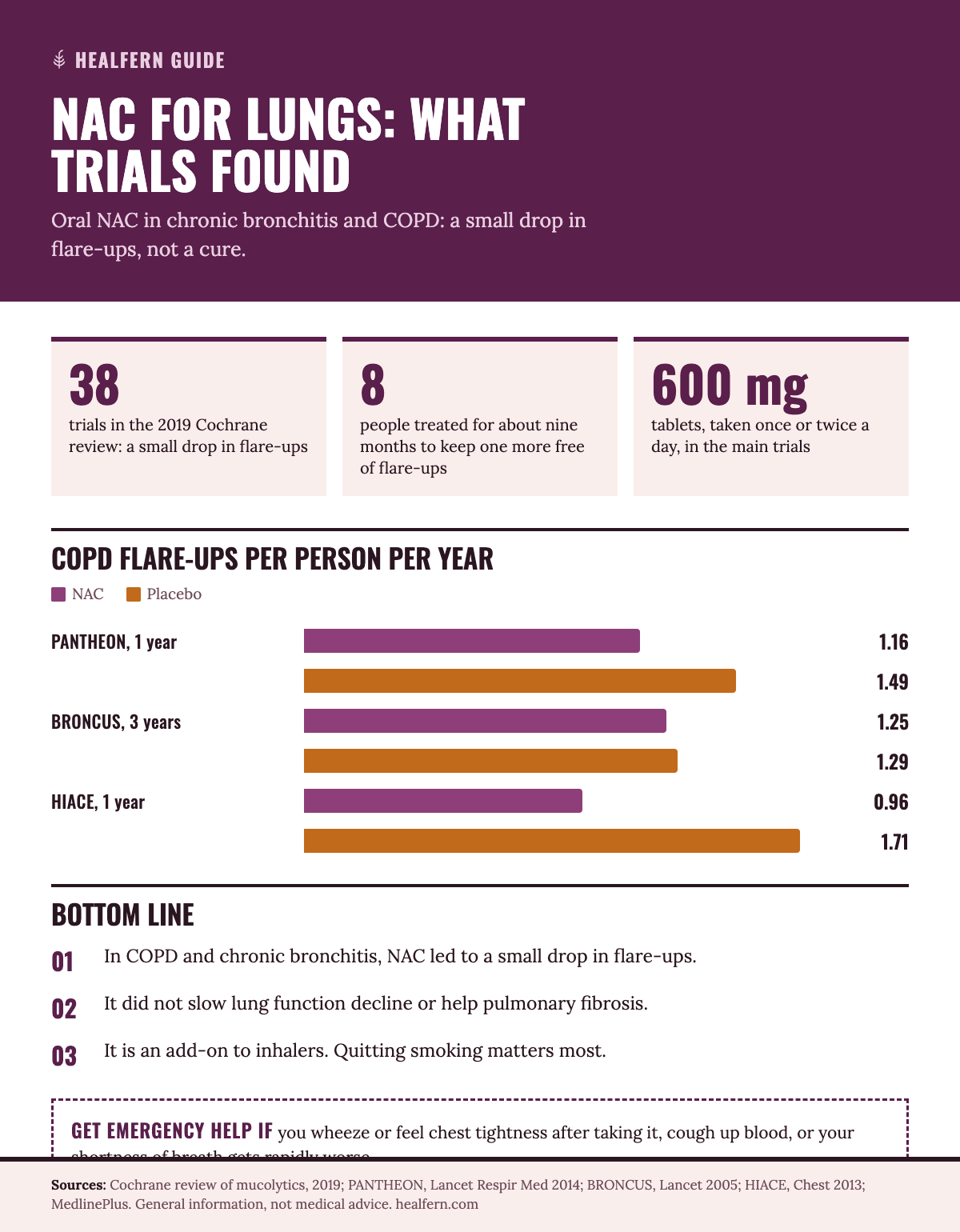
It seems to help a little. The 2019 Cochrane review pooled 38 trials of mucolytics, including NAC, in 10,377 people with chronic bronchitis or COPD. Treating eight people for about nine months kept one more person free of flare-ups, and days of disability fell by 0.43 a month.[3]
The big trials disagree with each other, though. PANTHEON, run at 34 Chinese hospitals, gave 1,006 people 600 mg twice a day for a year. Flare-ups fell from 1.49 to 1.16 per person per year, about 22% fewer.[4] The study was funded by a company that makes NAC.[4]
BRONCUS, a three-year European trial in 523 people, used 600 mg once a day. Flare-ups were 1.25 a year with NAC and 1.29 with placebo, no real difference.[5] The smaller HIACE trial in Hong Kong (120 people, 600 mg twice daily) reported 0.96 flare-ups a year versus 1.71.[6]
Cochrane flagged a warning sign: newer trials show less benefit than older ones, which may mean early results were inflated by bias.[3]
Who seemed to benefit most?
The trials point in different directions here. PANTHEON’s authors said the effect was clearest in moderate COPD.[4] A BRONCUS subgroup analysis suggested fewer flare-ups only in people not using inhaled steroids.[5] The 2015 meta-analysis found the benefit more apparent in chronic bronchitis without measurable airway obstruction.[7]
Cochrane, with the most data, found that COPD severity and past flare-ups did not seem to change the effect.[3] Subgroup findings like these need their own trials before anyone relies on them. Cochrane also found fewer people with a hospital stay, but the results were not consistent across studies, and the data were too imprecise to say anything about deaths.[3]
Does NAC improve lung function?
Not in a way that shows up on standard tests. In BRONCUS, the yearly drop in FEV1 (how much air you can blow out in one second) was 54 mL with NAC and 47 mL with placebo.[5] HIACE found better small-airway readings, but no change in breathlessness scores, quality of life or six-minute walking distance.[6] Cochrane saw limited impact on lung function or quality of life overall.[3]
| Study | Who and how long | Dose | Result |
|---|---|---|---|
| Cochrane review, 2019[3] | 38 trials, 10,377 adults with chronic bronchitis or COPD, 2 months to 3 years | NAC and other oral mucolytics | Small drop in flare-ups (8 treated for 1 to benefit); little effect on lung function |
| PANTHEON, 2014[4] | 1,006 people with moderate to severe COPD, 1 year | 600 mg twice daily | 1.16 vs 1.49 flare-ups a year; industry funded |
| BRONCUS, 2005[5] | 523 people with COPD, 3 years | 600 mg once daily | No difference in flare-ups or lung function decline |
| PANTHER, 2014[8] | 264 people with pulmonary fibrosis, 60 weeks | Oral NAC vs placebo | No difference in lung capacity, deaths or flare-ups |
Does NAC help pulmonary fibrosis?
No. The NIH-funded PANTHER trial randomly assigned 264 people with idiopathic pulmonary fibrosis (IPF) to NAC or placebo for 60 weeks. Forced vital capacity fell by 0.18 liters with NAC and 0.19 liters with placebo, which was not a significant difference.[8]
There was also no difference in deaths (4.9% vs 2.5%) or in acute flare-ups (2.3% in each group).[8] The trial originally had a third arm that combined NAC with prednisone and azathioprine. That arm was stopped early over safety concerns.[8]
Before PANTHER, NAC had been suggested as a helpful treatment for IPF even though placebo-controlled data were lacking.[8] If you have IPF and take NAC because of older advice, raise it at your next visit rather than stopping or starting anything on your own.
Does NAC help bronchiectasis or cystic fibrosis?
The evidence does not show a clear benefit for either. A 2026 meta-analysis of mucus-thinning drugs in bronchiectasis, NAC among them, found no significant drop in flare-ups. A Cochrane review found no evidence to recommend NAC or related thiol drugs in cystic fibrosis.[14][15]
Bronchiectasis
In bronchiectasis, mucus-thinning drugs are meant to break a cycle of poor mucus clearance, infection and inflammation. Registry data show 28% of patients use them, yet prescribing varies because the evidence is limited.[14]
The 2026 review pooled 24 studies with 7,051 adults and eight drugs, including NAC. In seven randomized trials with 1,259 people, flare-ups fell by 0.40 a year on average, a difference that was not statistically significant. Lung function rose slightly, by 3.23 percentage points of predicted FEV1. The authors rated the certainty of these results as low or very low, and most trials had some or high risk of bias.[14]
Cystic fibrosis
Inhaled acetylcysteine is one of the prescription options for thick mucus in cystic fibrosis.[1] Yet the 2013 Cochrane review of nine trials with 255 people found no significant clinical benefit from inhaled or oral thiol drugs, and seven of those trials were more than 10 years old.[15] The drugs were generally well tolerated.[15]
A later US trial gave 70 people with cystic fibrosis oral NAC or placebo three times a day for 24 weeks. Lung function held steady with NAC and fell with placebo, a difference of 150 mL in FEV1, but the main marker of airway inflammation in sputum did not change.[16] The authors called for more studies of clinical outcomes.[16]
| Condition | Best evidence | Finding |
|---|---|---|
| Bronchiectasis | 2026 meta-analysis, 24 studies, 7,051 adults[14] | No significant drop in flare-ups; small lung function gain; low or very low certainty |
| Cystic fibrosis | Cochrane review 2013, 9 trials, 255 people[15] | No evidence to recommend inhaled or oral thiol drugs |
| Cystic fibrosis | US trial 2015, 70 people, 24 weeks[16] | FEV1 held steady vs a decline on placebo (150 mL gap); sputum inflammation unchanged |
| Pulmonary fibrosis | PANTHER 2014, 264 people, 60 weeks[8] | No difference in lung capacity, deaths or flare-ups |
Can NAC help with colds, flu or chest congestion?
The evidence for colds and flu is thin and old. A 1997 Italian trial gave 262 people, mostly 65 or older, 600 mg of NAC twice a day or placebo for six winter months. The NAC group had fewer and milder flu-like episodes.[9]
NAC did not stop infection: the share of people who caught the H1N1 strain was similar in both groups. Among those infected, 25% on NAC developed symptoms compared with 79% on placebo.[9] People with chronic lung disease were excluded, so this trial says nothing about COPD.[9] We did not find a repeat trial of this size.
For chest congestion from thick mucus, the approved use is inhaled acetylcysteine given by nebulizer, usually 3 to 4 times a day, alongside other treatments.[1] That is a prescription product, different from the capsules sold as supplements. For a look at other cold remedies, see our guide to whether vitamin C helps with colds.
How much NAC was studied, and is it a supplement?
The lung trials used 600 mg tablets, taken once a day in BRONCUS and twice a day (1,200 mg total) in PANTHEON, HIACE and the 1997 flu trial.[4][5][6][9] The trials that found fewer flare-ups used the twice-daily amount.
Does more work better? A 2015 meta-analysis of 13 studies (4,155 patients) found 25% fewer flare-ups overall and its authors argued for at least 1,200 mg a day in people with airway obstruction.[7] But that was a comparison across different trials, and the Cochrane review found the type or dose of mucolytic did not seem to change the effect.[3] We would not treat a higher dose as proven.
NAC’s legal status is unusual. The FDA has said NAC is excluded from the definition of a dietary supplement because it was approved as a drug first. In 2022 it said it would use enforcement discretion, which means it does not plan to act against NAC sold as a supplement while it reviews the issue.[2] That is why you can still buy it as a supplement.
How long should you take NAC before judging it?
Think in months. The trials that counted flare-ups ran for one to three years, and the Cochrane estimate is based on about nine months of treatment on average. Flare-ups are counted per year, so a few weeks of use cannot show whether they are coming less often.[3][4][5]
PANTHEON and HIACE each lasted one year, and BRONCUS lasted three.[4][6][5] The trials in the Cochrane review ran from two months to three years.[3]
What to track
The trials measured flare-ups, so that is the number to watch. Note the date of each one, whether it needed antibiotics, and whether it led to a hospital stay. Antibiotics are the standard treatment for flare-ups caused by infection, and Cochrane looked at hospital stays as an outcome.[10][3]
Your breathing test is unlikely to change. FEV1 fell at a similar rate with NAC and placebo in BRONCUS, and Cochrane found little effect on lung function or quality of life.[5][3] Easier-to-clear mucus is the effect the inhaled drug is prescribed for.[1]
What happens when you stop
None of the trials we read reported what happened after people stopped taking NAC. If you started it for frequent flare-ups, talk with your lung doctor before stopping, the same way you would with any part of a COPD plan.[10]
Is NAC safe? Side effects and who should avoid it
Oral NAC was well tolerated in the big trials. In PANTHEON, 29% of people on NAC and 26% on placebo reported any side effect, and the most common serious event in both groups was a COPD flare-up.[4] A meta-analysis found side effects did not rise with dose.[7]
Inhaled acetylcysteine can cause nausea, vomiting, fever, runny nose, mouth swelling and throat irritation. It can also have a brief unpleasant smell.[1] MedlinePlus asks you to tell your doctor if you have asthma, are pregnant or plan to be, or are breastfeeding, and to list every medicine and supplement you take.[1]
Get emergency help right away if you have:
- chest tightness, wheezing, or trouble breathing or swallowing after taking it[1]
- coughing up blood[1]
- hives, rash or itching[1]
- a rapid increase in shortness of breath if you have COPD[12]
A cough with mucus that does not go away, shortness of breath that gets worse with mild activity, or frequent chest infections are reasons to see a doctor and get a breathing test (spirometry) before trying anything on your own.[12]
Should healthy people or smokers take NAC to protect their lungs?
The trials give no reason to. The lung trials enrolled people who already had COPD or another lung disease, and a 2014 mouse study raised a specific concern: NAC sped up the growth of lung tumors in mice. We found no human trial showing the same effect, but it argues against taking NAC as a general lung tonic.[3][8][17]
In the Swedish study, researchers added NAC or vitamin E to the diet of mice bred to develop lung cancer. Both antioxidants markedly increased tumor progression and shortened survival.[17] The researchers traced this to lower levels of reactive oxygen species, less DNA damage and lower activity of p53, a gene that normally restrains tumor growth.[17]
The authors wrote that antioxidants may speed the growth of early tumors or precancerous changes in high-risk groups, and they named smokers and people with COPD who take NAC for mucus.[17] The concern comes from mice. It still makes the case for using NAC only for a diagnosed problem and with a doctor involved.
For smokers, the step with real evidence is quitting. Up to 75% of people with COPD smoke or used to, and MedlinePlus calls quitting the best way to slow lung damage.[11][12]
If you already have COPD and your doctor suggests NAC, the human trials are the ones that apply to you. They showed a small drop in flare-ups, with side effects about the same as placebo.[3][4]
What do doctors use first for COPD and mucus?
MedlinePlus is clear that there is no cure for COPD, and that quitting smoking is the best way to slow lung damage.[12]
NHLBI lists the main treatments as bronchodilator inhalers, which relax the muscles around the airways, inhaled steroids for people with severe disease or frequent flare-ups, and newer nonsteroid anti-inflammatory medicines. One added in 2024 also helps the body clear mucus.[10] Antibiotics are used for flare-ups caused by infection.[10]
Pulmonary rehabilitation, a supervised program of exercise, education and breathing techniques, helps people breathe easier. Oxygen is added if blood oxygen is low, and NHLBI stresses annual vaccines and not smoking.[10] NHLBI also notes that many people use their inhaler the wrong way, so ask to be shown.[10]
If you and your doctor decide to add NAC, it sits on top of this plan. HIACE tested NAC on top of usual therapy, and PANTHEON included people who used inhaled steroids.[6][4]
Your NAC checklist
Use this before you buy or start NAC for your lungs.
- Get a diagnosis first. A lasting cough with mucus calls for a breathing test (spirometry).[12]
- Ask your doctor whether NAC fits your plan, especially if you have frequent flare-ups.[3]
- Check the label for 600 mg per capsule, the amount used in the trials. Our label reading guide explains serving sizes.[4]
- Keep taking your inhalers. NAC was tested as an add-on to usual therapy.[6]
- Tell your doctor if you have asthma, and stop and get help if you start wheezing.[1]
- Judge it over months. The Cochrane estimate is based on an average of about nine months of treatment.[3]
Browse more lung health guides, read about quercetin and what it was studied for, or see how we research our articles.
Verdict: a modest add-on for COPD flare-ups
NAC has been tested in large randomized trials, one with more than 1,000 people.[4] For people with chronic bronchitis or COPD, the pooled evidence points to a small drop in flare-ups, with side effects about the same as placebo.[3] It does not slow lung function decline and did not help pulmonary fibrosis.[5][8]
Our judgment: if you have COPD with frequent flare-ups, NAC at 600 mg twice a day is a reasonable thing to ask your lung doctor about. If you are healthy and hoping to “clean” or protect your lungs, the trials give you no reason to take it. Quitting smoking is the best way to slow lung damage.[12]
Questions people also ask
Is NAC good for your lungs?
For people with chronic bronchitis or COPD, a Cochrane review of 38 trials found mucolytics like NAC lead to a small drop in flare-ups. NAC did not slow lung function decline in a three-year trial, and there is no trial evidence it helps healthy lungs.
How much NAC should I take for COPD?
Trials used 600 mg tablets, once a day in BRONCUS and twice a day in PANTHEON and HIACE. The trials that found fewer flare-ups used 600 mg twice daily. Ask your doctor before starting, and keep using your prescribed inhalers.
Does NAC break up mucus?
Yes, that is its main action. MedlinePlus describes acetylcysteine as a mucolytic that thins mucus in the airways so it is easier to cough up. The prescription inhaled form is used with other treatments for chest congestion from thick mucus.
Does NAC help pulmonary fibrosis?
No. The NIH-funded PANTHER trial gave 264 people with idiopathic pulmonary fibrosis NAC or placebo for 60 weeks and found no difference in lung capacity, deaths or acute flare-ups between the two groups.
What are the side effects of NAC?
Oral NAC was well tolerated in trials, with side effects reported by 29% on NAC and 26% on placebo in PANTHEON. Inhaled NAC can cause nausea, throat irritation and runny nose. Wheezing, chest tightness or hives need urgent medical help.
Is NAC a drug or a supplement?
Both, in a way. The FDA says NAC is excluded from the supplement definition because it was approved as a drug first, but in 2022 it said it would use enforcement discretion, so NAC labeled as a supplement can still be sold.
Sources
- Acetylcysteine Oral Inhalation, MedlinePlus Drug Information, National Library of Medicine
- Policy Regarding N-acetyl-L-cysteine; Guidance for Industry; Availability, US Food and Drug Administration, Federal Register, 2022
- Mucolytic agents versus placebo for chronic bronchitis or chronic obstructive pulmonary disease, Poole et al., Cochrane Database of Systematic Reviews, 2019
- Twice daily N-acetylcysteine 600 mg for exacerbations of COPD (PANTHEON): a randomised, double-blind placebo-controlled trial, Zheng et al., Lancet Respiratory Medicine, 2014
- Effects of N-acetylcysteine on outcomes in COPD (BRONCUS): a randomised placebo-controlled trial, Decramer et al., The Lancet, 2005
- High-dose N-acetylcysteine in stable COPD: the 1-year HIACE study, Tse et al., Chest, 2013
- Influence of N-acetylcysteine on chronic bronchitis or COPD exacerbations: a meta-analysis, Cazzola et al., European Respiratory Review, 2015
- Randomized trial of acetylcysteine in idiopathic pulmonary fibrosis (PANTHER-IPF), IPF Clinical Research Network, New England Journal of Medicine, 2014
- Attenuation of influenza-like symptomatology and improvement of cell-mediated immunity with long-term N-acetylcysteine treatment, De Flora et al., European Respiratory Journal, 1997
- COPD Treatment, NHLBI, National Institutes of Health
- COPD, MedlinePlus, National Library of Medicine
- Chronic obstructive pulmonary disease (COPD), MedlinePlus Medical Encyclopedia, National Library of Medicine
- N-Acetylcysteine as an antioxidant and disulphide breaking agent: the reasons why, Aldini et al., Free Radical Research, 2018
- Mucoactive agents in bronchiectasis: a systematic review and meta-analysis, McCullough et al., European Respiratory Review, 2026
- Nebulized and oral thiol derivatives for pulmonary disease in cystic fibrosis, Tam et al., Cochrane Database of Systematic Reviews, 2013
- Long-term treatment with oral N-acetylcysteine: affects lung function but not sputum inflammation in cystic fibrosis subjects, Conrad et al., Journal of Cystic Fibrosis, 2015
- Antioxidants accelerate lung cancer progression in mice, Sayin et al., Science Translational Medicine, 2014
This article is general information, not medical advice. These statements have not been evaluated by the FDA, and supplements are not intended to diagnose, treat, cure or prevent any disease. Talk to your doctor or pharmacist before you start a supplement. How we research.

