To treat seasonal allergies, start with avoidance: windows shut, air conditioning on, sunglasses outdoors. Then use a steroid nasal spray every day, starting a week or two before your season. Add a non-drowsy antihistamine or eye drops for itch, and rinse with distilled or boiled water. If that fails, allergy shots or tablets can change the allergy itself.
We read the MedlinePlus entry on allergic rhinitis, the treatment pages from the two US allergy societies (ACAAI and AAAAI), the FDA’s guidance on nasal rinsing and on montelukast, the 2018 Cochrane review of saline rinses, and the recent trial reviews on quercetin, butterbur, probiotics and vitamin C. Every claim below links to the page or paper it came from.
The short version: cut your pollen exposure, use a steroid nasal spray every day through the season (start a week or two before it), add a non-drowsy antihistamine or eye drops for itch, and ask an allergist about immunotherapy if that is not enough.
| What it is | Hay fever (seasonal allergic rhinitis), a reaction to tree, grass and weed pollen or mold spores. It affects 40 to 60 million Americans.[2] |
|---|---|
| First step | Avoid the pollen you react to: windows shut, air conditioning on, indoors at peak times.[1][2] |
| Most effective medicine | Steroid nasal sprays, the single most effective drug class. Several are sold over the counter.[2][3] |
| Other first options | Non-drowsy antihistamine pills, antihistamine nasal sprays and eye drops, saline rinses.[1][2] |
| Long-term option | Allergy shots for 3 to 5 years, or under-the-tongue tablets for grass, ragweed or dust mite.[2][9] |
| Supplements | Quercetin-type polyphenols and probiotics have low-certainty evidence. Butterbur carries liver concerns.[11][13][14] |
| Biggest safety rules | Decongestant nasal sprays for 3 days at most. Rinse only with distilled, sterile or boiled water.[1][5] |
What is the first step to treat seasonal allergies?
The first step is to keep pollen out of your nose and eyes. MedlinePlus calls avoiding the pollens that trigger you the best treatment, and both US allergy societies list avoidance before any medicine.[1][2] MedlinePlus admits you may not be able to avoid all pollen, but you can cut your exposure.
Hot, dry, windy days carry the most pollen, and rain washes it to the ground.[1] ACAAI says outdoor counts usually peak in midmorning and early evening, although that varies by plant.[2] Habits that help:
- Keep windows shut at home and in the car, and run the air conditioning. Skip window fans that pull pollen inside.[1][2]
- Wear glasses or sunglasses outdoors, and try not to rub your eyes.[2]
- Dry laundry indoors, since pollen clings to sheets and towels on a line.[2]
- Check local pollen counts and plan yard work or runs for lower days.[3]
A mask helps when you cannot stay inside. AAAAI notes that a surgical mask filters particles bigger than 3 micrometers and an N95 filters particles as small as 0.04 micrometers, while pollen grains run 10 to 100 micrometers.[4] A HEPA air purifier traps pollen in the air of one room, but it does nothing for allergens that have already settled on furniture and floors.[4]
Seasons are also getting longer. AAAAI reports that pollen seasons start earlier and run longer, and that average daily pollen counts have risen over the past 25 years.[4]
Does rinsing your nose with saline help allergies?
Yes, modestly. A 2018 Cochrane review of 14 trials with 747 adults and children found that saline rinses may lower patient-rated symptom severity for up to three months compared with no rinse, with no reported side effects. The evidence was rated low quality, and no study ran past three months.[6] NCCIH also calls the benefit modest.[10]
A rinse washes pollen and mucus out mechanically, so it works alongside medicine rather than replacing it. When the review looked at saline added on top of a steroid spray or antihistamine, the data were too thin to say whether it helped further.[6]
How to rinse safely
The water matters more than the device. The FDA says tap water is not safe for nasal rinsing because it can carry organisms, including amoebas, that stomach acid would kill but that can survive in the nose and cause serious infections.[5] Use one of these:
- Distilled or sterile water, labeled as such.[5]
- Tap water boiled for 3 to 5 minutes and cooled to lukewarm. Stored in a clean closed container, it keeps for 24 hours.[5]
- Water run through a filter designed to trap infectious organisms.[5]
For a homemade solution, MedlinePlus gives 1 cup (237 ml) of distilled or boiled and cooled water, half a teaspoon (3 g) of salt and a pinch of baking soda.[1] Wash the device and let it dry between uses, and see a provider if you get fever, nosebleeds or headaches while rinsing.[5]
Which works best for allergies, a nasal spray or a pill?
A steroid nasal spray. ACAAI calls intranasal corticosteroids the single most effective drug class for allergic rhinitis, and MedlinePlus calls them the most effective treatment. They ease congestion, sneezing, itching and a runny nose, while most pills mainly help itch, sneezing and drip.[1][2]
Fluticasone (Flonase), triamcinolone (Nasacort), mometasone (Nasonex) and budesonide (Rhinocort) are all now sold without a prescription.[3] These are anti-inflammatory steroids, not the anabolic kind.[3]
Timing is most of the result
AAAAI advises starting a nasal steroid a week or two before your pollen season usually begins, then using it every day.[3] MedlinePlus says fluticasone may start to help in 1 to 2 days, but full benefit takes longer, and you should call your doctor if daily use for a week has not helped.[7] Spraying only on bad days gets you less relief, though MedlinePlus notes intermittent use can still help somewhat.[1]
Spray technique
Blow your nose first, tilt your head slightly forward and aim the tip away from the center wall of the nose (the septum).[2][7] The common side effects are dryness, stinging and nosebleeds, and pointing away from the septum reduces them.[2][3] Do not share the bottle, and throw it out once the labeled number of sprays is used.[7]
Are over-the-counter antihistamines safe to take every day?
For most adults the newer, low-sedating antihistamines are a reasonable daily option. ACAAI says second-generation products generally work well with minor side effects. Older ones such as diphenhydramine (Benadryl) can impair you the next day even when taken only at bedtime.[2][8]
Common over-the-counter choices named by the FDA include loratadine (Claritin), fexofenadine (Allegra), cetirizine (Zyrtec) and levocetirizine (Xyzal).[8] ACAAI lists sneezing, itching and a runny nose among what they relieve. For a stuffy nose, the steroid spray is the stronger tool.[1][2]
How to get more from them
Take them before symptoms start. ACAAI says a short-acting dose 30 minutes before a known exposure (a picnic in ragweed season, for example) helps most, and that a pill that “didn’t work” often would have if taken regularly for three to four days.[2] Do not take two antihistamines at once unless a doctor tells you to, and remember that alcohol and sedatives add to the drowsiness.[2]
Who should check first
Talk to your doctor before using antihistamines if you have glaucoma or an enlarged prostate, are pregnant or breastfeeding, or react badly to other medicines.[2] Older, sedating antihistamines can cause dry mouth, constipation and trouble urinating, especially in men with prostate problems.[3] Do not drive until you know how a product affects you.[1][2]
What about decongestants and other nasal sprays?
Decongestant nasal sprays clear a stuffy nose within minutes, but MedlinePlus says to stop after 3 days.[1] Longer use causes rebound swelling (rhinitis medicamentosa), so the nose gets more blocked and you spray more often.[2][3] Several other sprays are safe for regular use.
Decongestant pills can raise blood pressure and heart rate and cause nervousness or poor sleep.[3] Check with a doctor first if you have high blood pressure or heart disease, are pregnant, or take medicine for mood or behavior.[2] The options below come from ACAAI and MedlinePlus.
- Saline spray: can be used as often as needed for dryness or thick mucus.[2]
- Antihistamine nasal sprays (azelastine, olopatadine): work fast enough to use as needed, and may cause drowsiness or a bitter taste.[1][2]
- Cromolyn spray (NasalCrom): best used before exposure, four times daily, and may take several weeks to help.[2]
- Ipratropium spray (prescription): reduces a dripping nose.[2]
Montelukast comes last, not first
Montelukast (Singulair) is a prescription pill that blocks leukotrienes. In 2020 the FDA added a Boxed Warning about serious mood and behavior changes, including suicidal thoughts. It said that for hay fever, montelukast should be reserved for people who cannot use other allergy medicines or did not get relief from them.[8] If you or your child take it and notice agitation, vivid dreams, depression or sleep trouble, stop and contact a clinician right away.[8]
How do you treat itchy, watery allergy eyes?
Start with barriers and drops. Wear sunglasses outdoors, do not rub, and use antihistamine eye drops as needed for itching and watering, as MedlinePlus advises.[1][2] Oral antihistamines also ease eye itch, burning and tearing.[2]
Some over-the-counter drops are meant for short-term use only. ACAAI warns that long use of some of them can make eye symptoms worse, and that prescription drops are available for longer-term relief.[2] Ask your allergist or pharmacist if you are unsure about a specific product.[2]
A steroid nasal spray can help the eyes too. Over-the-counter fluticasone is labeled for itchy, watery eyes caused by hay fever as well as nasal symptoms.[7] Fluticasone may raise the risk of glaucoma or cataracts, so report eye pain, blurred vision or halos around lights.[7]
If an eye is red, sticky or painful, or your symptoms do not match your pollen season, read our guide to pink eye symptoms and get checked.
When should you consider allergy shots or tablets?
Consider immunotherapy when medicines do not control your symptoms, cause side effects you cannot live with, or you cannot avoid the pollen. ACAAI calls allergy shots the most effective form of immunotherapy, and MedlinePlus says severe cases need them.[1][2][9] It is the only option here that changes how your immune system reacts.[9]
Shots contain small amounts of the allergens you react to, in rising doses. ACAAI describes injections about once a week for roughly seven months, then every two weeks, then every four weeks, for a total of three to five years.[9] Because a severe allergic reaction (anaphylaxis) can occur soon after an injection, shots are given in an allergist’s office.[9]
Under-the-tongue tablets
Sublingual tablets were approved by the FDA in 2014. You dissolve one under the tongue daily, starting several months before the season, for up to three years.[2] They exist only for certain grass pollens, ragweed and house dust mite, and each covers a single allergen. Shots can cover several at once.[2][9]
You need allergy testing first. Skin prick testing is the most common method, with results in 10 to 20 minutes, and blood tests are used when skin testing is not possible.[1][2] Immunotherapy does not help nonallergic rhinitis.[2]
Do supplements like quercetin, butterbur, vitamin C or probiotics help allergies?
A few have some trial support, none has strong evidence, and one has a safety problem. Pooled trials of quercetin-type polyphenols and of probiotics show small symptom gains at low certainty. Butterbur matched an antihistamine in one trial but has liver concerns. Vitamin C does not appear to change hay fever.[11][12][13][14][15]
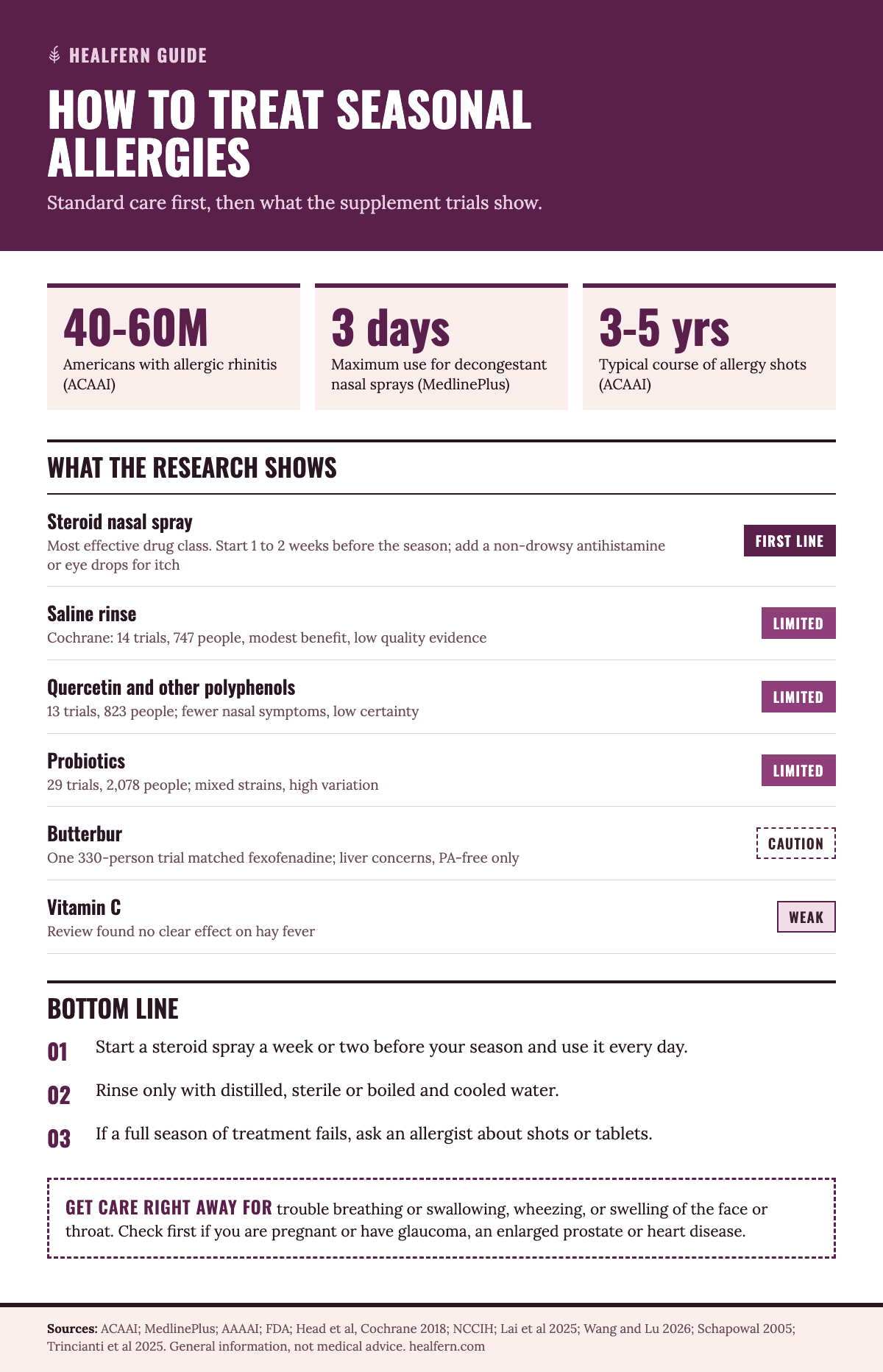
None of these is a substitute for the medicines above, and US law does not require supplements to be FDA approved before sale.[11] If you try one, use it alongside your spray. In our infographic, First line means what the allergy societies use first, Limited means several trials with small or low-certainty effects, Weak means no clear benefit, and Caution means some trial support plus a real safety concern.
Quercetin and other polyphenols
A 2025 meta-analysis pooled 13 randomized trials with 823 people taking polyphenols such as quercetin or catechins. Nasal symptoms, sneezing and nasal itch improved, but quality of life did not, and certainty was low to very low because of inconsistent results and risk of bias.[13] Our quercetin guide covers dosing and safety in more depth.
Butterbur
In a 2005 trial of 330 people, led from a Swiss allergy clinic, a butterbur extract (Ze 339, 8 mg total petasine three times daily) and fexofenadine 180 mg once daily both beat placebo, with no difference between them.[12] NCCIH says leaf extract studies suggest it may help hay fever.[11] The catch: the plant contains pyrrolizidine alkaloids (PAs), which can damage the liver and lungs and may cause cancer. NCCIH says to consider only products labeled or certified PA-free, notes rare liver injury even with products reported as PA-free, and says PA-free products seemed safe for up to 16 weeks in studies.[11] Butterbur can also cause reactions in people allergic to ragweed, daisies, marigolds or chrysanthemums.[11]
Vitamin C
A 2025 review found that oral vitamin C intake does not appear to affect allergic rhinitis in any significant way, and called its role there unclear.[15]
Probiotics
A 2026 meta-analysis of 29 randomized trials with 2,078 children and adults found better quality of life and nasal symptom scores with probiotics. The authors flagged high variation between studies and mixed strains, and said routine use is not supported by high-certainty evidence.[14] NCCIH reaches a similar view: some benefit, but formulations vary too much for firm conclusions.[10]
| Study | Who and how many | What was given | Result |
|---|---|---|---|
| Lai, 2025 meta-analysis[13] | 13 trials, 823 people, seasonal and year-round allergies | Polyphenols such as quercetin or catechins | Fewer nasal symptoms; no quality-of-life change; low to very low certainty |
| Wang and Lu, 2026 meta-analysis[14] | 29 trials, 2,078 children and adults | Various probiotic strains | Better quality of life and nasal scores; high heterogeneity |
| Schapowal, 2005 trial[12] | 330 people with intermittent hay fever | Butterbur Ze 339 three times daily vs fexofenadine 180 mg vs placebo | Both active pills beat placebo, equal to each other |
| Trincianti, 2025 review[15] | Narrative review of published studies | Oral vitamin C | No clear effect on allergic rhinitis |
Is it allergies, a cold or a sinus infection?
Hay fever comes back with the same season each year, causes itch, and does not cause a fever. ACAAI notes that it is not caused by a virus or bacteria and is not contagious. Most colds improve in three to seven days.[2]
Itch is the strongest clue. Itchy eyes, nose, mouth or throat are typical of allergy, along with sneezing, a runny nose and watery eyes soon after exposure. Congestion, cough, clogged ears, dark circles under the eyes and tiredness can follow.[1]
Other nose problems can overlap. ACAAI notes that a deviated septum or nasal polyps can complicate allergic rhinitis, and that catching a cold makes them worse.[2] Antibiotics do nothing for allergic rhinitis.[2] If you have facial pressure, fever or symptoms that keep getting worse, our guide to sinus infection symptoms explains what to watch for.
How should children and pregnant people treat seasonal allergies?
Both groups can usually use the same tools, with more checking first. For children, read every label for the age range and dose. For pregnancy, ACAAI says some antihistamines appear safe but their full safety has not been established, so check with your allergist or obstetrician before starting.[2]
Children
- Allergic kids can seem moody or irritable in season, and ACAAI warns this should not be mistaken for attention deficit disorder.[2]
- Older, sedating antihistamines can cause nightmares, jumpiness or restlessness in some children.[3]
- Nasal rinsing may be used from about age 2 if a pediatrician recommends it, though very young children may not tolerate it.[5]
- Over-the-counter fluticasone may slow growth. Talk to the doctor if a child aged 2 to 11 needs it more than 2 months a year, or a child 12 or older more than 6 months a year.[7]
- Montelukast is approved for seasonal allergies from age 2, but carries the same Boxed Warning for children.[8]
Pregnancy and breastfeeding
Ask before starting antihistamines or decongestant pills.[2] Avoid butterbur products that contain PAs because they may cause birth defects or liver damage, and little is known about PA-free products in pregnancy.[11] A saline rinse with safe water is a low-risk first step.[5][6]
Adults with other conditions
People with glaucoma, an enlarged prostate, high blood pressure or heart disease should check before using antihistamines or decongestants, and men with prostate enlargement may have urinary problems on either.[2]
What are the most common mistakes in treating seasonal allergies?
The biggest mistake is starting too late and stopping too early. Allergy medicines work best when started before pollen is in the air, and nasal steroids need daily use for several days to reach full effect.[3] The others below come straight from the allergy societies and the FDA.
- Using a decongestant nasal spray for more than 3 days, which leads to rebound congestion.[1][2]
- Rinsing with plain tap water.[5]
- Judging an antihistamine after one dose instead of three to four days of regular use.[2]
- Stacking two antihistamines, or two products with the same active ingredient.[2]
- Spraying a steroid straight at the septum, which causes irritation and nosebleeds.[2]
- Taking antibiotics for allergies.[2]
- Using OTC redness-relief eye drops for weeks.[2]
- Assuming over-the-counter pills will be enough for moderate or severe allergies. ACAAI allergist James Sublett says that is rare.[2]
When should you see a doctor about seasonal allergies?
Make an appointment if your symptoms are severe, if a treatment that used to work has stopped working, or if nothing you try helps, which is MedlinePlus’s list.[1] Also call if daily fluticasone has not helped after a week.[7] An allergist can test you and discuss immunotherapy.[2]
Get care right away if
- You have trouble breathing or swallowing, wheezing, or swelling of the face, throat, tongue or lips. MedlinePlus lists these as reasons to stop fluticasone and get emergency treatment.[7]
- You feel faint, or have severe or frequent nosebleeds.[7]
- You have fever, severe face pain or thick discharge while using a nasal spray or rinse.[5][7]
- You notice mood changes, agitation or suicidal thoughts on montelukast.[8]
- You have any reaction after an allergy shot. These are given in the office because anaphylaxis is possible.[9]
Seasonal allergy action checklist
- Note when your symptoms start each year, and begin a steroid nasal spray a week or two before that date.[3]
- Use the spray every day through the season, aimed away from the septum.[2][3]
- Add a non-drowsy antihistamine or antihistamine eye drops for itch.[1][2]
- Rinse with distilled, sterile or boiled and cooled water only.[5]
- Close windows on high pollen days and wear sunglasses outside.[1][2]
- Cap decongestant sprays at 3 days.[1]
- Read every active ingredient so you do not double up.[2]
- If you try a supplement, read the label first (how to read a supplement label), and for butterbur accept only products certified PA-free.[11]
- See an allergist if you still struggle after a full season of correct treatment.[1][2]
More guides on colds, sinuses and immunity are in our immune system section. How we pick and check sources is explained on our how we research page.
The bottom line on treating seasonal allergies
For most people, steroid spray plus avoidance does most of the work. Add a newer antihistamine or eye drops for itch and a saline rinse if you like it.[1][2][3][6] If a full season of that leaves you miserable, allergy shots or tablets are the step that changes the allergy itself.[9]
Our judgment call: skip butterbur. It looked as good as fexofenadine in one trial, but fexofenadine is an over-the-counter pill the FDA lists among safe and effective allergy medicines, and butterbur comes with the liver concerns NCCIH describes.[8][11][12] Quercetin and probiotics are a reasonable experiment for some people, but only alongside a spray that you are already using correctly.[13][14]
Questions people also ask
What is the fastest way to treat seasonal allergies?
An antihistamine nasal spray such as azelastine works quickly enough to use as needed, and a short-acting antihistamine taken 30 minutes before exposure helps most. Steroid sprays work best overall but take several days of daily use to reach full effect.
When should I start my allergy nasal spray?
AAAAI advises starting a nasal steroid spray a week or two before your pollen season usually begins and using it every day. Fluticasone may help within 1 to 2 days, but full benefit takes longer. Call your doctor if a week of daily use has not helped.
Is it safe to use a neti pot for allergies?
Yes, if you use the right water. The FDA says to use distilled or sterile water, tap water boiled for 3 to 5 minutes and cooled, or specially filtered water. Plain tap water can carry organisms that cause serious infections in the nose.
How long can I use a decongestant nasal spray?
No more than 3 days, according to MedlinePlus. Longer use causes rebound swelling called rhinitis medicamentosa, so your nose gets more blocked and you need the spray more often. Saline sprays and steroid sprays are safe for regular use.
Does quercetin work for seasonal allergies?
Possibly a little. A 2025 meta-analysis of 13 trials with 823 people found polyphenols such as quercetin reduced nasal symptoms, but quality of life did not change and certainty was low to very low. Use it alongside standard medicine, not instead of it.
Do allergy shots really work for hay fever?
ACAAI calls allergy shots the most effective form of allergy immunotherapy and the only treatment that changes the immune system. A course runs three to five years, starting with weekly shots, and they are given in an allergist's office because severe reactions can occur.
Sources
- Allergic rhinitis, MedlinePlus Medical Encyclopedia, National Library of Medicine, reviewed 2026
- Hay Fever (Rhinitis): Symptoms and Treatment, American College of Allergy, Asthma and Immunology, accessed 2026
- Hay Fever and Allergy Medications, American Academy of Allergy, Asthma and Immunology, accessed 2026
- Allergic Rhinitis: Reducing Allergen Exposure in a Changing Environment, American Academy of Allergy, Asthma and Immunology, 2020
- Is Rinsing Your Sinuses With Neti Pots Safe?, US Food and Drug Administration, consumer update, 2025 (archived copy)
- Saline irrigation for allergic rhinitis, Head et al, Cochrane Database of Systematic Reviews, 2018
- Fluticasone Nasal Spray, MedlinePlus Drug Information, National Library of Medicine, accessed 2026
- FDA requires Boxed Warning about serious mental health side effects for montelukast, US Food and Drug Administration, Drug Safety Communication, 2020 (archived copy)
- Allergy Shots (Subcutaneous Immunotherapy), American College of Allergy, Asthma and Immunology
- 6 Things To Know About Complementary Health Approaches for Seasonal Allergy Relief, National Center for Complementary and Integrative Health, accessed 2026
- Butterbur: Usefulness and Safety, National Center for Complementary and Integrative Health, 2024
- Treating intermittent allergic rhinitis: a randomized, placebo and antihistamine-controlled study of Butterbur extract Ze 339, Schapowal et al, Phytotherapy Research, 2005
- Clinical Effects of Polyphenolic Compounds on Allergic Rhinitis: A Systematic Review and Meta-Analysis, Lai et al, Journal of Allergy and Clinical Immunology: In Practice, 2025
- Efficacy of probiotics on immunological and clinical outcomes in allergic rhinitis: an umbrella review and updated meta-analysis, Wang and Lu, BMC Immunology, 2026
- Vitamin C in Allergy Mechanisms and for Managing Allergic Diseases: A Narrative Review, Trincianti et al, Children, 2025
This article is general information, not medical advice. These statements have not been evaluated by the FDA, and supplements are not intended to diagnose, treat, cure or prevent any disease. Talk to your doctor or pharmacist before you start a supplement. How we research.