
Pink eye usually causes a pink or red eye, itching or burning, watering, and discharge that can crust the lashes shut overnight. Watery discharge after a cold suggests a virus, thick pus suggests bacteria, and intense itching in both eyes suggests allergy. Most cases clear in 1 to 2 weeks. Eye pain, light sensitivity or blurry vision need a doctor.
We read the National Eye Institute’s pink eye pages, the CDC’s symptom, treatment and clinician guidance, MedlinePlus, and the American Academy of Ophthalmology’s patient pages. We also read the 2013 JAMA systematic review of conjunctivitis and the 2023 Cochrane review of antibiotics, which pooled 21 trials with 8,805 people.
The short answer: pink eye usually causes a pink or red eye, itching or burning, watering, and discharge that can crust the lashes shut overnight, and most cases clear on their own within 1 to 2 weeks, but eye pain, light sensitivity or blurry vision that does not clear when you blink need a doctor.[1][5][9]
| What it is | Swelling and redness of the conjunctiva, the clear layer lining the eyelids and covering the white of the eye.[8] |
|---|---|
| Main symptoms | Pink or red eye, itching or burning, watery eyes, discharge, and crusted lids in the morning.[1][4] |
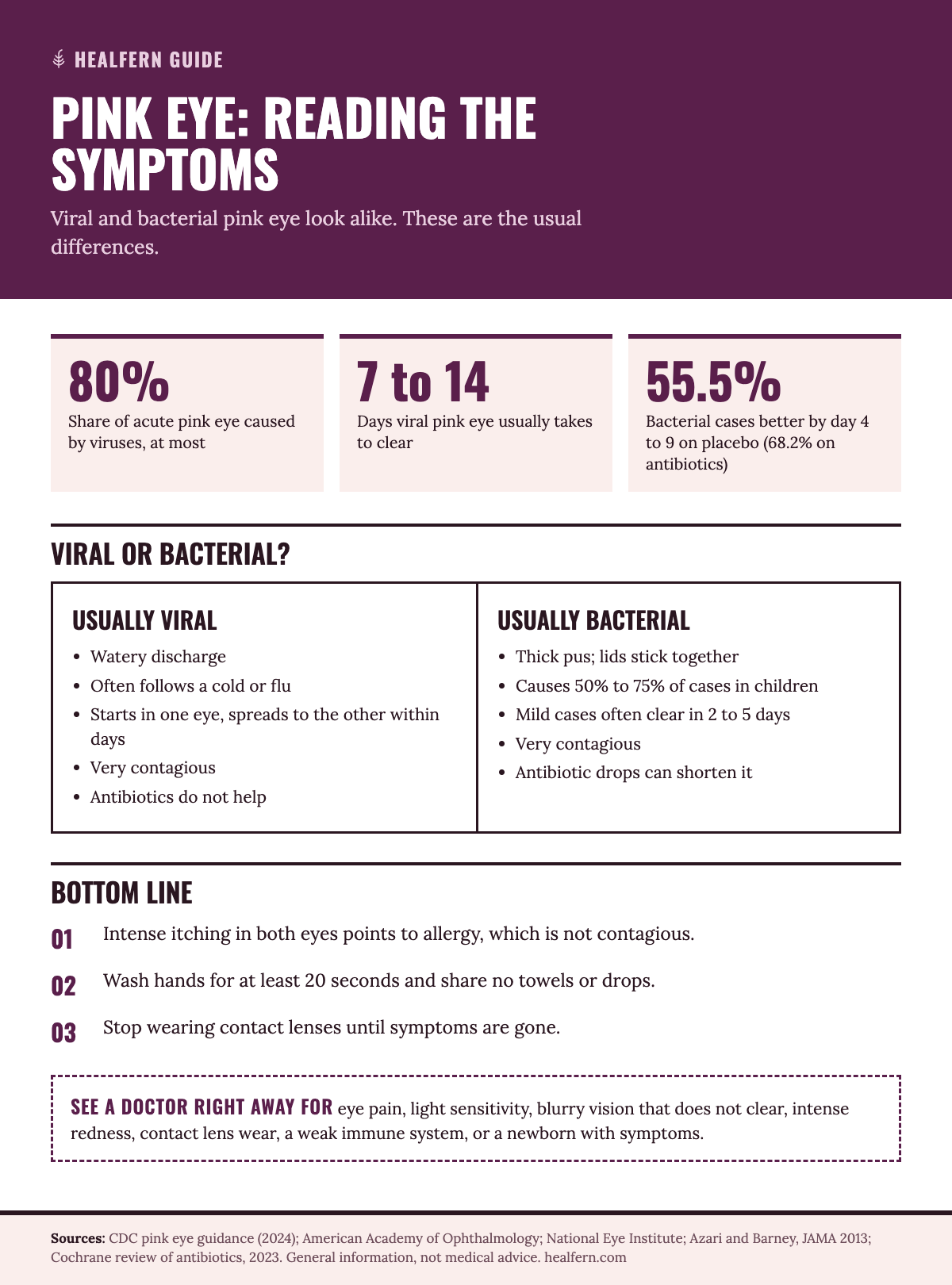
| Most common cause | Viruses, which cause up to 80% of acute cases. Bacteria and allergies are next.[11] |
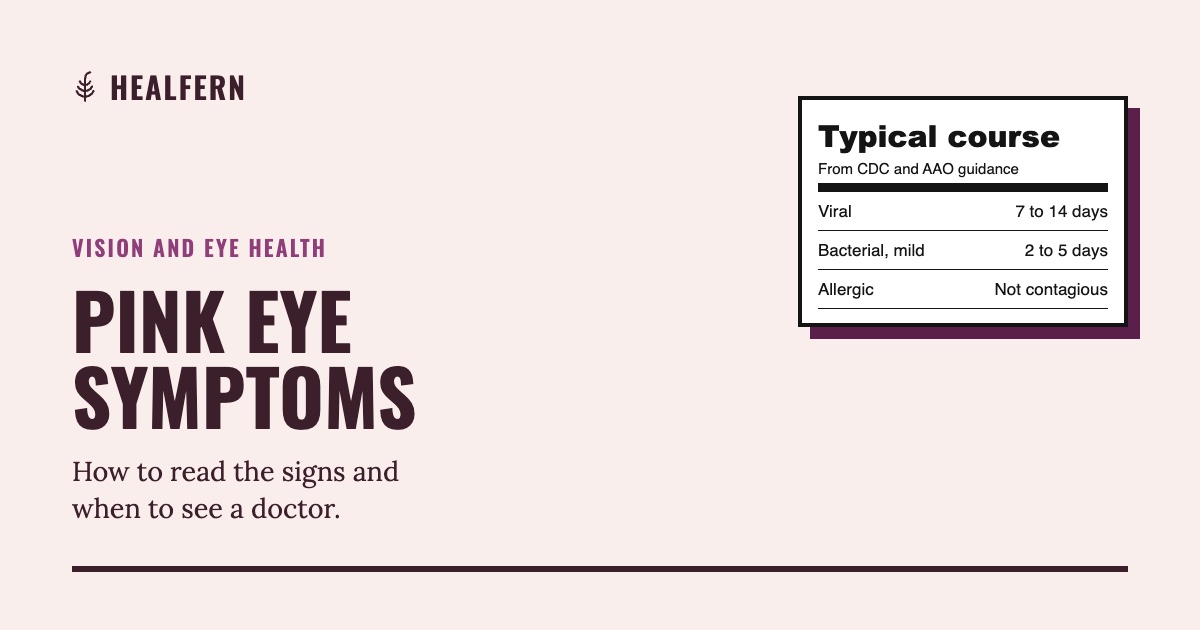
| How long it lasts | Viral: usually 7 to 14 days. Mild bacterial: often 2 to 5 days without treatment.[5] |
| Contagious? | Viral and bacterial types spread easily. Allergic pink eye does not spread.[3][9] |
| Antibiotic drops | Help only bacterial pink eye. In trials, 55.5% of people on placebo were better by days 4 to 9, versus 68.2% on antibiotics.[12] |
| See a doctor now if | Eye pain, light sensitivity, vision that stays blurry, intense redness, a weak immune system, contact lens use, or a newborn with symptoms.[5][1] |
What are the symptoms of pink eye?
The main symptoms of pink eye are a pink or red eye, itching or burning, watery eyes, and white, yellow or green discharge. The discharge can dry into a crust along the lashes, which may glue your eye shut when you wake up. One or both eyes can be affected.[1][4]
The color comes from swelling. When the conjunctiva is inflamed, the small blood vessels in it become easier to see, which turns the white of the eye pink or red.[3]
The National Eye Institute lists several other symptoms that may appear:[1]
- Swollen eyelids
- A feeling that something is stuck in your eye, or a gritty feeling
- Sensitivity to bright light
- Blurry vision
- A small lump in front of your ear, which is a swollen lymph node
Contact lens wearers often notice that their lenses feel uncomfortable or will not stay in place.[4]
Some of these symptoms are mild nuisances. Others, especially pain, light sensitivity and blurred vision that does not clear when you wipe away discharge, can point to a more serious eye problem. We cover those warning signs in detail below.[5]
Pink eye is very common. The JAMA review estimates that about 1% of all primary care visits in the United States are related to conjunctivitis.[11] For more on eye topics, see our vision and eye health archive.
How does pink eye usually start?
Pink eye often starts in one eye with redness, a gritty feeling and watering, then may spread to the other eye. With viral pink eye, the second eye usually becomes involved within a few days. Many people notice it first in the morning, when discharge has crusted the lashes overnight.[4][8]
The setting often gives a clue. Viral pink eye tends to show up during or right after a cold, flu or other respiratory infection, sometimes with a runny nose and sore throat.[4][9] If your eye problem arrived alongside a stuffy nose and facial pressure, our guide to sinus infection symptoms may also help.
The NEI says you are more likely to get pink eye if you:[1]
- Have been in contact with someone who has it
- Recently had a respiratory infection such as a cold
- Wear contact lenses
- Have been in contact with something you are allergic to
Children catch infectious pink eye more often than adults, because germs pass easily on hands and shared surfaces at school and day care. Adults more often pick it up from poorly cleaned contact lenses or from touching an infected surface at a gym or similar place.[9]
The infection can also come from your own body. The AAO notes that bacteria living in your nose and sinuses can spread to the eye.[9]
Viral, bacterial or allergic: how do the symptoms differ?
Viral pink eye usually brings watery discharge and often follows a cold. Bacterial pink eye tends to produce thick pus that sticks the lids together. Allergic pink eye causes intense itching in both eyes and is not contagious. These patterns overlap, so the type can be hard to tell.[4][9]
| Feature | Viral | Bacterial | Allergic |
|---|---|---|---|
| Discharge | Watery, not thick[4] | Thick pus; lids may stick together[4] | Watery; tearing[10] |
| Eyes affected | Often starts in one, spreads to the other within days[4] | One or both[4] | Usually both[4] |
| Main feeling | Burning[9] | Sore; pain is more common[9] | Intense itching[4] |
| Comes with | Cold, flu or respiratory infection[4] | Sometimes an ear infection[4] | Sneezing, itchy nose, asthma[4] |
| Contagious | Very[3] | Very[3] | No[9] |
Viral pink eye
Viral pink eye is the most common type overall and in adults.[11] It usually comes from the same viruses that cause the common cold, most often adenoviruses.[6][9] A swollen lymph node in front of the ear shows up in up to 50% of viral cases and is more common than with bacterial pink eye.[11]
Bacterial pink eye
Bacterial pink eye is the second most common infectious type in adults, but it causes the majority of cases in children, about 50% to 75%.[11] Lids that are matted shut on waking, no itching, and no past history of pink eye are the signs most linked to a bacterial cause.[11]
Allergic pink eye
Allergic conjunctivitis affects an estimated 15% to 40% of people, though few see a doctor for it.[11] Itching is the most consistent sign. Pollen, dust mites, animal dander, mold and cosmetics are common triggers.[6]
Symptoms overlap a great deal. In one study of people with lab-confirmed bacterial pink eye, 58% had itching and 35% had watery or no discharge.[11] That is why guessing the type from symptoms alone is unreliable.
What else can look like pink eye?
Several eye problems can mimic pink eye, including keratitis (inflammation of the cornea), irritation from chemicals or smoke, dry eye, and a foreign body such as a loose eyelash. Persistent symptoms, worsening pain, light sensitivity or vision changes mean you should see an eye professional rather than assume it is simple pink eye.[9][3]
Irritants are a common cause. Chemicals, smoke, dust, pool chlorine and air pollution can all inflame the conjunctiva.[8][1] Overuse of contact lenses, especially extended-wear lenses, can also cause it.[8]
Contact lens wearers need extra care
Contact lens wearers with bacterial pink eye are at higher risk of bacterial keratitis, an infection of the cornea. The CDC advises clinicians to have them remove their lenses, start antibiotic drops and see an ophthalmologist promptly.[6]
Some viral types are more serious
Epidemic keratoconjunctivitis, usually caused by certain adenoviruses, inflames both the conjunctiva and the cornea and can result in vision loss.[6] Herpes viruses can also cause conjunctivitis, often in one eye with blister-like sores on the skin.[6]
Conjunctivitis can also appear with measles and rubella, which bring a rash and fever, and has been seen in people with COVID-19 before other symptoms.[6][8]
Dry eye is a separate condition with its own treatments. If your eyes feel dry and gritty for weeks without discharge, our guide to omega-3 for dry eyes explains that condition and what the trials found.
What do pink eye symptoms look like in babies and children?
In newborns, pink eye usually shows up 1 day to 2 weeks after birth as discharge from the eye and puffy, red eyelids. It can be serious, so call the baby’s doctor right away. In older children, symptoms look like adult pink eye, and bacterial infection is the more common cause.[2][11]
Newborns
Newborn pink eye can come from an infection, irritation, or a blocked tear duct.[2] Bacteria or viruses in the birth canal can pass to the baby during delivery, including bacteria that cause sexually transmitted infections such as chlamydia and gonorrhea.[2]
MedlinePlus says an infection in a newborn must be treated at once to preserve eyesight.[8] Depending on the germ, treatment can mean antibiotics by mouth or through an IV.[2]
Some newborns get mild redness from the protective eye drops given at birth. That type usually clears in 1 to 2 days and is much less serious than an infection.[2] Only a doctor can tell which kind your baby has.
Older children
Bacterial infection causes 50% to 75% of pink eye in children, and it is seen more often from December through April.[11] Sometimes it comes with an ear infection.[4]
The AAO advises seeing a doctor right away for pain or trouble seeing, sensitivity to normal indoor light, more than a week of redness and discharge, or fever and achiness.[10]
How long do pink eye symptoms last?
Most pink eye clears within 1 to 2 weeks. Viral pink eye usually clears in 7 to 14 days but can take 2 to 3 weeks or longer. Mild bacterial pink eye often clears in 2 to 5 days without treatment but can take 2 weeks to go away completely.[9][5]
The NEI gives a similar estimate: pink eye often gets better on its own after 7 to 10 days.[1]
Allergic pink eye works differently. It lasts as long as you are exposed to the trigger and usually improves once the allergen is removed.[5][10]
When long-lasting symptoms are a red flag
Different sources draw the line at different points. MedlinePlus says to contact your provider if symptoms last longer than 3 or 4 days.[8] The CDC says to see a provider if symptoms get worse or do not improve, or if bacterial pink eye has not improved after 24 hours on antibiotics.[5] The AAO says to see an ophthalmologist if symptoms last longer than 1 to 2 weeks.[9]
A sensible reading: expect slow, steady improvement. If things are getting worse at any point, or not better after several days, get checked rather than waiting out the full two weeks.
Can you go to work or school with pink eye?
With allergic pink eye, yes, because it is not contagious. With viral or bacterial pink eye, the AAO advises staying home until your eyes are no longer red with discharge. The CDC says you may return without fever or other symptoms, with your doctor’s approval.[9][3]
The CDC adds that you should not attend if you still have symptoms and your work or school involves close contact with others.[3] Its clinician guidance says students should not attend school if they cannot avoid close contact.[6]
Schools and day cares set their own rules, and some require antibiotic drops before a child returns.[11] Check your school’s policy.
Avoid swimming pools while you have infectious pink eye.[7] Stay out of the gym too until your eyes clear, since shared equipment is one way adults pick it up.[9][10]
Viral pink eye spreads mainly by hand-to-eye contact, through hands or objects carrying the virus, and also through tears, eye discharge and respiratory droplets.[6] That is why the CDC’s prevention advice centers on handwashing.[7]
Do you need antibiotic eye drops for pink eye?
Usually not. Antibiotics do nothing for viral or allergic pink eye, and most bacterial cases clear on their own. Antibiotic drops shorten bacterial pink eye somewhat, so doctors use them in certain cases, such as heavy pus, a weak immune system, contact lens use, or suspected chlamydia or gonorrhea.[9][5][11]
| Source | What was studied | Size | Finding |
|---|---|---|---|
| Cochrane review, 2023[12] | Antibiotic drops or ointment vs placebo for acute bacterial pink eye | 21 trials, 8,805 people | Better by days 4 to 9: 55.5% on placebo vs 68.2% on antibiotics (moderate certainty) |
| Cochrane review, 2023[12] | Persistent infection | 19 trials, 5,280 people | 27% less likely with antibiotics |
| JAMA review, 2013[11] | Natural course of bacterial pink eye | Literature through March 2013 | At least 60% clear on their own within 1 to 2 weeks |
| JAMA review, 2013[11] | Share of acute cases by cause | Pooled studies | Viruses cause up to 80% |
Read together, these numbers explain the usual advice. Antibiotics help bacterial pink eye clear faster, but more than half of people improve within about a week without them.[12] Since most acute pink eye is viral anyway, many antibiotic prescriptions do nothing.[11]
The CDC lists cases where antibiotics may be necessary: discharge with pus, a weakened immune system, and when certain bacteria are suspected.[5] Pink eye caused by gonorrhea or chlamydia needs antibiotics by mouth or injection, not just drops.[11]
When should you see a doctor for pink eye?
See a doctor if you have eye pain, light sensitivity, blurred vision that does not clear when you wipe away discharge, intense redness, or symptoms that get worse or do not improve. People with weak immune systems, contact lens wearers and newborns with any symptoms should be seen promptly.[5][1]
See a doctor right away if
- You have moderate to severe eye pain.[9]
- Bright or normal indoor light hurts your eyes.[5][10]
- Your vision is blurry and does not clear when you wipe away discharge.[5]
- Your eye is intensely red, or symptoms are getting worse instead of better.[5]
- You wear contact lenses, or you recently scratched your eye.[1]
- You have a condition that weakens your immune system, such as cancer or HIV.[1]
- A newborn has eye discharge or puffy red eyelids.[2]
- You have fever, achiness or other signs of a serious infection, or a headache along with eye symptoms.[10][8]
- The skin around your eye becomes swollen or red.[8]
These signs matter because they can mean the cornea is involved, or that the cause is not ordinary conjunctivitis at all.[9] Some types, like epidemic keratoconjunctivitis, can threaten vision.[6]
How do doctors diagnose and treat pink eye?
Doctors usually diagnose pink eye by examining your eye and asking about your symptoms and recent illnesses. They sometimes swab the eye for a lab test. Treatment depends on the cause: supportive care for viral, antibiotics for some bacterial cases, and allergy drops for allergic pink eye.[5][8][9]
An in-office rapid test for adenovirus exists. The JAMA review reports 89% sensitivity and up to 94% specificity, and notes it can prevent unneeded antibiotics.[11]
Treatment by type
- Viral: there is no cure for most viral pink eye; the body clears it. Cool compresses and artificial tears ease discomfort. Doctors may prescribe antiviral medicine for herpes simplex or varicella-zoster infections.[9][5]
- Bacterial: antibiotic drops or ointment may be prescribed depending on severity. They can shorten the infection and reduce spread.[5]
- Allergic: avoid the trigger. Antihistamine eye drops and mast cell stabilizers relieve symptoms; steroid drops may be used in severe cases.[11][8]
- Chemical: rinse the substance out of the eye, then follow your doctor’s advice.[9]
Leave about 10 minutes between different types of eye drops.[8] Our research method explains how we choose sources like these.
What home care helps, and what should you avoid?
Cool compresses and over-the-counter artificial tears help most pink eye feel better. A warm, damp washcloth loosens crusted discharge. For allergic pink eye, avoiding the trigger and using allergy drops works best. No supplement or home remedy cures pink eye, and some popular ones can harm the eye.[5][10]
What helps
- Cool compresses and artificial tears to calm swelling and dryness.[5]
- A warm, damp washcloth laid over closed eyes until it cools, to loosen stuck lids. Use a clean cloth each time, and a separate one for each eye.[10]
- Ibuprofen or another over-the-counter pain reliever for discomfort.[10]
- No contact lenses until symptoms are gone or your eye doctor says it is fine.[5]
What to avoid
- Redness-relief drops such as Visine, which may be uncomfortable and make symptoms worse.[10]
- Breast milk in the eye. The AAO says studies suggest it does not work and it can introduce new bacteria.[10]
- Herbal extracts or foods in the eye. They are not sterile.[10]
- Steroid eye drops without an exam. In herpes pink eye, steroids can strengthen the virus and cause harm.[11]
We found no trial showing that any supplement shortens pink eye. Since viral pink eye often travels with a cold, you may also wonder about our review of vitamin C for colds, which covers what it does and does not do.
Checklist: how to stop pink eye from spreading
Viral and bacterial pink eye spread easily, mostly from hands to eyes. Good hygiene protects the people around you and your other eye. These steps come from CDC and NEI guidance.[7][1]
- Wash hands with soap and water for at least 20 seconds, or use hand sanitizer with at least 60% alcohol.[7]
- Wash hands before and after touching your eyes or putting in drops.[7]
- Clean discharge 2 or 3 times a day with a fresh wet washcloth or cotton ball each time.[1]
- Do not use the same eye drop bottle for an infected eye and a healthy eye.[7]
- Do not share pillows, towels, makeup, eye drops, contact lenses or glasses.[7]
- Wash pillowcases, sheets and towels often in hot water.[7]
- Throw away eye makeup, disposable lenses and lens cases used while infected.[1][7]
- Stay out of swimming pools until you are better.[7]
If you buy over-the-counter eye drops, check that the product is labeled for the eye and note its expiry date. Our label reading guide covers what to look for on any health product.
The verdict
Pink eye looks alarming but is usually mild. A red, watery, crusty eye that follows a cold is most likely viral and should clear in 1 to 2 weeks with cool compresses, artificial tears and careful handwashing.[5][11] Intense itching in both eyes points to allergy instead.[4]
Our judgment call: do not push for antibiotics for ordinary pink eye, since more than half of bacterial cases clear without them and they do nothing for the more common viral type.[12][11] Do push to be seen quickly for pain, light sensitivity, blurred vision, contact lens wear or a newborn with symptoms, because those are where pink eye stops being minor.[5]
Questions people also ask
What are the first signs of pink eye?
Pink eye often starts with redness, a gritty feeling and watering in one eye. Discharge may crust the lashes overnight, so many people notice it on waking. Viral pink eye usually spreads to the other eye within a few days.
How can I tell if pink eye is viral or bacterial?
Viral pink eye tends to cause watery discharge and often follows a cold. Bacterial pink eye tends to cause thick pus that sticks the lids together. Symptoms overlap a lot, so only a doctor can reliably tell the type.
How long is pink eye contagious?
Viral and bacterial pink eye stay contagious while you have symptoms. The AAO advises staying home until your eyes are no longer red with discharge, and the CDC says to return only without symptoms and with your doctor's approval.
Does pink eye go away on its own?
Usually. Viral pink eye clears in 7 to 14 days, and mild bacterial pink eye often clears in 2 to 5 days without treatment. In trials, 55.5% of people with bacterial pink eye improved by days 4 to 9 on placebo alone.
Do I need antibiotic eye drops for pink eye?
Often not. Antibiotics do nothing for viral or allergic pink eye. For bacterial pink eye they speed recovery, and doctors use them for heavy pus, contact lens wearers, weak immune systems or suspected chlamydia or gonorrhea.
When is pink eye an emergency?
See a doctor right away for eye pain, light sensitivity, blurry vision that does not clear when you blink, intense redness or worsening symptoms. Newborns with eye discharge or puffy red eyelids need a doctor right away.
Sources
- Pink Eye, National Eye Institute, 2025
- Pink Eye in Newborns, National Eye Institute
- About Pink Eye, CDC, 2024 (archived copy)
- Symptoms of Pink Eye, CDC, 2024 (archived copy)
- How to Treat Pink Eye, CDC, 2024 (archived copy)
- Clinical Overview of Pink Eye (Conjunctivitis), CDC, 2024 (archived copy)
- How to Prevent Pink Eye, CDC, 2024 (archived copy)
- Conjunctivitis or pink eye, MedlinePlus Medical Encyclopedia, 2024
- Conjunctivitis: What Is Pink Eye?, American Academy of Ophthalmology, 2026
- Pink Eye: Quick Home Remedies, American Academy of Ophthalmology
- Conjunctivitis: a systematic review of diagnosis and treatment (Azari, Barney), JAMA, 2013
- Antibiotics versus placebo for acute bacterial conjunctivitis, Cochrane Database of Systematic Reviews, 2023
This article is general information, not medical advice. These statements have not been evaluated by the FDA, and supplements are not intended to diagnose, treat, cure or prevent any disease. Talk to your doctor or pharmacist before you start a supplement. How we research.