Probably not much. In the year-long DREAM trial, 535 adults with moderate to severe dry eye took 3,000 mg of fish oil omega-3s or an olive oil placebo, and symptoms improved equally in both groups. The 2019 Cochrane review calls the evidence uncertain. Artificial tears, lid care and an eye exam come first, and a fish oil trial needs a doctor's OK.
We read the 2018 DREAM trial in the New England Journal of Medicine, the 2019 Cochrane review of 34 trials, the VITAL dry eye study, a 2023 meta-analysis and the NIH fact sheets on omega-3s and dry eye. We also checked what the National Eye Institute and the American Academy of Ophthalmology tell patients to try first.
The largest and best-run trial found fish oil did no better than an olive oil placebo for dry eye, and reviews that pool smaller studies call the evidence uncertain.[6][7]
| What it is | Fish oil supplements supplying the long-chain omega-3s EPA and DHA[5] |
|---|---|
| Why people use it | To ease burning, gritty, tired eyes, on the idea that omega-3s calm inflammation on the eye surface[5] |
| Amounts studied | 1,000 mg to 3,000 mg of EPA plus DHA a day, for 3 to 12 months[5][6] |
| Best evidence | DREAM trial, 535 adults: no better than placebo after 12 months[6] |
| Review verdict | Cochrane 2019: evidence “uncertain and inconsistent”[7] |
| Safety | Usually mild side effects such as fishy taste, heartburn and nausea[4] |
| Ask a doctor first if | You take warfarin or another blood thinner, or have heart rhythm problems[5] |
Does omega-3 help dry eyes?
For most people, probably not much. The biggest trial, DREAM, gave 3,000 mg of fish oil omega-3s a day for a year and saw the same symptom relief as an olive oil placebo.[6] Pooled reviews find possible small effects at best, and the NIH says the evidence shows no consistent link.[5][7]
The idea behind it is reasonable. Dry eye is partly an inflammatory problem of the eye surface, and EPA and DHA have anti-inflammatory effects in the body.[5] The National Eye Institute even lists low omega-3 intake as one risk factor for dry eye, next to age 50 or older, being female and wearing contact lenses.[1]
Dry eye is common: the NEI puts it at nearly 16.4 million Americans, and the NIH Office of Dietary Supplements says about 14% of US adults have it.[1][5] That is a big market, and fish oil is often sold as an easy add-on. When researchers tested it carefully, the payoff mostly disappeared.
What did the DREAM trial find?
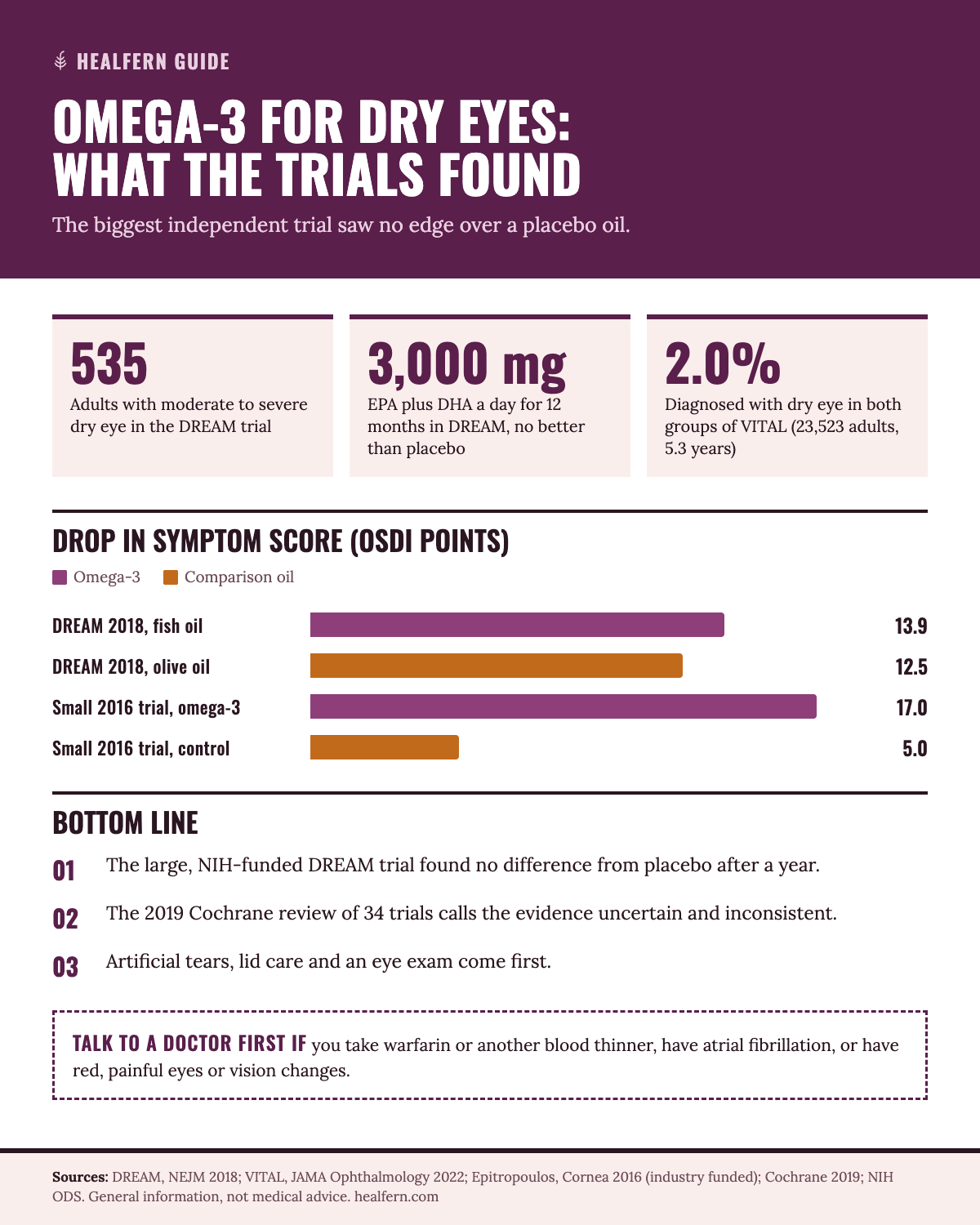
DREAM found no benefit. In this NIH-funded trial, 535 adults with moderate to severe dry eye took either 3,000 mg of omega-3s a day or an olive oil placebo for 12 months. Symptom scores fell by 13.9 points with fish oil and 12.5 points with placebo, a difference that was not statistically significant.[6]
The active capsules held 2,000 mg of EPA and 1,000 mg of DHA. The placebo held 5,000 mg of olive oil. About 81% of the people were women, with an average age of about 58.[5] Of them, 349 people got fish oil and 186 got placebo.[6]
The researchers also measured damage on the eye surface (staining scores), how fast the tear film broke up, and how much tear fluid the eyes made. None of those differed between groups either.[6]
Blood tests showed that 85.2% of the fish oil group was still taking the capsules at 12 months, and side effects were similar in both groups.[6] After the main trial, 43 people were randomly assigned to keep taking omega-3s or switch to placebo for another year. Again, outcomes did not differ.[4]
What happens if you stop taking fish oil for dry eye?
Not much, based on the one trial that tested it. In the DREAM extension study, people who had already taken 3,000 mg of omega-3s for a year were randomly assigned to keep taking them or switch to placebo for 12 more months. Symptoms changed about the same amount in both groups.[12]
The extension enrolled 22 people who stayed on omega-3s and 21 who switched to placebo. The gap in symptom change on the Ocular Surface Disease Index (OSDI) questionnaire was 0.6 points, which is close to nothing. Eye surface staining, tear break-up time and the Schirmer tear test did not differ either.[12]
The authors concluded that people who stopped did not do significantly worse than people who kept going.[12] With only 43 people, the study could miss a small effect. Still, it gives no sign that eyes get worse once the capsules stop.
What to track if you try it
DREAM judged success by symptoms on the OSDI questionnaire plus eye surface staining, tear break-up time and tear production.[6][12] Ask your eye doctor to record the same measures before you start and again at your stop date, so you compare like with like.
At home, a simple log helps: how many days your eyes bother you each week and how often you reach for drops. Trials ran 3 to 12 months.[5][6] A blood test called the omega-3 index shows the EPA and DHA in red blood cells over roughly the previous 120 days.[5] It shows whether the capsules raised your levels, but says nothing about how your eyes feel.
What does the Cochrane review say about fish oil and dry eye?
The 2019 Cochrane review pooled 34 trials with 4,314 adults and called the evidence for omega-3s “uncertain and inconsistent.” For long-chain omega-3s against placebo, it found low certainty evidence of little to no reduction in symptoms, based on 4 studies with 677 people.[7]
It did find a small increase in tear production on the Schirmer test, about 0.68 mm over 5 minutes across 6 studies and 1,704 people. The authors did not judge that difference to be clinically meaningful.[7] More than half of the included trials had a high risk of bias in at least one area, and follow-up ran from just 1 to 12 months.[7]
One comparison looked more favorable. In 2 small trials with 130 people, omega-3s beat omega-6 oils on symptoms, with moderate certainty.[7] Omega-6 oil is an active comparison, so this result cannot tell us whether omega-3s beat a placebo.
A 2023 meta-analysis by Wang and Ko pooled 19 trials with 4,246 patients and reported better symptoms and tear tests with omega-3s. The authors also warned that results varied widely between studies and that “caution is needed in generalizing these findings.”[8] An NCCIH-cited 2022 review of 8 studies (1,107 people) reached a similar “may improve” conclusion, with the same bias caveats.[4]
Does taking omega-3 lower your chance of getting dry eye?
No, according to the VITAL trial. Among 23,523 US adults aged 50 and older, 1,000 mg of omega-3s a day for a median of 5.3 years did not change how many people were diagnosed with dry eye: 2.0% in both the fish oil and placebo groups.[9]
VITAL is useful because it is so large and so long. The researchers checked medical records to confirm each diagnosis, and they also tracked reports of severe dry eye symptoms. That combined measure did not differ either (8.9% with fish oil, 9.1% with placebo).[9] The authors concluded that the results “do not support recommending” omega-3 supplements to lower the chance of developing dry eye.[9]
Diet studies point the other way, which is where some of the enthusiasm comes from. In the Women’s Health Study, 32,470 women with the highest omega-3 intake from food had a 17% lower risk of dry eye than those with the lowest intake.[5] But that was an observational snapshot. People who eat more fish may differ in many other ways, and a randomized trial is the better test.
Why did some smaller trials show a benefit?
Smaller trials were shorter, used different comparison oils, and some were paid for by supplement makers. Those features tend to make a supplement look better. When the large, independent, year-long DREAM trial used an olive oil placebo, the gap closed.[6][7]
Take the 2016 Epitropoulos trial. It gave 105 people with dry eye and oil gland problems 2,240 mg of omega-3s (1,680 mg EPA and 560 mg DHA) or a linoleic acid control for 12 weeks. Symptom scores fell by 17.0 points with omega-3s against 5.0 with the control.[10] The authors received payment from the company that makes the supplement, which the paper discloses.[10]
A 3-month trial of 518 people in northern India using 1,000 mg a day also reported fewer symptoms than placebo.[5] The Cochrane team notes that only 9 of its 34 trials were registered or had a published protocol, which makes selective reporting harder to rule out.[7]
| Study | Who and how many | Dose and length | Result |
|---|---|---|---|
| DREAM, NEJM 2018[6] | 535 adults, moderate to severe dry eye | 3,000 mg EPA plus DHA, 12 months | No better than olive oil placebo |
| Cochrane review 2019[7] | 34 trials, 4,314 adults | Varied, 1 to 12 months | Little to no symptom change vs placebo (low certainty) |
| VITAL ancillary, 2022[9] | 23,523 adults without dry eye | 1,000 mg, median 5.3 years | 2.0% diagnosed in both groups |
| Wang and Ko meta-analysis, 2023[8] | 19 trials, 4,246 patients | Varied | Benefit reported, wide variation between trials |
| Epitropoulos, 2016[10] | 105 adults with oil gland dysfunction | 2,240 mg, 12 weeks | Better symptoms; industry funded |
The 2023 meta-analysis found that higher doses, longer use and a larger share of EPA went with bigger effects.[8] That pattern comes from comparing different studies, not from a trial that tested doses head to head, and DREAM’s 3,000 mg dose was already high.[6]
Is krill oil better than fish oil for dry eyes?
One small trial hints that it might be, but the evidence is thin. A 2017 Australian study of 60 adults with mild to moderate dry eye found both krill oil and fish oil improved tear tests over 90 days. Only krill oil beat an olive oil placebo on symptoms.[11]
The krill group took 945 mg of EPA and 510 mg of DHA a day. The fish oil group took 1,000 mg of EPA and 500 mg of DHA, and the placebo group took 1,500 mg of olive oil.[11] Of the 60 people, 54 finished. OSDI symptom scores fell by 18.6 points with krill oil and 10.5 points with placebo.[11] Tear saltiness (osmolarity) dropped by about 19 mOsmol/L with both omega-3 oils and barely moved with placebo.[11]
The study ran at one site with roughly 18 people per group for 3 months. DREAM had 535 people and ran a full year.[6][11] One small positive trial cannot outweigh a large negative one.
The NIH Office of Dietary Supplements says krill oil carries its omega-3s mostly as phospholipids. Some studies suggest the body absorbs them a bit better than fish oil, and others do not.[5]
What about algal oil and flaxseed oil?
Algal oil is the vegetarian route to long-chain omega-3s. It usually provides about 100 to 300 mg of DHA, and some products add EPA.[5] Flaxseed oil supplies ALA, a plant omega-3. The body converts ALA to EPA and DHA poorly, at reported rates under 15%.[5]
That makes flaxseed a weak stand-in for the EPA and DHA amounts used in the eye trials above, which mostly tested fish oil or krill oil.[5][6][11]
Is omega-3 safe, and who should avoid it?
Fish oil is usually well tolerated. Common side effects are an unpleasant taste, bad breath, smelly sweat, headache, heartburn, nausea and diarrhea.[4] The FDA has concluded that supplements providing up to 5 g a day of EPA plus DHA are safe when used as recommended.[5]
Medicines and heart rhythm
Two large trials found that 4 g a day of omega-3s for several years slightly raised the risk of atrial fibrillation in people with heart disease or at high risk of it.[5] If you have a heart rhythm problem, talk to your doctor before taking fish oil at the doses used in dry eye studies.
Fish oil might also raise INR (a blood clotting measure) in people taking warfarin, although most research at 3 to 6 g a day found no meaningful change in anticoagulant status.[5] Anyone on a blood thinner should still check with a doctor or pharmacist first.
When dry eye needs a doctor
Contact a provider right away if your eyes are red or painful, you have discharge or a sore on the eye or eyelid, you have had an eye injury, or you have joint pain and a dry mouth along with dry eyes.[2] The American Academy of Ophthalmology also advises an eye exam if symptoms persist, get worse, or come with vision changes.[3] Severe dry eye left untreated can damage the cornea.[1]
Who might try fish oil for dry eye, and who should skip it?
Fish oil is a fair short experiment for an adult who eats little seafood, has had an eye exam and does not take a blood thinner. It is a poor first step on its own, a poor substitute for prescribed drops, and a question for your doctor if you have a heart rhythm problem.[3][5]
The US Dietary Guidelines suggest adults eat 8 ounces or more of a variety of seafood a week.[4] NCCIH notes that for some conditions the evidence for eating seafood is stronger than the evidence for omega-3 pills, and that seafood eaters tend to have healthier habits overall.[4] If you already eat fish often, a capsule adds less.
Match the plan to the type of dry eye
The TFOS DEWS II report, written by an international panel of dry eye experts, found that telling low tear production (aqueous deficient dry eye) apart from fast tear evaporation (evaporative dry eye) was critical for choosing treatment. It laid out a step-by-step plan based on severity.[13]
The same panel found that many dry eye treatments lack top-level evidence, often because trials were not masked, randomized or large enough.[13] Evaporative dry eye from blocked oil glands is common, and lid care is the first move there.[3] The 2016 trial that favored omega-3s enrolled people with oil gland problems, but it was industry funded.[10]
Pregnancy and cod liver oil
Federal guidance asks women who are pregnant or breastfeeding to eat 8 to 12 ounces of seafood a week from choices lower in methyl mercury.[4] Fish oil supplements have not been found to contain methyl mercury, because processing removes it.[5] Ask your obstetrician before adding a supplement.
Cod liver oil also carries vitamins A and D in amounts that vary, and both can be harmful in excess.[4]
What do eye doctors use first for dry eye?
Artificial tears come first. MedlinePlus advises using them at least 2 to 4 times a day, and the American Academy of Ophthalmology suggests preservative-free drops if you use them more than six times a day.[2][3] Supplements are never a replacement for an eye exam and standard care.
If drops are not enough, eye doctors can prescribe cyclosporine (Restasis) or lifitegrast (Xiidra), which help the eyes make more tears.[1] Tiny punctal plugs can keep tears on the eye longer.[1] Corticosteroid drops and oral doxycycline are other options for some people.[2]
Many cases involve blocked oil glands in the eyelids, called meibomian gland dysfunction, which the AAO calls a leading cause of evaporative dry eye. Warm compresses, lid massage and lid cleaning help here.[3]
The NEI also suggests a humidifier, screen breaks, wraparound sunglasses and avoiding smoke and air conditioning drafts.[1] Some medicines dry the eyes, including diuretics, beta-blockers, antihistamines, sleeping pills, antidepressants and heartburn drugs, so a medicine review is worth asking for.[3] MedlinePlus does list fish oil among other treatments, which is why some doctors still suggest it as an add-on.[2]
How do you read a fish oil label for dry eye?
Skip the big fish oil number on the front and add up the EPA and DHA in one serving. A typical 1,000 mg fish oil capsule holds about 180 mg of EPA and 120 mg of DHA. That is about 300 mg, a tenth of the 3,000 mg a day tested in DREAM.[5][6]
Products vary widely, so the Supplement Facts panel matters more than the brand name.[5] The FDA says supplement labels should not recommend more than 2 g a day of EPA plus DHA.[5] The NIH Dietary Supplement Label Database lets you compare the labels of many omega-3 products before you buy.[5]
| Type | What it holds | What to know |
|---|---|---|
| Natural triglyceride fish oil | EPA and DHA in the form found in fish | Absorbed somewhat better than ethyl esters[5] |
| Ethyl ester fish oil | EPA and DHA bonded to ethanol | Still raises blood EPA and DHA, just a bit less efficiently[5] |
| Re-esterified triglyceride | Ethyl esters converted back to triglycerides | The form used in the 2016 Epitropoulos trial[5][10] |
| Krill oil | EPA and DHA mostly as phospholipids | Absorption edge seen in some studies, not others[5] |
| Algal oil | About 100 to 300 mg DHA, sometimes EPA | Vegetarian option[5] |
| Cod liver oil | EPA, DHA, vitamin A and vitamin D | Vitamins A and D can be harmful in excess[4] |
Prescription omega-3 drugs are a separate category. They are approved to lower very high triglycerides, their makeup differs from store supplements, and NCCIH says their effects may not match those of supplements.[4]
What should you check before trying fish oil for your eyes?
If you and your eye doctor decide a trial of fish oil is worth it, go in with clear expectations and a stop date. Read the label for the actual EPA and DHA content, not the total fish oil weight, and see our guide to reading supplement labels.
- Get an eye exam first so the cause (oil glands, low tear volume, medicines, an autoimmune condition) is known.[3]
- Keep using artificial tears. In DREAM, people could continue their usual drops, and both groups improved.[5][6]
- Add up EPA plus DHA per serving. Studies used 1,000 to 3,000 mg a day.[5][6]
- Stay under 5 g a day of EPA plus DHA from all supplements combined.[5]
- Ask your doctor first if you take warfarin or have atrial fibrillation.[5]
- Give it a set period, such as 3 months, and stop if nothing changes. Trials ran 3 to 12 months.[5][6]
- Look for a third-party testing seal and skip products that claim to cure dry eye.
Eating fish is a fine habit for other reasons. Our MIND diet guide covers fish in a brain-healthy eating pattern, and our review of whether multivitamins work explains why large trials often overturn smaller ones. More eye topics live in our vision and eye health section, and how we research explains how we pick sources.
The verdict: is omega-3 worth it for dry eyes?
The best trial says no. A year of 3,000 mg a day did no better than olive oil in DREAM, and 5 years of 1,000 mg did not lower the chance of getting dry eye in VITAL.[6][9] The Cochrane review calls the rest of the evidence uncertain.[7]
Our judgment: start with artificial tears, lid care and an eye exam, because those have better support. Fish oil is a reasonable short experiment for someone who eats little fish and has a doctor’s OK, but it is a weak bet, and we would not pay for a premium “eye formula” on the strength of these trials.
Questions people also ask
Does fish oil help dry eyes?
In the DREAM trial, 535 adults took 3,000 mg of omega-3s or an olive oil placebo for a year, and symptoms improved about the same in both groups. The 2019 Cochrane review rates the overall evidence as uncertain and inconsistent.
How much omega-3 was used in dry eye studies?
Trials used roughly 1,000 to 3,000 mg of EPA plus DHA a day for 3 to 12 months. DREAM used 3,000 mg (2,000 mg EPA and 1,000 mg DHA). The FDA considers up to 5 g a day from supplements safe.
Can omega-3 stop me from getting dry eye?
The VITAL trial gave 23,523 adults 1,000 mg of omega-3s or placebo for a median of 5.3 years. Dry eye was diagnosed in 2.0% of both groups, so the supplement did not lower the chance of getting it.
What should I try first for dry eyes?
Artificial tears come first, used at least 2 to 4 times a day, with preservative-free drops if you need them more than six times daily. Warm compresses, lid cleaning, a humidifier and screen breaks also help, and an eye doctor can prescribe more.
Is fish oil safe with blood thinners?
Fish oil might raise INR in people on warfarin, though most research at 3 to 6 g a day found no meaningful change. Doses of 4 g a day slightly raised atrial fibrillation risk in heart patients, so ask your doctor first.
Is krill oil better than fish oil for dry eyes?
One 2017 trial of 60 adults found krill oil eased symptoms more than an olive oil placebo over 90 days, while fish oil improved tear tests but not symptoms. The trial was small and short, so it does not settle the question.
Sources
- Dry Eye, National Eye Institute, 2025
- Dry eye syndrome, MedlinePlus, National Library of Medicine, 2024
- What Is Dry Eye? Symptoms, Causes and Treatment, American Academy of Ophthalmology, 2025
- Omega-3 Supplements: What You Need To Know, NCCIH, 2024
- Omega-3 Fatty Acids: Fact Sheet for Health Professionals, NIH Office of Dietary Supplements, 2025
- n-3 Fatty Acid Supplementation for the Treatment of Dry Eye Disease (DREAM), New England Journal of Medicine, 2018
- Omega-3 and omega-6 polyunsaturated fatty acids for dry eye disease, Cochrane Database of Systematic Reviews, 2019
- Efficacy of Omega-3 Intake in Managing Dry Eye Disease: A Systematic Review and Meta-Analysis, Journal of Clinical Medicine, 2023
- Marine Omega-3 Fatty Acid Supplementation vs Placebo and Incidence of Dry Eye Disease (VITAL), JAMA Ophthalmology, 2022
- Effect of Oral Re-esterified Omega-3 Nutritional Supplementation on Dry Eyes, Cornea, 2016
- A Randomized, Double-Masked, Placebo-Controlled Clinical Trial of Two Forms of Omega-3 Supplements for Treating Dry Eye Disease, Deinema et al., Ophthalmology, 2017
- The Dry Eye Assessment and Management (DREAM) extension study: a randomized clinical trial of withdrawal of omega-3 supplementation, Hussain et al., The Ocular Surface, 2020
- TFOS DEWS II Management and Therapy Report, Jones et al., The Ocular Surface, 2017
This article is general information, not medical advice. These statements have not been evaluated by the FDA, and supplements are not intended to diagnose, treat, cure or prevent any disease. Talk to your doctor or pharmacist before you start a supplement. How we research.