Cataract symptoms usually start with cloudy or blurry vision, faded colors, glare and halos around lights, and poor night vision. Early cataracts often cause no symptoms. They do not hurt and usually grow slowly, so pain or sudden vision loss points to another problem. A dilated eye exam confirms a cataract, and surgery is the only treatment that removes it.
Cataract symptoms usually start with blurry or cloudy vision, faded colors and glare from lights, and they tend to build slowly over years. We read the National Eye Institute (NEI) cataract pages, MedlinePlus, the AREDS and AREDS2 cataract reports, a Cochrane review of antioxidant vitamins and two recent studies on driving and falls.[1][2][7][10][11][12]
A mild cataract often causes no symptoms at all, and the first signs most people notice are hazy vision and trouble with bright lights at night.[1] By age 80, more than half of Americans either have a cataract or have had surgery to remove one.[2]
| What it is | A cloudy area in the lens, the clear part of the eye that focuses light[1] |
|---|---|
| Main symptoms | Blurry or cloudy vision, faded colors, glare, halos, poor night vision, double vision[1][2] |
| Who gets it | Mostly older adults; lens proteins start to break down around age 40[1] |
| Main risks | Age, diabetes, smoking, heavy drinking, steroids, sun exposure, eye injury[1][4] |
| How it is found | A dilated eye exam, every 1 to 2 years from age 60[1][6] |
| Treatment | Surgery to replace the lens; 9 out of 10 people see better afterward[1][5] |
| Supplements | AREDS and AREDS2 formulas had no effect on cataract[7] |
What are cataract symptoms and signs?
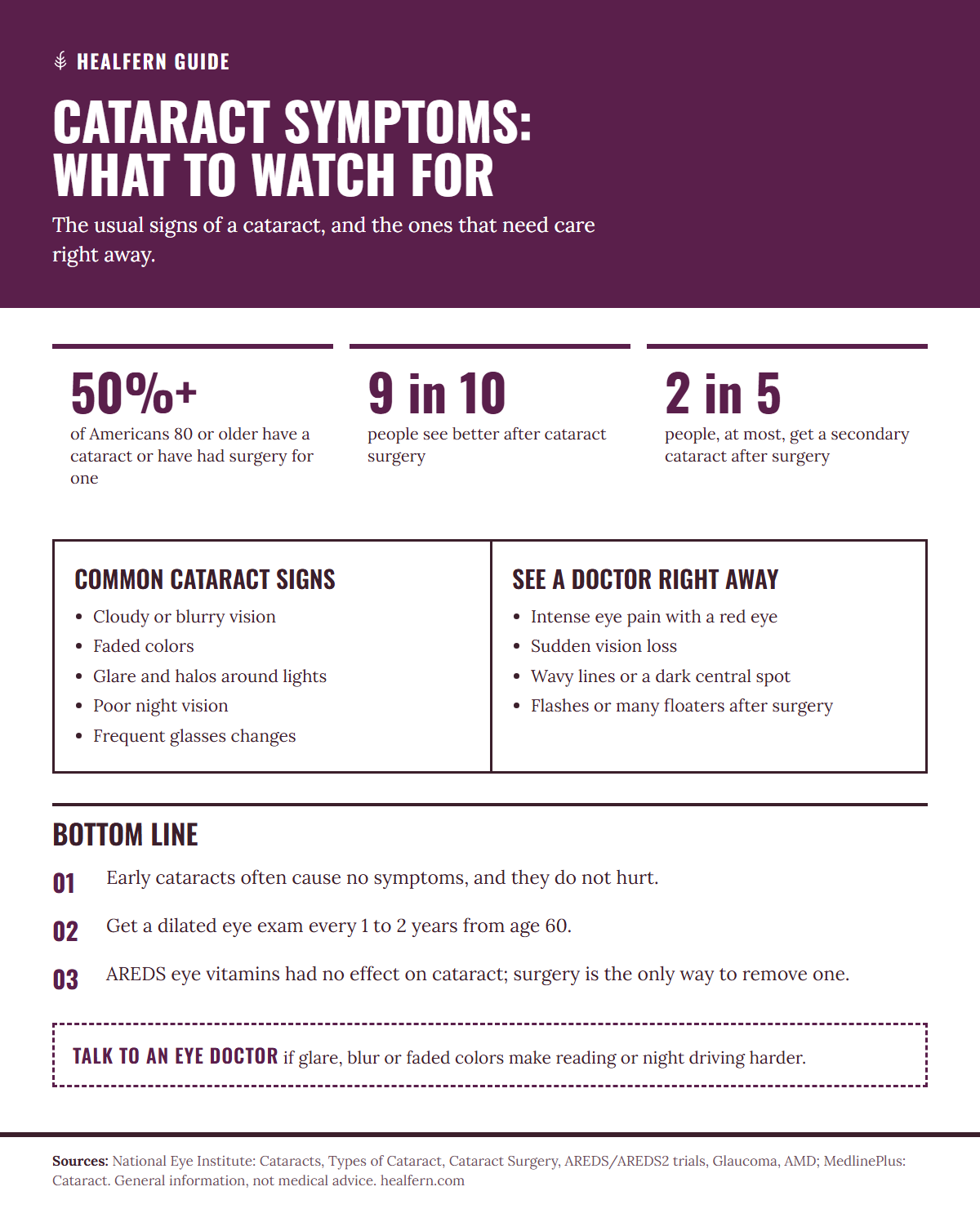
The main cataract symptoms are cloudy or blurry vision, colors that look faded, and lights that seem too bright or have halos around them. NEI also lists poor night vision, double vision and needing new glasses often.[1] These changes come from a cloudy lens that blocks and scatters light.[2]
The full list from NEI and MedlinePlus looks like this:[1][2]
- Vision that is cloudy, blurry, hazy or dim
- Colors that look faded or less bright
- Lamps, sunlight or headlights that seem too bright
- A halo around lights
- Trouble seeing well at night
- Double vision, which sometimes goes away as the cataract grows
- Frequent changes to your glasses or contact lens prescription
- Trouble reading or doing other everyday tasks
None of these signs is unique to cataracts. NEI and MedlinePlus both say they can also point to other eye problems, so an eye exam is the only way to know the cause.[1][2]
What are early cataract symptoms?
Early-stage cataracts usually cause no symptoms, which is why NEI lists early symptoms as “none”. The cloudy area starts small and grows slowly, so changes are easy to miss.[1][2] When early signs do show up, they are often mild glare, slightly dull colors or needing a stronger glasses prescription.[1]
Many people first notice a problem in one setting. Night driving feels harder because oncoming headlights look too bright. Reading needs more light than it used to.[1][2]
A cataract can form in one eye or both, but it cannot spread from one eye to the other.[1] If one eye is clearer, it can hide changes in the other. Covering each eye in turn while you look at a page or a sign is a simple way to notice a difference worth mentioning to your eye doctor.
Cataracts usually develop slowly, and brighter lighting or new glasses may be enough at first.[2] Once a cataract starts to interfere with daily tasks, it is time to talk about surgery.[2]
How do cataracts affect your vision day to day?
Cataracts scatter light inside the eye, so the biggest everyday effects are glare, washed-out colors and poor vision in dim light. MedlinePlus explains that the lens may turn yellow or brown, which changes how colors look.[2] People often notice this most when reading, driving at night or watching TV.[5]
Headlights, lamps and sunlight can seem far too bright, and lights may have halos.[1] Glare can make driving harder. A 2023 BMJ Open review of 101 studies with 778,052 people found that cataract surgery was linked to about half the risk of car crashes (relative risk 0.55, three studies).[11] The authors noted that the studies varied widely, so the size of that effect is uncertain.[11]
Colors can look faded or tinted because the lens takes on a yellow or brown tint.[4] After surgery, some people notice that colors seem brighter, because the artificial lens has no tint.[5] Double vision in one eye can happen with a cataract, and NEI notes it sometimes fades as the cataract gets bigger.[1]
Poor vision is linked to falls, but a 2026 study of Medicare enrollees found that cataract surgery did not change the one-year risk of falls or fractures. That risk was 8.86% without surgery.[12]
What causes cataracts, and at what age do symptoms start?
Most cataracts form because proteins in the lens break down and clump together with age, starting around age 40. The clumps grow thicker over time, so symptoms usually appear years after the process begins.[1][4] More than half of Americans aged 80 or older have a cataract or have had one removed.[1]
NEI lists factors that make cataracts more likely:[1][4]
- Diabetes and a family history of cataracts
- Smoking and drinking too much alcohol
- A lot of time in the sun, especially without sunglasses
- Steroid medicines, used for problems such as arthritis or allergies
- A serious eye injury, eye surgery such as glaucoma surgery, or radiation treatment
NEI also describes five main types. Age-related cataracts are the most common.[3] Traumatic cataracts can form soon after an eye injury or many years later. Radiation cataracts can follow UV exposure or cancer radiation. Pediatric cataracts are rare and usually genetic. Secondary cataracts form after cataract surgery.[3]
Worldwide, the WHO counts cataract as a cause of distance vision impairment or blindness in 94 million people, and 1 in 2 people who need cataract surgery cannot get it.[13]
Cataract vs glaucoma vs macular degeneration: how do the symptoms differ?
Cataracts blur your whole view like a foggy window, while glaucoma takes away side vision and macular degeneration damages central vision. All three can start with no symptoms, and all three are found with a dilated eye exam.[1][14][15] The table compares what each one usually feels like.
| Condition | Early stage | Later symptoms | Treatment |
|---|---|---|---|
| Cataract | None[1] | Cloudy vision, glare, halos, faded colors, poor night vision[1] | Surgery[1] |
| Glaucoma | Often none[14] | Loss of side vision, blind spots[14] | Eye drops, laser, surgery[14] |
| Macular degeneration (AMD) | None[15] | Wavy straight lines, blurry or blank spot in the center[15] | Depends on type and stage[15] |
A red, itchy or sticky eye is a different picture again. Our guide to pink eye symptoms and how they differ from other red-eye problems covers those signs, since cataracts do not make the eye red.[1]
You can have more than one of these at once. NEI notes that a doctor may remove a cataract partly to get a clear view of the back of the eye to track problems such as AMD or diabetic retinopathy.[5]
Do cataracts hurt or come on suddenly?
Cataracts do not cause pain and usually develop slowly, so sudden vision changes or a painful eye point to something else. Neither NEI nor MedlinePlus lists pain as a cataract symptom.[1][2] Intense eye pain with a red eye, nausea and blurry vision can mean angle-closure glaucoma, which needs care right away.[14]
A traumatic cataract after an eye injury can form soon after the injury or many years later, so any vision change after a blow to the eye needs a check.[3] Wavy lines or a dark spot in the center of your vision suggest a retina problem such as AMD, not a cataract.[15]
See a doctor right away if
- You have intense eye pain, a red eye, nausea or sudden blurry vision. Go to a doctor or an emergency room now.[14]
- Straight lines suddenly look wavy, or a blank spot appears in the center of your vision.[15]
- You lose vision, or notice flashes or many new floaters, after cataract surgery.[5]
- You have severe pain or a very red eye after surgery that medicine does not ease.[5]
Use this guide to decide how fast to act on a change in your vision.
| If you notice | Then |
|---|---|
| Slowly worsening blur, glare or faded colors | Book a dilated eye exam soon[1][6] |
| You are 60 or older with no symptoms | Get a dilated exam every 1 to 2 years[6] |
| You have diabetes | Most people need a dilated exam at least once a year[6] |
| Glare makes night driving unsafe | Avoid night driving until checked, and ask about surgery[5][11] |
| Sudden vision loss or eye pain | Seek care the same day[14] |
How are cataracts diagnosed and treated?
An eye doctor finds cataracts with a dilated eye exam, and surgery is the only way to remove one. Early on, brighter lights, anti-glare sunglasses, magnifying lenses and new glasses can help.[1] Surgery is usually suggested once a cataract gets in the way of reading, driving or watching TV.[1][5]
During the exam, drops widen the pupil so the doctor can see the lens and the back of the eye. It is simple and painless.[1][6] The exam also checks for glaucoma and other problems with no early warning signs.[6]
When to have cataract surgery
Most people do not need to rush. NEI says waiting usually will not harm your eyes or make surgery harder later.[1] In surgery, the doctor removes the cloudy lens and puts in an artificial lens called an intraocular lens (IOL).[5] The operation lasts about 1 hour, you are usually awake, and it is almost painless.[5]
About 9 out of 10 people see better afterward.[5] If both eyes need surgery, they are done at separate times, usually about a month apart. Most people are fully healed by 8 weeks.[5]
Secondary cataracts and other risks after surgery
A secondary cataract, also called posterior capsule opacification, makes vision cloudy again after surgery. Up to 2 in 5 people develop one.[3] It can appear weeks, months or years later.[5] A quick laser treatment called YAG laser capsulotomy fixes it, and most people see normally again within a few days.[3]
Possible problems include swelling, bleeding, infection, vision loss, double vision, changes in eye pressure and retinal detachment.[5] Tell your eye doctor about every medicine you take, since drugs that raise bleeding risk may need to be paused before surgery.[5] You will need someone to drive you home.[5]
Can cataracts be reversed or prevented with diet or vitamins?
No pill, diet or drop has been shown to reverse a cataract, and large trials found that eye vitamins do not prevent or slow them. NEI states that the AREDS and AREDS2 supplements do not have an effect on cataract.[7] Surgery remains the only treatment that removes one.[1]
| Study | Who and how long | What was tested | Result |
|---|---|---|---|
| AREDS report 9, 2001[8] | 4,629 people aged 55 to 80, about 6.3 years | Vitamin C 500 mg, vitamin E 400 IU, beta carotene 15 mg | No effect on lens clouding or cataract surgery |
| AREDS2 report 4, 2013[9] | 3,159 people, median 4.7 years | Lutein 10 mg and zeaxanthin 2 mg | No overall effect on cataract surgery or vision loss |
| Cochrane review, 2012[10] | 9 trials, 117,272 people | Beta carotene, vitamin C or vitamin E | No evidence of prevention or slowing |
Subgroups, safety and what does help
In AREDS2, people who ate the least lutein and zeaxanthin did a little better on the supplement, but this was a subgroup finding and not the main result.[9] Omega-3 supplements also had no effect on cataract.[7] If you take fish oil for another reason, our review of omega-3 for dry eyes and what the trials found covers that separate question.
Beta carotene turned skin yellow in 7.4% to 15.8% of people in the Cochrane trials, and NEI warns current and former smokers away from beta carotene because of lung cancer risk.[7][10]
To protect your eyes, NEI suggests sunglasses and a brimmed hat, protective eyewear for power tools and sports, quitting smoking, and plenty of fruits, leafy greens, nuts and whole grains.[1] MedlinePlus says blocking UV light can help delay cataracts.[2]
Bottom line
Cataract symptoms creep in slowly, with blur, glare, faded colors and poor night vision as the usual signs, and early cataracts often have none.[1] Pain, a red eye or sudden vision loss is not typical and needs prompt care.[14]
For most people, a dilated eye exam is a better first step than any supplement, because it confirms the cause and tells you whether surgery makes sense yet. You can browse more guides in our vision and eye health section, and see how we research our health articles.
Practical checklist
- Get a dilated eye exam every 1 to 2 years once you are 60, or yearly if you have diabetes and your doctor advises it.[6]
- Cover one eye at a time now and then to spot a change the other eye hides.
- Write down when glare, night driving or reading got harder, and bring the list to your exam.[1]
- Try brighter lamps, anti-glare sunglasses and an updated prescription while symptoms are mild.[1]
- Wear sunglasses and a brimmed hat outdoors, and quit smoking if you smoke.[1]
- Skip eye vitamins sold for cataracts; the NEI trials found no effect.[7]
Questions people also ask
Are cataracts hereditary?
They can run in families. NEI lists a family history of cataracts as a risk factor and suggests encouraging relatives to get checked. Most cataracts still come from normal aging of the lens, and pediatric cataracts are usually genetic.
Do cataracts cause blindness?
Without treatment, cataracts can lead to severe or even permanent vision loss, according to MedlinePlus. Worldwide they are a leading cause of blindness. Surgery replaces the cloudy lens, and about 9 out of 10 people see better afterward.
Can you have a cataract in only one eye?
Yes. A cataract can form in one eye or both, and it cannot spread from one eye to the other. A clearer eye can hide the change, so cover each eye in turn and mention any difference at your eye exam.
Is cataract surgery painful?
NEI describes it as almost painless. Numbing drops are used, you are usually awake, and the operation lasts about an hour. The eye may feel itchy or sensitive for a day or two, and most people are fully healed by 8 weeks.
Can children get cataracts?
Yes, though it is rare. Children can be born with cataracts or develop them later, usually for genetic reasons. Large ones need treatment right away so the child does not develop lazy eye (amblyopia) or other lasting vision problems.
Sources
- Cataracts, National Eye Institute, NIH, updated 2026
- Cataract, MedlinePlus, National Library of Medicine
- Types of Cataract, National Eye Institute, NIH, updated 2025
- Causes of Cataracts, National Eye Institute, NIH, updated 2024
- Cataract Surgery, National Eye Institute, NIH, updated 2024
- Get a Dilated Eye Exam, National Eye Institute, NIH
- AREDS/AREDS2 Clinical Trials, National Eye Institute, NIH, updated 2025
- A randomized, placebo-controlled, clinical trial of high-dose supplementation with vitamins C and E and beta carotene for age-related cataract and vision loss: AREDS report no. 9, Archives of Ophthalmology, AREDS Research Group, 2001
- Lutein/zeaxanthin for the treatment of age-related cataract: AREDS2 randomized trial report no. 4, JAMA Ophthalmology, AREDS2 Research Group, 2013
- Antioxidant vitamin supplementation for preventing and slowing the progression of age-related cataract, Cochrane Database of Systematic Reviews, Mathew et al., 2012
- Associations between vision impairment and vision-related interventions on crash risk and driving cessation: systematic review and meta-analysis, BMJ Open, Nguyen et al., 2023
- The association of cataract surgery with risk of falls and fractures among Medicare enrollees with cataract, Journals of Gerontology Series A, Thompson et al., 2026
- Blindness and vision impairment, World Health Organization fact sheet
- Glaucoma, National Eye Institute, NIH
- Age-Related Macular Degeneration (AMD), National Eye Institute, NIH
This article is general information, not medical advice. These statements have not been evaluated by the FDA, and supplements are not intended to diagnose, treat, cure or prevent any disease. Talk to your doctor or pharmacist before you start a supplement. How we research.