Early macular degeneration usually has no symptoms. As it progresses, straight lines can look wavy, a blurry or blank spot appears in the center of your vision, colors fade and dim light gets harder. Side vision stays. Wet AMD can change vision fast, so sudden distortion or a new dark spot needs an eye doctor right away. Anti-VEGF injections are the standard treatment.
Macular degeneration symptoms often stay hidden until the disease is past its early stage, and then they usually start with blurry or wavy central vision. We read the National Eye Institute pages on age-related macular degeneration (AMD), MedlinePlus, the AREDS and AREDS2 trials, a Cochrane review of eye injections and a 2023 study of the Amsler grid.[1][2][6][7][8][11]
Early AMD causes no symptoms, so the first sign most people notice is straight lines looking wavy or a blurry patch in the center of vision.[1] About 11 million Americans have AMD, and a sudden change in vision means you should see an eye doctor right away.[1]
| What it is | Damage to the macula, the part of the retina that gives sharp, straight-ahead vision[1] |
|---|---|
| Main symptoms | Blurry or wavy central vision, blank spots, dull colors, trouble seeing in dim light[1] |
| Types | Dry makes up 85 to 90 percent of cases; 10 to 15 percent of people with dry AMD go on to get the wet form[3] |
| Who gets it | Mostly people 55 and older, especially smokers, white people and those with a family history[1] |
| How it is found | A dilated eye exam, often with an OCT scan of the retina[1] |
| Main treatments | Anti-VEGF eye injections for wet AMD; AREDS2 vitamins for intermediate AMD[4][5] |
| Pain | AMD does not hurt, which is one reason it goes unnoticed[2] |
What are macular degeneration symptoms and signs?
The main macular degeneration symptoms are blurry or distorted vision in the center of what you look at, while side vision stays normal. The National Eye Institute (NEI) lists wavy or crooked straight lines, a blurry area near the center, blank spots and colors that look less bright.[1] Many people also find dim rooms harder to see in.[1]
AMD affects the macula, the small part of the retina used for reading, driving and recognizing faces.[2] Because only the center is hit, people with AMD can often still walk around a room using side vision.[3]
The signs you notice day to day tend to look like this:
- Door frames, tiles or lines of text that look bent or wavy[1]
- A smudge or gray patch in the middle of your view that may grow over time[1]
- Faces that look blurred when you look straight at them[2]
- Colors that seem faded[1]
- Needing much more light to read, and slow adjustment when you walk from a bright room into a dark one[1][3]
AMD does not cause pain or redness.[2] It often affects one eye before the other, and the stronger eye can hide the change for a long time.[3]
What are the first signs of macular degeneration?
Early AMD has no symptoms, so the first sign is usually something an eye doctor spots during an exam. NEI says plainly that early dry AMD “doesn’t cause any symptoms,” which is why an eye exam finds it before you do.[1] In the intermediate stage, some people notice mild blur in their central vision or trouble seeing in low light.[1]
What an eye doctor sees first is drusen, small yellow deposits under the retina.[3] Subtle changes can show up in a person’s forties or fifties, while vision loss usually becomes noticeable in their sixties or seventies.[3]
One early clue that is easy to dismiss is slow dark adaptation. MedlinePlus Genetics notes that slow adjustment to darkness and weaker vision in dim light often occur in the early stages.[3] If you find yourself waiting longer than you used to before you can see in a dark movie theater, mention it at your next eye exam.
Early signs carry a fairly low short-term risk. In the AREDS trial, people with only early signs had a 1.3% chance of reaching advanced AMD within 5 years.[6]
Wet vs dry macular degeneration symptoms: what is the difference?
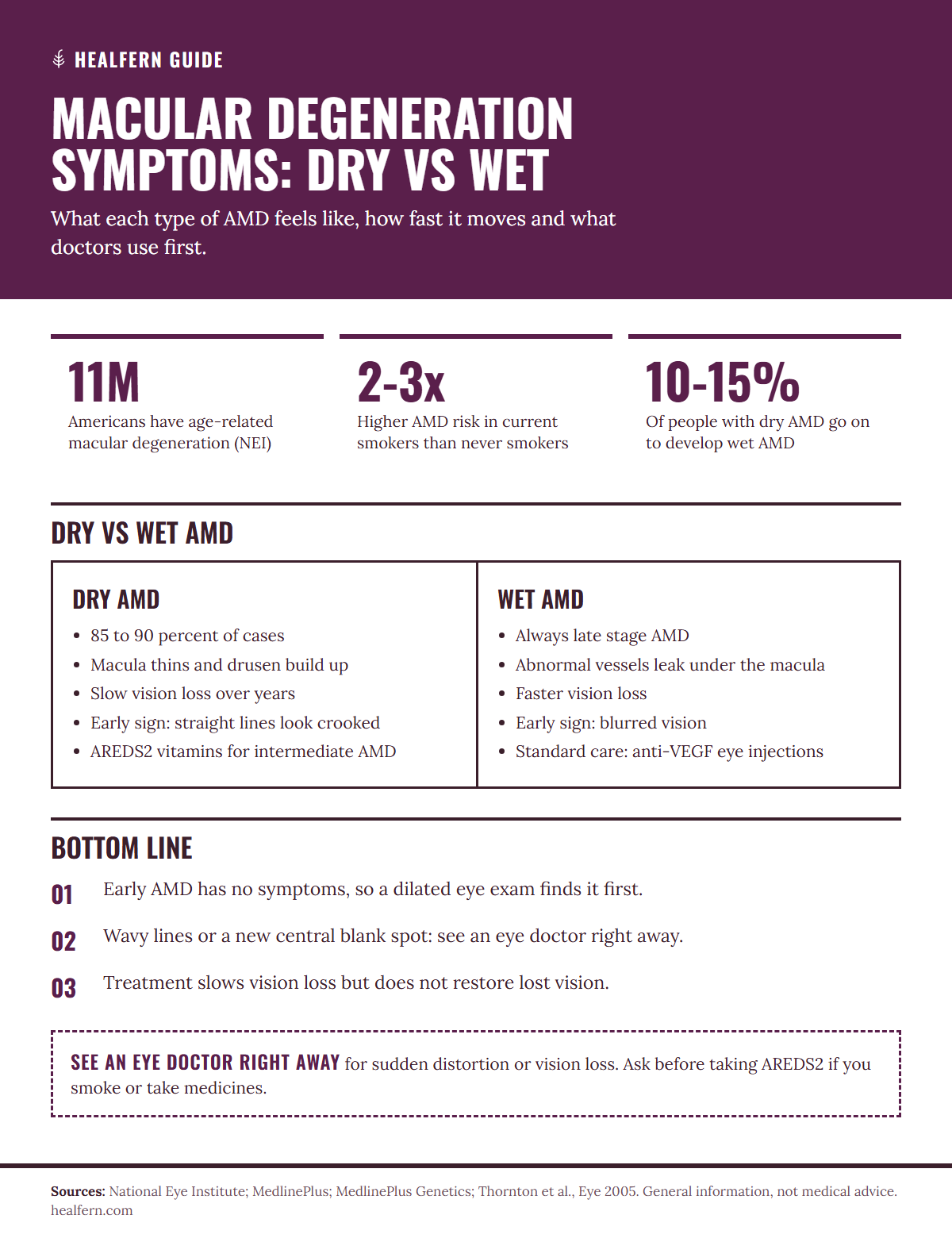
Dry AMD causes slow, gradual loss of central vision over years, while wet AMD can blur and distort vision within a short time because leaking blood vessels damage the macula. Dry AMD is far more common, making up 85 to 90 percent of cases.[3]
| Feature | Dry AMD | Wet AMD |
|---|---|---|
| What happens | The macula thins and drusen build up[1][3] | Abnormal blood vessels grow under the macula and leak[2][4] |
| How fast | Usually slow, over several years[1] | Usually faster vision loss[1] |
| Common early symptom | Straight lines that look crooked[2] | Blurred vision[2] |
| Late stage | Geographic atrophy, where parts of the macula waste away[3] | Always counted as late AMD[1] |
| Main treatment | No treatment for late dry AMD on the NEI page; AREDS2 vitamins for intermediate AMD[1][5] | Anti-VEGF injections into the eye[4] |
Any stage of dry AMD can turn into wet AMD.[1] Between 10 and 15 percent of people with the dry form make that switch.[3] That is why a new symptom in someone who already has dry AMD should never wait for the next routine visit.
Can macular degeneration come on suddenly?
Dry AMD rarely changes overnight, but wet AMD can cause new distortion or a dark spot over days, because leaking vessels damage the macula quickly. MedlinePlus says wet AMD “damages the macula quickly.”[2] NEI calls straight lines looking wavy a warning sign for late AMD and says to see an eye doctor right away.[1]
Speed matters because wet AMD responds to treatment. Anti-VEGF injections can slow or stop further vision loss.[4] They cannot bring back vision that is already gone, so the timing of the first visit counts.[2]
People with late AMD in one eye also have a higher chance of getting it in the other eye.[1] If your good eye starts to see wavy lines, treat it as urgent.
See an eye doctor right away if
- Straight lines suddenly look bent, wavy or broken[1]
- A new dark, blank or blurry spot appears in the center of your vision[1]
- Your vision drops quickly in one eye, even if the other eye seems fine[2]
- You already have dry AMD and notice any new change[1][3]
Can macular degeneration cause hallucinations?
Yes, some people with advanced AMD see things that are not there, a condition called Charles Bonnet syndrome. The images can be patterns, faces or full scenes, and people know they are not real.[12] A StatPearls review puts it at up to nearly 30% of people with advanced macular degeneration.[12]
Charles Bonnet syndrome happens because the brain fills in for missing input from the eyes. It is not a mental illness and it is not dementia.[12] Many people never mention it because they fear being labeled as mentally ill, so the true number is probably higher.[12]
Education and reassurance are the main treatment, and better lighting, moving your eyes, or changing focus can stop an episode.[12] Tell your doctor about any hallucinations, though, because other causes such as medicines or brain conditions need to be ruled out.[12]
What causes macular degeneration, and who is at risk?
AMD is caused by a mix of aging, genes and lifestyle, and age is the strongest risk factor. NEI says people 55 and older are more likely to have it, and risk is higher in white people, smokers and those with a family history.[1] An estimated 15 to 20 percent of people with AMD have a parent or sibling with it.[3]
Smoking is the main risk you can change. A review of 17 studies found that 13 linked smoking to AMD, with current smokers at two to three times the risk of people who never smoked.[9] The same review found signs that the risk falls after quitting.[9]
Other links include high blood pressure, heart disease, obesity, a high-fat diet and sunlight exposure, though researchers are not sure how much each one matters.[3] If you are watching your blood pressure, our guide to symptoms of high blood pressure and when to worry covers why it often has no symptoms at all.
Genes play a large role. Changes in complement genes such as CFH, and in the ARMS2 and HTRA1 region, raise risk.[3] A gene test is not part of routine care, and NEI’s advice for anyone at risk is regular eye exams.[1]
A 2022 study estimated that in 2019, 18.34 million Americans age 40 and older had early AMD and 1.49 million had late AMD.[10]
How is macular degeneration tested?
A dilated eye exam is the standard test for AMD, often followed by an optical coherence tomography (OCT) scan. The exam is painless. Drops widen your pupil so the doctor can look at the retina, and OCT takes detailed pictures of the layers at the back of the eye.[1]
Regular exams find AMD before it causes vision loss.[2] The AREDS researchers advised that people older than 55 have dilated eye exams to find out their risk of advanced AMD.[6]
At home, many people with AMD use an Amsler grid. It is a square of straight lines with a dot in the center. You cover one eye, look at the dot, and watch for lines that look wavy or missing.[11]
The grid has limits. A 2023 review of 10 studies with 1,890 eyes found it picked up only 67% of wet AMD cases compared with healthy eyes.[11] The authors said people at risk should keep having regular eye exams no matter what the grid shows.[11]
What to do about a change in your vision
| If you notice | What it may mean | What to do |
|---|---|---|
| No symptoms, age 55 or older or a family history | Early AMD can be present with no symptoms[1] | Book a dilated eye exam and ask how often to return[1] |
| More trouble reading in dim light | Can be an early or intermediate sign[1][3] | Mention it at your next eye exam |
| Straight lines look wavy | Warning sign of late AMD[1] | See an eye doctor right away[1] |
| New blank or dark spot in the center | Possible late AMD, wet or dry[1] | Same-day or next-day eye visit |
| Seeing images you know are not real | Possible Charles Bonnet syndrome[12] | Tell your doctor so other causes can be checked[12] |
What is the treatment for macular degeneration?
Treatment depends on the type and stage: anti-VEGF injections are the standard care for wet AMD, and AREDS2 vitamins are used for intermediate AMD. There is no treatment for early AMD, so doctors track it with regular exams.[1] Treatment can slow vision loss but does not restore vision.[2]
For wet AMD, NEI says most people get anti-VEGF injections as their only treatment.[4] The doctor numbs the eye and injects the medicine with a very small needle, usually once a month at first.[4] Photodynamic therapy, a light-activated drug plus a laser, is used much less often.[4]
The evidence for injections is strong. A 2019 Cochrane review of 16 trials with 6,347 people found that people given anti-VEGF drugs were 4.19 times as likely to gain 15 or more letters on an eye chart after one year compared with control treatment.[8] Serious eye infection happened in less than 1% of treated people.[8]
| Study | Who and how many | Length | Main result |
|---|---|---|---|
| AREDS, 2001[6] | 3,640 people aged 55 to 80 | 6.3 years on average | Antioxidants plus zinc lowered the odds of advanced AMD (odds ratio 0.72) and of moderate vision loss (0.73) |
| AREDS2, 2013[7] | 4,203 people aged 50 to 85 at risk of advanced AMD | 5 years | Adding lutein and zeaxanthin (hazard ratio 0.90) or omega-3s (0.97) gave no further overall benefit |
| Cochrane anti-VEGF review, 2019[8] | 16 trials, 6,347 people with wet AMD | 1 year | 4.19 times as likely to gain 15 or more letters; under 1% eye infection |
| Smoking review, 2005[9] | 17 studies | Mixed designs | 13 found 2 to 3 times higher risk in current smokers |
| Amsler grid review, 2023[11] | 10 studies, 1,890 eyes | Not applicable | Found 67% of wet AMD cases |
Do eye vitamins help?
The AREDS2 formula is the only supplement mix with trial support, and only for some people. NEI says it may stop intermediate AMD in one or both eyes from turning into late AMD, and may slow AMD in the other eye when one eye already has late AMD.[5] It cannot stop early AMD from moving to the intermediate stage.[5]
The daily amounts are vitamin C 500 mg, vitamin E 400 IU, zinc 80 mg, copper 2 mg, lutein 10 mg and zeaxanthin 2 mg.[5] NEI notes you cannot get this mix from food or a regular multivitamin.[5] Our article on whether multivitamins work explains why a daily multi is a different product.
Adding omega-3 fish oil to the formula did not help AMD in AREDS2.[7] If you take fish oil for another reason, our review of omega-3 for dry eyes and what the big trials found covers that separate question.
Side effects and who should be careful
- Smokers and former smokers should avoid the older AREDS formula with beta-carotene. In AREDS2, lung cancer was more common with beta-carotene, 2.0% vs 0.9%, mostly in former smokers.[5][7]
- AREDS2 supplements contain very large doses that can change how your body digests food and how other medicines work.[5]
- Tell your doctor about every medicine and supplement you take before you start one.[5]
- Eye injections can cause inflammation and raised eye pressure; report pain, redness or worse vision after an injection.[8]
If vision loss has already happened, low vision aids and vision rehab can help you stay independent.[1]
Bottom line
Practical checklist
- Get a dilated eye exam if you are 55 or older, smoke, or have a parent or sibling with AMD.[1][3]
- Check each eye on its own now and then by covering the other one, because a good eye can hide a change.[3]
- Treat wavy lines or a new central blank spot as same-day news for your eye doctor.[1]
- If you smoke, quitting is the biggest change you can make for your eyes.[9]
- Ask your eye doctor whether your stage of AMD fits AREDS2 before you buy any eye vitamin.[5]
- Read the label: an AREDS2 match lists the six amounts above and no beta-carotene.[5]
Macular degeneration often gives no warning in its early stage, and the symptoms people do notice, wavy lines and a blurry center, usually point to later disease.[1]
For most people over 55, a regular dilated exam is the better first step than any supplement, because it finds AMD early and tells you whether AREDS2 vitamins fit your stage. You can see the full list of guides in our vision and eye health section, and read how we research our health articles.
Questions people also ask
Is macular degeneration hereditary?
It can run in families, but it does not follow a simple inheritance pattern. About 15 to 20 percent of people with AMD have a parent or sibling with it. Genes such as CFH and ARMS2 raise risk, and age and smoking add to it.
Can macular degeneration be reversed?
No. Treatment can slow or stop further vision loss, but it does not restore vision that is already lost. That is why early exams and a quick visit for new symptoms such as wavy lines matter so much.
Is macular degeneration painful?
No. AMD does not hurt and does not make the eye red. Its symptoms are changes in vision, such as blur, wavy lines or blank spots in the center. Eye pain points to a different problem and needs its own check.
Can macular degeneration cause blindness?
AMD does not cause complete blindness, according to the National Eye Institute. Side vision usually stays. Late AMD can take away central vision, though, which makes reading, driving and seeing faces hard.
Can you have macular degeneration symptoms in one eye only?
Yes. AMD often affects one eye before the other, and the stronger eye can hide the change. Late AMD in one eye raises the risk in the other eye, so check each eye on its own and keep up with exams.
At what age do macular degeneration symptoms start?
Small changes in the retina can appear in your forties or fifties, but vision loss usually becomes noticeable in your sixties or seventies. People 55 and older are more likely to have AMD, according to the National Eye Institute.
Sources
- Age-Related Macular Degeneration (AMD), National Eye Institute, NIH, updated 2021
- Macular Degeneration, MedlinePlus, National Library of Medicine
- Age-related macular degeneration, MedlinePlus Genetics, National Library of Medicine
- Treatments for Wet AMD (Advanced Neovascular AMD), National Eye Institute, NIH, updated 2024
- AREDS 2 Supplements for Age-Related Macular Degeneration, National Eye Institute, NIH, updated 2021
- A randomized, placebo-controlled, clinical trial of high-dose supplementation with vitamins C and E, beta carotene, and zinc for AMD and vision loss: AREDS report no. 8, Archives of Ophthalmology, AREDS Research Group, 2001
- Lutein + zeaxanthin and omega-3 fatty acids for age-related macular degeneration: the AREDS2 randomized clinical trial, JAMA, AREDS2 Research Group, 2013
- Anti-vascular endothelial growth factor for neovascular age-related macular degeneration, Cochrane Database of Systematic Reviews, Solomon et al., 2019
- Smoking and age-related macular degeneration: a review of association, Eye, Thornton et al., 2005
- Prevalence of Age-Related Macular Degeneration in the US in 2019, JAMA Ophthalmology, Rein et al., 2022
- Diagnostic Accuracy of the Amsler Grid Test for Detecting Neovascular Age-Related Macular Degeneration, JAMA Ophthalmology, Rasmussen et al., 2023
- Charles Bonnet Syndrome, StatPearls, Mars et al., 2025
This article is general information, not medical advice. These statements have not been evaluated by the FDA, and supplements are not intended to diagnose, treat, cure or prevent any disease. Talk to your doctor or pharmacist before you start a supplement. How we research.