
Low glycemic foods score 55 or less on the glycemic index. Reliable picks include beans, lentils, barley, pasta, rolled oats, milk, yogurt, apples, oranges and carrots. Swapping high GI staples such as cornflakes, white rice and potatoes for these lowered A1C by about 0.31 points in trials of people with diabetes, though portions and overall diet still matter.

We read the 2008 and 2021 International Tables of Glycemic Index from the University of Sydney, the MedlinePlus guide to glycemic index, NIDDK’s diabetes eating advice and the American Diabetes Association’s 2019 nutrition consensus report. We also read a 2021 BMJ meta-analysis of 29 trial comparisons and two randomized trials published in JAMA.
Low glycemic foods score 55 or less on a 100-point scale. They include most beans and lentils, barley, pasta, rolled oats, milk, yogurt, apples, oranges and carrots, and swapping them for high-GI foods modestly lowered A1C in trials of people with diabetes.[1][2][4]
| What it is | The glycemic index (GI) ranks carbohydrate foods by how fast they raise blood sugar compared with pure glucose[1] |
|---|---|
| Low, medium, high | Low is 55 or less, medium 56 to 69, high 70 or more[1] |
| Reliably low foods | Dairy, legumes, pasta and most fruits tested around the world[3] |
| Foods that vary | Breads, breakfast cereals and rice, including whole grain versions, come in high and low GI forms[2][3] |
| Best evidence | A 2021 meta-analysis of 29 trial comparisons in 1,617 people with diabetes found A1C fell by 0.31 percentage points[4] |
| Main limits | The American Diabetes Association calls the results mixed; portion size and total carbohydrate still matter[7][1] |
| Be careful if | You take insulin or sulfonylureas, which can cause low blood sugar when you change how you eat[8][10] |
Which foods have a low glycemic index?
Legumes, dairy, pasta and most whole fruits are the most reliably low GI foods, with consistent values in labs around the world.[3] Barley, rolled oats, corn tortillas and some grainy breads also test low. Everything in the table below scored 55 or less in the international GI tables.[2]
The values are averages from several labs, measured against glucose. Your own blood sugar response can differ, and so can the same food from another brand.[2] MedlinePlus adds bulgur, quinoa, parboiled rice, high-fiber bran cereal, non-starchy vegetables, greens, grapefruit and most nuts to the low GI group.[1]
| Food | Group | Average GI |
|---|---|---|
| Soya beans | Legumes | 16 |
| Kidney beans | Legumes | 24 |
| Chickpeas | Legumes | 28 |
| Barley | Grains | 28 |
| Lentils | Legumes | 32 |
| Soy milk | Dairy and alternatives | 34 |
| Apple, raw | Fruit | 36 |
| Skim milk | Dairy and alternatives | 37 |
| Full-fat milk | Dairy and alternatives | 39 |
| Carrots, boiled | Vegetables | 39 |
| Fruit yogurt | Dairy and alternatives | 41 |
| Dates, raw | Fruit | 42 |
| Orange, raw | Fruit | 43 |
| Corn tortilla | Grains | 46 |
| Spaghetti, whole meal | Grains | 48 |
| Vegetable soup | Vegetables | 48 |
| Spaghetti, white | Grains | 49 |
| Orange juice | Fruit | 50 |
| Banana, raw | Fruit | 51 |
| Mango, raw | Fruit | 51 |
| Sweet corn | Vegetables | 52 |
| Chapatti | Grains | 52 |
| Specialty grain bread | Grains | 53 |
| Porridge, rolled oats | Grains | 55 |
Source for all values: Atkinson, Foster-Powell and Brand-Miller, International Tables of Glycemic Index, Diabetes Care 2008.[2]
Which high glycemic foods have easy low GI swaps?
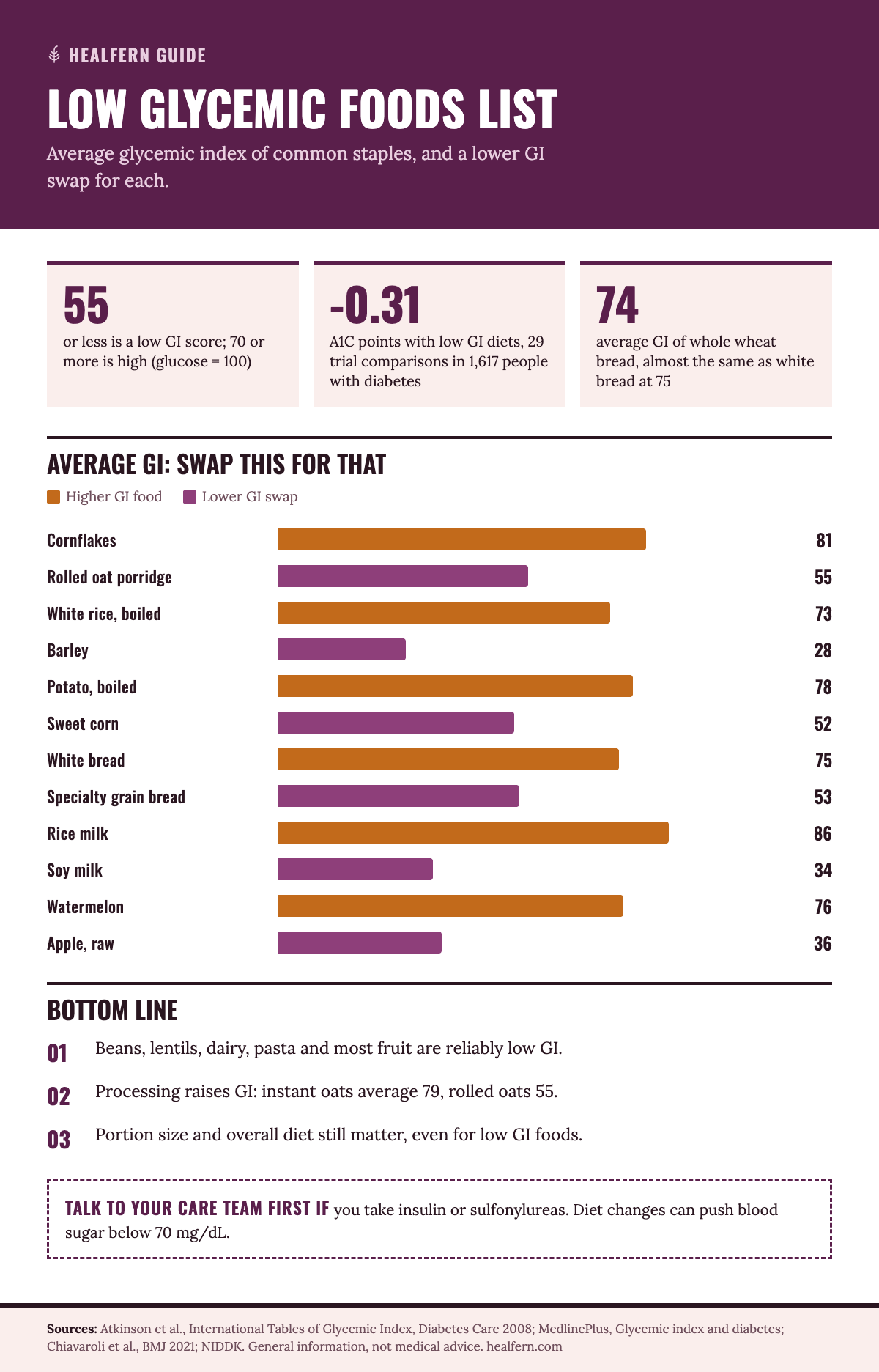
Breakfast cereals, potatoes, rice and white bread are where most people can make the biggest change. Cornflakes average 81, boiled potato 78, white rice 73 and white bread 75, while rolled oats, barley, pasta and lentils sit far lower.[2] Each swap below trades a high or medium GI staple for a lower one.
| Higher GI food | GI | Lower GI swap | GI |
|---|---|---|---|
| Cornflakes | 81 | Porridge, rolled oats | 55 |
| Instant oat porridge | 79 | Porridge, rolled oats | 55 |
| Potato, boiled | 78 | Sweet corn | 52 |
| Potato, instant mash | 87 | Lentils | 32 |
| White bread | 75 | Specialty grain bread | 53 |
| Whole wheat bread | 74 | Corn tortilla | 46 |
| White rice, boiled | 73 | Barley | 28 |
| Brown rice, boiled | 68 | Spaghetti, white | 49 |
| Couscous | 65 | Barley | 28 |
| Rice milk | 86 | Soy milk | 34 |
| Rice crackers | 87 | Chickpeas | 28 |
| Watermelon | 76 | Apple, raw | 36 |
Whole wheat bread averages 74, almost the same as white bread at 75, and brown rice averages 68, only a little below white rice at 73.[2] The 2021 tables found the same wide spread in whole grain cereals and put it down to manufacturing methods, so for GI, how a grain is processed matters more than its color.[3]
Juice tests fairly low too: orange juice averaged 50 and apple juice 41.[2] MedlinePlus still notes that juice has a higher GI than whole fruit, so the whole orange or apple is the better pick.[1]
What do glycemic index numbers mean?
The GI compares how quickly a food raises blood sugar with the rise from pure glucose, which is set at 100. Foods at 55 or below are low, 56 to 69 are medium, and 70 or more are high.[1] Only foods with carbohydrate have a GI, so meat, oils and fats are not rated.[1]
The glycemic load (GL) adds portion size. It is the GI multiplied by the grams of available carbohydrate in a serving, divided by 100.[4] That is why MedlinePlus stresses that portion size and the amount of carbohydrate still count, even when every food on the plate is low GI.[1]
Several things push a food’s GI up or down:
- Processing. Instant oat porridge averages 79, while rolled oat porridge averages 55.[2]
- Cooking. Al dente pasta has a lower GI than soft-cooked pasta.[1]
- Ripeness. The GI of a piece of fruit changes as it ripens.[1]
- Fat and fiber. Foods higher in either tend to score lower.[1]
- Variety. Most potatoes are high GI, but researchers have identified some low GI varieties.[3]
The numbers are less precise than they look. The 2008 tables warn that many foods were tested only once, in 10 or fewer people.[2] Values in healthy people and people with diabetes do track closely, with a correlation of 0.94 across 20 staple foods.[2]
Does cooking and cooling change a food’s GI?
Yes, often by more than the choice between white and brown. Longer cooking raises GI, cooling cooked starch lowers it, and processing matters most of all. In one small trial, white rice cooled for 24 hours in the fridge and then reheated produced a smaller blood sugar rise than freshly cooked rice.[14][1]
The rice study, from Indonesia in 2015, measured resistant starch, the part of starch your gut does not break down into glucose. Freshly cooked white rice had 0.64 g per 100 g. Rice cooled 10 hours at room temperature had 1.30 g, and rice cooled 24 hours at 4°C then reheated had 1.65 g.[14] In 15 healthy adults, the chilled and reheated rice gave a glucose response of 125 versus 152 mmol·min/L for fresh rice.[14]
That is one small study in people without diabetes, so treat it as a pointer. It fits the pattern in the GI tables, where the same ingredient lands in very different places depending on what was done to it: instant oat porridge at 79 and rolled oat porridge at 55 are the same grain.[2]
Kitchen habits that nudge GI down
- Cook pasta al dente rather than soft. MedlinePlus lists cooking time as a factor that changes GI.[1]
- Choose rolled or steel-cut oats over instant; the averages are 55 versus 79.[2]
- Cook rice or potatoes ahead, chill them, and reheat or eat them cold in a salad, based on the resistant starch finding.[14]
- Eat fruit a little less ripe, since ripeness raises GI.[1]
- Put fat, protein or fiber on the same plate. Foods with more of either tend to score lower, and eating foods together changes the response.[1]
Is a low GI food always a healthy choice?
No. GI only describes how fast a carbohydrate raises blood sugar, and some low GI foods are high in fat or sugar. Chocolate averages 40 and ice cream 51, both in the low band.[2] The authors of the GI tables say chocolate’s saturated fat reduces its nutritional value and that GI should not be used on its own.[2]
Some high GI foods are nutritious. MedlinePlus lists potatoes and watermelon among high GI foods but advises balancing them with lower GI choices rather than cutting every high GI food.[1] Watermelon averages 76.[2] For foods like this, glycemic load, which factors in how much carbohydrate a serving holds, is the fairer guide.[4]
The American Diabetes Association’s consensus report puts the broader goal plainly: eat more nonstarchy vegetables, cut added sugars and refined grains, and choose whole foods over highly processed ones.[7] A low GI list works best inside that pattern.
Does a low glycemic diet lower A1C?
Modestly, in people who already have diabetes. A 2021 BMJ meta-analysis of 29 trial comparisons in 1,617 people found low GI or low GL diets cut A1C by 0.31 percentage points more than higher GI diets, with high certainty of evidence.[4] Fasting glucose, LDL cholesterol and body weight also fell a little.[4]
A trial run by David Jenkins in Toronto, gave 210 adults with type 2 diabetes either low GI or high cereal fiber advice for six months. A1C fell 0.50 points with low GI advice and 0.18 points with high fiber advice.[5]
Not every expert body is convinced. The American Diabetes Association’s 2019 consensus report cited two reviews that found no significant effect on A1C and mixed effects on fasting glucose, and noted that studies define low and high GI differently.[7] In adults without diabetes, the OmniCarb feeding trial found that a low GI version of a healthy DASH-style diet did not improve insulin sensitivity, cholesterol or blood pressure.[6]
| Study | Who and how long | What was compared | Result |
|---|---|---|---|
| Chiavaroli 2021, BMJ meta-analysis | 29 trial comparisons, 1,617 people with type 1 or 2 diabetes; median 12 weeks | Low GI or GL diets vs higher GI diets | A1C down 0.31 points; high certainty[4] |
| Jenkins 2008, JAMA | 210 adults with type 2 diabetes; 6 months | Low GI advice vs high cereal fiber advice | A1C down 0.50 vs 0.18 points[5] |
| OmniCarb 2014, JAMA | 163 overweight adults without diabetes; 5 weeks per diet | High vs low GI versions of DASH-type diets | No gain in insulin sensitivity, LDL or blood pressure[6] |
| ADA consensus 2019 | Expert review of the evidence | GI and GL for diabetes care | Reviews found no significant A1C effect; definitions vary[7] |
In OmniCarb, the low GI diet with high carbohydrate actually lowered insulin sensitivity by 20% and raised LDL by 6% compared with the high GI version.[6] The authors concluded that choosing foods by GI inside an already healthy diet may not improve those risk factors.[6]
Does a low glycemic diet help with weight loss?
Probably not by much on its own. A 2023 Cochrane review of 10 randomized trials in 1,210 people with overweight or obesity found that low GI or GL diets made little to no difference to body weight compared with higher GI diets, a gap of about 0.8 kg, with moderate certainty.[12]
That reverses the 2007 version of the same review, which pooled six short trials in 202 people and reported about 1.1 kg more weight loss on low GI diets, along with lower total and LDL cholesterol.[16] The 2023 update kept only one of those studies after tightening its rules to trials of at least eight weeks, and added nine newer ones.[12]
In the update, seven trials compared low with higher GI diets head to head, and three compared a low GI diet with any other diet. Trial length ran from eight weeks to 18 months, and every trial had an unclear or high risk of bias in some area.[12] Fat mass fell slightly more on the low GI diets, about 0.9 kg, with low certainty, and fasting glucose did not improve.[12] Against other diets the weight gap was about 1.2 kg and again not significant.[12]
The weight effect is small, and the A1C benefit in people with diabetes is a separate finding from different trials.[4] If weight is your main goal, the Cochrane numbers say how much you eat matters more than the GI of your carbohydrate. The NIDDK’s plate method, which fixes portions first, is the better starting point, with GI deciding which carbohydrate fills its quarter.[8]
How do you build a low glycemic meal?
Start with the plate method. The NIDDK suggests a 9-inch plate with half nonstarchy vegetables, one quarter high-fiber carbohydrate foods such as beans, whole grains or fruit, and one quarter protein.[8] Picking the carbohydrate quarter from the low GI list above brings the two ideas together.
When you do eat a high GI food, MedlinePlus suggests pairing it with low GI foods to balance the effect on blood sugar.[1] The GI of a food can change when you eat it with other foods, so white rice with lentils and vegetables may act differently from a bowl of white rice alone.[1] If you take insulin, the NIDDK says counting carbohydrates helps you know how much insulin to take.[8]
Protein helps fill the plate without raising GI. Our guide to high protein foods lists options with protein per serving.
Does the order you eat food in change your blood sugar?
In one small pilot study, yes, and by a lot. Eleven adults with type 2 diabetes on metformin ate the same 628-calorie meal twice, a week apart. When they ate the vegetables and chicken first and the bread and orange juice last, blood sugar after the meal was 29% lower at 30 minutes and 37% lower at 60 minutes.[13]
The 2015 Weill Cornell study measured glucose and insulin before the meal and at 30, 60 and 120 minutes.[13] With carbohydrate first, glucose peaked at 199 mg/dL at 60 minutes. With carbohydrate last, the peak was 126 mg/dL.[13] The total glucose rise over two hours was 73% lower, and insulin at 60 and 120 minutes was lower as well.[13]
The meal held 55 g of protein, 68 g of carbohydrate and 16 g of fat. The carbohydrate was ciabatta bread and orange juice, the protein was skinless grilled chicken, and the vegetables were a salad and steamed broccoli. Only the order changed.[13]
Eleven people and one meal make a pilot study, and the authors said so. Nobody has shown that eating this way for months lowers A1C. It costs nothing to try, and it fits the NIDDK plate method: start with the vegetable half and the protein quarter, and finish with the carbohydrate quarter.[8] If you use a glucose meter, a before and after reading on two similar days will tell you whether it works for you.
Practical checklist
- Swap instant oats or cornflakes for rolled oat porridge (55).[2]
- Replace some rice or potato with barley (28), lentils (32) or pasta cooked al dente.[1][2]
- Choose whole fruit over juice, and apples (36) or oranges (43) over watermelon (76).[1][2]
- Pick soy milk (34) or cow’s milk (37 to 39) over rice milk (86).[2]
- Fill half your plate with nonstarchy vegetables.[8]
- Keep portions in check, since portion size and total carbohydrate still count for low GI foods.[1][4]
- Check breads and cereals by brand, since GI varies with how they are made. Our label reading guide shows how to compare fiber and carbohydrate per serving.[3]
Safety: who should be careful with a low glycemic diet?
Changing what you eat is low risk for most people, but it can drop blood sugar too far if you take insulin or sulfonylureas. The NIDDK says people on those medicines are the most likely to have low blood glucose, which for many people with diabetes means a reading below 70 mg/dL.[10][8] Talk with your care team before a big change so they can adjust doses.
See a doctor if you notice the common signs of diabetes: urinating more often, feeling very thirsty or hungry even after eating, blurred vision, fatigue, sores that do not heal, or frequent infections.[9] See a doctor right away if those symptoms come on quickly over days or weeks, or with unexplained weight loss, which can signal type 1 diabetes.[9]
A low GI list does not replace diabetes testing or treatment. Many people with type 2 diabetes have no symptoms at all, so ask about screening if you have risk factors.[9]
Is low glycemic eating useful in pregnancy and gestational diabetes?
It is one of the diet patterns with trial support, though the evidence grade is low. A 2024 network meta-analysis of 39 trials in 2,712 women with gestational diabetes found that low GI diets lowered blood sugar two hours after meals and reduced average birth weight by about 180 grams compared with control diets.[15]
The same analysis ranked the DASH diet higher on several outcomes, including fasting glucose and the need for insulin, which it cut by 71%.[15] Both are whole-food patterns built on vegetables, legumes, whole grains and fruit, so in practice they overlap a great deal. The authors rated the certainty as low for the low GI findings and very low for some DASH findings, and called for better trials.[15]
Gestational diabetes is managed with your obstetric team, who set blood sugar targets and decide whether insulin is needed. Make food changes with them, because changing how much carbohydrate you eat also changes how much insulin you need.[8]
When you need a high GI food instead
If you take insulin or a sulfonylurea and your blood sugar drops below 70 mg/dL, the NIDDK’s advice is the reverse of a low GI list. Take 15 to 20 grams of fast-acting carbohydrate, such as glucose tablets, 4 to 6 ounces of regular soda or fruit juice, or a tablespoon of sugar or honey, then wait 15 minutes and check again.[10] The NIDDK suggests carrying glucose tablets or a juice box with you. Alcohol without food can also pull blood sugar down and hide the early warning signs, so eat if you drink.[10]
What do doctors recommend first for blood sugar?
Eating changes, physical activity and, when needed, medicines. The NIDDK recommends working with a registered dietitian for medical nutrition therapy and using the plate method or carbohydrate counting to plan meals.[8] If you have type 2 diabetes and overweight, your doctor may recommend medicines that also help with weight loss.[8]
The American Diabetes Association does not name a single best eating pattern for diabetes. Its consensus report says several patterns can work, and that the common thread is more vegetables, fewer refined grains and added sugars, and more whole foods.[7] Low GI eating fits inside that advice as one tool among several.[1]
A short note on supplements: NCCIH says chromium, cinnamon and berberine have only weak evidence of a possible benefit for blood sugar, from small studies with mixed results.[11] The NIDDK warns that some supplements can affect how well diabetes medicines work.[8] Our cinnamon for blood sugar review covers the trials, and our research methods page explains how we grade evidence.
More guides sit in our blood sugar support and blood sugar and diabetes sections.
The verdict on low glycemic foods
A low glycemic foods list is a useful shopping tool. Beans, lentils, barley, pasta, rolled oats, dairy and whole fruit test low and stay low across labs, and trials in people with diabetes show a small A1C benefit from eating this way.[3][4] The effect is modest, the ADA still calls the evidence mixed, and the numbers shift with brand, ripeness and cooking.[7][1]
Our call: use GI to choose between carbohydrate foods, especially breakfast cereals, bread, rice and potatoes, and let portion size and overall food quality decide the rest. If you take diabetes medicine, make the change with your care team.
Questions people also ask
What GI number counts as low glycemic?
A GI of 55 or less is low, 56 to 69 is medium, and 70 or more is high. The scale runs from 0 to 100, with pure glucose set at 100, according to MedlinePlus.
Is brown rice low glycemic?
Not quite. In the international GI tables, boiled brown rice averaged 68, which is medium, compared with 73 for white rice. Barley at 28 and white spaghetti at 49 are much lower swaps.
Are bananas low glycemic?
Yes. Raw bananas averaged a GI of 51 in the 2008 international tables, just inside the low band. MedlinePlus notes that ripeness changes the GI of fruit, so a very ripe banana may score differently.
Is oatmeal good for blood sugar?
Rolled oat porridge averaged a GI of 55, which is low. Instant oat porridge averaged 79, which is high. Steel-cut or rolled oats are the better choice if you are watching your blood sugar.
Does a low glycemic diet lower A1C?
In people with diabetes, a 2021 meta-analysis of 29 trial comparisons found low GI diets lowered A1C by 0.31 percentage points. The American Diabetes Association still describes the evidence as mixed, so treat it as one useful tool.
What is the difference between glycemic index and glycemic load?
Glycemic index ranks how fast a carbohydrate raises blood sugar. Glycemic load also counts portion size: it is the GI multiplied by the grams of available carbohydrate in a serving, divided by 100.
Sources
- Glycemic index and diabetes, MedlinePlus, National Library of Medicine
- Atkinson FS et al. International tables of glycemic index and glycemic load values: 2008, Diabetes Care, 2008
- Atkinson FS et al. International tables of glycemic index and glycemic load values 2021: a systematic review, American Journal of Clinical Nutrition, 2021
- Chiavaroli L et al. Effect of low glycaemic index or load dietary patterns on glycaemic control and cardiometabolic risk factors in diabetes, BMJ, 2021
- Jenkins DJ et al. Effect of a low-glycemic index or a high-cereal fiber diet on type 2 diabetes: a randomized trial, JAMA, 2008
- Sacks FM et al. Effects of high vs low glycemic index of dietary carbohydrate on cardiovascular disease risk factors and insulin sensitivity: the OmniCarb trial, JAMA, 2014
- Evert AB et al. Nutrition Therapy for Adults With Diabetes or Prediabetes: A Consensus Report, Diabetes Care, American Diabetes Association, 2019
- Diabetes Diet, Eating, and Physical Activity, NIDDK, reviewed 2023
- Symptoms and Causes of Diabetes, NIDDK, reviewed 2024
- Low Blood Glucose (Hypoglycemia), NIDDK, reviewed 2021
- Diabetes and Dietary Supplements, NCCIH, updated 2023
- Chekima K et al. Low glycaemic index or low glycaemic load diets for people with overweight or obesity, Cochrane Database of Systematic Reviews, 2023
- Shukla AP et al. Food Order Has a Significant Impact on Postprandial Glucose and Insulin Levels, Diabetes Care, 2015
- Sonia S et al. Effect of cooling of cooked white rice on resistant starch content and glycemic response, Asia Pacific Journal of Clinical Nutrition, 2015
- Zhang L et al. Effects of Dietary Approaches and Exercise Interventions on Gestational Diabetes Mellitus: A Systematic Review and Bayesian Network Meta-analysis, Advances in Nutrition, 2024
- Thomas DE et al. Low glycaemic index or low glycaemic load diets for overweight and obesity, Cochrane Database of Systematic Reviews, 2007
This article is general information, not medical advice. These statements have not been evaluated by the FDA, and supplements are not intended to diagnose, treat, cure or prevent any disease. Talk to your doctor or pharmacist before you start a supplement. How we research.