The best high-protein foods for weight loss give lots of protein for few calories: skinless chicken or turkey breast, white fish, canned tuna, nonfat Greek yogurt, cottage cheese, tofu and lentils. In a meta-analysis of 24 trials, higher-protein diets led to about 0.8 kg more weight loss and helped keep muscle. Calories still matter most, and people with kidney disease should check with a doctor first.
We read the 2012 meta-analysis of 24 weight-loss trials that compared higher-protein and standard-protein diets, the 773-person Diogenes trial in the New England Journal of Medicine, and NIH guidance on obesity treatment and kidney disease. We also pulled protein and calorie numbers for 18 common foods from the USDA FoodData Central database.
The short answer: lean poultry, fish, nonfat Greek yogurt, cottage cheese, tofu and beans give you the most protein for the fewest calories, and eating more protein while cutting calories led to slightly more fat loss and less muscle loss in trials, but the extra benefit was modest.
| What it is | Choosing foods that give a lot of protein per calorie, as part of a lower-calorie eating plan. Protein supplies 4 calories per gram.[2] |
|---|---|
| Used for | Losing fat while keeping muscle, and keeping weight off after a diet.[4][5] |
| Typical servings | A 3 oz portion of chicken or turkey breast has about 26 g of protein; a 6 oz cup of nonfat Greek yogurt has about 17 g; a cup of lentils has about 18 g.[1] |
| How much protein | The adult minimum is 0.8 g per kilogram of body weight a day, and protein can make up 10% to 35% of calories.[2][3] |
| Best evidence | A meta-analysis of 24 trials with 1,063 adults found 0.79 kg more weight loss and 0.87 kg more fat loss on higher-protein diets over about 12 weeks.[4] |
| Safety | Whole foods are generally safe. Red and processed meat are linked with heart disease and diabetes risk in large observational studies.[3] |
| Who should check first | People with chronic kidney disease, who may need moderate protein amounts set by a dietitian or doctor.[10] |
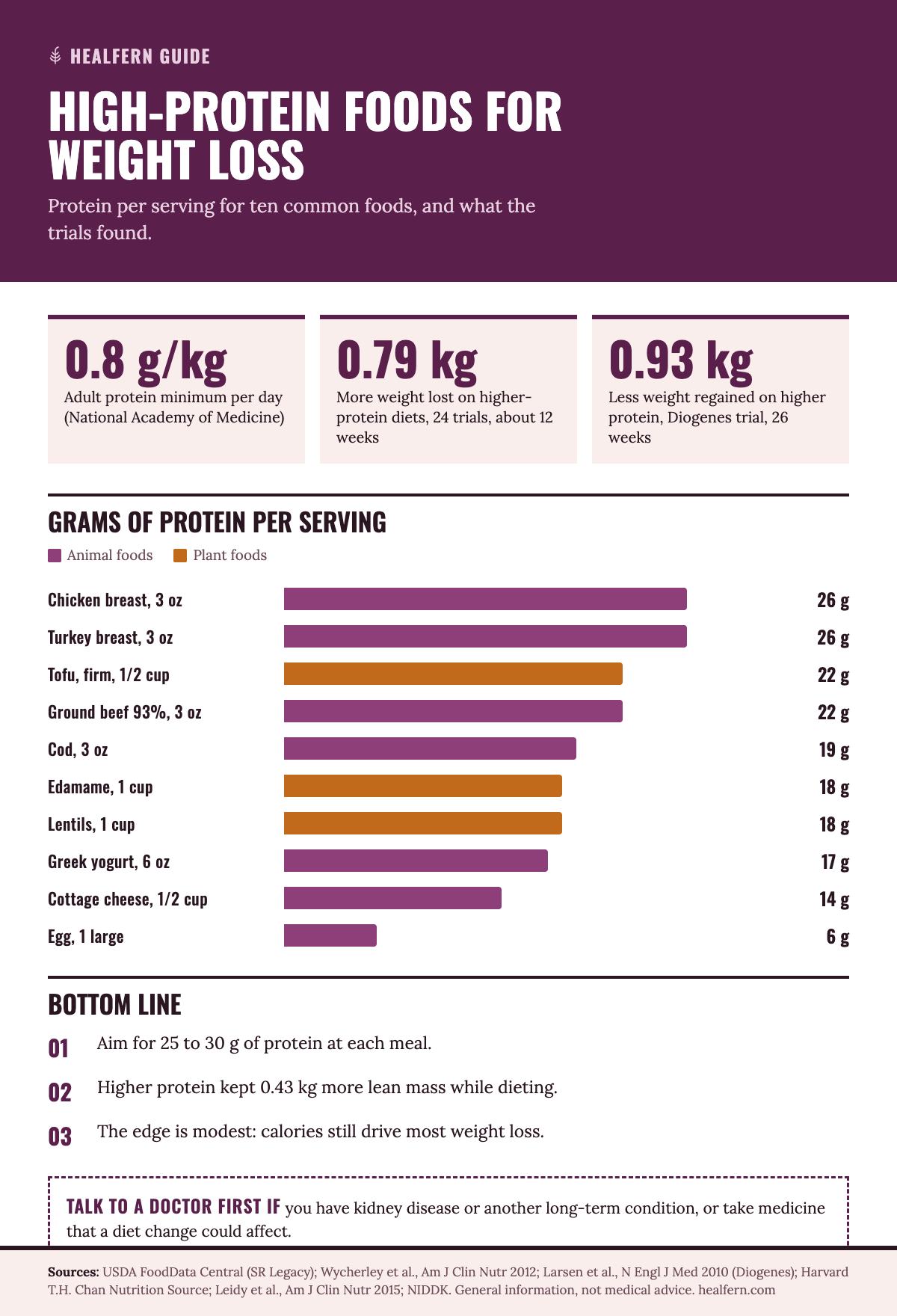
Which high-protein foods are best for weight loss?
The foods that help most are the ones with a lot of protein and few calories: skinless chicken or turkey breast, white fish, shrimp, canned light tuna, nonfat Greek yogurt and low-fat cottage cheese. Tofu, edamame, lentils and beans cost a few more calories per gram of protein but add fiber.[1]
The table below uses USDA FoodData Central values for cooked foods. The last column shows how many grams of protein you get for every 100 calories, which is a quick way to compare a fillet of cod with a scoop of peanut butter.[1]
| Food | Serving | Protein | Calories | Protein per 100 calories |
|---|---|---|---|---|
| Chicken breast, roasted, no skin | 3 oz | 26 g | 140 | 19 g |
| Turkey breast, roasted, meat only | 3 oz | 26 g | 125 | 20 g |
| Tuna, light, canned in water | 3 oz | 16 g | 73 | 23 g |
| Cod, baked | 3 oz | 19 g | 89 | 22 g |
| Shrimp, cooked | 3 oz | 19 g | 101 | 19 g |
| Salmon, Atlantic farmed, cooked | 3 oz | 19 g | 175 | 11 g |
| Ground beef, 93% lean, broiled | 3 oz | 22 g | 164 | 14 g |
| Greek yogurt, plain, nonfat | 6 oz container | 17 g | 100 | 17 g |
| Cottage cheese, 1% fat | 1/2 cup | 14 g | 81 | 17 g |
| Egg, hard-boiled | 1 large | 6 g | 78 | 8 g |
| Milk, 1% fat | 1 cup | 8 g | 103 | 8 g |
| Tofu, firm (calcium-set) | 1/2 cup | 22 g | 181 | 12 g |
| Edamame, cooked | 1 cup | 18 g | 188 | 10 g |
| Lentils, boiled | 1 cup | 18 g | 230 | 8 g |
| Black beans, boiled | 1 cup | 15 g | 227 | 7 g |
| Chickpeas, boiled | 1 cup | 14 g | 269 | 5 g |
| Peanut butter, smooth | 2 tbsp | 7 g | 191 | 4 g |
| Almonds, dry roasted | 1 oz | 6 g | 170 | 3 g |
Canned light tuna and cod give more than 20 g of protein per 100 calories. Nuts and peanut butter are healthy foods, but at under 4 g per 100 calories they work better as a small add-on than as your main protein.[1]
Harvard’s Nutrition Source makes a related point: protein comes in a “package” with fat, sodium and fiber, so the rest of the package matters too. A 4 oz ham steak has 22 g of protein but about 1,500 mg of sodium, while salmon is naturally low in sodium.[3]
How much protein do you need each day?
The National Academy of Medicine sets a minimum of 0.8 g of protein per kilogram of body weight per day for adults. That works out to about 50 g a day for a 140-pound person and about 70 g for a 200-pound person.[3]
MedlinePlus puts the healthy range at 10% to 35% of your daily calories. On a 2,000-calorie diet, 100 g of protein supplies 400 calories, or 20% of the day.[2]
Weight-loss research often uses more than the minimum. A 2015 review in the American Journal of Clinical Nutrition suggested 1.2 to 1.6 g per kilogram a day, with at least 25 to 30 g at meals.[8] That figure comes from a narrative review of earlier studies, so it is a sensible target with room to adjust.
In practice, 25 to 30 g is roughly a 3 oz chicken breast, half a cup of firm tofu with a glass of milk, or a cup of lentils plus a glass of milk.[1]
When should you eat protein, and does timing matter?
Spreading protein across breakfast, lunch and dinner appears to work better than loading most of it into dinner, at least for muscle. In a small 2014 crossover study, eating about 30 g at each of three meals raised 24-hour muscle protein synthesis by 25% compared with the same daily total skewed toward the evening.[12]
Spread it across the day
The study, from the University of Texas Medical Branch, fed eight healthy adults two diets with identical calories and protein for seven days each. The even pattern supplied roughly 32 g, 30 g and 33 g at breakfast, lunch and dinner. The skewed pattern supplied about 11 g, 16 g and 63 g, which the authors describe as the way many people actually eat.[12]
Muscle protein synthesis was 25% higher on the even pattern, and the gap held after a week on each diet.[12] Eight people is a very small sample, and two of the authors reported speaking fees from the beef industry, so treat this as supporting evidence rather than proof.[12]
Breakfast is the usual gap
Breakfast is where most people fall short, since toast, cereal and fruit supply little protein.[12] The 2015 review that suggested 25 to 30 g per meal made the same point about meal-level targets.[8] Nonfat Greek yogurt (17 g per 6 oz container) with a hard-boiled egg (6 g) gets close, and half a cup of 1% cottage cheese with a glass of 1% milk supplies 22 g.[1]
None of this changes the daily total. The timing evidence rests on muscle measurements, not on weight on a scale, so spread protein out because it is easy and plausible, and expect the calorie deficit to do most of the work.[4]
Does eating more protein help you lose weight?
Yes, a little, when calories are also cut. In a 2012 meta-analysis of 24 trials with 1,063 adults, people on higher-protein, lower-calorie diets lost 0.79 kg more weight and 0.87 kg more fat than people on standard-protein diets with the same calories, over about 12 weeks on average.[4]
The same analysis found that higher-protein diets lowered triglycerides more and kept resting energy use from dropping as far. The authors called these “modest benefits.”[4]
Less than one extra kilogram over three months is real but small. Calorie intake still drives most of the result, which is why NIH lists a calorie-appropriate eating plan and more physical activity as the base of treatment.[9]
Keeping the weight off
A larger trial suggests protein helps here too, modestly. In Diogenes, adults from eight European countries first lost an average of 11.0 kg on an 800-calorie diet. Then 773 of them were randomly assigned to one of five diets for 26 weeks, eating as much as they wanted.[5]
Those on higher-protein diets regained 0.93 kg less than those on lower-protein diets. Fewer people dropped out of the high-protein groups than out of the low-protein, high-glycemic group.[5] Only 71% of participants finished, a reminder that sticking with any plan is the hard part.[5]
The trial combined protein with glycemic index, and the low-glycemic groups also regained less. If steadier blood sugar interests you, our low glycemic foods list covers that side.
Does protein keep you full and protect muscle?
Protein seems to help with both, and the evidence is stronger for muscle than for appetite. Higher-protein diets kept about 0.43 kg more lean mass during weight loss, while the fullness research rests on a handful of small studies.[4][7]
Fullness
Protein does seem to make people feel fuller, though the evidence is limited. A 2016 meta-analysis found that higher-protein meals raised fullness ratings more than lower-protein meals, but only five studies met its strict criteria.[7]
The authors added that results should be applied to real life “cautiously,” because fullness scores do not always change how much people eat later.[7] The 2015 review agreed: protein raised fullness and satiety hormones, but did not reduce how much people ate at the next meal.[8]
In the 2012 meta-analysis, three of the five trials that measured satiety reported more of it on the higher-protein diet.[4] So a protein-rich breakfast may make the morning easier for some people, but it will not replace counting or planning your calories.
Muscle
When people cut calories, they lose some muscle along with fat. Higher-protein diets reduced that muscle loss: the 2012 meta-analysis found 0.43 kg more fat-free mass kept compared with standard-protein diets.[4]
The benefit appears to hold in older adults. A 2016 meta-analysis of 20 randomized trials in adults over 50 found that those eating higher-protein diets kept more lean mass and lost more fat during weight loss.[6] That review defined higher protein as at least 25% of calories or 1.0 g per kilogram a day.[6]
NIH guidance pairs a weight-loss eating plan with at least 150 minutes a week of moderate activity, such as brisk walking.[9]
Do older adults need more protein while losing weight?
Yes, according to the geriatric groups that have looked at it. The PROT-AGE study group, convened by the European Union Geriatric Medicine Society, recommends 1.0 to 1.2 g of protein per kilogram a day for adults over 65, above the 0.8 g minimum for younger adults, with more for those who exercise or are ill.[13]
The reasoning is that older bodies make less use of each dose. The group’s 2013 position paper describes “declining anabolic responses to ingested protein,” meaning the same meal builds less muscle at 70 than it did at 30.[13] Chronic illness and inflammation, which are more common with age, raise needs further.[13]
The paper advises at least 1.2 g per kilogram for older adults who are active, and 1.2 to 1.5 g for most of those with acute or chronic disease. It pairs the protein with both endurance and resistance exercise at levels each person can tolerate.[13] The exception is severe kidney disease, where protein has to be limited under medical care.[13][10]
That lines up with the weight-loss trials. The 2016 meta-analysis of adults over 50 found that higher-protein diets kept more lean mass during dieting, and it defined higher protein as at least 1.0 g per kilogram.[6] For a 170-pound (77 kg) adult, 1.0 to 1.2 g per kilogram works out to 77 to 92 g a day, or about 30 g at each of three meals.[13]
The group frames the goal as helping older people “maintain and regain lean body mass and function,” which is why it treats protein as a priority during any period of weight loss.[13]
What do the main studies show?
Most of the evidence comes from short, controlled trials. Here are the studies we relied on, largest single trial first.
| Study | Who and how long | What was compared | Result |
|---|---|---|---|
| Diogenes trial, NEJM 2010[5] | 773 adults after an 11.0 kg loss, 26 weeks | Higher vs lower protein, with high or low glycemic index | 0.93 kg less regain on higher protein |
| Wycherley meta-analysis, 2012[4] | 24 trials, 1,063 adults, about 12 weeks | Higher vs standard protein, same calories | 0.79 kg more weight loss, 0.87 kg more fat loss, 0.43 kg more lean mass kept |
| Kim meta-analysis, 2016[6] | 20 trials, adults over 50 | At least 25% of calories or 1.0 g/kg from protein vs less | More lean mass kept, more fat lost |
| Dhillon meta-analysis, 2016[7] | 5 studies (28 in a vote count) | Higher vs lower protein meals | Higher fullness ratings, under tightly defined conditions |
A few limits apply to all of these. The trials in the 2012 meta-analysis lasted about 12 weeks on average, and Diogenes ran for 26 weeks.[4][5] Longer studies have produced mixed results, largely because people found it hard to keep eating the assigned diet.[8]
The fullness research is thinner still, since only five studies met the strict criteria for pooling.[7] The effects are measured in fractions of a kilogram. They are consistent in direction, which is why most reviewers agree protein helps, but the size of the help is small.[4]
Is a high-protein diet safe, and who should be careful?
For most healthy adults, getting protein from whole foods within the 10% to 35% range is considered safe.[2] The Diogenes trial found no difference in diet-related side effects between groups.[5]
The source of the protein matters more for long-term health. Large observational studies link regular red meat, and especially processed red meat, with higher risk of heart disease, stroke and type 2 diabetes. In one 2011 analysis, each extra daily serving of processed red meat was linked with 32% higher diabetes risk.[3] These studies show associations, not proof of cause, but they are a good reason to favor fish, poultry, beans and dairy.
Kidney disease
If you have chronic kidney disease, do not raise your protein on your own. NIDDK notes that some people with CKD need moderate amounts of protein so waste does not build up in the blood, and that protein-rich foods such as meat, dairy and beans also contain phosphorus.[10] Your doctor or a dietitian can set your target.
Protein powders and supplements
You do not need a powder to eat enough protein. Dietary supplements do not need FDA review or approval before they are sold, and manufacturers are responsible for their own safety and label claims.[11] If you use one, count its calories like any other food. MedlinePlus also notes that you can meet your protein needs without animal products.[2]
Does extra protein harm healthy kidneys?
For adults with normal kidney function, the best available analysis says no. A 2018 systematic review of 28 randomized trials with 1,358 participants found that the change in kidney filtration rate did not differ between higher-protein diets and lower- or normal-protein diets.[14] People who already have kidney disease are a separate case.[10]
The review, published in the Journal of Nutrition, counted a diet as higher protein if it supplied at least 1.5 g per kilogram, at least 20% of calories, or at least 100 g a day. Trials had to last more than four days and include only adults without kidney disease.[14]
Filtration rate was slightly higher at the end of the higher-protein diets, but when the authors compared each group’s change from start to finish, protein had no effect.[14] They concluded that higher-protein intakes “do not adversely influence kidney function” in healthy adults.[14]
The main limit is that the risk of selection bias in the included trials was unclear, and the trials were short.[14] The finding covers months, not decades.
None of this applies if you have chronic kidney disease. NIDDK notes that some people with CKD need moderate protein so waste does not build up in the blood, and that a dietitian or doctor should set the amount.[10] If you are unsure of your kidney function, a routine blood test can check it before you change your diet.
What do doctors recommend first for weight loss?
Doctors start with lifestyle changes: a healthy eating plan with fewer calories and more physical activity. Effective programs usually include 14 or more counseling sessions over 6 months, daily tracking of food and activity, and at least 150 minutes a week of moderate exercise.[9]
When lifestyle changes are not enough, NIH lists prescription weight-loss medicines and, for people with a BMI of 35 or higher, weight-loss surgery.[9] Higher-protein foods fit inside any of these plans and can make a calorie target easier to live with. They sit alongside medical care and do not stand in for it.
For more on this topic, browse our weight loss guides and the wider weight loss section. If you are weighing popular shortcuts, our review of apple cider vinegar for weight loss looks at what those trials found.
How do you read a food label for protein?
Start with the serving size, then the grams of protein per serving, then compare those grams with the calories. MedlinePlus explains that every packaged food in the United States carries a Nutrition Facts label listing calories, protein, total sugar and added sugar per serving, and that the serving size reflects how much people usually eat, not how much you should eat.[15]
- Check the serving size and the number of servings. If a bottle holds two servings and you drink it all, double every number on the label.[15]
- Find protein in grams. Divide by calories and multiply by 100 to get protein per 100 calories, the same measure used in our table. Above 15 g per 100 calories puts a food in the range of chicken breast and nonfat Greek yogurt.[1]
- Look at added sugar. The label lists it separately from total sugar, so flavored yogurts and protein bars need both lines checked.[15]
- Use percent daily value as a quick filter: 5% or less of a nutrient is low and 20% or more is high. That rule is handy for the sodium and saturated fat that come with some protein foods.[15][3]
- Read the sodium line on cured and deli meats. Harvard’s example is a 4 oz ham steak with about 1,500 mg of sodium next to 22 g of protein.[3]
Protein powders carry a Supplement Facts panel instead, and the FDA does not review them before sale, so the same habit applies: count the calories and the sugar, not just the protein.[11]
Practical checklist for a higher-protein plan
- Work out your minimum: body weight in kilograms times 0.8. A 200-pound person needs about 70 g a day.[3]
- Build each meal around 25 to 30 g of protein, such as a 3 oz chicken breast, or a cup of lentils with a glass of milk.[1][8]
- Pick foods with more protein per 100 calories: white fish, tuna, poultry breast, nonfat Greek yogurt, cottage cheese.[1]
- Add beans, lentils or edamame a few times a week for fiber as well as protein.[1]
- Limit processed meats such as bacon, ham and deli meats.[3]
- Keep total calories in check; protein adds 4 calories per gram.[2]
- If you buy a protein powder, read the label for calories, added sugar and serving size. Our guide to reading a supplement label walks through it.[11]
- Talk to your doctor first if you have kidney disease.[10]
The verdict
High-protein foods are a sound part of a weight-loss plan. Trials show a small edge in fat loss, better muscle retention, and slightly less regain afterward. The size of that edge is under a kilogram in most studies, so protein is a helper and the calorie deficit still does the heavy lifting.[4][5]
Our judgment call: skip the powders and shakes unless they truly save you time, and spend the effort on two or three protein foods you actually like, such as Greek yogurt, tuna or lentils, eaten at every meal. In the longer trials, the people who stuck with the higher-protein plan were the ones who saw results.[8] You can read more about how we check studies on our how we research page.
Questions people also ask
What food has the most protein for the fewest calories?
Among common foods in USDA data, canned light tuna and baked cod give more than 20 g of protein per 100 calories. Skinless chicken and turkey breast, shrimp, nonfat Greek yogurt and low-fat cottage cheese are close behind.
How much protein should I eat to lose weight?
The adult minimum is 0.8 g per kilogram of body weight a day, about 70 g for a 200-pound person. A 2015 review suggested 1.2 to 1.6 g per kilogram during weight loss, with 25 to 30 g at each meal.
Does a high-protein diet burn more fat?
In a meta-analysis of 24 trials, higher-protein diets with the same calories led to 0.87 kg more fat loss over about 12 weeks. The effect is real but modest, and cutting calories still drives most weight loss.
Are plant foods good protein sources for weight loss?
Yes. Firm tofu gives about 22 g of protein per half cup, and a cup of cooked lentils gives about 18 g along with 16 g of fiber. MedlinePlus notes you can meet protein needs without animal products.
Is eating a lot of protein bad for your kidneys?
For healthy adults, protein within 10% to 35% of calories is considered fine. People with chronic kidney disease may need moderate amounts so waste does not build up, so they should ask a dietitian or doctor.
Do I need protein shakes to lose weight?
No. Whole foods can supply all the protein you need. Supplements, including protein powders, do not need FDA approval before sale, so if you use one, check the label for calories, sugar and serving size.
Sources
- FoodData Central, SR Legacy dataset, USDA Agricultural Research Service, 2018 data release
- Protein in diet, MedlinePlus, National Library of Medicine, reviewed 2025
- Protein, The Nutrition Source, Harvard T.H. Chan School of Public Health
- Effects of energy-restricted high-protein, low-fat compared with standard-protein, low-fat diets: a meta-analysis of randomized controlled trials, Wycherley et al., American Journal of Clinical Nutrition, 2012
- Diets with high or low protein content and glycemic index for weight-loss maintenance, Larsen et al., New England Journal of Medicine, 2010
- Effects of dietary protein intake on body composition changes after weight loss in older adults, Kim et al., Nutrition Reviews, 2016
- The effects of increased protein intake on fullness: a meta-analysis and its limitations, Dhillon et al., Journal of the Academy of Nutrition and Dietetics, 2016
- The role of protein in weight loss and maintenance, Leidy et al., American Journal of Clinical Nutrition, 2015
- Treatment for overweight and obesity, National Institute of Diabetes and Digestive and Kidney Diseases
- Healthy eating for adults with chronic kidney disease, National Institute of Diabetes and Digestive and Kidney Diseases
- Dietary Supplements for Weight Loss, Health Professional Fact Sheet, NIH Office of Dietary Supplements, updated 2022 (archived copy)
- Dietary protein distribution positively influences 24-h muscle protein synthesis in healthy adults, Mamerow et al., Journal of Nutrition, 2014
- Evidence-based recommendations for optimal dietary protein intake in older people: a position paper from the PROT-AGE Study Group, Bauer et al., Journal of the American Medical Directors Association, 2013
- Changes in kidney function do not differ between healthy adults consuming higher- compared with lower- or normal-protein diets: a systematic review and meta-analysis, Devries et al., Journal of Nutrition, 2018
- Food Labeling, MedlinePlus, National Library of Medicine, updated 2026
This article is general information, not medical advice. These statements have not been evaluated by the FDA, and supplements are not intended to diagnose, treat, cure or prevent any disease. Talk to your doctor or pharmacist before you start a supplement. How we research.