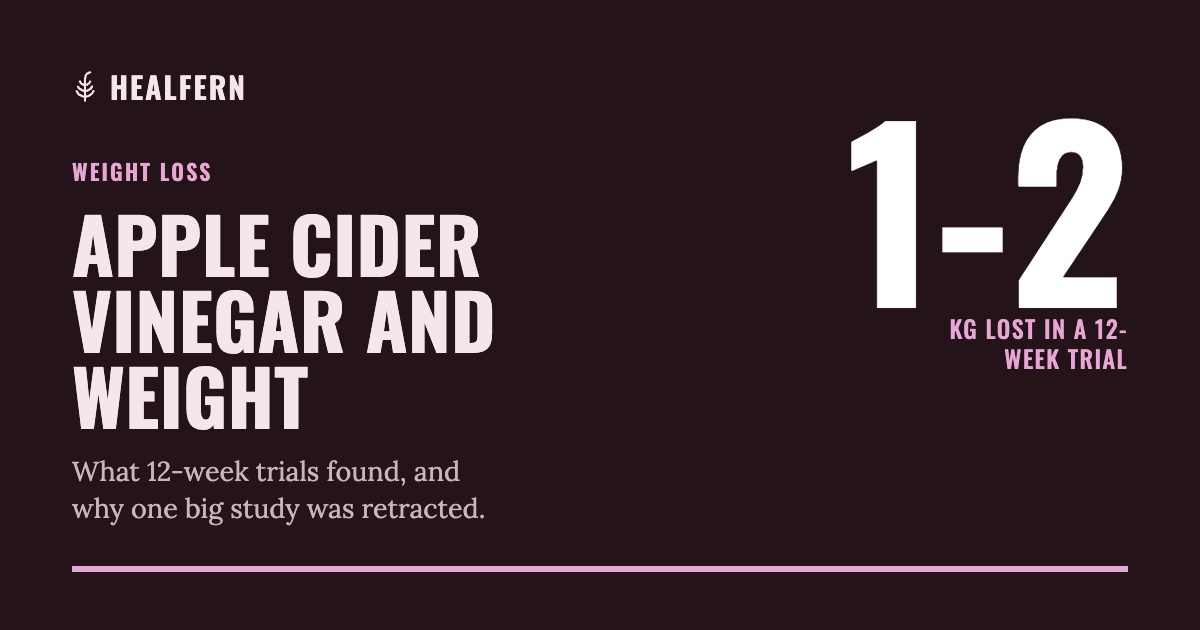
Apple cider vinegar may help with a small amount of weight loss. In the best-run trial, adults who drank 15 to 30 mL a day in water for 12 weeks lost about 1 to 2 kg, then regained most of it after stopping. A widely shared 2024 trial that claimed much bigger losses was retracted in 2025 over data problems.
We read the 12-week Japanese trial that most apple cider vinegar claims trace back to, the 2025 meta-analysis of 10 trials, a 2026 umbrella review of vinegar research, and the 2025 retraction notice for a widely shared Lebanese study. We also checked safety reports and what NIH says about weight-loss supplements.
The short answer: apple cider vinegar may help with a small amount of weight loss, roughly 1 to 2 kg over 12 weeks in the best-run trial, and that loss faded once people stopped drinking it[1].
| What it is | Fermented apple vinegar. In the main trial, 15 mL held 750 mg of acetic acid, its main active compound[1]. |
|---|---|
| Studied for | Body weight, waist size, blood sugar and blood fats in adults with overweight, obesity or type 2 diabetes[2]. |
| Amounts studied | 5 to 30 mL a day of liquid vinegar, usually diluted in water, for 4 to 12 weeks[2]. |
| Best evidence | Pooled vinegar trials show an average weight difference of about 1.06 kg compared with control groups[4]. |
| Safety | Side effects look uncommon at studied amounts, though vinegar can wear tooth enamel and tablets have injured the throat[5][8][9]. |
| Who should avoid it | People with gastroparesis, low potassium, or medicines that need medical oversight should ask a doctor first[7][10][11]. |

Does apple cider vinegar help you lose weight?
It may help a little. In the strongest single trial, 155 Japanese adults who drank 15 or 30 mL of apple vinegar a day for 12 weeks lost 1.2 kg and 1.9 kg, while the placebo group gained 0.4 kg[1]. A 2026 umbrella review of vinegar trials put the pooled average at about 1.06 kg[4].
That is a real but modest change: 1 to 2 kg is roughly 2 to 4 pounds over three months.
The loss did not last. Four weeks after people stopped the vinegar drinks, the 15 mL group was back at its starting weight of 74.9 kg on average, and the 30 mL group had regained most of what it lost[1].
A 2020 systematic review of 13 human studies reached a cautious verdict: there may be health benefits, but “the evidence for the health effects of AV is insufficient” because of too few large, low-bias trials[5]. NIH’s Office of Dietary Supplements says the same about weight-loss products in general, noting there is little scientific evidence that they work[11].
What did the main apple cider vinegar trials find?
The main trials found small drops in weight and waist size over 4 to 12 weeks, with the biggest claimed losses coming from studies that do not hold up. The Japanese trial by Kondo and colleagues is still the cleanest test, with a double-blind design and a taste-matched placebo drink[1].
A 2025 meta-analysis by Castagna and colleagues pooled 10 randomized trials with 789 participants. It found lower body weight, BMI and waist size with daily vinegar, and converted the weight effect to about 7.4 kg[2]. That number is far larger than any well-run single trial shows, and the next section explains why it needs a second look.
The 2026 umbrella review, which re-analyzed 10 earlier meta-analyses covering 38 studies, found a body weight change of 1.06 kg but no significant change in BMI or waist size[4].
| Study | Who and how long | Amount | Result |
|---|---|---|---|
| Kondo 2009, Japan[1] | 155 adults with BMI 25 to 30, 12 weeks | 15 or 30 mL apple vinegar a day in a drink | Lost 1.2 kg and 1.9 kg; placebo gained 0.4 kg; regained after stopping |
| Castagna 2025 meta-analysis[2] | 10 trials, 789 adults, 4 to 12 weeks | 5 to 30 mL a day or tablets | Lower weight, BMI and waist; included a trial later retracted |
| Shahmohammadi 2026 umbrella review[4] | 10 meta-analyses, 38 studies | Varied | Weight down 1.06 kg; no change in BMI or waist size |
| Abou-Khalil 2024, Lebanon[3] | Adolescents and young adults, 12 weeks | 5, 10 or 15 mL a day | Retracted in 2025; results could not be replicated |
The Kondo trial was run by researchers at Mizkan Group Corporation, a vinegar maker[1]. Industry-run trials need independent replication, and so far there has been little of it.
Why was a widely shared apple cider vinegar study retracted?
It was retracted because the journal could not reproduce the analysis and found multiple errors. The 2024 Lebanese trial in BMJ Nutrition, Prevention & Health drew wide media coverage for its large weight losses. In September 2025 the journal withdrew it, with the authors’ agreement[3].
The notice lists the problems plainly. The dataset showed “patterns inconsistent with random allocation” of participants, the p-values were improbably small for the number of people studied, and the trial had not been registered in advance, which breaches the journal’s policy[3].
The 2025 Castagna meta-analysis, published days before the retraction, included the Lebanese trial as one of its 10 studies[2][3]. We could not check how much that single trial moved its 7.4 kg estimate, so we give more weight to the umbrella review figure and the Japanese trial.
If you see headlines promising 6 or 7 kg from a spoonful of vinegar, check whether they cite the retracted Lebanese trial.
How could vinegar affect appetite and blood sugar?
The main ideas are that vinegar slows stomach emptying, blunts blood sugar spikes after meals, and makes people feel full. The fullness part has a less flattering explanation. A 2014 study by Darzi and colleagues found that vinegar cut appetite mostly because it made people feel sick[6].
In that study, 16 healthy volunteers drank vinegar with breakfast. Their appetite dropped, but nausea ratings rose too, and the least pleasant drink had the biggest effect. The authors concluded that promoting vinegar as a natural appetite suppressant “does not seem appropriate”[6].
The blood sugar effect has better support. The 2026 umbrella review linked vinegar with lower fasting glucose (about 9.40 mg/dL) and lower HbA1c (about 0.70 percentage points), both rated moderate certainty[4]. That is useful context, but it is also a reason for caution if you already take medicine that lowers blood sugar. Our guide to cinnamon for blood sugar covers a similar kitchen-cupboard claim.
Slower stomach emptying was measured directly in a 2007 pilot study. In 10 people with type 1 diabetes and gastroparesis, 30 mL of apple cider vinegar slowed emptying further, from a median of 27% to 17%[7].
Does apple cider vinegar burn fat?
Only in mice, so far. The idea comes from a 2009 Mizkan study in which mice on a high-fat diet were fed water or a weak acetic acid solution by stomach tube for 6 weeks. The acid-fed mice built up less body fat and liver fat, even though they ate the same amount of food[14].
The researchers traced the effect to the liver. Acetic acid switched on genes that help cells burn fat for fuel, including PPAR alpha and the enzymes ACO and CPT-1, through a signaling protein called AMPK[14]. When they removed AMPK from liver cells in a dish, the effect went away[14].
That is a tidy story, and it is where most of the “fat burning” marketing comes from. It has two problems. The mice got acetic acid at 0.3% or 1.5% straight into the stomach every day, which is a long way from a diluted tablespoon with dinner[14]. And the same company ran the 12-week human trial, where the weight change was 1 to 2 kg[1][14].
In people, the better-documented effect is on the meal itself. In a 2005 Swedish study, 12 healthy volunteers ate white bread holding 50 grams of carbohydrate, with or without vinegar. The more acetic acid they had with the bread, the lower their blood sugar and insulin were at 30 minutes, and the fuller they felt at 30, 90 and 120 minutes[13].
By the two-hour mark, though, the total glucose response was no different from plain bread[13]. Vinegar seems to delay the sugar rise, and the total over two hours was unchanged. No human study has shown that this turns into fat loss beyond the small weight changes covered above.
Does apple cider vinegar lower cholesterol or blood sugar too?
A little, in people who already have high readings. A 2021 meta-analysis of 9 trials found that apple cider vinegar lowered total cholesterol by about 6 mg/dL, fasting glucose by about 8 mg/dL, and HbA1c by 0.5 percentage points. It did not change LDL, HDL, fasting insulin or insulin resistance[15].
Those numbers sit close to the 2026 umbrella review, which put the fasting glucose drop at about 9.4 mg/dL and the HbA1c drop at 0.7 points[4]. Two teams pooling overlapping trials and landing in the same range is about as good as the vinegar evidence gets.
The details matter more than the headline. In the 2021 analysis, the cholesterol and triglyceride effects showed up mainly in people with type 2 diabetes, in trials that used 15 mL a day or less, and in trials that ran longer than 8 weeks[15]. Fasting glucose fell only in the trials longer than 8 weeks[15].
In apparently healthy participants, the picture flipped: fasting glucose and HDL appeared to rise slightly[15]. The authors do not explain why, and the changes are small, but a result in people with diabetes does not automatically carry over to someone with normal blood sugar.
None of this makes vinegar a substitute for diabetes or cholesterol care. If your doctor already tracks these numbers, mention a daily vinegar drink before you start it, because the glucose effect can add to the effect of medicine[4][15].
How much apple cider vinegar did studies use, and in what form?
Trials used 15 to 30 mL of liquid vinegar a day, about 1 to 2 tablespoons, always diluted. In the Kondo trial, people drank it inside a 500 mL beverage split into two portions, one after breakfast and one after supper[1]. Across the 10 trials in the 2025 meta-analysis, doses ran from 5 to 30 mL a day[2].
The 2025 meta-analysis found a significant weight effect only in the 30 mL subgroup[2]. The Kondo trial, by contrast, found that both 15 mL and 30 mL beat placebo, and the authors wrote that 15 mL a day was enough to see their effects[1]. With so few trials, there is no strong case that more vinegar works better.
Are apple cider vinegar gummies and tablets the same?
No trial in the pooled evidence shows that gummies match liquid vinegar. Most of the trials used liquid, and only one used effervescent tablets[2]. When researchers tested 8 apple cider vinegar tablet products in 2005, they found “considerable variability” in tablet size, acidity, acid content and label claims, and they doubted some contained apple cider vinegar at all[8].
The researchers ran those tests after a reported case of esophageal injury linked to one of these tablets[8]. If you choose a pill or gummy, check the label for the amount of vinegar per serving and compare it with the 15 to 30 mL used in trials. See our notes on reading a supplement label.
When should you take apple cider vinegar, and with what?
With a meal, diluted in water, is what the trials did. In the Kondo trial, people drank their vinegar in two portions, one after breakfast and one after supper[1]. In the Swedish bread study, the vinegar came with the meal itself, and that timing is what produced the lower 30-minute sugar rise[13].
The logic is simple. The meal effect depends on acetic acid being in the stomach as carbohydrate arrives, which slows how fast the stomach empties[7][13]. Vinegar taken on its own at a random hour has no meal to act on, and it exposes your teeth and throat to acid for nothing[8][9].
Bedtime dosing is a popular online tip. The Kondo trial and the Swedish study both gave vinegar with food, and we found no weight-loss trial that tested a bedtime dose on its own[1][13].
How to mix it
Fifteen mL, one tablespoon, in a large glass of water matches the lower Kondo dose and holds about 750 mg of acetic acid[1]. The Swedish study used more, 18 to 28 mmol of acetic acid, which works out to roughly 1.1 to 1.7 grams, or about 1.5 to 2 tablespoons of a 5% vinegar[13].
Finish the glass with the meal instead of sipping it over an hour, then rinse with water, since the lab erosion study measured enamel mineral loss after hours of acid contact[9]. If you also take a glucose-lowering medicine, the meal-time sugar effect is one more reason to clear it with your doctor first[4][13].
How do you read an apple cider vinegar label?
Look for the acid strength, the source, and the amount per serving. FDA has no formal standard of identity for vinegar, but its labeling policy says natural vinegar normally holds more than 4 grams of acetic acid per 100 mL, and any vinegar diluted with water must state its percent strength, never below 4%[16].
That number tells you how a bottle compares with the trials. The Kondo vinegar delivered 750 mg of acetic acid in 15 mL, which is a 5% product[1]. A bottle labeled 4% or 5% is in the studied range. “Diluted with water to 4 percent acid strength” on a label is normal and legal[16].
The name matters too. Under FDA policy, “cider vinegar” or “apple vinegar” means a product fermented from apple juice. A 1924 Supreme Court case, U.S. v. 95 Barrels of Alleged Apple Cider Vinegar, held that vinegar made from dried apples could not use the name[16]. Mixtures of distilled and cider vinegar should be labeled as mixtures[16].
Words like raw, unfiltered or “with the mother” are not measures of acetic acid. The Kondo trial used a plain apple vinegar drink[1], and the meta-analyses report doses in milliliters, with no comparison of filtered against unfiltered products[2].
For gummies and tablets, the label should state the vinegar or acetic acid per serving. The 2005 product test found tablets whose acid content did not match their labels[8]. If the amount is missing, you cannot compare the product with the 15 to 30 mL used in trials, and there is no reason to buy it.
Is it safe to drink apple cider vinegar every day?
For most healthy adults, small diluted amounts appear low risk. The Kondo trial reported no adverse effects and no liver or kidney problems over 12 weeks[1], and the 2020 systematic review judged the risk of side effects “inconsiderable” when vinegar is taken in recommended amounts and ways[5]. Undiluted or very large amounts are a different matter.
- Teeth. In a lab study, vinegar dissolved minerals from human tooth enamel, with losses of about 20% in the most acidic samples after hours of contact[9]. Dilute it, drink it with a meal, and rinse with water afterward.
- Throat. Tablets have caused esophageal injury[8]. Never sip undiluted vinegar.
- Stomach. Nausea is common enough that it may explain the appetite effect[6].
- Potassium and bones. A 1998 case report described low potassium and osteoporosis in a person who drank large amounts of cider vinegar for years[10].
Ask a doctor first if you have gastroparesis or diabetes with nerve damage to the stomach, since vinegar slowed emptying further in that group[7]. Do the same if you take insulin or other glucose-lowering drugs, have kidney disease or low potassium, or are pregnant or breastfeeding. NIH notes that some weight-loss supplements can interact with medicines[11].
See a doctor promptly if you have pain when swallowing, chest pain after taking a tablet, or ongoing heartburn.
What do doctors use first for weight loss?
Doctors start with lifestyle changes: an eating plan built around your calorie needs and regular physical activity. NIDDK suggests losing 5% of body weight over 6 months as a reasonable first goal, which means 10 pounds for a 200-pound person[12].
Programs that work tend to include 14 or more counseling sessions over 6 months, at least 150 minutes a week of moderate activity such as brisk walking, and regular tracking of food, activity and weight[12]. When lifestyle changes are not enough, doctors may prescribe weight-loss medicines, and surgery may be considered for people with a BMI of 35 or higher[12].
Protein-rich meals can help with fullness on a reduced-calorie plan. Our list of high-protein foods for weight loss gives protein per serving.
At best, apple cider vinegar is a small add-on to a plan that already works. NIH also points out that supplements do not need FDA review before they are sold, and that makers rarely test whether their products work[11].
For more weight topics, browse our weight loss guides, and see how we research each article.
A practical checklist if you want to try it
- Use liquid vinegar, 1 tablespoon (15 mL) diluted in a large glass of water, the amount used in the main trial[1].
- Drink it with or after a meal, as trial participants did, and rinse your mouth with plain water afterward[1][9].
- Do not drink it straight, and do not take more than 30 mL a day, the top dose studied[2].
- Skip tablets unless the label states the vinegar amount per serving; product quality has varied widely[8].
- Stop if you get nausea, heartburn, or throat pain[6][8].
- Check with your doctor first if you take diabetes medicine or have gastroparesis or low potassium[7][10].
- Track your weight for 12 weeks alongside your diet and activity, so you can tell whether anything changed[12].
Verdict: is apple cider vinegar worth it for weight loss?
The research supports a small effect, about 1 to 2 kg over three months, and the best trial showed that weight coming back after people stopped[1][4]. The headline studies with much bigger losses rest partly on a trial that has been retracted[3].
Our judgment: if you like the taste and your doctor has no concerns, a diluted tablespoon with meals is cheap and low risk, but expect almost nothing on the scale. Spend your effort on the eating, activity and medical options that move weight by 5% or more[12].
Questions people also ask
How much apple cider vinegar should I drink a day to lose weight?
Trials used 15 to 30 mL a day, about 1 to 2 tablespoons, diluted in water. The main Japanese trial split it between breakfast and supper. More than 30 mL has not been studied for weight, and both doses in that trial gave similar small losses.
How long does apple cider vinegar take to work for weight loss?
Studies ran 4 to 12 weeks. In the 12-week Japanese trial, people lost 1.2 to 1.9 kg on average. Four weeks after they stopped, most of that weight had come back, so any effect seems to last only while you keep drinking it.
Do apple cider vinegar gummies work for weight loss?
There is no good trial evidence that gummies work. Nearly all studies used liquid vinegar. A test of 8 vinegar tablet products found large differences in acid content and labels, and some may not have contained apple cider vinegar.
Can apple cider vinegar reduce belly fat?
The Japanese trial measured visceral fat by CT scan and found it fell more in the vinegar groups than with placebo over 12 weeks. The changes were small, the trial was run by a vinegar maker, and the effect has not been confirmed in larger independent trials.
Is it bad to drink apple cider vinegar every day?
Diluted amounts up to 30 mL a day caused no reported problems in a 12-week trial. Undiluted vinegar can erode tooth enamel and irritate the throat, and very large amounts over years were linked to low potassium in one case report.
Should I take apple cider vinegar before bed or with meals?
With meals. The 12-week Japanese trial split the daily dose after breakfast and supper, and a Swedish study found vinegar taken with a bread meal lowered the 30-minute blood sugar rise and raised fullness. No weight trial tested a bedtime dose on its own.
Sources
- Vinegar intake reduces body weight, body fat mass, and serum triglyceride levels in obese Japanese subjects, Kondo et al., Bioscience, Biotechnology, and Biochemistry, 2009
- Effect of apple cider vinegar intake on body composition in humans with type 2 diabetes and/or overweight: a systematic review and meta-analysis of randomized controlled trials, Castagna et al., Nutrients, 2025
- Retraction: Apple cider vinegar for weight management in Lebanese adolescents and young adults with overweight and obesity, BMJ Nutrition, Prevention and Health, 2025
- Vinegar consumption and health: an umbrella review of meta-analyses of randomized controlled trials, Shahmohammadi et al., Food Science and Nutrition, 2026
- Safety and side effects of apple vinegar intake and its effect on metabolic parameters and body weight: a systematic review, Launholt et al., European Journal of Nutrition, 2020
- Influence of the tolerability of vinegar as an oral source of short-chain fatty acids on appetite control and food intake, Darzi et al., International Journal of Obesity, 2014
- Effect of apple cider vinegar on delayed gastric emptying in patients with type 1 diabetes mellitus: a pilot study, Hlebowicz et al., BMC Gastroenterology, 2007
- Esophageal injury by apple cider vinegar tablets and subsequent evaluation of products, Hill et al., Journal of the American Dietetic Association, 2005
- In vitro study on dental erosion caused by different vinegar varieties using an electron microprobe, Willershausen et al., Clinical Laboratory, 2014
- Hypokalemia, hyperreninemia and osteoporosis in a patient ingesting large amounts of cider vinegar, Lhotta et al., Nephron, 1998
- Dietary Supplements for Weight Loss: Fact Sheet for Consumers, NIH Office of Dietary Supplements (archived copy), 2026
- Treatment for Overweight and Obesity, NIDDK, National Institutes of Health
- Vinegar supplementation lowers glucose and insulin responses and increases satiety after a bread meal in healthy subjects, Ostman et al., European Journal of Clinical Nutrition, 2005
- Acetic acid upregulates the expression of genes for fatty acid oxidation enzymes in liver to suppress body fat accumulation, Kondo et al., Journal of Agricultural and Food Chemistry, 2009
- The effect of apple cider vinegar on lipid profiles and glycemic parameters: a systematic review and meta-analysis of randomized clinical trials, Hadi et al., BMC Complementary Medicine and Therapies, 2021
- CPG Sec 525.825 Vinegar, Definitions, US Food and Drug Administration compliance policy guide (archived copy), 1995
This article is general information, not medical advice. These statements have not been evaluated by the FDA, and supplements are not intended to diagnose, treat, cure or prevent any disease. Talk to your doctor or pharmacist before you start a supplement. How we research.