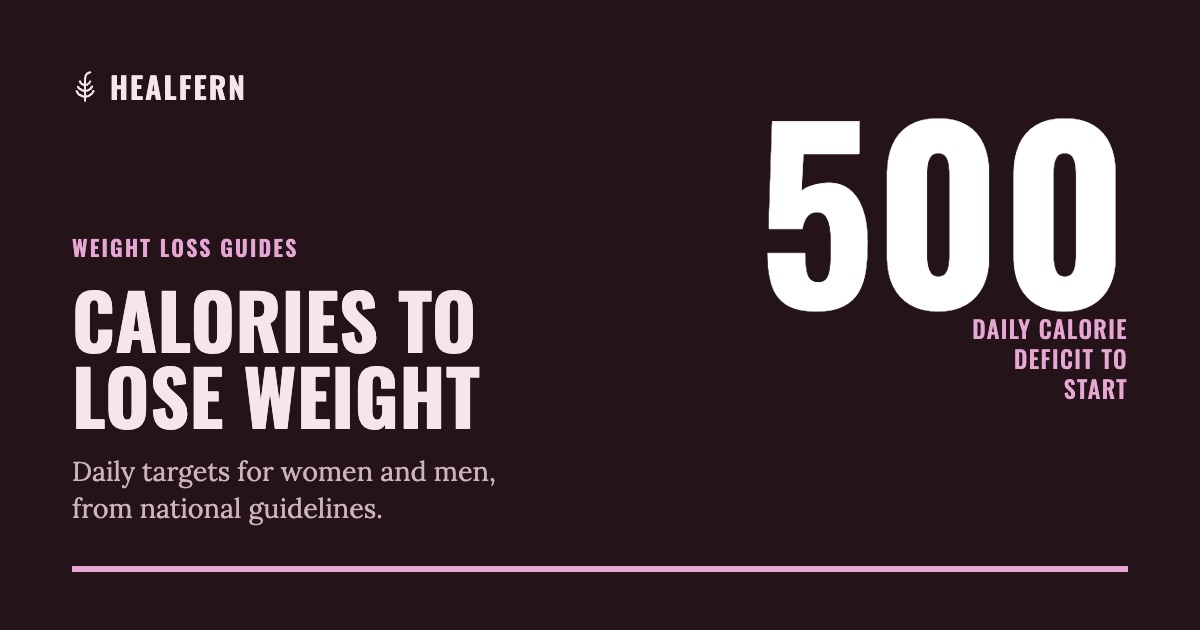
Most women lose weight on about 1,200 to 1,500 calories a day and most men on about 1,500 to 1,800. Another way to set it is to subtract 500 to 750 calories from what you burn now. Aim to lose 1/2 to 1 pound a week. Going under 800 calories a day is only safe with a doctor watching.
We read the calorie tables in the Dietary Guidelines for Americans, the 2013 obesity guideline from the American Heart Association, American College of Cardiology and The Obesity Society, and NIH pages from NIDDK, NHLBI and MedlinePlus. We also read the main trials behind the advice, including POUNDS LOST, DIETFITS, CALERIE and the NIH follow-up of The Biggest Loser contestants.
The short answer: most women lose weight on about 1,200 to 1,500 calories a day and most men on about 1,500 to 1,800, which works out to roughly 500 to 750 calories below what your body burns now.[2]
| What it is | Eating fewer calories than you burn so your body draws on stored fat. An energy deficit is required for weight loss.[2] |
|---|---|
| Typical maintenance needs | Adult women need an estimated 1,600 to 2,400 calories a day and adult men 2,000 to 3,000, depending on age, size and activity.[1] |
| Typical weight-loss targets | 1,200 to 1,500 calories a day for women and 1,500 to 1,800 for men, or a deficit of 500 to 750 calories a day.[2] |
| Safe pace | For most people the safest pace is about 1/2 to 1 pound a week.[3] |
| Best evidence | A two-year trial of 811 adults found reduced-calorie diets led to similar weight loss whatever their mix of fat, protein and carbohydrate.[10] |
| Safety | Diets under 800 calories a day should be used only with medical supervision. Losing more than 1 or 2 pounds a week can cost muscle, water and bone density.[2][3] |
| Who should check first | Children, teens, pregnant women, older adults and anyone with a medical condition or on regular medicines.[3][4] |
How many calories should I eat a day to lose weight?
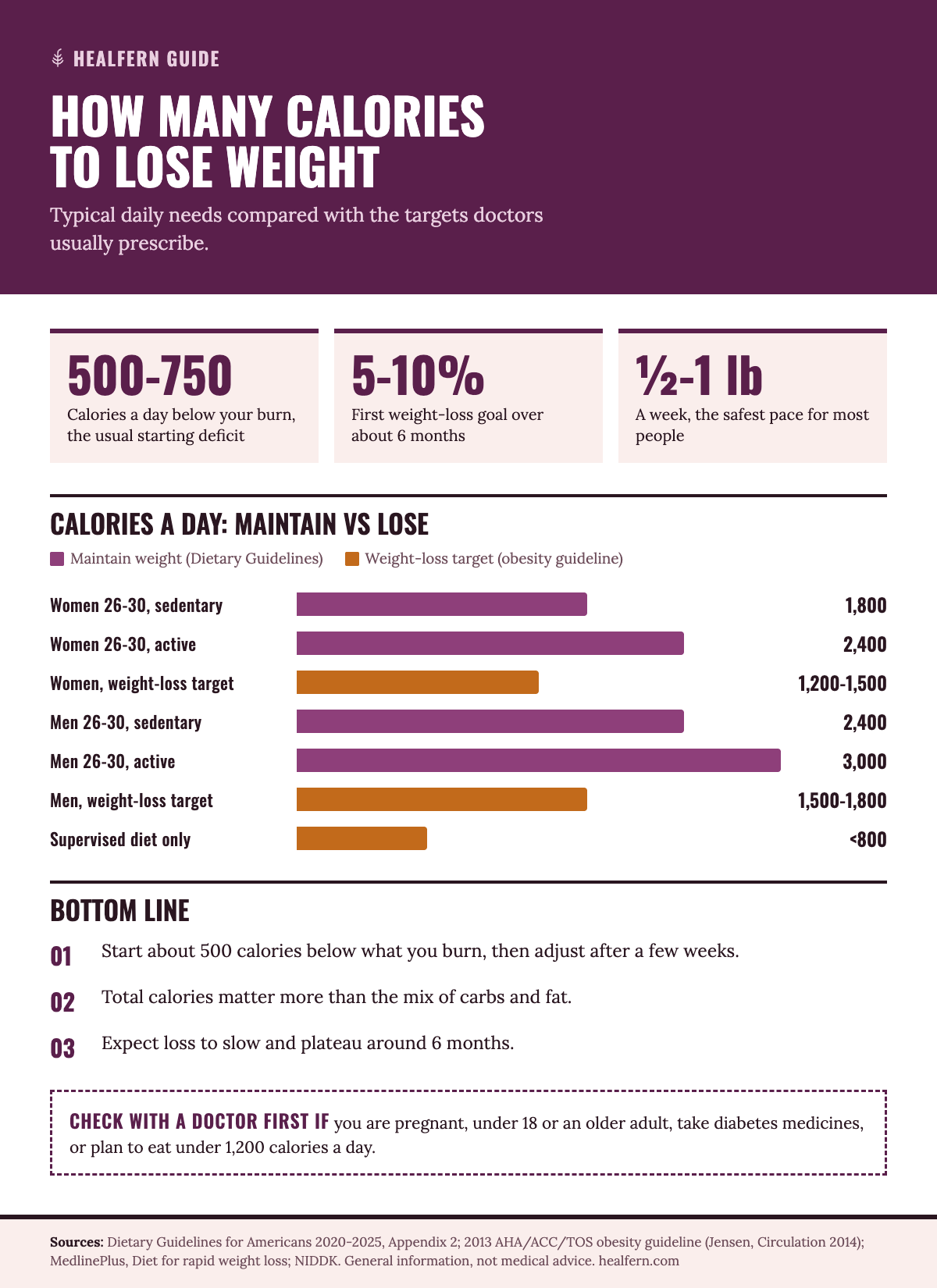
For most adults, the answer is a daily target of 1,200 to 1,500 calories for women and 1,500 to 1,800 for men. Those are the ranges the 2013 American Heart Association, American College of Cardiology and Obesity Society guideline says doctors usually prescribe. The guideline adds that the numbers are usually adjusted for body weight and activity.[2]
The same guideline gives a second method. You estimate what you burn each day, then subtract 500 or 750 calories, or cut about 30%.[2] A tall, active man who burns 3,000 calories could lose weight on 2,300. A small woman who sits most of the day may need to stay near the bottom of her range.
Both methods point at the same goal, a steady deficit you can live with for months. The rest of this guide covers how to find your own starting number, how fast the scale should move and why it slows down.
How many calories does your body burn now?
Your starting point is your maintenance number, the calories that keep your weight stable. The Dietary Guidelines estimate 1,600 to 2,400 calories a day for adult women and 2,000 to 3,000 for adult men. Needs rise with height, weight and activity, and they fall with age.[1]
The government estimates
The table below copies a few rows from Appendix 2 of the Dietary Guidelines. The figures assume a reference woman who is 5 feet 4 inches and 126 pounds and a reference man who is 5 feet 10 inches and 154 pounds, so heavier or taller people burn more.[1] “Moderately active” means walking about 1.5 to 3 miles a day on top of normal life. “Active” means more than 3 miles.[1]
| Group | Sedentary | Moderately active | Active |
|---|---|---|---|
| Women, 26 to 30 | 1,800 | 2,000 | 2,400 |
| Women, 51 to 55 | 1,600 | 1,800 | 2,200 |
| Women, 61 and older | 1,600 | 1,800 | 2,000 |
| Men, 26 to 30 | 2,400 | 2,600 | 3,000 |
| Men, 51 to 55 | 2,200 | 2,400 | 2,800 |
| Men, 76 and older | 2,000 | 2,200 | 2,400 |
Working out your own number
For a closer estimate, many dietitians start with the Mifflin-St Jeor equation, built from measurements of 498 adults aged 19 to 78. For women, resting calories equal 10 times weight in kilograms, plus 6.25 times height in centimeters, minus 5 times age, minus 161. For men, the last step is plus 5 instead of minus 161. In that study the older Harris-Benedict equations overestimated resting burn by 5%.[7]
Resting burn is only part of the day. NIDDK’s free Body Weight Planner asks for an activity level, with typical values from 1.4 for sedentary people to 2.5 for very active people and a default of 1.6.[6] Multiplying resting calories by that level gives a rough daily total.
Here is a worked example using the equation. A 40-year-old woman who is 5 feet 4 inches and 180 pounds has a resting burn near 1,470 calories. At an activity level of 1.4 to 1.6 she burns roughly 2,060 to 2,350 a day, so a 500-calorie deficit puts her near 1,560 to 1,850.[6][7] Treat any result as a starting guess and adjust after a few weeks of weighing.
How big should your calorie deficit be?
A daily deficit of 500 to 750 calories is the standard starting point in the national obesity guideline. That size is large enough to show on the scale within weeks and small enough that most people can keep eating normal foods. Some programs instead cut total intake by about 30%.[2]
MedlinePlus says that for most people the safest diet is one that produces a loss of 1/2 to 1 pound a week, and that losing more than 1 or 2 pounds a week is not safe for most people because it can cause loss of muscle, water and bone density.[3]
A bigger cut is not automatically better. In the CALERIE trial, healthy adults were asked to eat 25% fewer calories for two years. On average they managed an 11.9% cut, about half the target, and still lost 7.5 kg (about 16.5 pounds), most of it fat.[12] So plan around a deficit you can actually hold for months.
Is 1,200 calories a day enough?
For many women, 1,200 calories is the low end of the range doctors prescribe, and it can work. For most men it is below the usual 1,500 to 1,800 range. The guideline frames these numbers as starting points adjusted to body weight and activity, so a heavy or very active person may lose steadily on far more.[2]
The bigger risk is going lower without help. MedlinePlus describes very low-calorie diets of as few as 800 calories a day, usually made of shakes, soups and bars that supply the needed nutrients. It says these are for adults with obesity who need to lose weight for health reasons, should be used only with a provider and are generally not used for more than 12 weeks.[3] The obesity guideline goes further and recommends diets under 800 calories only in a medical setting with monitoring.[2]
If a plan leaves you hungry, tired or dizzy at 1,200, talk to a doctor or dietitian about a higher target and more activity.
Is the 3,500-calorie rule accurate?
Only roughly, and only for some people. The old rule says every pound of weight loss takes a 3,500-calorie deficit, so 500 a day equals a pound a week. NIH researcher Kevin Hall showed in 2008 that this matches people with more than about 30 kg of body fat but overestimates the deficit needed for leaner people.[8]
The bigger flaw is time. The rule assumes your burn stays fixed. In reality, a smaller body uses fewer calories, so the same daily cut produces less loss each month. Hall’s 2011 model in The Lancet found the body’s response to a change in intake is slow, with a half time of about one year.[9] In plain terms, about half of the total change from a lasting calorie cut shows up in the first year, and the rest arrives more slowly after that.[9]
The model also found that people with more body fat lose more weight for the same cut in calories.[9] The free NIDDK Body Weight Planner grew out of this research and gives a calorie target that accounts for the slowdown, which is more useful than a fixed 3,500-calorie rule.[6][9]
How fast will you lose weight on a calorie deficit?
Expect the fastest loss in the first few months and a slower pace after that. In comprehensive lifestyle programs, average losses reach up to 8 kg (about 17.6 pounds) in six months, and weight loss levels off around six months for most people.[2] NIDDK suggests a first goal of 5% to 10% of starting weight within six months.[4]
For someone who weighs 200 pounds, NIDDK’s example goal is about 10 pounds in the first six months.[4] That can feel slow. NHLBI notes that losing just 3% to 5% of your weight can lower blood triglycerides and glucose and reduce the risk of type 2 diabetes, and that losing more can improve blood pressure and cholesterol.[5]
The first week or two often looks better than the math. MedlinePlus notes that very fast loss includes water and muscle as well as fat.[3] Judge your plan on the trend over four to eight weeks, not on any single weigh-in.
How do calorie needs change with age, sex and activity?
Calorie needs fall as you age, are higher in men than in women of the same age, and rise with daily activity. The Dietary Guidelines link the drop with age to a lower basal metabolic rate, and their tables show the gap clearly.[1]
A sedentary man aged 26 to 30 needs an estimated 2,400 calories to hold his weight, while a sedentary man 76 or older needs about 2,000. A sedentary woman aged 26 to 30 needs about 1,800, and one over 60 needs about 1,600.[1] Moving from sedentary to active adds roughly 400 to 600 calories a day in most of the adult rows.[1]
This is why two people on the same 1,500-calorie plan can get very different results. It is also why the obesity guideline pairs a lower-calorie diet with at least 150 minutes a week of aerobic activity, such as brisk walking.[2] For keeping weight off over the long term, the guideline cites higher levels of about 200 to 300 minutes a week.[2]
Why does weight loss slow down or stall?
Weight loss slows because a smaller body burns fewer calories, because the body adapts by burning a bit less than expected, and because food intake tends to creep up over time. Most people hit a plateau around six months.[2]
Your body adapts
The NIH follow-up of 14 contestants from The Biggest Loser is an extreme example. They lost an average of 58.3 kg in 30 weeks, and their resting burn fell by 610 calories a day. Six years later they had regained 41.0 kg, yet their resting burn was still 704 calories a day below where it started, about 499 calories lower than their body size predicted.[13] These were extreme losses, so most dieters will see a much smaller effect, but the direction is the same.
MedlinePlus explains that rapid loss is a big stress for the body and triggers a stronger hormonal response, which is one reason weight loss slows over time and weight returns when the diet is relaxed.[3]
Intake is hard to count
The other common cause is counting. In a 1992 New England Journal of Medicine study, people who said they could not lose weight on under 1,200 calories underreported what they ate by an average of 47% and overreported their exercise by 51%. Their metabolism was within 5% of predicted values.[14] NIDDK’s planner makes the same point, noting that people often underestimate how much they eat.[6]
Does it matter where the calories come from?
For weight loss itself, the total matters more than the mix. In the POUNDS LOST trial, 811 overweight adults were randomly assigned to four reduced-calorie diets with different shares of fat, protein and carbohydrate. After two years, weight loss was similar on all four, and the authors concluded that reduced-calorie diets work regardless of which macronutrients they emphasize.[10]
The DIETFITS trial at Stanford tested a healthy low-fat diet against a healthy low-carb diet in 609 adults for 12 months. The low-fat group lost 5.3 kg and the low-carb group 6.0 kg, a difference that was not statistically significant. Neither genotype nor insulin secretion predicted who did better.[11]
Food choice still matters for health. The Dietary Guidelines favor vegetables, fruits, whole grains, legumes, lean protein and less refined grain and sugar for long-term health.[1] Our guide to high-protein foods for weight loss covers how protein fits into a calorie deficit, food by food.
What does the research show?
The strongest trials agree on two points. A sustained calorie deficit produces weight loss, and the type of diet matters less than how well people stick to it. In POUNDS LOST, each group session attended was linked with about 0.2 kg more weight loss.[10]
| Study | Who and how long | Approach | Result |
|---|---|---|---|
| POUNDS LOST, NEJM 2009[10] | 811 overweight adults, 2 years | Four reduced-calorie diets with different fat, protein and carb shares | About 6 kg lost at 6 months; 2.9 to 3.6 kg at 2 years, similar across diets |
| DIETFITS, JAMA 2018[11] | 609 adults aged 18 to 50, 12 months | Healthy low-fat vs healthy low-carb | 5.3 kg vs 6.0 kg, no significant difference |
| CALERIE, Lancet Diabetes Endocrinol 2019[12] | 218 healthy non-obese adults, 2 years | Target 25% calorie cut; achieved 11.9% | 7.5 kg lost, 71% of it fat |
| Biggest Loser follow-up, Obesity 2016[13] | 14 contestants, 6 years | Extreme diet and exercise competition | Resting burn still 704 calories a day below baseline after 6 years |
Taken together, these studies support a moderate deficit kept up for months. None of them found a best ratio of carbs to fat.
Who should not cut calories on their own?
Children, teens, pregnant women and older adults should not follow a rapid weight-loss diet unless a provider recommends it, according to MedlinePlus. Anyone using a very low-calorie diet needs medical supervision.[3] NIDDK’s planner itself is not designed for people under 18 or for pregnant or breastfeeding women.[6]
Fast weight loss has side effects. MedlinePlus lists gallstones, gout, fatigue, constipation, diarrhea and nausea, along with loss of muscle, water and bone density when loss runs faster than 1 to 2 pounds a week.[3]
NIDDK suggests talking with a health care professional before starting a program, partly to review medical problems and any medicines or dietary supplements that may affect your weight.[4] Ask before you start if you take diabetes medicines. If you notice signs of very high or low blood sugar, our guide to high blood sugar symptoms explains when to call a doctor.
Pregnancy is a separate case. The Dietary Guidelines estimate no extra calories in the first trimester but about 340 more in the second, 452 more in the third and 330 to 400 more while breastfeeding, and they advise following your provider’s guidance.[1] Pregnancy is not the time for a weight-loss deficit unless your doctor sets one.
How do doctors help people lose weight?
Doctors usually start with a structured lifestyle program, a lower-calorie eating plan, more physical activity and regular support. The obesity guideline recommends high-intensity programs of at least 14 sessions in six months, run by a trained interventionist in person or in groups.[2]
These programs also teach self-monitoring of food, activity and weight. For keeping weight off, the guideline adds weighing yourself at least weekly.[2] Programs delivered by phone or online with personal feedback have produced losses of up to 5 kg over 6 to 12 months.[2]
NIDDK says a good program should include a reduced-calorie eating plan, a plan for more activity and a plan for keeping weight off. It warns against programs that promise weight loss without diet or exercise or claims such as “lose 30 pounds in 30 days.”[4] When lifestyle changes are not enough, NIDDK notes that health care professionals may also use weight-loss medicines or metabolic and bariatric surgery, usually alongside lifestyle changes.[4] No supplement replaces this care, including popular options such as apple cider vinegar.
How do you track calories without getting it wrong?
Track for a few weeks with a food app or journal, weigh yourself at least weekly and make small adjustments based on the trend. Self-monitoring of food, activity and weight is a core part of every successful program in the obesity guideline.[2]
- Find your starting number with the NIDDK Body Weight Planner or the Mifflin-St Jeor equation, then subtract 500 calories.[6][7]
- Do not go below about 1,200 calories (women) or 1,500 (men) without a doctor or dietitian, and never under 800 on your own.[2][3]
- Log everything for two weeks, including drinks, cooking oil and weekend meals. Self-reports can miss nearly half of intake.[14]
- Read serving sizes on Nutrition Facts labels; our label reading guide shows where calories hide.
- Weigh at the same time of day, at least once a week, and judge the four-week trend.[2]
- Aim for 150 minutes of brisk walking or similar activity a week.[2]
- If loss stalls for a month, check your logging first, then trim your target slightly or add activity.
- Expect a plateau around six months and set a maintenance plan before you reach it.[2]
For more guides in this series, see our weight loss guides and the wider weight loss section. Our methods are described on how we research.
Verdict: how many calories should you eat?
Start around 1,200 to 1,500 calories a day if you are a woman and 1,500 to 1,800 if you are a man, or about 500 calories below your estimated burn. Aim for 1/2 to 1 pound a week and judge the trend over a month. These are the ranges with the most support from national guidelines and long trials.[2][3]
Our judgment call: pick the higher end of your range first. The CALERIE volunteers, healthy and supported, hit only half their target cut, and in our reading of the trials the people who did best were the ones who kept going, not the ones who cut hardest.[10][12]
Questions people also ask
How many calories should a woman eat to lose weight?
Most women lose weight on about 1,200 to 1,500 calories a day, the range the national obesity guideline says is usually prescribed. Taller, heavier or very active women may lose steadily on more, so adjust after a few weeks of weighing.
How many calories should a man eat to lose weight?
Most men lose weight on about 1,500 to 1,800 calories a day. Another method is to estimate what you burn, often 2,000 to 3,000 calories for adult men, and subtract 500 to 750.
Is a 500 calorie deficit enough to lose weight?
Yes, for most adults. A 500 to 750 calorie daily deficit is the standard starting point in the obesity guideline, and it fits the pace of 1/2 to 1 pound a week that MedlinePlus calls safest for most people.
Why am I not losing weight on 1,200 calories?
The most common reason is that intake is higher than it seems. In one study, people who said they ate under 1,200 calories underreported intake by 47%. Your burn also falls as you lose weight, and most people plateau around six months.
Is it safe to eat 800 calories a day?
Only with medical supervision. Diets under 800 calories a day are very low-calorie diets, usually made of meal replacements, and guidelines limit them to adults with obesity who are monitored by a provider, generally for no more than 12 weeks.
Does it matter if I cut carbs or fat?
Not much for weight loss itself. The POUNDS LOST trial of 811 adults and the DIETFITS trial of 609 adults found similar weight loss on reduced-calorie diets with different shares of fat and carbohydrate. Choose the plan you can keep.
Sources
- Dietary Guidelines for Americans, 2020-2025, Appendix 2: Estimated Calorie Needs, USDA and HHS, 2020
- 2013 AHA/ACC/TOS guideline for the management of overweight and obesity in adults, Jensen et al, Circulation, 2014
- Diet for rapid weight loss, MedlinePlus, National Library of Medicine, reviewed 2026
- Choosing a safe and successful weight-loss program, NIDDK, National Institutes of Health
- Aim for a healthy weight, NHLBI, National Institutes of Health, updated 2025
- Body Weight Planner, NIDDK, National Institutes of Health
- A new predictive equation for resting energy expenditure in healthy individuals, Mifflin et al, American Journal of Clinical Nutrition, 1990
- What is the required energy deficit per unit weight loss?, Hall, International Journal of Obesity, 2008
- Quantification of the effect of energy imbalance on bodyweight, Hall et al, The Lancet, 2011
- Comparison of weight-loss diets with different compositions of fat, protein, and carbohydrates (POUNDS LOST), Sacks et al, New England Journal of Medicine, 2009
- Effect of low-fat vs low-carbohydrate diet on 12-month weight loss (DIETFITS), Gardner et al, JAMA, 2018
- 2 years of calorie restriction and cardiometabolic risk (CALERIE), Kraus et al, Lancet Diabetes and Endocrinology, 2019
- Persistent metabolic adaptation 6 years after The Biggest Loser competition, Fothergill et al, Obesity, 2016
- Discrepancy between self-reported and actual caloric intake and exercise in obese subjects, Lichtman et al, New England Journal of Medicine, 1992
This article is general information, not medical advice. These statements have not been evaluated by the FDA, and supplements are not intended to diagnose, treat, cure or prevent any disease. Talk to your doctor or pharmacist before you start a supplement. How we research.