
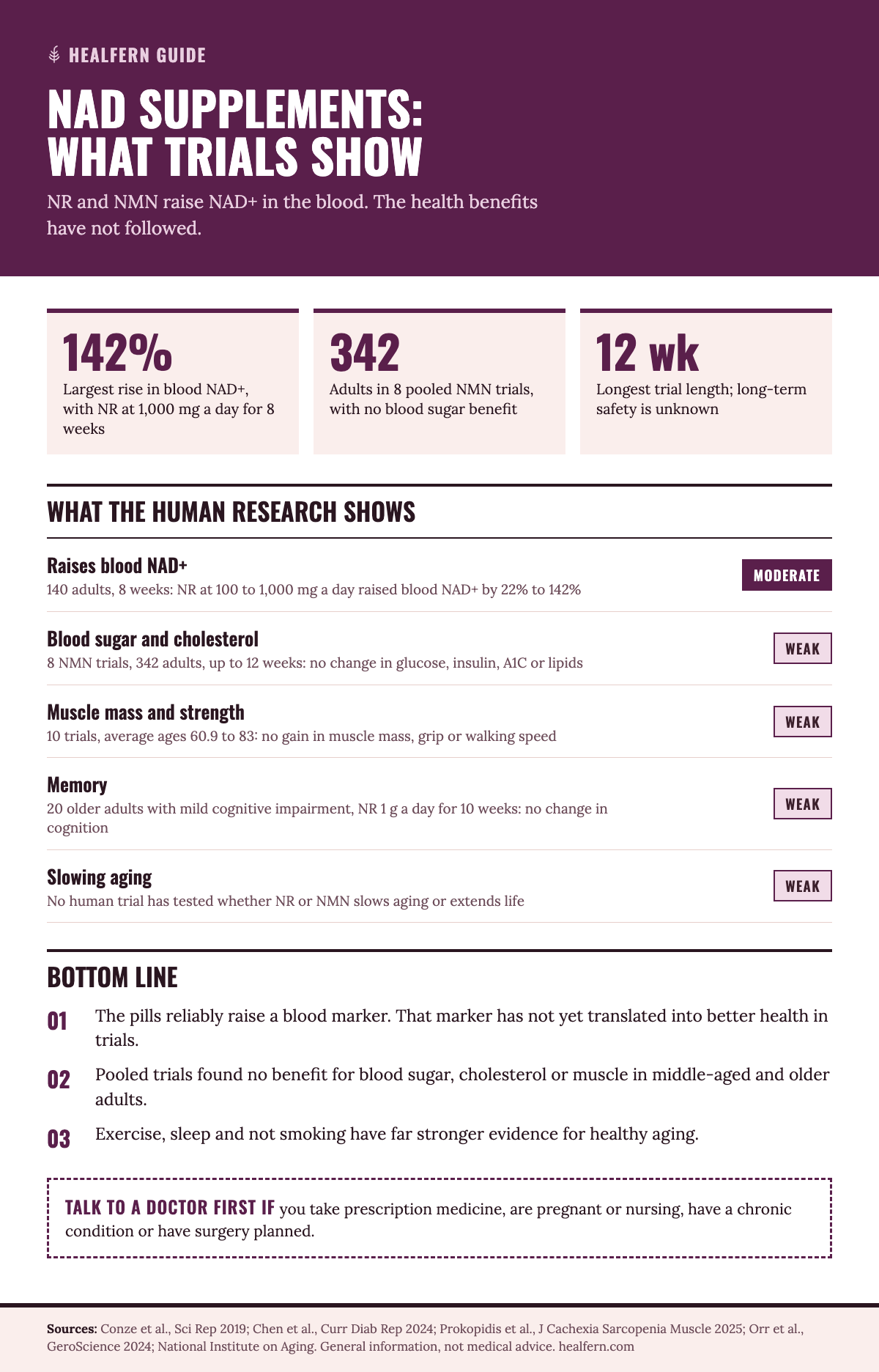
NAD+ precursors such as nicotinamide riboside (NR) and NMN reliably raise NAD+ in the blood, by up to 142% in one trial. That is where the proven benefit stops. No human trial has tested whether they slow aging, and 2024 and 2025 meta-analyses found no benefit for blood sugar, cholesterol, muscle mass or strength. They looked safe for up to 12 weeks.
We read the six human trials of NAD+ precursors most often cited by supplement sellers, two 2024 and 2025 meta-analyses that pooled the newer trials, and the NIH Office of Dietary Supplements fact sheet on niacin, the vitamin family these products belong to.[4][5][6][7][10][11][1] We also checked what the National Institute on Aging says about healthy aging. Our method is on the how we research page.
The short answer: NAD+ precursor pills such as nicotinamide riboside (NR) and nicotinamide mononucleotide (NMN) reliably raise NAD+ in the blood, but no human trial has shown that they slow aging, and pooled trials found no benefit for blood sugar or muscle strength.[4][8][10][11]
| What they are | Pills that supply building blocks the body turns into NAD (nicotinamide adenine dinucleotide), a coenzyme more than 400 enzymes need. NR and NMN are the most common forms.[1] |
|---|---|
| Marketed for | Slowing aging, energy, metabolism, muscle and brain health. The marketing rests mostly on rodent research.[6] |
| Amounts studied | NR at 100 to 2,000 mg a day; NMN at 250 to 2,000 mg a day, for 14 days to 12 weeks.[8][5][11] |
| Best evidence | They raise blood NAD+ levels, by about 22% to 142% for NR depending on dose.[8] |
| Weak or no evidence | Aging, blood sugar, cholesterol, muscle mass, grip strength and memory.[10][11][9] |
| Safety | Well tolerated in trials lasting up to 12 weeks. Long-term safety is unknown.[5][8] |
| Ask a doctor first | If you take prescription drugs, are pregnant or nursing, have a chronic condition or have surgery planned.[2] |
What is NAD+, and why do supplements target it?
NAD+ is a coenzyme found in every cell. Your body makes it from niacin (vitamin B3) and from the amino acid tryptophan, and more than 400 enzymes depend on it, many of them involved in turning food into energy.[1] Supplements target it because NAD+ levels appear to fall as people and animals age.[4]
The sales pitch runs like this: if NAD+ drops with age, and raising it helped old mice, topping it up might help people. Rodent studies drove most of the commercial interest; the Washington University team that ran one of the main human trials noted that NMN is sold in the US with claims about glucose control and “the metabolic complications of aging” built on that animal work.[6]
The NIH Office of Dietary Supplements groups nicotinamide riboside with the niacin family. It notes that NR and NMN are sold as supplements but are not marketed or labeled as sources of niacin.[1] Most Americans already get more niacin than the RDA from food. Men average 31.4 mg a day and women 21.3 mg.[1]
How does the body turn NR or NMN into NAD+?
Cells absorb NR and NMN and convert them to NAD+ through a short chemical pathway, and the rise shows up in blood cells within hours. In the first human pharmacokinetic study of NR, a single dose raised NAD+ in blood cells 2.7-fold, with the peak about eight hours after swallowing it.[12]
That 2016 study, published in Nature Communications, had two parts. One volunteer took 1,000 mg of NR and gave blood over 24 hours; his blood-cell NAD+ had risen 2.3-fold at about four hours and peaked at 2.7-fold near eight hours.[12] Then 12 healthy adults took single doses of 100, 300 and 1,000 mg in random order, with 7-day washouts between doses, and the NAD+ rise grew with the dose.[12]
Two details from that work matter for anyone reading a label. First, NAD+ and its related compounds were found only inside blood cells, not in plasma or urine, so “NAD+ in the blood” means NAD+ inside blood cells.[12] Second, the body does not bank the extra. The main waste product, a methylated form of nicotinamide called Me2PY, rose about 10-fold in plasma and urine after the NAD+ peak, so part of each dose is processed and passed out.[12]
ChromaDex, the NR supplier, sponsored the study, and three authors held company stock.[12] The pathway itself is not in dispute, since NAD+ is also what the body makes from ordinary niacin and from tryptophan in food.[1] What pharmacokinetics cannot tell you is whether more NAD+ in a white blood cell changes anything in a muscle or a brain. The Science trial found muscle NAD+ unchanged after 10 weeks of NMN.[6]
Do NAD supplements raise NAD+ levels?
Yes. This is the one claim the trials support consistently. Both NR and NMN raised NAD+ in blood within weeks, and the rise held for as long as people kept taking them.[4][8][7] What the trials could not show is that a higher blood number changed health.
In an 8-week 2019 trial of 140 healthy overweight adults, NR at 100, 300 and 1,000 mg a day raised whole-blood NAD+ by 22%, 51% and 142% within two weeks.[8] That trial was funded by ChromaDex, which sells NR. In the 2018 University of Colorado crossover trial, 500 mg of NR twice a day raised NAD+ in blood cells by about 60% compared with placebo.[4]
NMN did the same thing. A 60-day trial of 80 healthy middle-aged adults found blood NAD rose in every NMN group (300, 600 and 900 mg) compared with placebo.[7] In older adults with mild cognitive impairment, 1 g of NR a day raised blood NAD+ 2.6-fold over 10 weeks.[9]
One caution from the Science trial: after 10 weeks of NMN, NAD+ rose in blood cells but muscle NAD+ content did not change.[6]
Do NAD supplements slow aging?
No human trial has tested whether NR or NMN slows aging or extends life. The trials so far are small, last 6 to 12 weeks, and measure markers such as blood NAD+, blood pressure or walking distance. Animal results have not yet carried over to people in a consistent way.[10][11]
The closest thing to an aging outcome comes from the 80-person NMN trial, which reported that a “blood biological age” score rose in the placebo group and stayed flat with NMN. The same trial reported longer six-minute walks, with the longest distances and highest NAD levels at 600 and 900 mg a day.[7] That study was co-sponsored by the NMN manufacturer, and its lead author worked for the company, so it needs independent repeats.[7]
| Trial | Who and how long | Dose | Result |
|---|---|---|---|
| Martens, 2018 | 24 healthy middle-aged and older adults who finished, two 6-week phases | NR 1,000 mg/day | NAD+ up about 60%; blood pressure trend only[4] |
| Dollerup, 2018 | 40 obese men, 12 weeks | NR 2,000 mg/day | No change in insulin sensitivity or body fat[5] |
| Yoshino, 2021 | 25 women with prediabetes, 10 weeks | NMN 250 mg/day | Muscle insulin sensitivity up 25%; glucose, weight and lipids unchanged[6] |
| Yi, 2023 | 80 healthy middle-aged adults, 60 days | NMN 300 to 900 mg/day | Longer walk test; no insulin change; maker co-sponsored[7] |
| Orr, 2024 | 20 older adults with mild cognitive impairment, 10 weeks | NR 1 g/day | NAD+ up 2.6-fold; no change in cognition[9] |
| Chen, 2024 meta-analysis | 8 trials, 342 adults, up to 12 weeks | NMN 250 to 2,000 mg/day | No effect on glucose, insulin, A1C or lipids[11] |
Who paid for the research?
Several of the trials had industry ties. The 140-person NR dose trial was funded by ChromaDex, the company behind NIAGEN, a branded form of NR.[8] The 80-person NMN trial was co-sponsored by its NMN supplier.[7] Two authors of the Science NMN trial hold NMN patents or licensing ties, which the journal disclosed.[6]
The trials without product money behind them found less. The Danish trial in obese men was investigator-initiated, used a high dose of 2,000 mg a day, and found no metabolic benefit.[5] The two meta-analyses, which pooled every eligible trial regardless of sponsor, also found no benefit for blood sugar, lipids or muscle.[10][11]
Sample size is the other problem. The NMN trials in the 2024 review enrolled 14 to 108 people each, enough to see a change in a blood marker but too few to pick up modest effects on how people feel or function.[11]
Do NMN or NR help blood sugar, muscles or memory?
So far the pooled answer is no for all three. A 2024 meta-analysis of 8 NMN trials found no benefit for fasting glucose, insulin, A1C or cholesterol, and a 2025 meta-analysis of 10 trials in adults over 60 found no gain in muscle mass, grip strength or walking speed.[11][10]
The blood sugar picture is mixed at the single-trial level. NMN at 250 mg a day raised muscle insulin sensitivity by 25% in 13 women with prediabetes, yet their blood glucose, weight and lipids did not change.[6] NR at 2,000 mg a day for 12 weeks did not improve insulin sensitivity in 40 obese men, and it did not change their body composition or resting energy use either.[5] The pooled NMN trials were small, with 14 to 108 people each.[11]
For muscle, the 2025 review included six NMN trials and four NR trials with average ages from 60.9 to 83. Its authors wrote that the evidence “does not support” NMN or NR for preserving muscle mass and function.[10] NR did lengthen walking distance in one trial of people with peripheral artery disease.[10]
For memory, the only placebo-controlled NR trial in mild cognitive impairment was a 20-person pilot. Cognition scores stayed the same in both groups.[9]
Do NAD supplements help older adults walk or move better?
Possibly, in one specific group. The longest NAD trial to date, six months of NR in 90 people with peripheral artery disease, improved six-minute walking distance by about 17.6 meters compared with placebo.[14] In healthy older men, 12 weeks of NMN produced only borderline changes in gait speed and grip, and pooled trials found no muscle benefit.[15][10]
The six-month peripheral artery disease trial
The NICE trial, published in Nature Communications in 2024 and funded by the American Heart Association, randomized 90 adults with a mean age of 71 to NR 1,000 mg a day, NR plus 125 mg of resveratrol, or placebo.[14] After six months, walking distance rose 7.0 meters with NR and fell 10.6 meters with placebo. Among people who took at least 75% of their pills, the NR gain was 31 meters.[14] Adding resveratrol did not help; that group did not beat placebo.[14]
Two cautions. The result came with a 90% confidence interval whose lower bound was only 1.8 meters, and the authors call for a larger trial to confirm it.[14] Also, 89 of 90 people finished, but diarrhea was more common on NR (39.3%) than on placebo (27.6%), and most common with NR plus resveratrol (54.6%).[14]
Healthy older men
A 2022 Tokyo trial gave 42 men aged 65 and older either 250 mg of NMN or placebo for 6 or 12 weeks. Blood NAD+ rose, everyone took more than 90% of their doses, and the supplement was well tolerated.[15] Gait speed and left-hand grip showed what the authors called “nominally significant” improvements that “should be validated in larger studies,” while body composition did not change.[15] Three authors were employees of the NMN supplier.[15]
The pattern fits the meta-analysis: people with a disease that limits blood flow to the legs may get a measurable walking benefit, and healthy older adults mostly do not.[10]
When should you take an NAD supplement, and does timing matter?
Only one trial has tested timing, and it gives a hint rather than an answer. In 108 Japanese adults aged 65 and older, 250 mg of NMN taken in the afternoon produced the largest improvements in a sit-to-stand test and in daytime drowsiness over 12 weeks, but the placebo groups improved on several of the same measures.[13]
The 2022 University of Tsukuba study split people into four groups: NMN or placebo, taken either before noon or after noon. Everyone swallowed six tablets once a day with water.[13] At the end, the five-times sit-to-stand test had improved in all four groups, and drowsiness had improved in both afternoon groups, placebo included.[13] The NMN afternoon group had the biggest effect sizes (0.72 for sit-to-stand and 0.64 for drowsiness), which the authors read as a possible advantage of afternoon dosing.[13] The authors declared no conflict of interest; the tablets came from Mitsubishi Corporation Life Sciences.[13]
Pharmacokinetics suggest timing is not critical for the NAD+ rise itself. After a single dose of NR, blood-cell NAD+ was still climbing at four hours and peaked near eight hours, so a morning dose covers the day and an evening dose covers the night.[12] Trials that showed the rise used once-daily dosing in the 140-person NR trial and twice-daily dosing in the Colorado trial, and both worked.[8][4]
We found no trial comparing doses taken with and without food, so that question is open. If you try one, pick a time you will remember and keep it the same, since the trials measured steady daily use rather than occasional doses.[8][7]
Are NAD supplements safe, and who should avoid them?
In trials lasting up to 12 weeks, NR and NMN caused no more side effects than placebo, even at 2,000 mg of NR a day.[5][8] Nobody knows what happens after years of use, because no trial has run that long. Side effects that did occur were mild.[4]
In the Colorado trial, 7 of 30 people reported 14 mild adverse events across both phases, and none were serious.[4] The 140-person NR trial saw no flushing and no rise in LDL cholesterol.[8] In the memory trial, adverse event reports did not differ between NR and placebo.[9] High doses of ordinary niacin (nicotinic acid) do cause flushing, which is why the adult upper limit for supplemental niacin is 35 mg a day.[1] NR and NMN are not covered by that limit, since they are not labeled as niacin.[1]
The six-month NICE trial adds the longest safety record so far. Diarrhea was the main side effect: 39.3% of people on 1,000 mg of NR a day reported it, against 27.6% on placebo.[14]
The National Center for Complementary and Integrative Health warns that supplements can interact with medicines, can pose risks before surgery, and often have not been tested in pregnant women, nursing mothers or children.[2] Talk to your doctor before starting if any of that applies to you.
See a doctor about the symptoms you hoped to fix. Fatigue, weakness or memory trouble can have treatable causes that a pill will not address.
What do doctors recommend for healthy aging instead?
The National Institute on Aging calls physical activity “a cornerstone of healthy aging.” Its advice centers on habits with long-term evidence behind them: staying active, eating well, sleeping seven to nine hours, limiting alcohol and not smoking.[3]
NIA says people who exercise regularly live longer and may have more years without pain or disability, and that exercise helps older adults keep muscle mass.[3] That last point is relevant here, since muscle is one of the main things NAD pills are sold for and the pooled trials found no muscle benefit.[10]
NIA also says quitting smoking improves health at any age, even for people over 60 who have smoked for decades.[3] Regular checkups and managing conditions such as high blood pressure round out the list.[3]
These habits take more effort than a capsule, and they have far more human evidence behind them. If you take a multivitamin and wonder whether that covers the gap, see our look at whether multivitamins work. More guides sit in our anti-aging section.
Who might reasonably try an NAD supplement, and who should skip it?
The trials point to a narrow group: adults who have talked with their doctor, accept that the proven effect stops at a blood marker, and can afford a 12-week test. People with peripheral artery disease are the only group with a six-month trial showing a functional gain.[14] Healthy adults hoping to slow aging have no trial on their side.[10][11]
Reasonable candidates, based on what has been tested:
- Adults over 60 with leg artery disease who want to walk farther, under a doctor’s care, since that is the group in the NICE trial.[14]
- Healthy middle-aged or older adults who understand that the measured outcomes so far are blood NAD+, a walk test and small strength changes that still need confirmation.[15][7]
People who should skip it or ask first:
- Anyone pregnant or nursing, and children. NCCIH notes that most supplements have not been tested in these groups, and the NAD trials we read enrolled only adults.[2]
- People on prescription medicines, until a pharmacist has checked for interactions.[2]
- People with blood sugar problems hoping for better glucose control. Eight pooled NMN trials found none.[11]
- Anyone prone to diarrhea or gut upset, since the longest NR trial saw more diarrhea than placebo.[14]
- People who want to build muscle or grip strength. Ten pooled trials in adults over 60 found no gain.[10]
On cost, no trial has weighed price against benefit, and the benefit side is thin. The National Institute on Aging’s advice on physical activity has far more human evidence behind it.[3]
How should you choose an NAD supplement, if you try one?
Pick a product whose label states the exact form and dose, and keep the dose within the ranges trials used: about 250 to 1,000 mg a day for most studies.[11][8] The FDA does not review supplements for safety or effectiveness before they are sold, so the label is your main check.[2]
- Check the form: nicotinamide riboside (often as NR chloride) or NMN (beta-NMN). “NAD+ blend” with no amounts tells you little. Our label reading guide covers what to look for.
- Check the dose per serving against the trials, which mostly used 250 to 1,000 mg a day.[11][8]
- Know NMN’s status. The NIH fact sheet says the FDA ruled in November 2022 that NMN could not be legally sold as a dietary supplement because it was under study as a drug.[1] Check the FDA’s current position before buying.
- Skip labels that promise to reverse aging. Under federal rules, a supplement label is not allowed to make disease claims at all.[2]
- Set a test period and a goal. Trials ran 6 to 12 weeks; if you notice nothing by then, stopping is reasonable.[4][5]
- Tell your doctor and pharmacist, especially if you take prescription medicines.[2]
- If you also take a B-complex, check total B vitamin intake. Our article on vitamin B6 and neuropathy explains why stacking B vitamins can backfire.
Verdict: are NAD supplements worth it?
NAD+ precursors do what they say at the chemical level: they raise NAD+ in your blood. Beyond that, the human evidence is thin. Pooled trials show no benefit for blood sugar, cholesterol or muscle, and no trial has tested aging itself.[10][11]
Our judgment call: for most healthy adults, NR or NMN is an expensive experiment with unproven payoff, and the same money spent on exercise does more for the outcomes these pills promise. If you want to try one anyway, choose NR with a clear dose, tell your doctor, and treat it as a 12-week trial.[3][5]
Questions people also ask
What are the proven benefits of NAD supplements?
The only consistent finding is that NR and NMN raise NAD+ levels in the blood. In one 140-person trial, NR raised blood NAD+ by 22% to 142% depending on dose. Trials have not shown that this rise improves health or slows aging.
Is NMN or NR better?
No trial has compared them head to head on health outcomes. Both raise blood NAD+. NR has more published safety data, including 2,000 mg a day for 12 weeks. The NIH fact sheet notes the FDA said in 2022 that NMN could not be sold as a supplement.
Do NAD supplements help blood sugar?
A 2024 meta-analysis of 8 NMN trials with 342 adults found no effect on fasting glucose, insulin, A1C or cholesterol. One trial in 25 women with prediabetes found better muscle insulin sensitivity, but their blood sugar did not change.
Are NAD supplements safe?
In trials lasting up to 12 weeks, NR and NMN caused no more side effects than placebo, and NR did not cause flushing. Long-term safety is unknown. Ask your doctor first if you take prescription medicine, are pregnant or have surgery planned.
How much NAD supplement do studies use?
Most trials used 250 to 1,000 mg a day, with some testing up to 2,000 mg. Trials lasted from 14 days to 12 weeks. One manufacturer-funded NMN trial suggested 600 mg worked best, but that has not been confirmed independently.
Do NAD supplements build muscle in older adults?
A 2025 meta-analysis of 10 trials in adults with average ages of 60.9 to 83 found NMN did not improve muscle mass, grip strength or walking speed. The authors said the evidence does not support NMN or NR for preserving muscle.
Sources
- Niacin: Fact Sheet for Health Professionals, NIH Office of Dietary Supplements, updated 2022
- Using Dietary Supplements Wisely, National Center for Complementary and Integrative Health, 2019
- What Do We Know About Healthy Aging?, National Institute on Aging, accessed 2026
- Chronic nicotinamide riboside supplementation is well-tolerated and elevates NAD+ in healthy middle-aged and older adults, Martens et al., Nature Communications, 2018
- A randomized placebo-controlled clinical trial of nicotinamide riboside in obese men: safety, insulin-sensitivity, and lipid-mobilizing effects, Dollerup et al., American Journal of Clinical Nutrition, 2018
- Nicotinamide mononucleotide increases muscle insulin sensitivity in prediabetic women, Yoshino et al., Science, 2021
- The efficacy and safety of beta-nicotinamide mononucleotide (NMN) supplementation in healthy middle-aged adults, Yi et al., GeroScience, 2023
- Safety and Metabolism of Long-term Administration of NIAGEN (Nicotinamide Riboside Chloride) in a Randomized, Double-Blind, Placebo-controlled Clinical Trial of Healthy Overweight Adults, Conze et al., Scientific Reports, 2019
- A randomized placebo-controlled trial of nicotinamide riboside in older adults with mild cognitive impairment, Orr et al., GeroScience, 2024
- The Effect of Nicotinamide Mononucleotide and Riboside on Skeletal Muscle Mass and Function: A Systematic Review and Meta-Analysis, Prokopidis et al., Journal of Cachexia, Sarcopenia and Muscle, 2025
- Effects of Nicotinamide Mononucleotide on Glucose and Lipid Metabolism in Adults: A Systematic Review and Meta-analysis of Randomised Controlled Trials, Chen et al., Current Diabetes Reports, 2024
- Nicotinamide riboside is uniquely and orally bioavailable in mice and humans, Trammell et al., Nature Communications, 2016
- Effect of 12-Week Intake of Nicotinamide Mononucleotide on Sleep Quality, Fatigue, and Physical Performance in Older Japanese Adults: A Randomized, Double-Blind Placebo-Controlled Study, Kim et al., Nutrients, 2022
- Nicotinamide riboside for peripheral artery disease: the NICE randomized clinical trial, McDermott et al., Nature Communications, 2024
- Chronic nicotinamide mononucleotide supplementation elevates blood nicotinamide adenine dinucleotide levels and alters muscle function in healthy older men, Igarashi et al., npj Aging, 2022
This article is general information, not medical advice. These statements have not been evaluated by the FDA, and supplements are not intended to diagnose, treat, cure or prevent any disease. Talk to your doctor or pharmacist before you start a supplement. How we research.