Most doctors treat a PSA up to 4.0 ng/mL as normal, though some use 2.5 or 3 for younger men and higher cutoffs for older men. One study set age ranges from 2.5 in the 40s to 6.5 in the 70s, but most groups do not use them. A high PSA often comes from an enlarged or inflamed prostate, so the first step is usually a repeat test.
We read the National Cancer Institute PSA fact sheet, both MedlinePlus pages on the PSA test, the American Cancer Society pages on screening tests and early detection, the 2018 USPSTF recommendation, NIDDK’s pages on enlarged prostate and prostatitis, the finasteride drug label, and five studies: the 1993 Olmsted County study that set the first age-specific ranges, a 77,700-man community study, the Prostate Cancer Prevention Trial biopsy study, the PRECISION MRI trial and a 2018 BMJ meta-analysis of screening trials.
The short answer: no PSA level is normal for everyone, but most labs and doctors treat 4.0 ng/mL as the usual upper limit, some use lower cutoffs (2.5 or 3) for younger men and higher ones for older men, and a high result often has a cause other than cancer, so the usual next step is a repeat test.[1][3][4]
| What PSA is | A protein made by normal and cancerous prostate cells. The test measures how much is in your blood, in nanograms per milliliter (ng/mL).[1][4] |
|---|---|
| Usual upper limit | Up to 4.0 ng/mL is commonly called normal. In men in their 50s or younger, it is usually below 2.5 ng/mL.[3] |
| Age-specific ranges | One Mayo Clinic study set upper limits of 2.5 (40s), 3.5 (50s), 4.5 (60s) and 6.5 ng/mL (70s), but most organizations do not recommend using them.[9][4] |
| What a high result means | At 4 to 10 ng/mL, about 1 in 4 men has prostate cancer on biopsy. Above 10, the chance is over 50%.[4] |
| Common causes besides cancer | Enlarged prostate (BPH), prostatitis, urinary infection, recent ejaculation, cycling, a catheter or a recent prostate procedure.[1][3][4] |
| Usual next step | A repeat PSA in 6 to 8 weeks, then possibly a rectal exam, MRI or biopsy.[1] |
| Screening advice | USPSTF: at ages 55 to 69, an individual choice made with a clinician. It recommends against screening at 70 and older.[6] |
What is PSA and what does the test measure?
PSA (prostate-specific antigen) is a protein made by the prostate, the gland below the bladder that makes the fluid part of semen. Most PSA ends up in semen, and a small amount leaks into the blood. The PSA test is a standard blood draw that measures that amount in ng/mL.[2][4]
Both normal and cancerous prostate cells make PSA. So do prostates that are enlarged or inflamed, which is why the test cannot say on its own what is going on.[1] MedlinePlus puts it plainly: a PSA test “can’t show what is causing abnormal PSA levels.”[2]
Doctors use the test in three ways. It screens men who have no symptoms. It follows up symptoms such as painful or frequent urination, blood in urine or semen, and pelvic or back pain. And it tracks men who have already been treated for prostate cancer, where a rising PSA can be the first sign the cancer has come back, often months or years before symptoms.[1]
What is a normal PSA level?
There is no single normal PSA level. The National Cancer Institute says no threshold separates normal from abnormal, because no PSA level means a man has cancer. In practice, a result above 4.0 ng/mL is generally treated as abnormal, and MedlinePlus calls up to 4.0 the normal range.[1][3]
Doctors do not all draw the line in the same place. The American Cancer Society notes that many doctors use 4 ng/mL as the point for further testing, while others start at 2.5 or 3.[4] NCI adds that some doctors use a higher cutoff, such as 5 ng/mL, for older men and a lower one, such as 2.5 ng/mL, for younger men.[1]
Any cutoff misses some cases. Most men without prostate cancer have a PSA under 4, yet about 15% of men below 4 will have prostate cancer if they have a biopsy.[4] And some men with a high PSA have no cancer at all.[2]
So “normal” on your lab report means “inside the range this lab or doctor uses.” Your doctor reads it next to your age, family history, race, medicines and earlier results.[3]
What are normal PSA levels by age?
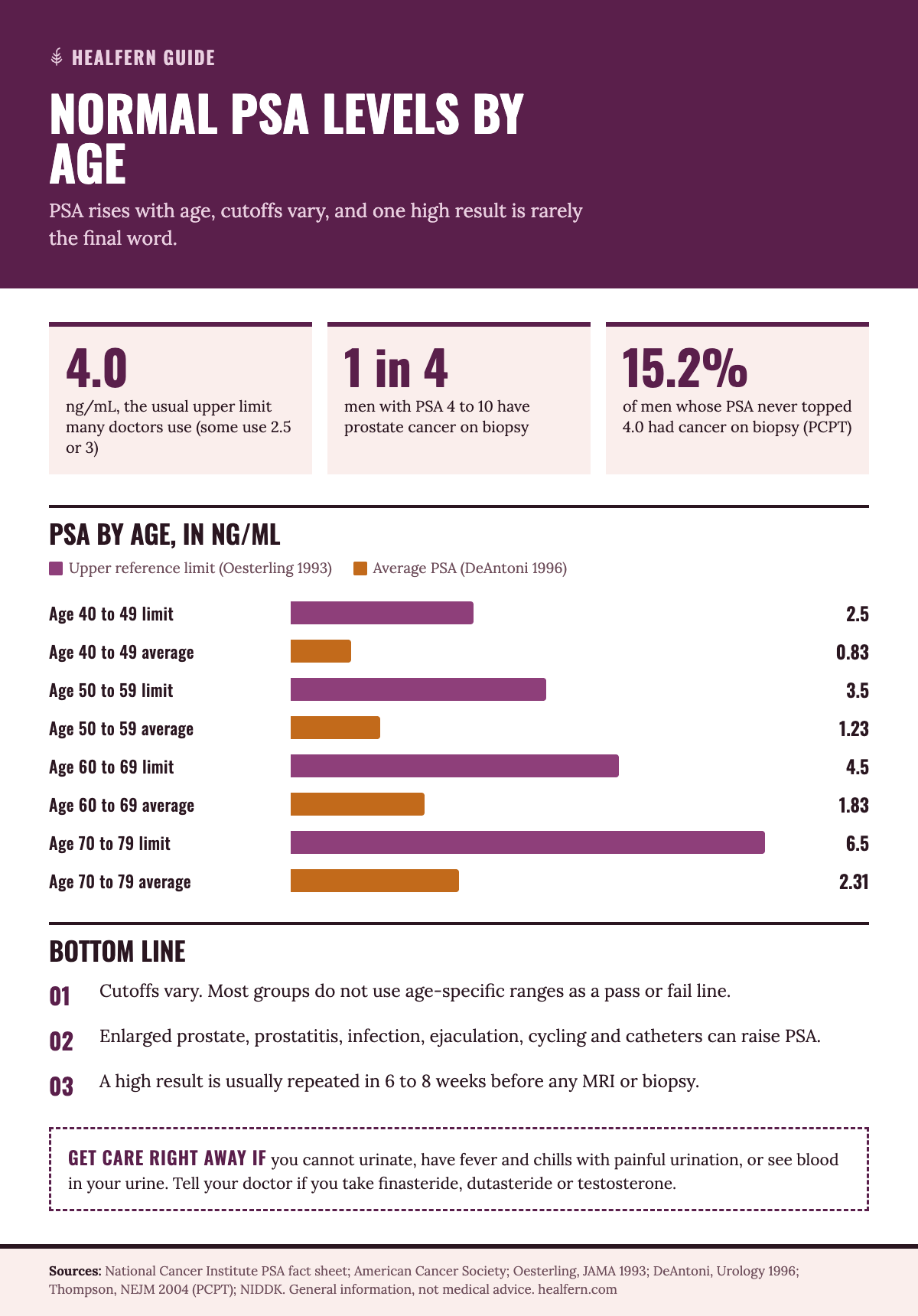
PSA rises with age even in healthy men, because the prostate usually grows. The best-known age-specific ranges come from a 1993 Mayo Clinic study of 471 healthy Minnesota men without prostate cancer. It set the upper limit (the 95th percentile) at 2.5 ng/mL in the 40s, 3.5 in the 50s, 4.5 in the 60s and 6.5 in the 70s.[9]
| Age | Reference range, Oesterling 1993 | Average PSA, DeAntoni 1996 |
|---|---|---|
| 40 to 49 | 0.0 to 2.5 ng/mL | 0.83 ng/mL |
| 50 to 59 | 0.0 to 3.5 ng/mL | 1.23 ng/mL |
| 60 to 69 | 0.0 to 4.5 ng/mL | 1.83 ng/mL |
| 70 to 79 | 0.0 to 6.5 ng/mL | 2.31 ng/mL |
The averages come from a separate community study of 77,700 men aged 40 to 79 tested during Prostate Cancer Awareness Week in 1993 and 1994, with known cancers excluded. Average PSA climbed with each decade, and so did the spread of results.[10] The Mayo study also found PSA in a healthy 60-year-old rose about 3.2% a year, roughly 0.04 ng/mL.[9]
Why most doctors do not use these ranges
These are one research team’s ranges, not a national standard. The American Cancer Society says their usefulness “is not well proven, so most doctors and professional organizations do not recommend their use.”[4] The Mayo ranges came from a small, mostly white group of men from one county, measured with a 1990s lab assay.[9] The 77,700-man study found average PSA differed by race but said the meaning of race-specific ranges was “yet to be determined.”[10] Treat the table as background, not as a pass or fail line.
What does a high PSA mean?
A high PSA means something is making your prostate release more PSA than usual. That can be cancer, but it is often an enlarged prostate, inflammation or a short-lived trigger. The higher the number, the likelier cancer is. The American Cancer Society gives rough odds for each range.[1][4]
- Below 4 ng/mL: about 15% of men would have prostate cancer found on biopsy.[4]
- 4 to 10 ng/mL (the “borderline range”): about a 1 in 4 chance of prostate cancer.[4]
- Above 10 ng/mL: the chance is over 50%.[4]
False alarms are common. About 6% to 7% of men have a false-positive PSA in any round of screening, and only about 25% of men who have a biopsy because of a raised PSA turn out to have prostate cancer.[1]
A low number is not a clean bill of health either. In the Prostate Cancer Prevention Trial, 2,950 men whose PSA never went above 4.0 had a biopsy anyway after seven years. Cancer was found in 15.2%, ranging from 6.6% of men at 0.5 ng/mL or less to 26.9% of men at 3.1 to 4.0. About 15% of those cancers were higher grade (Gleason 7 or above).[11]
What can raise PSA besides prostate cancer?
Several common, harmless or treatable things push PSA up. The big ones are an enlarged prostate (BPH), prostatitis, a urinary tract infection, recent ejaculation, cycling and recent prostate or bladder procedures, including a catheter. Many of these raise PSA only for days or weeks, which is why a retest matters.[1][3][4]
Enlarged prostate (BPH)
BPH is a noncancerous enlargement of the prostate. A bigger gland makes more PSA.[4] NIDDK estimates BPH affects 5% to 6% of men aged 40 to 64 and 29% to 33% of men 65 and older, and calls it the most common prostate problem in men over 50.[7]
Prostatitis and urinary infections
Prostatitis is inflammation of the prostate, sometimes from infection. It is the most common urinary tract problem in men under 50 and leads to about two million health care visits a year in the US.[8] An infection or inflammation of the prostate can keep PSA raised for a month or two, and MedlinePlus advises not testing soon after a urinary tract infection.[1][3]
Ejaculation and cycling
Ejaculation can raise PSA for a short time.[4] MedlinePlus advises no sex or masturbation for 24 hours before the test, and NCI suggests avoiding things that raise PSA for 2 days.[2][1] Some studies suggest cycling raises PSA briefly, possibly from seat pressure, though not all studies found this.[4]
Catheters, procedures and medicines
A catheter recently placed in the bladder, a cystoscopy, a prostate biopsy and even a recent colonoscopy can raise PSA.[3] A biopsy can keep it up for a month or two.[1] Testosterone, or medicines that raise testosterone, may push PSA up too.[4]
What can lower a PSA reading?
Some medicines lower PSA, which can hide a real rise. The best known are the BPH drugs finasteride and dutasteride (5-alpha reductase inhibitors). Doctors use a lower cutoff for men taking them.[1][4]
The finasteride label says the drug cut PSA by about 50% within six months in clinical studies. For a man on it for six months or more, the label says to double his PSA value before comparing it with normal ranges for untreated men. It also says to set a new baseline at least six months after starting and to check any confirmed rise from the lowest value, even if the number still looks normal.[12]
Other things that may lower PSA:
- Some herbal mixtures sold as supplements might mask a high PSA, so tell your doctor about every supplement you take.[4]
- Saw palmetto, an herb many men use for urinary symptoms, does not seem to affect PSA, according to the American Cancer Society.[4]
- Long-term aspirin, statins and thiazide water pills may lower PSA in some research, but this has not been confirmed.[4]
We found no NIH or cancer-society source showing that any supplement lowers PSA in a way that protects your prostate. A supplement that pushes the number down without changing what is happening in the gland would only make the test harder to read.
What are free PSA, PSA velocity and PSA density?
These are add-on measures that help doctors decide whether a borderline PSA needs a biopsy. Free PSA is the share of PSA not bound to blood proteins. Velocity is how fast PSA rises over time. Density is PSA divided by prostate size. None of them diagnoses cancer.[4]
Percent-free PSA
Men with prostate cancer tend to have a lower percent-free PSA. It is mainly used when total PSA is in the 4 to 10 range.[4] The American Cancer Society says many doctors recommend a biopsy when free PSA is 10% or less and suggest considering one between 10% and 25%. Not all doctors agree 25% is the best cutoff.[4]
PSA velocity
Velocity is a calculation from several past results, not a separate test. Some research found PSA climbs faster with cancer, but studies have not shown velocity beats the PSA level itself, so most doctors do not use it for screening.[4] Your doctor will still look at how much and how fast your PSA has changed when deciding the next step.[3]
PSA density
Density adjusts for a large prostate. The doctor measures prostate volume with a transrectal ultrasound and divides PSA by it. A higher density points more toward cancer, and it appears about as accurate as percent-free PSA, but it requires the ultrasound.[4]
What happens after a high PSA result?
Usually you repeat the test before anything else. NCI says a doctor may repeat it in 6 to 8 weeks for a man with no symptoms, and MedlinePlus says most often within 3 months, sometimes after treating a prostate infection first. If PSA stays high, the next steps are a rectal exam, a urine test, an MRI or a biopsy.[1][3][2]
- Repeat PSA. PSA goes up and down, so a second result shows whether the first was a blip.[2]
- Digital rectal exam (DRE). The doctor feels the prostate for lumps or hard areas. Some doctors draw blood before the exam in case the exam itself nudges PSA.[2][4]
- Urine test. Checks for an infection that could explain the result.[2]
- MRI or other tests. If PSA keeps rising, especially fast, or a lump is felt, the doctor may order blood or urine markers, an MRI or a high-resolution micro-ultrasound.[1]
- Biopsy. Needles take small tissue samples through the rectum wall or the skin between the scrotum and anus, guided by ultrasound, and sometimes aimed at spots seen on MRI. A biopsy is the only way to diagnose prostate cancer.[1][2]
Biopsy has real risks: bleeding, blood in semen or urine, trouble urinating and infection, including serious infection.[1][2] An MRI first can spare some men a needle. In the PRECISION trial of 500 men with suspected cancer, 28% of the MRI group had a scan that did not suggest cancer and skipped biopsy. The MRI approach found clinically significant cancer in 38% of men, against 26% with standard biopsy, and found fewer harmless cancers.[13]
What does the research on PSA show?
The studies behind PSA advice show three things. Average PSA rises with age. Cancer turns up across the “normal” range. And screening has a small benefit for prostate cancer deaths that must be weighed against false alarms, biopsies and treatment side effects. Here are the key studies we read.[9][11][14]
| Study | Who and how many | What it looked at | Main result |
|---|---|---|---|
| Oesterling, JAMA 1993[9] | 471 healthy men aged 40 to 79, Olmsted County, Minnesota | PSA by age and prostate size | Upper limits of 2.5, 3.5, 4.5 and 6.5 ng/mL by decade |
| DeAntoni, Urology 1996[10] | 77,700 men aged 40 to 79 without known cancer | PSA by age and race | Average PSA 0.83 in the 40s up to 2.31 in the 70s; means differed by race |
| Thompson, NEJM 2004 (PCPT)[11] | 2,950 men whose PSA never exceeded 4.0, biopsied after 7 years | Cancer at “normal” PSA | Cancer in 15.2%; 26.9% at PSA 3.1 to 4.0 |
| Kasivisvanathan, NEJM 2018 (PRECISION)[13] | 500 men with suspected cancer, no prior biopsy | MRI first vs standard biopsy | 28% avoided biopsy; significant cancer found in 38% vs 26% |
| Ilic, BMJ 2018[14] | 5 randomized trials, 721,718 men | PSA screening vs usual care | About 1 fewer prostate cancer death per 1,000 men over 10 years in the lower-bias trial; no change in overall deaths |
The meta-analysis also estimated that for every 1,000 men screened, about 1 more would be hospitalized for sepsis, 3 more would need pads for urine leakage and 25 more would report erectile problems.[14]
Should you get a PSA test? What the USPSTF says
For men aged 55 to 69, the US Preventive Services Task Force says the decision to have periodic PSA screening “should be an individual one,” made after talking with a clinician about benefits and harms (grade C). It recommends against PSA screening for men 70 and older (grade D). This is the 2018 recommendation, and the Task Force lists an update in progress.[6]
The Task Force estimate, as summarized by NCI, for every 1,000 men aged 55 to 69 screened over 13 years:[1]
- About 1.3 deaths from prostate cancer avoided (later trial data suggest up to 2), and 3 men spared from cancer that spreads.
- 240 men with a positive PSA, many of them false positives that lead to biopsy.
- 100 men diagnosed with prostate cancer, 80 of them treated with surgery or radiation.
- 50 men with sexual problems and 15 with urine leakage from treatment.
The USPSTF names older age, African American race and family history as the biggest risk factors.[6] The American Cancer Society suggests starting the screening talk at 50 for men at average risk who expect to live at least 10 more years, at 45 for Black men and men whose father or brother had prostate cancer before 65, and at 40 for men with more than one such relative.[5] NCI notes Medicare covers a yearly PSA test for eligible men over 50.[1]
How often should you have a PSA test?
If you choose screening, how often depends partly on your last result. The American Cancer Society says men with a PSA under 2.5 ng/mL may need a retest only every 2 years, and men at 2.5 or higher should be tested yearly. Men with less than a 10-year life expectancy and no symptoms should not be offered screening.[5]
The USPSTF does not set a fixed interval. It frames screening for 55 to 69 as periodic and individual.[6] Overall health, not age alone, guides the decision, because many prostate cancers grow so slowly they would never cause harm in a man with other serious health problems.[5]
If you have been treated for prostate cancer, the schedule is different and set by your care team. One high reading after treatment does not always mean the cancer is back. Doctors look for a rising trend over time.[1]
When should you see a doctor right away?
A PSA number by itself is not an emergency. Some urinary symptoms are. NIDDK says to get care right away if you cannot urinate at all, have painful, frequent and urgent urination with fever and chills, see blood in your urine, or have severe pain in the lower belly or urinary tract.[7][8]
See a doctor soon, not urgently, if you have painful, slow or frequent urination, blood in your semen, or pelvic or back pain that does not go away. These are the symptoms that lead doctors to order a PSA test as a follow-up.[1][2]
Before any PSA test, tell the person ordering it about every medicine and supplement you take, especially finasteride, dutasteride or testosterone. Do not stop any medicine unless your doctor tells you to.[2][4]
How do you prepare for a PSA test? A checklist
A few simple steps make the result easier to trust. Most of them are about avoiding short-term triggers that raise PSA, and making sure your doctor has the facts needed to read it.[1][2][3]
- No ejaculation for at least 24 hours before the test, and ideally 2 days.[2][1]
- Skip long or hard bike rides for 2 days before.[1][4]
- Wait until a urinary infection or prostatitis has cleared, and ask how long to wait after a biopsy, cystoscopy, catheter or colonoscopy.[1][3]
- If you are having a rectal exam the same day, ask for the blood draw first.[4]
- List every medicine and supplement, including finasteride, dutasteride, testosterone and herbal blends. See our guide to reading a supplement label.[4]
- Ask which cutoff your doctor uses and keep a copy of every result so changes over time can be compared.[3][4]
- If the result is high, ask about a repeat test before a biopsy.[1]
Night-time trips to the bathroom are a common reason men first ask about their prostate. Our guide to frequent urination at night covers the usual causes, and foods that irritate the bladder lists drinks worth cutting back. More guides are in our prostate health section, and how we research explains how we pick sources.
Verdict: how to read your PSA number
4.0 ng/mL is a common rule of thumb. Lower results do not rule out cancer, and higher ones often come from an enlarged or inflamed prostate, a recent ejaculation or a procedure. Age-specific ranges exist, but they are one research team’s numbers and most organizations do not use them.[1][4][9][11]
Our judgment: the single most useful thing you can do with a high PSA is ask for a clean repeat test, avoiding ejaculation, cycling and infection beforehand, before anyone talks about a biopsy. If it stays high, MRI-first workups can spare some men a needle. And no supplement has been shown to lower PSA in a way that matters, so taking one will not fix a high reading.[1][13]
Questions people also ask
What is a normal PSA level for a 60 year old man?
There is no single normal level. Many doctors use 4.0 ng/mL as the usual upper limit. One 1993 Mayo Clinic study set 4.5 ng/mL as the upper limit for men in their 60s, but most organizations do not recommend age-specific ranges.
What PSA level is considered high?
A result above 4.0 ng/mL is generally treated as abnormal, though some doctors act at 2.5 or 3. At 4 to 10 ng/mL about 1 in 4 men has prostate cancer on biopsy; above 10 the chance is over 50%.
Can a high PSA be caused by something other than cancer?
Yes. An enlarged prostate, prostatitis, a urinary tract infection, recent ejaculation, cycling, a catheter and recent prostate or bladder procedures can all raise PSA. Many of these effects are short-lived, which is why a repeat test is usually the first step.
Should I avoid ejaculation before a PSA test?
Yes. MedlinePlus advises no sex or masturbation for 24 hours before the test, and the National Cancer Institute suggests avoiding activities that raise PSA, including ejaculation and vigorous cycling, for 2 days beforehand.
Does finasteride affect PSA test results?
Yes. The finasteride label says it lowered PSA by about 50% within six months. For men on it six months or longer, the label says to double the PSA value before comparing it with normal ranges for untreated men.
Can supplements lower my PSA?
No supplement has been shown to lower PSA in a way that protects the prostate. The American Cancer Society says saw palmetto does not seem to affect PSA, while some herbal mixtures might mask a high reading. Tell your doctor about every supplement you take.
Sources
- Prostate-Specific Antigen (PSA) Test, National Cancer Institute, updated 2025
- Prostate-Specific Antigen (PSA) Test, MedlinePlus, National Library of Medicine
- Prostate-specific antigen (PSA) blood test, MedlinePlus Medical Encyclopedia, reviewed 2025
- Screening Tests for Prostate Cancer, American Cancer Society, revised 2023
- American Cancer Society Recommendations for Prostate Cancer Early Detection, American Cancer Society, revised 2023
- Prostate Cancer: Screening, final recommendation statement, US Preventive Services Task Force, 2018
- Enlarged Prostate (Benign Prostatic Hyperplasia), NIDDK, reviewed 2024
- Prostatitis: Inflammation of the Prostate, NIDDK, reviewed 2014
- Serum prostate-specific antigen in a community-based population of healthy men: establishment of age-specific reference ranges, Oesterling JE et al., JAMA, 1993
- Age- and race-specific reference ranges for prostate-specific antigen from a large community-based study, DeAntoni EP et al., Urology, 1996
- Prevalence of prostate cancer among men with a prostate-specific antigen level of 4.0 ng per milliliter or less, Thompson IM et al., New England Journal of Medicine, 2004
- PROSCAR (finasteride) prescribing information, DailyMed, National Library of Medicine, 2026
- MRI-targeted or standard biopsy for prostate-cancer diagnosis (PRECISION), Kasivisvanathan V et al., New England Journal of Medicine, 2018
- Prostate cancer screening with prostate-specific antigen (PSA) test: a systematic review and meta-analysis, Ilic D et al., BMJ, 2018
This article is general information, not medical advice. These statements have not been evaluated by the FDA, and supplements are not intended to diagnose, treat, cure or prevent any disease. Talk to your doctor or pharmacist before you start a supplement. How we research.