Coffee, tea, soda, alcohol, citrus juice, tomatoes, spicy food, chocolate and artificial sweeteners are the foods and drinks most often linked to bladder flares. In one survey, 90.2% of people with interstitial cystitis named food triggers, but triggers vary. Plain water is the safest swap, and a one to two week elimination diet shows which items bother you.
We read the NIDDK pages on interstitial cystitis and bladder control, MedlinePlus, the Urology Care Foundation’s patient guide, and the studies the food lists come from. That includes a 104-patient food survey, a 2026 systematic review of diet trials, and five studies of caffeine and urinary symptoms in adults.
Coffee, tea, soda, alcohol, citrus juice, tomatoes, spicy food, chocolate and artificial sweeteners are the items most often linked to bladder flares, and plain water is the simplest swap, but triggers differ from one person to the next.[1][8]
| What it is | A list of foods and drinks that people with bladder pain or urgency often report as triggers[1][2] |
|---|---|
| Most reported triggers | Coffee, tea, soda, alcohol, citrus fruits and juices, artificial sweeteners and hot pepper[7] |
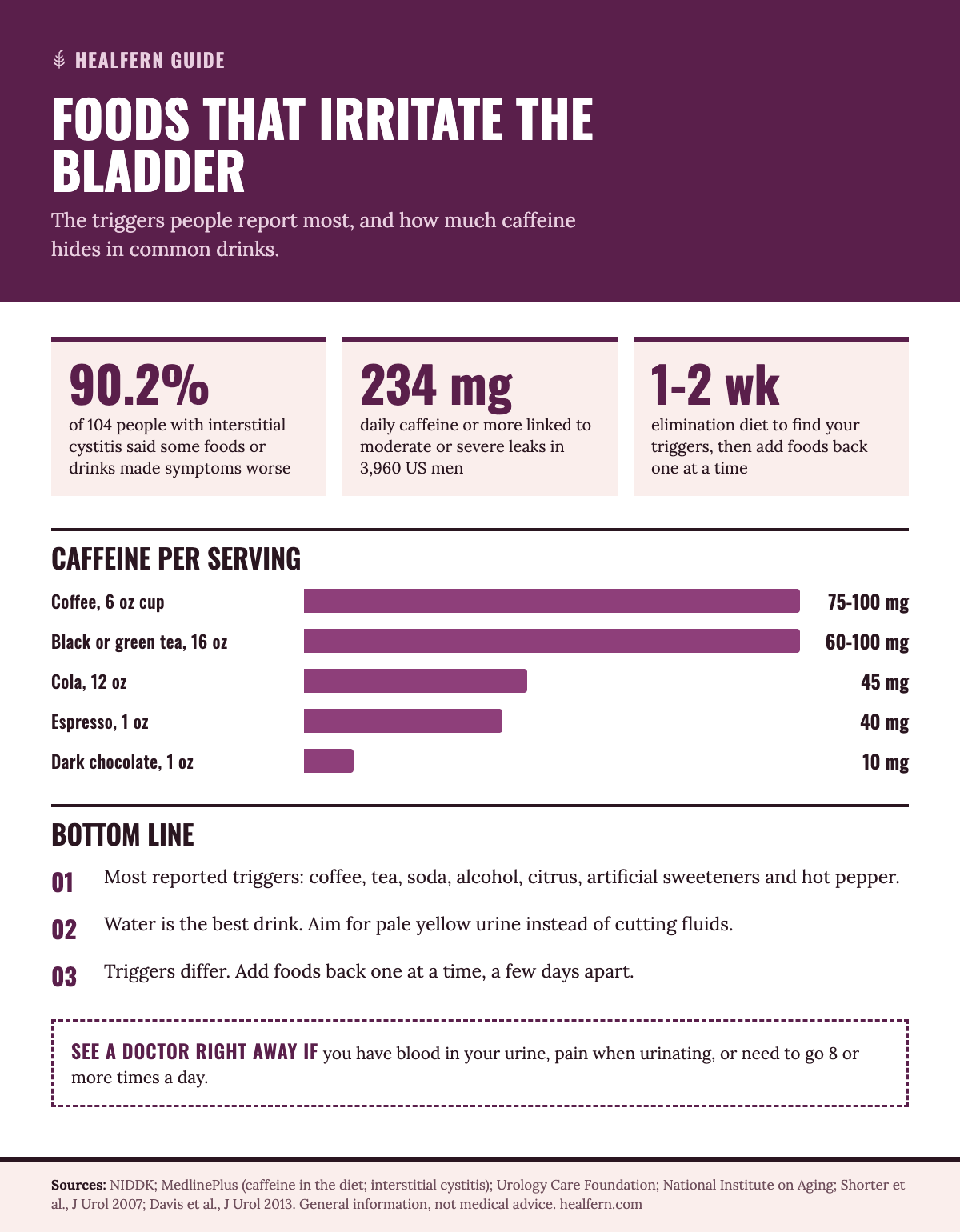
| How common | 90.2% of 104 people with interstitial cystitis said some foods or drinks made symptoms worse[7] |
| Best evidence | Mostly surveys; a 2026 review found 4 diet trials with 147 patients and called the randomized evidence insufficient for strong recommendations[14] |
| Best drink swap | Water, enough that your urine stays pale yellow[2] |
| How to test it | Cut likely triggers for one to two weeks, then add foods back one at a time[4] |
| See a doctor first if | You see blood in your urine, it hurts to urinate, or you go eight or more times a day[5] |
Which foods and drinks irritate the bladder most often?
The NIDDK names citrus juices, coffee, tea, soda, alcohol, tomatoes and tomato sauces, hot and spicy foods, artificial sweeteners, chocolate and MSG as common flare triggers for interstitial cystitis (IC).[1] Its bladder control pages add carbonated drinks to the list for people with leaks and urgency.[2] Not everyone reacts to every item.
The longer list on MedlinePlus comes from the Interstitial Cystitis Association. It adds aged cheeses, cured or processed meats, fava and lima beans, onions, rye and sourdough bread, sour cream, soy, tofu and yogurt, plus most acidic fruits and most nuts.[3] The sources we read give no trial data on those extra items one by one, so treat the long list as a set of suspects to test.
| Food or drink | What the sources say | Swap to try |
|---|---|---|
| Coffee and black or green tea | Among the most bothersome items in the IC survey; coffee has 75 to 100 mg caffeine per 6 oz cup[7][6] | Water, or a smaller cup you track in a diary |
| Soda and other fizzy drinks | Carbonated and caffeinated drinks are on NIDDK’s irritant list; a 12 oz cola has about 45 mg caffeine[2][6] | Still water |
| Alcohol | Listed by NIDDK and rated among the worst items in the survey[1][7] | Water or a non-citrus, non-fizzy drink |
| Citrus fruits and juices | Orange and grapefruit juice named by NIDDK; citrus was a top trigger in the survey[1][7] | Pears, blueberries or honeydew melon, which the ICA list rates as OK[3] |
| Tomatoes and tomato sauce | High-acid foods named by NIDDK[1] | Test your own tolerance, since sensitivities vary between people[8] |
| Hot and spicy foods | Named by NIDDK; hot pepper was one of the most bothersome items[1][7] | Herbs without chili heat |
| Artificial sweeteners | Named by NIDDK and in the survey’s worst group[1][7] | Unsweetened drinks while you test |
| Chocolate | Named by NIDDK; it also carries caffeine, about 10 mg per ounce of dark chocolate[1][6] | Small amounts after testing |
| MSG and some processed foods | MSG named by NIDDK; cured and processed meats are on the ICA list[1][3] | Fresh, plainly seasoned food |
| Most nuts | On the ICA list, except almonds, cashews and pine nuts[3] | Almonds, cashews or pine nuts |
How do foods and drinks irritate the bladder?
Mostly through two routes: more urine arriving faster, and a bladder lining or set of nerves that reacts to what is in it. Caffeine does both in a small urodynamic study, artificial sweeteners act on sweet taste receptors found in the bladder lining, and acidic foods are thought to bother a lining that is already sore.[17][19][8]
The clearest human data come from a small study in Thailand. Twelve adults with overactive bladder symptoms drank 8 ml of water per kilogram of body weight, with or without caffeine at 4.5 mg per kilogram, on two separate days.[17] After caffeine, the bladder signaled its first desire to void at a smaller volume, and the volume and flow rate at voiding went up.[17] Caffeine made more urine and made the bladder feel full sooner.
That dose is high. For a 150-pound adult, 4.5 mg per kilogram comes to roughly 300 mg of caffeine in one sitting, about three 6 oz cups of coffee by the MedlinePlus figures.[17][6] The study did not test smaller amounts, so it cannot say whether one cup does the same thing.
Artificial sweeteners have a stranger story. A 2011 laboratory study found the T1R2 and T1R3 sweet taste receptors, the same ones on your tongue, in the lining of human and rat bladders.[19] Saccharin made strips of rat bladder muscle contract harder, but only when the lining was still attached.[19] That is a finding in animal tissue. It explains why sweeteners might bother some people without proving that they do.
For acidic foods such as citrus and tomatoes, the leading idea is that acid, potassium or other compounds in urine reach a damaged bladder lining and set off pain nerves.[8] No trial has tested that with real foods. It fits what patients report, and that is as far as the evidence goes.
How much caffeine is too much for your bladder?
None of the studies we read set a safe caffeine limit for the bladder. In large US surveys, the people who drank the most caffeine were more likely to report leaks, starting around 204 mg a day in women and 234 mg a day in men, about two cups of coffee.[9][10] Those surveys show a link, not proof that caffeine caused the leaks.
The women’s data came from 4,309 adults in the National Health and Nutrition Examination Survey (NHANES). Their average intake was 126.7 mg a day, and the top quarter had higher odds of any leakage, though not of moderate or severe leakage.[9] In 3,960 men from the same surveys, intake of 234 mg or more was tied to moderate or severe leakage, and the odds rose further at 392 mg or more.[10]
A long-term cohort found something different. Among 21,564 women with moderate incontinence in the Nurses’ Health Studies, symptoms got worse over two years in 21% of the heaviest caffeine users and 22% of the lightest.[13] The authors noted they could not test short-term effects.
For scale, MedlinePlus lists 75 to 100 mg per 6 oz cup of coffee, 40 mg per ounce of espresso, 60 to 100 mg per 16 oz cup of tea and 45 mg in a 12 oz cola.[6] It calls about 400 mg a day a moderate amount for most adults, and lists more frequent urination as a side effect of caffeine.[6]
Does cutting caffeine help bladder urgency?
It helped in one small trial and did not in another. In a randomized trial of 95 adults with urinary symptoms, those taught to cut caffeine had less urgency and fewer bathroom trips after one month.[11] In a four-week crossover study of women, switching to decaf brought no improvement, while drinking less fluid did help some.[12]
The Bryant trial was run by continence nurses in Australia, and the caffeine group did cut their intake significantly.[11] The Swithinbank study enrolled 110 women with stress leakage or an overactive bladder muscle, and 69 finished it.[12] Both are small and short, so neither settles the question.
Caffeine probably bothers some bladders more than others. If you drink three or four cups a day and have urgency, cutting back for a few weeks is a cheap test. Taper slowly, because MedlinePlus notes that stopping caffeine suddenly can cause headaches and drowsiness.[6]
What can you drink instead of coffee and soda?
Water is the first choice. The NIDDK says “water is best” and suggests drinking enough that you need to urinate every few hours and your urine is pale yellow.[2] Staying hydrated may also ease IC symptoms, so cutting fluids hard to avoid bathroom trips can backfire.[1]
There is no single target. The NIDDK says the right amount depends on your size, your activity level and where you live, so ask your health care professional what fits you.[2]
Other options people use while testing triggers:
- Plain still water, sipped through the day rather than in large amounts at once.[2]
- Decaf coffee or tea, with the caveat that one trial found no symptom benefit from switching.[12]
- Juice or blends made from pears or blueberries instead of orange or grapefruit, since the ICA list rates those fruits as OK.[3]
- Milk, if dairy agrees with you; yogurt and sour cream are on the ICA list, so test them separately.[3]
If you drink cranberry juice to head off infections, our cranberry for UTIs guide covers what the trials found.
Should you drink less to stop urgency and leaks?
A modest cut can help, a big cut is hard to keep up, and going too far risks dehydration. In a small crossover trial, adults with overactive bladder who drank 25% less than usual had fewer bathroom trips, less urgency and fewer wakings at night. Drinking more made daytime frequency worse.[18]
The trial, by Hashim and Abrams in Bristol, enrolled 24 people who voided eight or more times a day. Each spent four days at 25% less fluid than their baseline, four days at 50% less, then four days each at 25% and 50% more, with normal days in between.[18] The 25% cut brought a significant drop in frequency, urgency and nocturia. Patients struggled to change intake by 50% in either direction, and overall quality of life scores did not move.[18]
The authors noted that about 300 ml of daily fluid came from foods with water in them, such as fruit and soup, so a diary that counts only drinks undercounts.[18] The Swithinbank study of women with leakage pointed the same way: less fluid helped some, while switching to decaf did not.[12]
The limit is dehydration. The NIDDK’s test is simple: your urine should stay pale yellow and you should need to go every few hours.[2] If a 25% cut pushes you past that, you have cut too much. Hard fluid restriction can also bring on constipation, which the NIDDK says makes bladder problems worse.[2]
A practical version: measure what you drink for two or three days, trim about a quarter, mostly from the evening and from caffeinated or fizzy drinks, and keep the rest as water.[18][2] If a doctor has told you to drink more for another condition, that advice comes first.
How do you find your own trigger foods?
Use a short elimination diet. The Urology Care Foundation suggests dropping all the likely irritants for one to two weeks. If symptoms ease, add one food back, wait a few days, then try the next.[4] A food and symptom diary makes the pattern easier to see.[1]
Add back only one item at a time. As the Urology Care Foundation points out, if you eat a banana, strawberries and tomatoes on the same day, you will not know which one caused a flare.[4] MedlinePlus gives the same advice: stop foods one at a time and watch for change.[3]
A registered dietitian can build an eating plan around your results.[1] Reviewers who study diet and IC recommend a controlled elimination diet because it finds personal sensitivities while keeping nutrition intact, and because people react to different foods.[8]
If you also wake up at night to urinate, the timing of drinks matters as much as the type. Our guide to frequent urination at night covers that side.
What should you track to know if the diet is working?
Keep a bladder diary for two or three days before you change anything, then again after each change. The NIDDK version records what, when and how much you drink, when you urinate and how much, any leaks, and whether a strong urge came first.[16] Compare the two and look for fewer trips and fewer urges.
Doctors use the same diary to narrow down the cause of bladder control problems, so bring it to your appointment.[16] The NIDDK offers a printable version, but a notebook or a phone note works as long as it has the same columns.
- Time, amount and type of every drink (coffee, soda, water).[16]
- Time of every bathroom trip and, when you can, the amount.[16]
- Any leak, how much, and what you were doing when it happened.[16]
- Whether a strong, sudden urge came before the trip or the leak.[16]
- Foods eaten, so you can line up a flare with a meal from the day before.[1]
Count daytime trips, night wakings and urges per 24 hours. The fluid trial above used eight or more voids a day plus at least one urgency episode as its entry point, which gives a rough sense of what “frequent” means to a specialist.[18]
Give each change time. The Bryant trial rechecked its caffeine group after one month, and the Urology Care Foundation’s elimination approach runs one to two weeks before you add anything back.[11][4] If the numbers have not moved after two to three weeks without the main suspects, food is probably not your main driver, and it is time to ask about bladder training, pelvic floor therapy or medicines.[5]
How strong is the evidence linking food to bladder symptoms?
It is weak to moderate. Most of what we know comes from questionnaires, where people with IC report which foods make them worse. A 2026 systematic review found only four controlled diet studies with 147 patients in total.[14] An individualized elimination diet improved symptom scores, but the authors said the evidence was too thin for strong recommendations.[14]
Researchers have proposed a few reasons food might matter: acidic foods, potassium, caffeine and alcohol may reach a sensitive bladder lining or nerves that overreact.[8] For ordinary leakage, the NIDDK states plainly that no direct scientific evidence links nutrition to making it better or worse.[2]
| Study | Who and how many | What was tested | Result |
|---|---|---|---|
| Shorter 2007, J Urol | 104 people with IC | Survey of 175 foods, drinks and supplements | 90.2% reported food triggers; coffee, tea, soda, alcohol, citrus, sweeteners and hot pepper rated worst[7] |
| Bryant 2002, randomized | 95 adults with urinary symptoms | Caffeine reduction advice, 1 month | Less urgency and frequency[11] |
| Swithinbank 2005, crossover | 69 women completed | Decaf switch and fluid changes, 4 weeks | Decaf no help; less fluid helped some[12] |
| Gleason 2013, NHANES | 4,309 women | Caffeine intake vs leaks | 204 mg a day or more linked to any leakage[9] |
| Davis 2013, NHANES | 3,960 men | Caffeine intake vs leaks | 234 mg a day or more linked to moderate or severe leakage[10] |
| Townsend 2012, cohort | 21,564 women, 2 years | Long-term caffeine vs worsening | No link: 21% vs 22% worsened[13] |
| Alahmed 2026, systematic review | 4 studies, 147 patients with IC | Elimination, anti-inflammatory and other diets | Elimination diet helped; overall evidence insufficient[14] |
Safety: who should see a doctor before changing their diet?
See a doctor first if your bladder symptoms are new, getting worse, or come with warning signs. Food changes are low risk, but they can delay care for an infection or another cause. MedlinePlus notes that IC is often confused with repeated urinary tract infections.[3]
See a doctor right away if you have:
- Blood in your urine.[5]
- Pain or burning when you urinate.[5]
- A need to urinate eight or more times a day, or only small amounts after strong urges.[5]
- Trouble starting, or a weak stream.[5]
Do not cut fluids sharply without advice; the NIDDK wants your urine pale yellow.[2] Constipation can make bladder health worse and lead to leaks, so keep fiber from whole grains, vegetables and fruit in the diet.[2] If you smoke, the NIDDK says some people find smoking makes bladder irritation worse.[2]
If you are pregnant, take prescription medicines, or have diabetes or kidney disease, ask your care team before a long elimination diet. A registered dietitian can tailor the plan to your needs.[1]
Do bladder irritants matter more if you have an enlarged prostate?
The advice is the same, and the NIDDK gives it to men with benign prostatic hyperplasia (BPH) in plain terms. Its lifestyle list for BPH symptoms includes avoiding or limiting alcohol and caffeine, drinking less before going out or going to bed, and emptying the bladder completely each time.[15]
BPH is common. The NIDDK estimates it affects 5% to 6% of men ages 40 to 64 and 29% to 33% of men 65 and older.[15] The prostate sits below the bladder and surrounds the urethra at the bladder neck, so growth there changes how the bladder fills and empties.[15]
When a doctor evaluates BPH, the NIDDK says they will ask how much you drink each day, whether you consume caffeine or alcohol, what medicines you take, and whether you have had repeated urinary infections.[15] Writing those answers down beforehand saves a visit.
The caffeine data for men match the advice. In the NHANES analysis of 3,960 men, 234 mg of caffeine a day or more went with moderate or severe leakage, so the two-cup line applies to men as much as to women.[10] Timing matters too: the NIDDK says you can cut night trips by limiting what you drink before bed.[15]
If your prostate is only slightly enlarged and symptoms do not affect your quality of life, the NIDDK says a doctor may suggest watchful waiting with yearly checkups, and these lifestyle changes fit inside that.[15] For older men there is an extra reason to try diet first: the NIA notes that some overactive bladder medicines have been linked to a higher risk of cognitive decline in adults over 65.[5]
Do not assume it is your prostate. Blood in the urine, pain or burning, or trouble starting a stream need a doctor, and the overlap between BPH, infection and bladder problems is why the NIDDK asks about infections first.[15][5]
What do doctors try first for bladder pain and urgency?
Lifestyle and behavior changes come first. The Urology Care Foundation says behavioral therapy, including changes to what you eat and drink, is tried before medicines.[4] For leaks and urgency, the NIA describes bladder training, urgency suppression, timed voiding and pelvic floor exercises.[5]
Timed voiding means urinating on a schedule, for example every hour, and slowly stretching the gap.[5] For IC, MedlinePlus adds pelvic floor physical therapy and biofeedback to relax tight muscles.[3]
If those are not enough, doctors may prescribe medicines. For IC, MedlinePlus lists pentosan polysulfate sodium, tricyclic antidepressants such as amitriptyline for pain and frequency, and hydroxyzine, an antihistamine.[3] For overactive bladder, the NIA warns that some medicines have been linked to a higher risk of cognitive decline in adults over 65, so ask about the options.[5]
A note on supplements: questionnaire studies suggest some people with IC report fewer food flares with calcium glycerophosphate or sodium bicarbonate.[8] That is self-reported data, not trial proof, and neither should replace the steps above. Our research methods page explains how we grade this kind of evidence.
Practical checklist for a calmer bladder
- Start a two-week food and symptom diary before you change anything.[1]
- Cut the main suspects for one to two weeks: coffee, tea, soda, alcohol, citrus, tomatoes, spicy food, artificial sweeteners and chocolate.[1][4]
- Drink enough water to keep your urine pale yellow.[2]
- Add foods back one at a time, a few days apart.[4]
- If you keep caffeine, track the milligrams, and note whether symptoms change near 200 mg a day.[6][9]
- Taper caffeine slowly to avoid withdrawal headaches.[6]
- Read labels for artificial sweeteners and MSG in drinks and packaged food. Our label reading guide shows where to look.[1]
- Ask about bladder training and pelvic floor therapy at your next visit.[5]
More guides on this topic sit in our urinary and prostate support and prostate health sections.
The verdict on bladder-irritating foods
The usual suspects are consistent across NIH and urology sources: caffeine, alcohol, fizzy drinks, citrus, tomatoes, spice, sweeteners and chocolate. The proof is thinner than the lists suggest, because most of it comes from people reporting what bothers them.[7][14]
Our call: a two-week elimination diet with water as your main drink is worth trying if you have urgency or bladder pain, because it costs little and the answer is personal. Pair it with a doctor’s visit if your symptoms are new, severe or come with any of the warning signs above.
Questions people also ask
What drinks irritate the bladder the most?
Coffee, tea, soda, alcohol and citrus juices were rated the most bothersome drinks in a survey of 104 people with interstitial cystitis. The NIDDK lists the same drinks, plus carbonated and caffeinated beverages for people with leaks and urgency.
What is the best drink for an irritated bladder?
Plain water. The NIDDK says water is best and suggests drinking enough that your urine stays pale yellow and you urinate every few hours. Staying hydrated may also help symptoms of interstitial cystitis, according to the NIDDK.
Is decaf coffee better for the bladder?
Maybe not. In a four-week study of women with leakage or overactive bladder, switching from caffeinated to decaf drinks brought no symptom improvement. A separate trial of 95 adults found that cutting caffeine did reduce urgency and frequency.
How much caffeine is linked to bladder leaks?
In US survey data, women taking 204 mg a day or more and men taking 234 mg a day or more were more likely to report leaks. That is roughly two cups of coffee, though the surveys show a link rather than cause.
How long should a bladder elimination diet last?
The Urology Care Foundation suggests one to two weeks without likely irritants. If symptoms improve, add one food back, wait a few days, and then test the next one so you can tell which food causes a flare.
Are bananas bad for the bladder?
The sources we read do not single out bananas. Most acidic fruits are on the Interstitial Cystitis Association list, while blueberries, honeydew melon and pears are rated OK. Test any fruit you suspect one at a time.
Sources
- Eating, Diet, and Nutrition for Interstitial Cystitis, NIDDK, reviewed 2024
- Prevention of Bladder Control Problems and Bladder Health, NIDDK, reviewed 2021
- Interstitial cystitis, MedlinePlus, National Library of Medicine, reviewed 2025
- What is Interstitial Cystitis/Bladder Pain Syndrome? (archived copy), Urology Care Foundation (American Urological Association), 2023
- Urinary Incontinence in Older Adults, National Institute on Aging
- Caffeine in the diet, MedlinePlus, National Library of Medicine, reviewed 2025
- Shorter B et al. Effect of comestibles on symptoms of interstitial cystitis, Journal of Urology, 2007
- Friedlander JI et al. Diet and its role in interstitial cystitis/bladder pain syndrome and comorbid conditions, BJU International, 2012
- Gleason JL et al. Caffeine and urinary incontinence in US women, International Urogynecology Journal, 2013
- Davis NJ et al. Caffeine intake and its association with urinary incontinence in United States men, Journal of Urology, 2013
- Bryant CM et al. Caffeine reduction education to improve urinary symptoms, British Journal of Nursing, 2002
- Swithinbank L et al. The effect of fluid intake on urinary symptoms in women, Journal of Urology, 2005
- Townsend MK et al. Caffeine intake and risk of urinary incontinence progression among women, Obstetrics and Gynecology, 2012
- Alahmed FB et al. Interstitial Cystitis and Dietary Interventions: A Systematic Review, International Urogynecology Journal, 2026
- Prostate Enlargement (Benign Prostatic Hyperplasia), NIDDK, reviewed 2024
- Diagnosis of Bladder Control Problems (Urinary Incontinence), NIDDK, reviewed 2021
- Lohsiriwat S et al. Effect of caffeine on bladder function in patients with overactive bladder symptoms, Urology Annals, 2011
- Hashim H, Abrams P. How should patients with an overactive bladder manipulate their fluid intake?, BJU International, 2008
- Elliott RA et al. Expression and distribution of the sweet taste receptor isoforms T1R2 and T1R3 in human and rat bladders, Journal of Urology, 2011
This article is general information, not medical advice. These statements have not been evaluated by the FDA, and supplements are not intended to diagnose, treat, cure or prevent any disease. Talk to your doctor or pharmacist before you start a supplement. How we research.