
Cranberry products may lower the risk of another UTI in women who get them often, by about a quarter, according to a 2023 Cochrane review of 50 trials. They showed little or no benefit in pregnancy or in nursing home residents, and they do not treat an infection you already have. If you have UTI symptoms now, see a clinician for testing and treatment.
We read the 2023 Cochrane review of 50 cranberry trials, the NCCIH cranberry fact sheet, the American Urological Association guideline on recurrent UTIs, and the abstracts of four large trials, two that found a benefit and two that did not. We also checked NIDDK and MedlinePlus for how doctors diagnose and treat a bladder infection.
The short answer: cranberry products may lower the chance of another UTI in women who get them often, by roughly a quarter, but they do not treat an infection you already have, and they showed little or no benefit in pregnancy or in nursing home residents.[1][2]
| What it is | The fruit of Vaccinium macrocarpon, sold as juice, tablets and capsules. Its proanthocyanidins (PACs) are thought to stop bacteria sticking to the bladder wall.[1] |
|---|---|
| Used for | Lowering the risk of repeat, symptomatic UTIs. It is not recommended for treating an active UTI.[1] |
| Amounts studied | Trials used 240 mL of juice a day, 8 oz of 27% juice twice a day, or capsules with 72 mg of PACs. No dose has been settled.[4][5][6][2] |
| Best evidence | Cochrane 2023: 50 trials, 8,857 people. Risk ratio 0.74 in women with recurrent UTIs.[2] |
| Guideline view | The AUA says clinicians should offer cranberry as an option for women with recurrent UTIs (moderate recommendation, Grade B evidence).[3] |
| Safety | Generally safe by mouth. Very large amounts can cause stomach upset and diarrhea.[1] |
| Check with a clinician first | People on warfarin, and anyone pregnant or breastfeeding who wants more than food amounts.[1] |
Does cranberry help prevent UTIs?
For some groups, yes, modestly. The 2023 Cochrane review pooled 26 placebo-controlled trials with 6,211 people and found cranberry products cut the risk of a symptomatic, lab-confirmed UTI by about 30% overall (risk ratio 0.70). The review rated that result as moderate certainty, and the trials varied a lot.[2]
That review is the largest summary of the evidence. It covers 50 randomized trials and 8,857 people in total, 26 of them new since the 2012 version.[2] NCCIH reads the same body of work a little more cautiously. It says cranberry may lower the risk of recurrent symptomatic UTIs in women by 25 percent, sometimes more than 30 percent, but that “the effectiveness of cranberry is still in question because of inconsistent findings.”[1]
The U.S. Food and Drug Administration has taken a similar line. Since 2020 it has let makers of cranberry supplements say there is “limited” evidence that daily use may reduce the risk of recurrent UTIs in healthy women. Juice labels must call the evidence “limited and inconsistent.”[1] The FDA has not approved cranberry for UTIs; supplements do not need approval before sale, and this qualified wording is what it allows on labels.[1]
How does cranberry work in the bladder?
The proposed action is mechanical. Cranberry’s A-type proanthocyanidins (PACs) appear to stop P-fimbriated E. coli, the bacteria behind most bladder infections, from sticking to the cells that line the urinary tract. Bacteria that cannot attach get flushed out with urine. This has been shown in lab dishes and in urine samples, and it remains the leading explanation rather than a proven one.[12][13]
A 2005 Rutgers study isolated the PACs from cranberry juice cocktail and compared them with PACs from grape juice, apple juice, green tea and dark chocolate. Cranberry’s A-linked PACs blocked bacterial adhesion in the lab at 60 micrograms per milliliter. Grape PACs, which have the B-type linkage, showed only minor activity at 1,200 micrograms per milliliter, and the others showed none. Volunteers’ urine blocked adhesion after they drank cranberry juice cocktail, but not after the other foods.[12]
A 2010 follow-up gave 32 volunteers in Japan, Hungary, Spain and France cranberry powder standardized for PAC content or a placebo. Their urine showed anti-adhesion activity that rose with the PAC dose and lasted up to 24 hours at 72 mg of PACs. In a worm model, E. coli grown in urine from cranberry takers was also less able to kill the worms.[13]
There are two cautions. The lead author of both studies works at a university cranberry research center.[12] And a urine bioassay is a stand-in for the outcome that matters. When Cochrane compared low, moderate and high PAC doses by counting actual infections, it found no difference.[2] The mechanism is plausible; the dose link has not held up in people.
Who benefits from cranberry, and who does not?
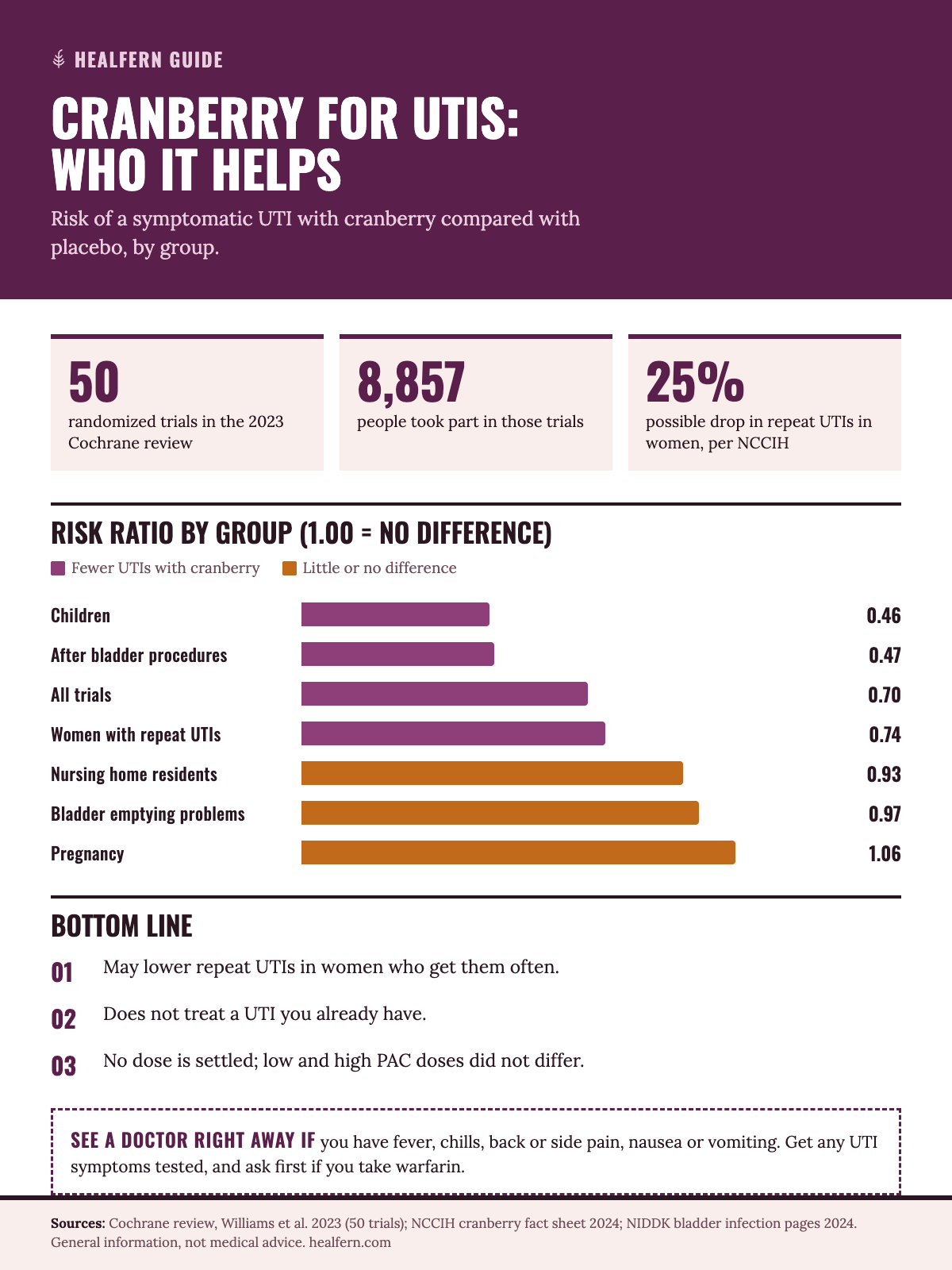
The benefit showed up in women with recurrent UTIs, in children, and in people at risk after a bladder procedure such as radiotherapy. It did not show up in older adults living in care homes, in pregnant women, or in adults whose bladders do not empty fully because of nerve problems.[2]
The Cochrane review split the results by group. A risk ratio below 1 means fewer UTIs with cranberry; 1 means no difference.
- Women with recurrent UTIs: 8 trials, 1,555 people, risk ratio 0.74.[2]
- Children: 5 trials, 504 children, risk ratio 0.46.[2]
- People susceptible after an intervention: 6 trials, 1,434 people, risk ratio 0.47.[2]
- Older adults in institutions: 3 trials, 1,489 people, risk ratio 0.93, little or no benefit.[2]
- Pregnant women: 3 trials, 765 women, risk ratio 1.06, little or no benefit.[2]
- Adults with nerve-related bladder emptying problems: 3 trials, 464 people, risk ratio 0.97.[2]
NCCIH adds that studies in women having gynecological surgery and in people with multiple sclerosis did not find cranberry helpful.[1] The group with the clearest benefit is otherwise healthy adult women who keep getting bladder infections.
Does cranberry juice work for children?
Modestly, in the one large trial. Cochrane pooled 5 trials with 504 children and found a risk ratio of 0.46, the largest effect of any group.[2] The biggest of those trials, in 263 Finnish children treated for a UTI, did not cut the share of children who got another infection, but it did cut the total number of infections and the days spent on antibiotics.[14]
That 2012 trial ran in 7 hospitals. Children drank cranberry juice (129) or a placebo juice (134) for 6 months and were followed for a year. In the final analysis of 255 children, 16% in the cranberry group and 22% in the placebo group had at least one recurrence, a 6 point difference that did not reach statistical significance.[14]
Counting episodes instead of children told a different story: 27 UTIs with cranberry versus 47 with placebo, or 0.16 fewer episodes per person-year. Children on cranberry also spent 6 fewer days per patient-year on antimicrobials.[14] Fewer antibiotic days is a real gain for a child who keeps getting infections, even if the odds of ever having another one did not change much.
Keep the setting in mind. These children had already been treated for a UTI in a hospital and stayed under medical follow-up. The trial says nothing about giving juice to a healthy child, and NCCIH notes that large amounts of cranberry can cause stomach upset and diarrhea, especially in young children.[1] A child with UTI symptoms needs a clinician and a urine test; cranberry is not a treatment for any age group.[1]
Can cranberry treat a UTI you already have?
No. NCCIH states that cranberry is not recommended as a treatment for an existing UTI in any population, and it warns against using cranberry products in place of proven treatment. Every trial in the Cochrane review tested cranberry for lowering the risk of new infections, not for clearing a current one.[1][2]
A bladder infection caused by bacteria is usually treated with antibiotics. Drinking more fluids can help flush bacteria and ease symptoms while the medicine works.[8] MedlinePlus notes that bladder symptoms most often go away within 24 to 48 hours after treatment begins.[10]
Relying on juice instead of treatment is risky, because a bladder infection can spread to one or both kidneys, and NIDDK says quick treatment matters when kidney symptoms appear.[9] If you think you have a UTI right now, get it checked. Cranberry is something to discuss afterward, as part of a plan to lower the odds of the next one.
What do the individual trials show?
The single trials point in different directions, which is why the pooled numbers matter. A juice trial with Ocean Spray co-authors found fewer clinical UTIs, a university trial in college women found none, and a Yale trial of high-PAC capsules in nursing homes found no difference over a year.[4][5][6]
| Study | Who and how many | Product and length | Result |
|---|---|---|---|
| Cochrane review, 2023[2] | 50 trials, 8,857 people | Juice, tablets, capsules | Risk ratio 0.70 overall; 0.74 in women with recurrent UTIs |
| Maki et al., 2016[4] | 373 women with a recent UTI | 240 mL cranberry beverage daily, 24 weeks | 39 vs 67 clinical UTI episodes (rate ratio 0.61); two authors from Ocean Spray |
| Barbosa-Cesnik et al., 2011[5] | 319 college women with an acute UTI | 8 oz of 27% juice twice daily, 6 months | No benefit: 20.0% recurrence vs 14.0% on placebo |
| Juthani-Mehta et al., 2016[6] | 185 women aged 65+ in 21 nursing homes | Capsules with 72 mg PACs daily, 1 year | No difference: 29.1% vs 29.0% had bacteria plus pyuria |
In the Maki trial, which listed Ocean Spray staff among its authors, the time to a culture-positive UTI did not differ between groups (hazard ratio 0.97), even though clinician-diagnosed episodes fell.[4] And the nursing home trial used a fairly high PAC dose, 72 mg a day, yet saw 10 symptomatic UTIs on cranberry and 12 on placebo.[6]
Juice, capsules or PACs: how much cranberry was studied?
There is no agreed dose. Cochrane says no regimen for PAC dose has been established, and it found no difference in UTI risk between low, moderate and high PAC doses. It could not tell whether juice or tablets work better, because that evidence was very low certainty.[2]
The AUA guideline mentions a figure you will see on many labels: 36 mg of PACs. Its text says most providers “would agree” a supplement standardized to at least 36 mg of PAC is a good option, citing one meta-analysis.[3] The same guideline warns that PAC levels vary by product, that many study products were made only for research, and that tablets are not regulated like antibiotics.[3] So 36 mg is a common target that trials have not confirmed as a cutoff.
NCCIH notes that turning cranberries into tablets or capsules can lower their PAC content, which may make a product less effective.[1] Cochrane also points out that the dose may not be printed on the package at all.[2] A label that lists only “cranberry fruit powder 500 mg” tells you little about PACs. For help reading labels, see our label reading guide.
When should you take cranberry, and how long before you know if it works?
Take it every day, at about the same time, and judge it over 6 to 12 months. In the PAC dosing study, the anti-adhesion effect in urine lasted up to 24 hours after 72 mg of PACs, which is the case for once-daily use. The trials that found a benefit ran for 6 months to a year.[13][4][14]
The trial lengths are a useful guide. Maki gave juice for 24 weeks, Barbosa-Cesnik for 6 months, the Finnish children’s trial for 6 months with a year of follow-up, and the nursing home trial for a full year.[4][5][14][6] None of them tested a week or a month, so a short trial of a product tells you little. Juice studies used one or two servings a day.[4][5] Taking cranberry only when symptoms start has no trial support, and NCCIH says it is not a treatment for an active infection.[1]
What to track
Keep a short diary: the date of each episode, whether a urine culture confirmed it, and each antibiotic course. The AUA defines recurrent UTI as 2 infections in 6 months, so compare your 6 months on cranberry with the 6 months before.[3] The water trial tracked exactly these two things, episodes per year and antibiotic courses, which is why its result is easy to read.[7] If your count has not moved after 6 months, the product is not working for you.
What happens when you stop
No trial we read followed people after they stopped taking cranberry, so there is no data on a lasting effect. In the dosing study the urinary anti-adhesion activity faded within a day, so there is no reason to expect a carryover.[13] If you stop, assume your risk returns to where it was.
Is cranberry safe, and who should avoid it?
Cranberry taken by mouth is generally considered safe. Very large amounts can upset the stomach and cause diarrhea, especially in young children. In the Cochrane review, stomach and gut side effects probably did not differ from placebo (10 trials, 2,166 people, risk ratio 1.33).[1][2]
Medicines and pregnancy
The evidence on cranberry and the blood thinner warfarin is conflicting. If you take warfarin or any other prescription medicine, NCCIH advises talking with your clinician before starting cranberry.[1] In pregnancy and breastfeeding, food amounts look safe, but the evidence for larger supplement amounts is not conclusive.[1] Pregnant women also showed no reduction in UTIs in the Cochrane analysis.[2] Supplements are not approved by the FDA before they are sold, so tell every clinician what you take.[11]
See a doctor right away if
- You have fever and chills, nausea or vomiting, or pain in your back, side or groin. These can be signs the infection has reached a kidney.[9]
- Your fever is above 101°F (38.3°C), or an older relative becomes suddenly confused, which can be the only sign of a UTI in older people.[10]
- You are pregnant and have a fever or feel unwell.[10]
- Symptoms have not eased a couple of days into treatment. Bladder symptoms usually settle within 24 to 48 hours.[10]
What do doctors use first for UTIs?
For an active bladder infection, doctors test the urine and usually prescribe antibiotics. For simple bladder infections in women, MedlinePlus lists a course of 1 to 5 days. For repeat infections, the AUA asks clinicians to culture the urine with each episode before treating.[10][3]
The AUA defines recurrent UTI as two infections in six months. For prevention it lists several options with different strengths of evidence:[3]
- Vaginal estrogen for perimenopausal and postmenopausal women, where there is no reason to avoid it (moderate recommendation).[3]
- Antibiotic prophylaxis after a talk about risks and benefits, such as a single dose after sex or a daily low dose.[3][10]
- Cranberry as an option (moderate recommendation, Grade B).[3]
- More water for women who drink less than 1.5 liters (about 50 oz) a day.[3]
The water option rests on a 2018 trial of 140 premenopausal women who drank under 1.5 liters a day. Adding 1.5 liters of water daily for 12 months cut cystitis episodes from 3.2 to 1.7 and antibiotic courses from 3.6 to 1.9. Several of its authors worked for Danone Research.[7] NIDDK adds everyday steps: wipe front to back, urinate when you feel the urge, empty your bladder fully, and ask about switching from a diaphragm or spermicide.[8] If night trips to the bathroom are part of the picture, our guide to frequent urination at night covers other causes.
How does cranberry compare with D-mannose and methenamine?
Cranberry has the broadest trial base of the three non-antibiotic options, and none of the evidence is strong. D-mannose, a sugar sold as a supplement, failed the largest placebo-controlled trial so far in 2024. Methenamine hippurate, a non-antibiotic medicine, matched daily low-dose antibiotics in a 2022 UK trial.[15][16]
| Option | Best trial | Result |
|---|---|---|
| Cranberry | Cochrane 2023, 50 trials, 8,857 people[2] | Risk ratio 0.74 in women with recurrent UTIs, moderate certainty |
| D-mannose, 2 g daily | Hayward 2024, 598 women, 99 UK primary care centers, 6 months[15] | 51.0% had a medically attended UTI vs 55.7% on placebo; not significant |
| Methenamine hippurate | Harding 2022 (ALTAR), 240 women, 12 months, vs daily antibiotics[16] | 1.38 vs 0.89 UTIs per person-year; within the preset non-inferiority margin |
The D-mannose trial deserves attention because the product is widely sold for exactly this use. Women had an average age of 58 and at least 2 UTIs in 6 months or 3 in a year. After 6 months, the 5 point difference in medically attended UTIs could have been chance, and no secondary outcome differed either, including antibiotic use and symptom duration.[15] Earlier promising results came from hospital clinics without placebo control, which the authors note.[15]
Methenamine is a different kind of option. The ALTAR trial compared it with the current standard, daily low-dose antibiotics, in 240 women over 12 months. Women on methenamine had about half an extra infection per year, inside the margin of one episode that a patient group had set in advance. Side effects were reported by 28% on methenamine and 24% on antibiotics, mostly mild.[16] This is something to raise with your clinician, especially if you want to use fewer antibiotics.
We found no trial that combined cranberry with either option, so there is no evidence that stacking them adds anything.
How to choose and use a cranberry product
If you and your clinician decide cranberry is worth a try, pick a product that states its PAC content, use it daily, and judge it over months, not days. Keep antibiotics and testing for actual infections. The checklist below follows the guidance in the sources we read.[3][2]
- Get a diagnosis first. Confirm that your repeat symptoms are UTIs with a urine test, as the AUA advises.[3]
- Look for the PAC amount in milligrams per serving on the label. Many products list only fruit powder.[2][3]
- Do not pay extra for “maximum strength.” Cochrane found no difference between low and high PAC doses.[2]
- Expect juice to need daily drinking. Trials used about 240 mL (8 oz) a day or more.[4][5]
- Tell your clinician if you take warfarin.[1]
- Stop if it causes stomach upset or diarrhea.[1]
- Do not use cranberry instead of treatment when symptoms start.[1]
Some drinks may irritate the bladder and mimic UTI symptoms. Our list of foods that irritate the bladder can help you sort out triggers. For more on our sources and grading, see how we research, and browse more women’s health guides.
Verdict: is cranberry worth trying for UTIs?
For a woman who gets repeat bladder infections, cranberry is a reasonable, low-risk thing to try alongside the steps a doctor recommends. The best evidence suggests about one in four fewer infections, with moderate certainty, and the AUA now lists it as an option.[2][3]
Our judgment call: the benefit is real but small and uneven, and the most positive single trial had industry co-authors. If you drink little water, raising your intake has trial support of its own and costs less.[7] Cranberry does nothing for an infection that has already started, so treat that first.[1]
Questions people also ask
Does cranberry juice help a UTI go away faster?
No. NCCIH says cranberry is not recommended as a treatment for an existing UTI in any group. Bacterial bladder infections are usually treated with antibiotics, and symptoms often ease within 24 to 48 hours of starting them.
How much cranberry should I take to lower my UTI risk?
No dose is settled. Trials used about 240 mL of juice a day or capsules with 36 to 72 mg of PACs. The 2023 Cochrane review found no difference in UTI risk between low and high PAC doses.
Are cranberry pills better than cranberry juice?
Nobody knows yet. The Cochrane review could not tell whether juice or tablets work better because that evidence was very low certainty. NCCIH notes that processing cranberries into pills can lower their PAC content.
Is cranberry safe to take with warfarin?
The evidence is conflicting. Some reports raised concern about cranberry and warfarin, and others found no problem. NCCIH advises anyone taking warfarin or other prescription medicine to talk with a clinician before using cranberry products.
Does cranberry help prevent UTIs during pregnancy?
The Cochrane review found little or no benefit in pregnant women, based on 3 trials with 765 women. Food amounts of cranberry look safe in pregnancy, but larger supplement amounts have not been shown safe, so ask your prenatal care provider.
What else lowers the risk of repeat UTIs?
The AUA lists vaginal estrogen after menopause, antibiotic prophylaxis, and more water for women who drink under 1.5 liters a day. In one trial, adding 1.5 liters of water daily cut episodes from 3.2 to 1.7 a year.
Sources
- Cranberry: Usefulness and Safety, NCCIH, updated 2024
- Cranberries for preventing urinary tract infections (Williams et al.), Cochrane, 2023
- Recurrent Uncomplicated Urinary Tract Infections in Women: AUA/CUA/SUFU Guideline, American Urological Association, 2019, amended 2025
- Consumption of a cranberry juice beverage lowered the number of clinical UTI episodes (Maki et al.), American Journal of Clinical Nutrition, 2016
- Cranberry juice fails to prevent recurrent urinary tract infection (Barbosa-Cesnik et al.), Clinical Infectious Diseases, 2011
- Effect of cranberry capsules on bacteriuria plus pyuria among older women in nursing homes (Juthani-Mehta et al.), JAMA, 2016
- Effect of increased daily water intake in premenopausal women with recurrent UTIs (Hooton et al.), JAMA Internal Medicine, 2018
- Treatment for Bladder Infection in Adults, NIDDK, 2024
- Symptoms and Causes of Bladder Infection in Adults, NIDDK, 2024
- Urinary tract infection - adults, MedlinePlus, National Library of Medicine
- Using Dietary Supplements Wisely, NCCIH
- A-type cranberry proanthocyanidins and uropathogenic bacterial anti-adhesion activity (Howell et al.), Phytochemistry, 2005
- Dosage effect on uropathogenic E. coli anti-adhesion activity in urine following consumption of cranberry powder standardized for proanthocyanidin content (Howell et al.), BMC Infectious Diseases, 2010
- Cranberry juice for the prevention of recurrences of urinary tract infections in children: a randomized placebo-controlled trial (Salo et al.), Clinical Infectious Diseases, 2012
- D-Mannose for prevention of recurrent urinary tract infection among women: a randomized clinical trial (Hayward et al.), JAMA Internal Medicine, 2024
- Alternative to prophylactic antibiotics for the treatment of recurrent urinary tract infections in women: ALTAR non-inferiority trial (Harding et al.), BMJ, 2022
This article is general information, not medical advice. These statements have not been evaluated by the FDA, and supplements are not intended to diagnose, treat, cure or prevent any disease. Talk to your doctor or pharmacist before you start a supplement. How we research.