Most hot flashes are caused by falling estrogen during perimenopause and menopause, which narrows the brain's comfortable temperature range so small rises in body heat set off flushing and sweat. Up to 87% of women report them. Other causes include anti-estrogen and cancer drugs, opioids, steroids, an overactive thyroid, fever, and prostate cancer hormone therapy in men.
What causes hot flashes is a question with one common answer and several less common ones. We read the National Institute on Aging pages on menopause and hot flashes, the National Cancer Institute summary on hot flashes and night sweats, the SWAN study on how long they last, The Menopause Society’s 2023 nonhormone statement and the main fezolinetant trial.[1][6][5][11][12]
Most hot flashes come from falling estrogen, which narrows the brain’s comfortable temperature range, and up to 87% of women report them around menopause.[4] Medicines, thyroid problems, fevers and prostate cancer treatment can cause them too.[6][8][9]
| What it is | A sudden feeling of heat in the upper body and face, often with flushing and sweating, lasting 30 seconds to 10 minutes[2] |
|---|---|
| Main cause | Falling estrogen during the menopausal transition, which most often starts between ages 45 and 55[1][2] |
| Other causes | Removal of both ovaries, chemotherapy, tamoxifen, aromatase inhibitors, opioids, tricyclic antidepressants, steroids, an overactive thyroid, fever[6][8][9] |
| In men | About 75% of men on androgen deprivation therapy for prostate cancer get them[7] |
| How long they last | A median of 7.4 years in total in the SWAN study of 3,302 women[5] |
| Best-studied treatment | Hormone therapy; nonhormone options include SSRIs, SNRIs, gabapentin, fezolinetant and CBT[11] |
| Supplements | Black cohosh, soy and DHEA are not proven, and some carry a risk of liver damage[1] |
What causes hot flashes?
A hot flash happens when the part of the brain that controls body temperature overreacts to a tiny rise in core heat and tries to dump it fast. Falling estrogen narrows the range of temperatures that feel comfortable, so a small change that once went unnoticed now sets off flushing and sweat.[4]
The National Cancer Institute notes that core body temperature rises just before a hot flash.[7] The body responds by sweating, which is its normal way to lose heat through the skin.[6]
Researchers have traced part of this to a group of brain cells called KNDy neurons. They respond to estrogen and grow larger in women after menopause, and they signal with a messenger called neurokinin B.[4] That pathway is the target of the newer drug fezolinetant, which the NIA says works “in the part of the brain that regulates body temperature.”[1]
Estrogen is not the only hormone involved. In men, hot flashes appear when testosterone drops sharply. The NCI describes the same instability in the brain’s temperature center, so a fast fall in either sex hormone can set them off.[7]
What causes hot flashes during perimenopause and menopause?
During perimenopause the ovaries work less well, and estrogen and progesterone levels decline, which is believed to cause hot flashes.[1] The transition usually begins between ages 45 and 55, and menopause itself means 12 months in a row without a period.[2][3]
Hot flashes often show up early, along with changes in the menstrual cycle.[2] They can happen several times an hour, a few times a day, or only once or twice a week.[2]
Some habits make them more frequent. The NIA lists alcohol, spicy foods and caffeine as things that can make symptoms worse, and says women who are overweight or obese may have more frequent and severe hot flashes.[1] It also advises quitting smoking.[1]
Why hot flashes can continue after menopause is over
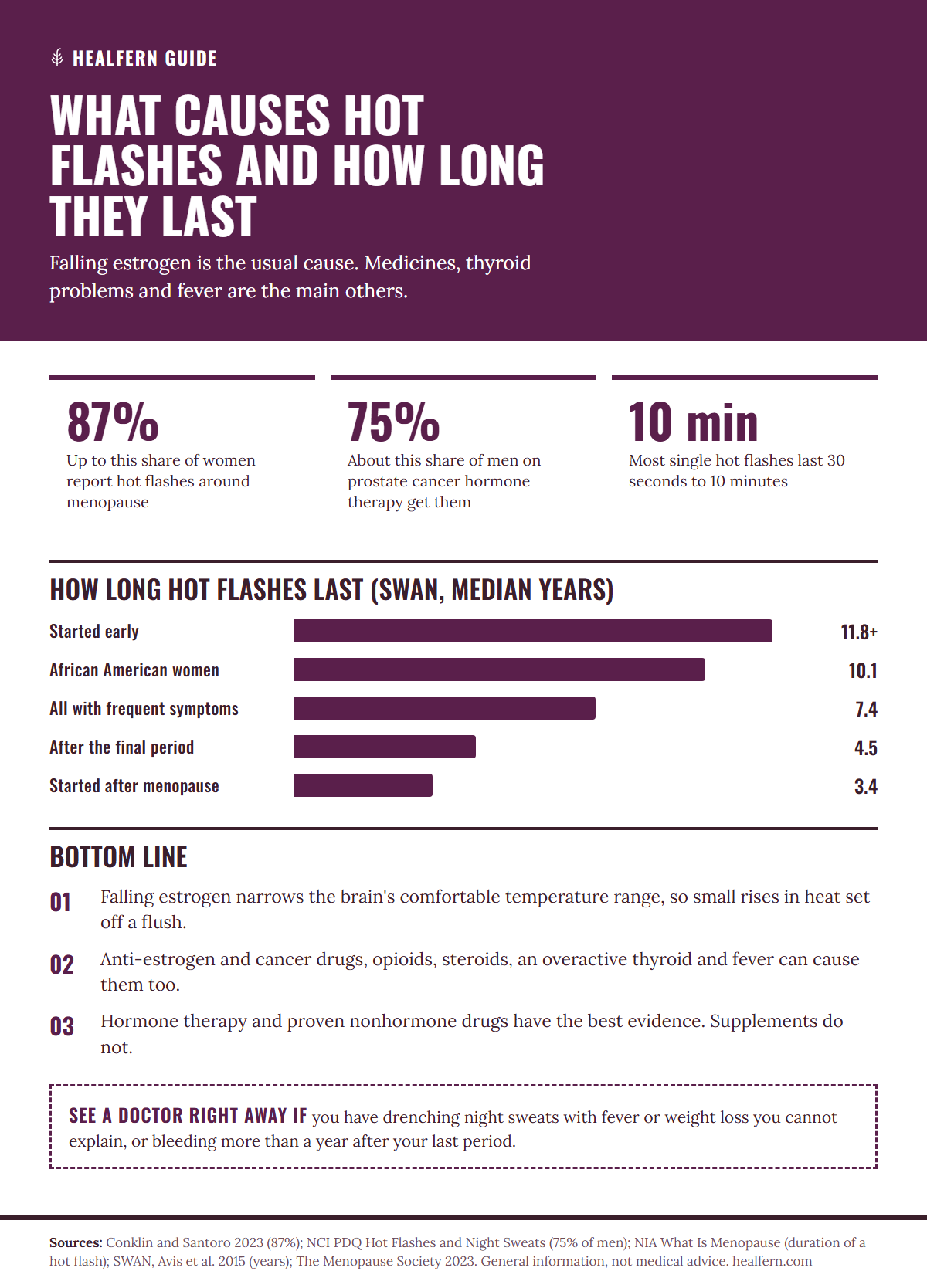
Many women expect hot flashes to stop once periods stop. The SWAN study, which followed 3,302 women at 7 US sites, found they often do not.[5] Among women with frequent symptoms, the median total length was 7.4 years, and they went on for a median of 4.5 years after the final period.[5]
When they began made a big difference. Women whose hot flashes began early, before their periods changed, had them for more than 11.8 years. Women whose hot flashes started only after menopause had them for about 3.4 years. African American women had them for a median of 10.1 years.[5] So hot flashes in a woman in her 60s are often still menopause. A new pattern that starts years later deserves a look for other causes, covered below.
What causes hot flashes other than menopause?
Hot flashes outside menopause most often come from medicines, cancer treatment, an overactive thyroid or a fever. Sweating is also normal with exercise and anxiety, and hyperhidrosis, or heavy sweating, can come from thyroid or nervous system disorders and low blood sugar.[6][8][9]
Medicines and cancer treatment
The NCI lists chemotherapy, radiation, tamoxifen and aromatase inhibitors as causes in people treated for cancer.[6] It also names opioids, tricyclic antidepressants and steroids as drugs that can cause hot flashes and night sweats in both women and men.[6] Anti-estrogen drugs lower or block estrogen, which mimics the change that happens at menopause.[4]
An overactive thyroid
Hyperthyroidism speeds up the body. The NIDDK lists “sweating or trouble tolerating heat” among its symptoms, along with weight loss despite a bigger appetite.[8] It is more common in women and in people older than 60, so it overlaps with the age when menopause is the first guess.[8] A blood test can sort this out.
Fever and infection
A fever makes you sweat as your body works to bring its temperature back down.[9] Hot, sweaty spells that come with chills, a cough or feeling unwell point to an infection rather than hormones.
Anxiety and low blood sugar
MedlinePlus lists anxiety as a normal cause of sweating and low blood sugar as a cause of heavy sweating.[9] A sudden flush with a racing heart and worry can feel a lot like a hot flash. People with diabetes who sweat and feel shaky should check their blood sugar.
What causes hot flashes in men?
In men, hot flashes usually follow a sharp drop in testosterone, most often from androgen deprivation therapy for prostate cancer. About 75% of men on this therapy get hot flashes, and in one trial 93% of men on 12 months of treatment had them.[7]
The NCI explains that surgery to remove the testicles and hormone therapy with gonadotropin-releasing hormone drugs both trigger hot flashes and night sweats.[6] In that trial, 99% of men later said their hot flashes went away, usually before testosterone fully recovered.[7]
Men who are not on cancer treatment and start having hot flashes should see a doctor. The same non-hormone causes apply to them: medicines like opioids and steroids, an overactive thyroid, and fever.[6][8][9]
What causes hot flashes in young women?
In women under 40, hot flashes can signal premature menopause, the effect of surgery or cancer treatment, or a non-hormone cause like a thyroid problem. MedlinePlus calls menopause before age 40 premature and before age 45 early.[3]
Removing both ovaries brings on menopause right away, and the NCI notes this can happen during surgery to lower cancer risk or as part of cancer surgery.[6] A hysterectomy alone does not cause menopause unless the ovaries are also removed.[3] Chemotherapy can also bring menopause on earlier.[3]
For a young woman with regular periods, the non-hormone list matters more. Medicines, an overactive thyroid and fever are all worth checking.[6][8][9] The NIA says a doctor may suggest a blood test to check hormone levels when periods stop at an early age.[2]
Why do hot flashes happen at night?
Night sweats are hot flashes that happen during sleep, and they can wake you up drenched. The NIA uses the term for hot flashes at night, and the NCI describes them as hot flashes combined with sweats while sleeping.[1][6]
A warm bedroom and heavy covers make them more likely to wake you. The NIA suggests lowering the bedroom temperature, layering bedding so you can adjust it, using a fan and drinking small amounts of cold water before bed.[1] The NCI adds loose cotton clothes and moving air.[6]
Broken sleep is one of the main reasons hot flashes wear people down. If you are thinking about a sleep aid, read our guide on how much melatonin to take first, and talk to your doctor. Drenching night sweats with weight loss or fever are a different matter, covered in the red flags below.[10]
Which cause fits your pattern?
Your age, your periods, your medicines and any other symptoms usually point to the likely cause. Use this table to start a talk with your doctor. It is not a diagnosis.
| If this sounds like you | Likely cause to ask about | Usual next step |
|---|---|---|
| Age 45 to 55, periods changing or stopped | Menopausal transition[2] | Track hot flashes; discuss options if they bother you[1] |
| Over 60, hot flashes since menopause | Long-lasting menopause symptoms[5] | Review treatment; hormone therapy is weighed differently with age[11] |
| Started a new medicine, such as an opioid, steroid or tamoxifen | Drug side effect[6] | Ask the prescriber; do not stop on your own |
| Weight loss, fast heartbeat, always too warm | Overactive thyroid[8] | Thyroid blood test |
| Fever, chills, cough or feeling ill | Infection[9] | See a doctor, especially if it lasts |
| Man on prostate cancer hormone therapy | Low testosterone from treatment[7] | Ask your cancer team about options |
| Under 40 with missed periods | Possible premature menopause[3] | Hormone blood tests[2] |
What does the research show?
The best data on hot flashes come from large long-term studies of women and from trials of prescription drugs. Supplement research is smaller and less consistent. These are the studies and reviews this guide relies on.
| Study | Who and how many | Length | Main result |
|---|---|---|---|
| SWAN, Avis 2015[5] | 3,302 US women; 1,449 with frequent hot flashes | Many years of follow-up | Median 7.4 years in total; 4.5 years after the final period |
| SKYLIGHT 1, Lederman 2023[12] | 527 women aged 40 to 65 with 7 or more hot flashes a day | 12 weeks, then a 40-week extension | Fezolinetant 45 mg cut about 2.55 more hot flashes a day than placebo; drug company funded |
| Men on androgen deprivation therapy[7] | Men with prostate cancer | 12 months of treatment | 93% had hot flashes; 99% said they resolved later |
| Black cohosh review, 2023[14] | 22 studies | Varied | Possible help for hot flashes; product quality and liver concerns |
The 2023 Menopause Society statement graded the whole field. Its panel recommended CBT, clinical hypnosis, SSRIs and SNRIs, gabapentin and fezolinetant at its top evidence level. It did not recommend supplements, herbal remedies or soy.[11]
When should you see a doctor about hot flashes?
See a doctor if hot flashes disrupt your sleep or work, start outside the usual menopause years, or come with other new symptoms. Most are harmless, but a few patterns need a check soon.[1][2]
See a doctor right away if you have:
- Drenching night sweats with fever, or weight loss you cannot explain in the past 6 months; the NCI lists these as signs of Hodgkin lymphoma[10]
- Bleeding or spotting after more than a year without a period[2]
- A racing heart or weight loss despite eating more[8]
- Fever with chills or a cough that does not go away[9]
- Yellow skin or eyes, dark urine or pale stools while taking fezolinetant[13]
Before you take anything for hot flashes, tell your doctor about all your medicines and supplements. The NCI notes that some antidepressants change how tamoxifen works.[6] Black cohosh is not safe in pregnancy, and its safety after breast cancer is uncertain.[14]
What to track before your visit
- How many hot flashes you have a day and how long each one lasts
- Whether they wake you at night
- The date of your last period
- Any new medicine in the past few months, including steroids and opioids
- Triggers you notice, such as alcohol, spicy food or caffeine[1]
- Other symptoms such as weight change, fever or a fast heartbeat
- Every supplement you take, with the label
How do doctors treat hot flashes?
Hormone therapy is still the most effective treatment for hot flashes, and The Menopause Society says it should be considered for women within 10 years of their final period.[11] The NIA calls it a very effective treatment for women who can use it.[1]
Hormone therapy has real risks, including heart attack, stroke, blood clots, breast cancer, gallbladder disease and dementia, and those risks vary with age and health.[1] Patches may be a better fit for women with heart risk factors.[1] Many women who have had breast cancer cannot use estrogen.[6]
For those who cannot or prefer not to take hormones, there are proven nonhormone options:[11]
- Paroxetine (Brisdelle): an SSRI the FDA approved for menopause hot flashes[1]
- Other SSRIs and SNRIs, and gabapentin: recommended at the top evidence level[11]
- Fezolinetant (Veozah): blocks the neurokinin 3 receptor; in SKYLIGHT 1 the effect showed after 1 week[1][12]
- CBT and clinical hypnosis: drug-free options with good evidence[11]
Fezolinetant now carries a boxed warning for liver injury. Its label calls for liver blood tests every month for the first 3 months, then at 6 and 9 months.[13] Men on prostate cancer treatment may be offered progestin, antidepressants or anticonvulsants.[6] When the cause is a thyroid problem, a drug or an infection, doctors deal with that cause first.[8]
Do supplements like black cohosh or soy help hot flashes?
No supplement has been shown to reliably relieve hot flashes, and The Menopause Society does not recommend supplements, herbal remedies or soy for them.[11] The NIA says black cohosh, DHEA and soy isoflavones are not proven, and some carry risks such as liver damage.[1]
Black cohosh has the most research. A 2023 review of 22 studies found it may help hot flashes, but NCCIH warns of rare liver damage and of products that contained the wrong herb.[14] The NCI summary says most studies of soy and black cohosh found them no better than a placebo.[6]
Other supplements have not done much better. Vitamin E was only slightly better than a placebo, and ground flaxseed and magnesium oxide gave mixed results.[6] Magnesium from food is still worth getting for its own sake; see our list of foods highest in magnesium. If you are hoping a daily pill will cover the gap, read our look at whether multivitamins work.
If you still want to try a supplement, tell your doctor first and stop if you notice signs of liver trouble, such as yellow skin or dark urine.[14] You can read how we pick and check sources in how we research.
Bottom line
For most women in their 40s and 50s, hot flashes come from falling estrogen, and they can last for years past the final period.[4][5] If they start at an unusual age, come with weight loss or fever, or follow a new medicine, look for another cause before blaming hormones.[6][8][10]
Our view: if hot flashes are disrupting your life, talk with your doctor about hormone therapy or a proven nonhormone drug before trying a supplement, because those options have the strongest trial evidence.[11] You can find related topics in our women’s health guides.
Questions people also ask
Why am I getting so many hot flashes all of a sudden?
A sudden rise often follows a hormone shift in perimenopause, a new medicine such as a steroid or opioid, or triggers like alcohol, caffeine and spicy food. An overactive thyroid or a fever can also do it, so mention a sudden change to your doctor.
What causes hot flashes in women over 70?
Some women keep having menopause hot flashes for many years. In the SWAN study, women whose hot flashes started early had them for more than 11.8 years. New hot flashes at this age deserve a check for medicines, thyroid problems and infection.
Can you get hot flashes when you are not in menopause?
Yes. Anti-estrogen drugs, chemotherapy, opioids, tricyclic antidepressants, steroids, an overactive thyroid, anxiety, low blood sugar and fever can all cause flushing or sweating. Men on prostate cancer hormone therapy get them too.
Are hot flashes a sign of cancer?
Usually not. Most are due to menopause or medicines. But drenching night sweats with fever or unexplained weight loss can be a sign of lymphoma or another illness, so see a doctor promptly if you notice that pattern.
How long does a single hot flash last?
According to the National Institute on Aging, most hot flashes last between 30 seconds and 10 minutes. They can come several times an hour, a few times a day, or only once or twice a week.
Sources
- Hot Flashes: What Can I Do?, National Institute on Aging, reviewed 2021
- What Is Menopause?, National Institute on Aging
- Menopause, MedlinePlus, National Library of Medicine
- Neurokinin receptor antagonists as potential non-hormonal treatments for vasomotor symptoms of menopause, Conklin and Santoro, Therapeutic Advances in Reproductive Health, 2023
- Duration of menopausal vasomotor symptoms over the menopause transition (SWAN), Avis et al., JAMA Internal Medicine, 2015
- Hot Flashes and Night Sweats (PDQ), Patient Version, National Cancer Institute
- Hot Flashes and Night Sweats (PDQ), Health Professional Version, National Cancer Institute
- Hyperthyroidism (Overactive Thyroid), NIDDK, National Institutes of Health
- Sweat, MedlinePlus, National Library of Medicine
- Adult Hodgkin Lymphoma Treatment (PDQ), Patient Version, National Cancer Institute
- The 2023 nonhormone therapy position statement of The North American Menopause Society, The Menopause Society, Menopause journal, 2023
- Fezolinetant for treatment of moderate-to-severe vasomotor symptoms associated with menopause (SKYLIGHT 1), Lederman et al., The Lancet, 2023
- VEOZAH (fezolinetant) tablets: label, DailyMed, National Library of Medicine, 2026
- Black Cohosh: Usefulness and Safety, NCCIH, 2024
This article is general information, not medical advice. These statements have not been evaluated by the FDA, and supplements are not intended to diagnose, treat, cure or prevent any disease. Talk to your doctor or pharmacist before you start a supplement. How we research.