
Zinc for colds may help a little if you start early. The 2024 Cochrane review of 34 trials found zinc may shorten a cold by about 2 days, with low-certainty evidence, and little or no effect on preventing colds. Trials that worked used more than 75 mg a day from lozenges. Never use zinc nasal gels or swabs, which are linked to lasting smell loss.
Zinc for colds is one of the most popular cold remedies, so we checked what the trials measured. We read the 2024 Cochrane review, the NIH Office of Dietary Supplements zinc fact sheet, the NCCIH page on flu and colds, four randomized trials, four meta-analyses and the 2009 FDA warning on zinc nasal products. You can read how we research health topics.
Zinc lozenges started early may shorten a cold by about 2 days, but they do not seem to prevent colds, and the evidence is low certainty.[3]
| What it is | An essential mineral, also sold in lozenges, tablets and syrups as a cold remedy[2] |
|---|---|
| Studied for | Shortening a cold once symptoms start, and preventing colds[3] |
| Amounts in trials | Zinc gluconate lozenges gave 45 to 276 mg of zinc a day for 4.5 to 21 days[3] |
| Best evidence | Cochrane 2024, 34 trials, 8,526 people: colds about 2.37 days shorter, low certainty[3] |
| Prevention | Little or no effect on catching a cold (risk ratio 0.93)[3] |
| Safety | Bad taste and nausea are common; zinc nasal gels and swabs are linked to lasting smell loss[8][11] |
| Who should ask first | People on quinolone or tetracycline antibiotics, penicillamine or thiazide diuretics, and parents of young children[2][14] |
Does zinc for colds work?
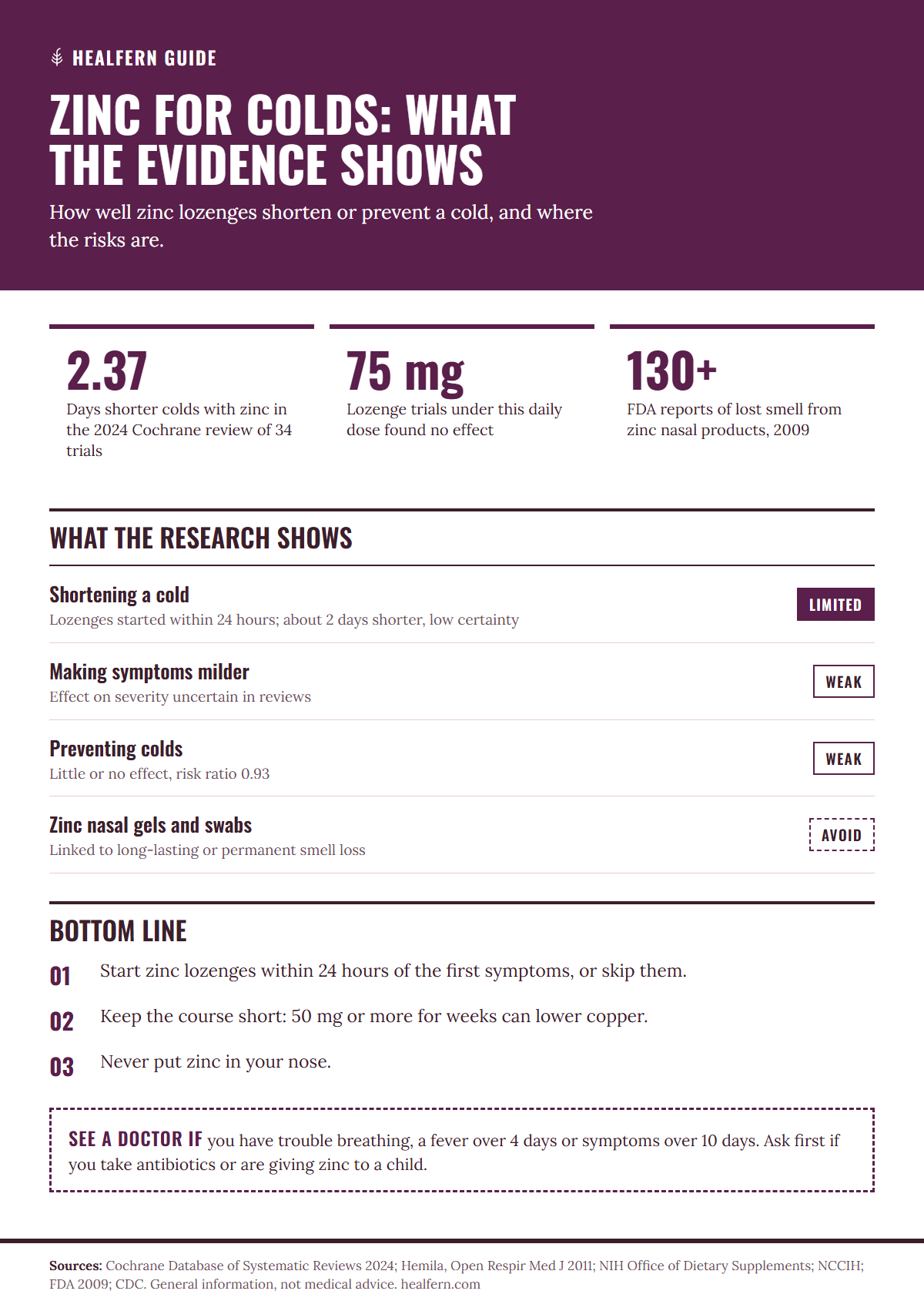
Zinc for colds seems to work a little for some people. The 2024 Cochrane review found zinc may cut about 2.37 days from a cold that has already started, but it rated that evidence low certainty. It found no clear effect on how bad symptoms felt.[3]
The review pooled 34 randomized trials with 8,526 participants, including 12 studies in children.[3] The treatment result came from 8 trials with 972 people. Those trials disagreed with each other a lot, and most studies had an unclear or high risk of bias in at least one area.[3]
An earlier 2021 review in BMJ Open landed in a similar place. Across 28 trials and 5,446 adults, symptoms cleared about 2 days sooner with zinc, and 19 more adults per 100 were still sick on day 7 without it.[4] The authors rated the 2-day finding very low certainty.
The NIH Office of Dietary Supplements sums it up the same way. Lozenges or syrup taken early can shorten a cold, but they do not appear to make symptoms milder.[2] NCCIH lists oral zinc among the cold remedies that show some promise.[1]
How does zinc help fight a cold?
No one knows for sure how zinc acts on a cold. Researchers think zinc released in the mouth and throat may stop rhinoviruses from attaching and copying themselves, and may calm inflammation. That idea explains why most trials used lozenges or syrup that linger in the throat instead of pills you swallow.[2]
More than 200 viruses can cause a cold, and rhinoviruses are the most common.[12] A lozenge that dissolves slowly keeps zinc in contact with the throat, where those viruses settle.[2]
This is still a hypothesis. The authors of the 1996 Cleveland Clinic trial wrote that the way zinc acts on colds remains unknown.[8] Zinc is needed for normal immune function. The cold trials, though, tested short bursts of frequent lozenges taken during a cold.[2][3]
What do the main zinc and cold studies show?
The trials disagree, which is why reviewers rate the evidence low. The positive trials gave zinc lozenges every 2 to 3 hours while awake, starting within 24 hours of the first symptoms. A larger 2000 trial found no benefit in natural colds. The table sets the main studies side by side.[8][9][10]
| Study | Who and how many | Zinc used | Result |
|---|---|---|---|
| Mossad, 1996[8] | 100 adults, colds under 24 hours old | 13.3 mg zinc gluconate lozenge every 2 hours awake | Median 4.4 vs 7.6 days |
| Prasad, 2000[9] | 50 adults, colds under 24 hours old | 12.8 mg zinc acetate lozenge every 2 to 3 hours awake | Mean 4.5 vs 8.1 days |
| Turner and Cetnarowski, 2000[10] | 273 lab-induced and 281 natural colds | 13.3 mg gluconate or 5 or 11.5 mg acetate lozenges | 1 day shorter for lab colds on gluconate; no effect on natural colds |
| Hemila, 2011[7] | 13 trial comparisons | Under vs over 75 mg a day | Under 75 mg: no effect; over 75 mg: 20% to 42% shorter |
| Hemila, 2017[6] | 7 trials, 575 people | Over 75 mg a day, acetate or gluconate | Colds 33% shorter on average |
| Hemila and others, 2017[5] | 3 trials, 199 people | 80 to 92 mg a day, zinc acetate | 70% vs 27% recovered by day 5 |
| Cochrane, 2024[3] | 34 trials, 8,526 people | Mostly lozenges | 2.37 days shorter, low certainty; no clear prevention |
Can zinc help prevent a cold?
Probably not. In the 2024 Cochrane review, taking zinc before getting sick made little or no difference to the risk of catching a cold (risk ratio 0.93). That result came from 9 trials with 1,449 people and was rated low certainty, so a daily zinc pill is a weak plan for avoiding colds.[3]
When colds did happen in the prevention trials, zinc probably made little or no difference to how long they lasted.[3] In studies where volunteers were given a rhinovirus on purpose, zinc did not stop them from developing a cold (risk ratio 0.96).[4]
Taking zinc for months also carries risk. NCCIH notes that little is known about the long-term safety of some supplements taken for months to prevent colds, and high zinc doses over time can lower copper and HDL cholesterol.[1]
Other supplements have mixed records too. Our guide on whether vitamin C helps with colds covers its trials, and our review of quercetin benefits looks at another popular immune supplement. You can browse all our immune system health guides as well.
How much zinc should you take for a cold?
Trials that worked gave more than 75 mg of zinc a day in total, split into a lozenge every 2 to 3 hours while awake. Lozenge trials under 75 mg a day found no effect, while higher doses shortened colds. Doses above 100 mg a day added no extra benefit.[6][7]
As a worked example, one trial gave six lozenges a day, and six 13.3 mg lozenges come to about 80 mg of zinc.[2][10] That is double the 40 mg daily upper limit for adults, so these doses belong to a short course only.[2]
The upper limit matters because doses of 50 mg or more taken for weeks can block copper absorption.[2] Here are the daily upper limits from all sources, by age.
| Age | Upper limit per day |
|---|---|
| 1 to 3 years | 7 mg[2] |
| 4 to 8 years | 12 mg[2] |
| 9 to 13 years | 23 mg[2] |
| 14 to 18 years | 34 mg[2] |
| Adults 19 and older | 40 mg[2] |
For comparison, the daily need for most adults is 11 mg for men and 8 mg for women.[2]
What kind of zinc is best for colds?
Most positive trials used lozenges made with zinc acetate or zinc gluconate. In a 2017 analysis of 7 trials, acetate lozenges shortened colds by 40% and gluconate by 28%, but the gap was not statistically significant. Well-made gluconate lozenges may work as well as acetate.[6]
How the zinc is delivered seems to matter more than the salt. Most Cochrane trials gave lozenges, while others used tablets, syrups, powders, capsules or nasal products.[3] The NIH fact sheet explains that lozenges and syrups stick briefly to the mouth and throat, which is where zinc is thought to act.[2]
We found no cold trial that tested zinc picolinate, so picolinate capsules are untested for this use. Skip any zinc product that goes in the nose, for the reasons in the safety section below.[11]
When is the best time to take zinc for a cold?
Start as soon as you notice symptoms. The trials with the clearest benefit enrolled people within 24 hours of their first cold symptoms. A 2017 pooled analysis of 199 patients advised trying zinc acetate lozenges within that first day, and found 70% had recovered by day 5 versus 27% on placebo.[5]
No trial we read tested starting zinc on day 3 or later, so the value of a late start is unknown. The 2000 Prasad trial and the 1996 Mossad trial both recruited only people whose colds were less than a day old.[8][9]
As for how long, in the early trials, people kept taking lozenges for as long as they had symptoms.[8][9] Across the Cochrane trials, courses ran from 4.5 to 21 days.[3]
Cold symptoms can last 10 to 14 days.[12] If you are not getting better after 10 days, the CDC advice is to see a health care provider rather than keep treating it at home.[13]
What are the side effects of zinc lozenges, and who should avoid them?
Short courses of zinc lozenges are usually safe for healthy adults, but side effects are common. In the 1996 Cleveland Clinic trial, 80% of people on zinc had bad-taste reactions and 20% had nausea, compared with 30% and 4% on placebo. The Cochrane review also found more non-serious side effects with zinc (risk ratio 1.34).[3][8]
The 2021 BMJ Open review counted nausea and mouth or nose irritation, with one extra person affected for every 7 treated.[4] Very high intakes can also cause dizziness, headaches, vomiting and loss of appetite.[2]
The FDA warning on nasal zinc
In 2009 the FDA told consumers to stop using three Zicam nasal gels and swabs sold as cold remedies.[11] The agency had more than 130 reports of lost sense of smell, called anosmia, and some people lost it after the first dose. The FDA said anosmia may be long-lasting or permanent.[11]
NCCIH concludes that the risk of a serious, lasting side effect outweighs any possible benefit for a minor illness.[1] Losing your sense of smell can also make it harder to notice gas or smoke.[11]
Zinc can bind quinolone and tetracycline antibiotics, so take the antibiotic at least 2 hours before or 4 to 6 hours after zinc.[2] Zinc also interacts with penicillamine, and thiazide diuretics raise the amount of zinc lost in urine.[2] People who take these or other daily medicines should talk with a health care provider about zinc first.[2]
Can kids take zinc for colds?
Ask your child’s doctor first. The Cochrane review included 12 studies in children, but child upper limits are far below the doses used in adult cold trials. The limit is 7 mg a day at ages 1 to 3 and 12 mg at ages 4 to 8, while effective adult trials used more than 75 mg.[2][3][7]
The American Academy of Pediatrics says over-the-counter cough and cold medicines are not recommended for children under 4.[14] It suggests home care instead, such as saline drops for a stuffy nose.[14]
For a cough in children 1 year and older, the AAP suggests 2 to 5 mL of honey as needed. Never give honey to a baby under 1, because it can cause infant botulism.[14]
What do doctors recommend first for a cold?
Doctors treat a cold with rest and symptom relief, because there is no cure. MedlinePlus lists rest, fluids, a clean humidifier, warm salt-water gargles, saline drops and over-the-counter medicines as the main cold treatments. Antibiotics do not work against the viruses that cause colds.[12][13]
Most adults get 2 to 3 colds a year.[12] Zinc lozenges can be added to these steps if you want to try them. If you might have flu or COVID-19, get tested, because antiviral medicines work best when started soon after symptoms begin.[13] NCCIH found no complementary approach shown to help the flu.[1]
See a doctor if you have any of these signs:[13]
- Trouble breathing or fast breathing[13]
- Signs of dehydration[13]
- A fever that lasts longer than 4 days[13]
- Symptoms that last more than 10 days without getting better[13]
- Symptoms that improve, then return or get worse[13]
- A long-term health condition that gets worse[13]
Pressure around the eyes and cheeks that will not clear can mean something other than a cold. Compare your symptoms with our guide to sinus infection symptoms.
Should you try zinc lozenges for your cold?
Zinc lozenges are a reasonable short trial for a healthy adult who starts on day one and can put up with the taste. The decision table below matches common situations to a sensible next step. It draws only on the trial and safety findings cited in this guide.[2][3]
| If this applies to you | Then consider this |
|---|---|
| Healthy adult, symptoms began in the last 24 hours | A short course of zinc acetate or gluconate lozenges every 2 to 3 hours while awake is reasonable[5][9] |
| Symptoms began 3 or more days ago | Little reason to start; the trials enrolled people within 24 hours[5][8] |
| You want to avoid colds all winter | Zinc showed little or no prevention effect[3] |
| You take a quinolone or tetracycline antibiotic | Take the antibiotic 2 hours before or 4 to 6 hours after zinc[2] |
| Your child is under 4 | Ask the pediatrician; over-the-counter cold medicines are not advised at this age[14] |
| You are thinking of a zinc nasal gel, swab or spray | Skip it; nasal zinc is linked to lasting smell loss[1][11] |
| Fever over 4 days or trouble breathing | See a doctor[13] |
Checklist before you buy zinc lozenges
A useful zinc lozenge label names the zinc salt and the elemental zinc in each lozenge. Elemental zinc is the amount of actual zinc per lozenge, and it is the number to add up across the day. Run through these checks before you buy or start a course.[2]
- Look for zinc acetate or zinc gluconate, the forms used in the trials.[6]
- Find the elemental zinc per lozenge and multiply by how many you plan to take; six 13.3 mg lozenges come to about 80 mg.[10]
- Keep the course short and stop when the cold ends, since 50 mg or more for weeks can lower copper.[2]
- Choose lozenges, never nasal gels, swabs or sprays.[11]
- Count zinc from other products, such as multivitamins and some denture creams.[2]
- Remember that supplements do not go through the testing that drugs do before they are sold.[15]
- Space zinc away from quinolone and tetracycline antibiotics.[2]
Bottom line
Zinc for colds has modest evidence behind it. Lozenges started within a day of symptoms may shave about 2 days off a cold, but the evidence is low certainty, zinc does not seem to prevent colds, and bad taste and nausea are common.[3][8]
For most healthy adults, rest, fluids and symptom relief are the better first step, with zinc lozenges as an optional add-on for the first few days. Never put zinc in your nose, keep high doses short, and see a doctor if symptoms last more than 10 days or you have trouble breathing.[11][13]
Questions people also ask
Does zinc help a sore throat from a cold?
It may. In the 1996 Cleveland Clinic trial, people taking zinc gluconate lozenges had a median of 1 day with a sore throat, compared with 3 days on placebo. That was one trial of 100 adults, so treat it as a small signal.
Does zinc help with the flu?
There is no good evidence that it does. NCCIH says no complementary approach has been shown to help the flu. If you might have flu, get tested early, because antiviral medicines work best when started soon after symptoms begin.
Can you take too much zinc for a cold?
Yes. The adult upper limit is 40 mg a day, and very high intakes can cause nausea, dizziness, headaches, vomiting and loss of appetite. Taking 50 mg or more for weeks can also lower copper levels.
Does zinc make cold symptoms less severe?
Probably not by much. The NIH fact sheet says zinc lozenges seem to shorten colds but not make symptoms milder, and the 2024 Cochrane review called the effect on severity uncertain, based on very low-certainty evidence.
Sources
- Flu and Colds: In Depth, NCCIH, NIH
- Zinc: Fact Sheet for Health Professionals, NIH Office of Dietary Supplements, 2026
- Zinc for prevention and treatment of the common cold, Cochrane Database of Systematic Reviews, 2024
- Zinc for the prevention or treatment of acute viral respiratory tract infections in adults, BMJ Open, 2021
- Zinc acetate lozenges may improve the recovery rate of common cold patients: an individual patient data meta-analysis, Open Forum Infectious Diseases, 2017
- Zinc lozenges and the common cold: a meta-analysis comparing zinc acetate and zinc gluconate, and the role of zinc dosage, JRSM Open, 2017
- Zinc lozenges may shorten the duration of colds: a systematic review, Open Respiratory Medicine Journal, 2011
- Zinc gluconate lozenges for treating the common cold: a randomized, double-blind, placebo-controlled study, Annals of Internal Medicine, 1996
- Duration of symptoms and plasma cytokine levels in patients with the common cold treated with zinc acetate, Annals of Internal Medicine, 2000
- Effect of treatment with zinc gluconate or zinc acetate on experimental and natural colds, Clinical Infectious Diseases, 2000
- FDA Advises Consumers Not To Use Certain Zicam Cold Remedies, U.S. Food and Drug Administration, 2009 (archived)
- Common Cold, MedlinePlus, National Library of Medicine
- Manage Common Cold, Centers for Disease Control and Prevention, 2026
- Coughs and Colds: Medicines or Home Remedies?, American Academy of Pediatrics, HealthyChildren.org
- Dietary Supplements, MedlinePlus, National Library of Medicine
This article is general information, not medical advice. These statements have not been evaluated by the FDA, and supplements are not intended to diagnose, treat, cure or prevent any disease. Talk to your doctor or pharmacist before you start a supplement. How we research.


