A panic attack is a sudden surge of intense fear with strong physical symptoms, such as a pounding heart and chest pain, that most often peaks within 10 to 20 minutes. "Anxiety attack" is not a medical diagnosis. People use it for either a panic attack or for worry and tension that build slowly around a stressor. Cognitive behavioral therapy helps both.
We read the National Institute of Mental Health (NIMH) guide to panic disorder, the MedlinePlus entries on panic disorder and generalized anxiety disorder, the American Psychiatric Association’s patient page on anxiety disorders, the national survey data on how common panic attacks are, the National Heart, Lung, and Blood Institute’s list of heart attack symptoms, two large meta-analyses of cognitive behavioral therapy, and NCCIH’s review of complementary approaches for anxiety.
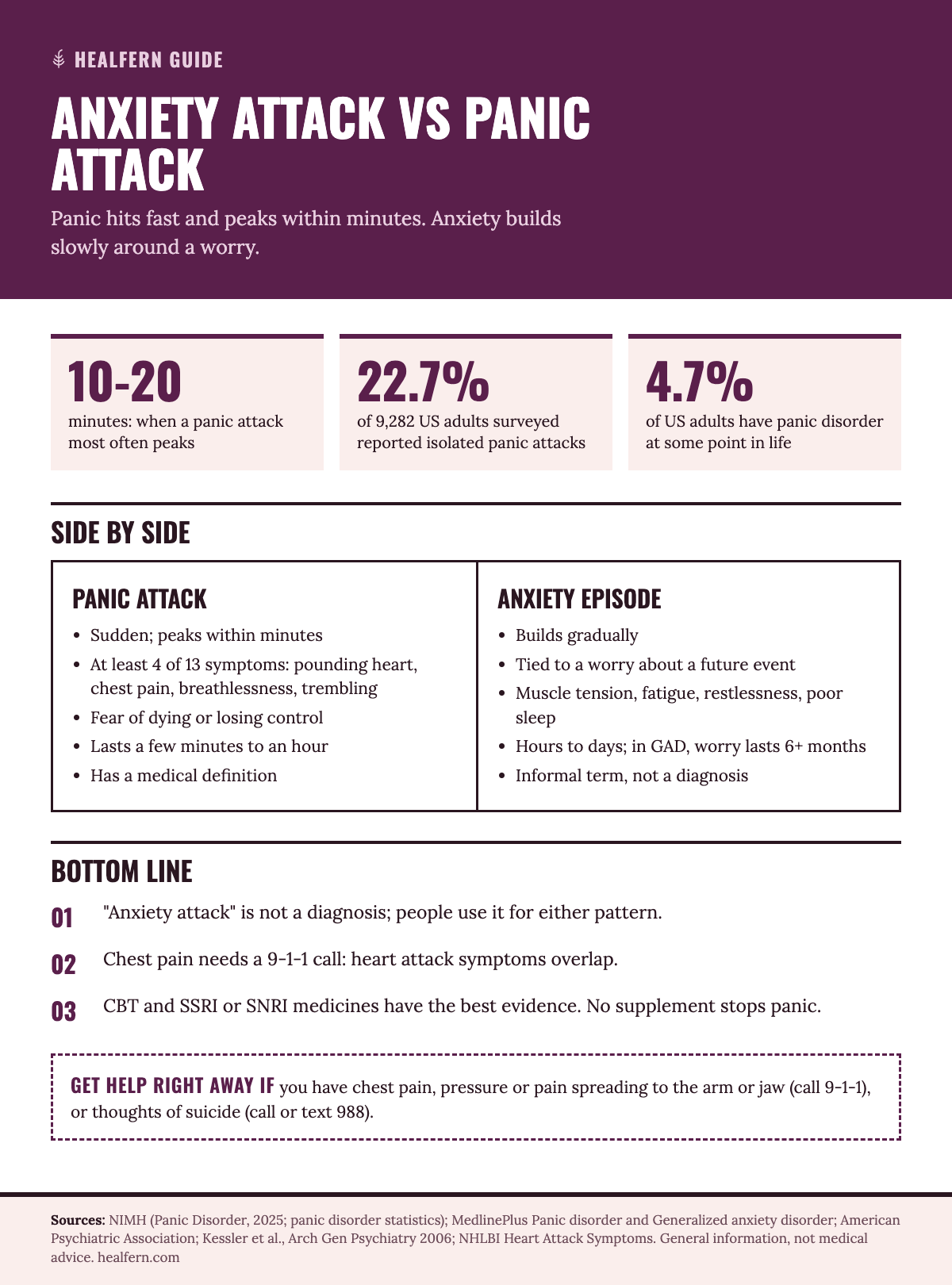
The short answer: a panic attack is a defined medical event, a sudden surge of intense fear with strong physical symptoms that peaks within minutes, while “anxiety attack” is an everyday phrase with no formal definition, usually meaning a slower build of worry and tension tied to a stressor.[1][2][3]
| Panic attack | A sudden wave of fear or discomfort, or a sense of losing control, even when there is no clear danger.[1] |
|---|---|
| Anxiety attack | Not a diagnosis. MedlinePlus lists “anxiety attacks” as another name for panic attacks, while many people use it for intense worry that builds over time.[2][3] |
| Timing | A panic attack starts suddenly and most often peaks within 10 to 20 minutes. Worry in generalized anxiety lasts for months.[2][5] |
| Body symptoms | Panic: at least 4 of 13 listed symptoms, such as a pounding heart, chest pain, shortness of breath and trembling. Anxiety: muscle tension, fatigue, restlessness, poor sleep.[2][5] |
| How common | 22.7% of US adults reported isolated panic attacks in a national survey of 9,282 people. About a third of adults have an anxiety disorder at some point.[8][4] |
| Danger | NIMH says panic attacks themselves are not life-threatening, but chest pain should be checked because heart attack symptoms overlap.[1][9] |
| What helps most | Cognitive behavioral therapy and certain antidepressants. No supplement has shown it stops panic attacks.[1][11][13] |
What is the difference between an anxiety attack and a panic attack?
A panic attack is sudden. It hits hard, peaks within minutes, and can arrive with no obvious trigger. What most people call an anxiety attack builds more slowly around a specific worry, such as an exam or a medical result, and its body symptoms tend to be milder. Only panic attacks have a medical definition.[1][2][3]
The American Psychiatric Association (APA) draws the line between fear and anxiety this way: “Fear is a response to an immediate threat, while anxiety refers to anticipation of a future concern.” A panic attack is fear at full volume. Anxiety is the dread of what might happen next.[3]
The two often travel together. NIMH notes that many people who have had a panic attack start worrying about having another one, and that worry can grow into its own ongoing anxiety.[1] So the same person can have both: a background of anxious anticipation, punctuated by sudden peaks of panic.
What does a panic attack feel like?
A panic attack feels like an emergency in the body. MedlinePlus lists 13 possible symptoms, and a full attack involves at least 4 of them. The most common are a racing or pounding heart, chest pain, shortness of breath, shaking, sweating and a sudden fear of dying or losing control.[2]
The MedlinePlus list covers:
- Chest pain or discomfort
- Dizziness or feeling faint
- Fear of dying, or fear of losing control or of impending doom
- A feeling of choking
- Feelings of detachment or unreality
- Nausea or upset stomach
- Numbness or tingling in the hands, feet or face
- Palpitations, a fast heart rate or a pounding heart
- A sense of shortness of breath or smothering
- Sweating, chills or hot flashes
- Trembling or shaking[2]
NIMH describes the experience as a “false alarm.” Researchers think the body’s survival response fires too often or too strongly. A person feels their heart pound, assumes the worst, and the fear itself feeds more physical symptoms.[1] That loop helps explain why attacks can feel like they come from nowhere and why the fear of dying is so common during one.
What do people mean by an anxiety attack?
“Anxiety attack” is a common phrase, not a diagnosis. The anxiety disorders NIMH lists are generalized anxiety disorder, panic disorder, social anxiety disorder and phobia-related disorders, with no condition called an anxiety attack. People use the phrase for two different things: a panic attack, or a stretch of heavy worry and tension.[4][2]
MedlinePlus treats the phrase as a synonym. Its panic disorder entry lists “panic attacks,” “anxiety attacks” and “fear attacks” as alternative names for the same thing.[2] So if a friend says they had an anxiety attack and describes a racing heart, shaking and a sense of doom that came on fast, they are probably describing a panic attack.
Many other people use the phrase for anxiety that builds. That pattern looks more like the symptoms MedlinePlus describes for generalized anxiety: worry that is hard to control, trouble concentrating, fatigue, irritability, restlessness, muscle tension and poor sleep, sometimes with an upset stomach, sweating or trouble breathing.[5] These feelings can rise and fall over hours or days, often around a specific stressor.
The APA’s patient page offers a useful test. Ordinary stress is occasional, tied to a situation such as a presentation, and fades once the stress passes. An anxiety disorder involves worry that is persistent and excessive, lasts for months or keeps coming back, and interferes with work, school or relationships.[3]
How do the two compare side by side?
The clearest differences are speed, peak and trigger. Panic comes on abruptly and peaks fast. Anxiety builds gradually and tends to track a worry you can name. The table below sets the features out using the definitions from MedlinePlus, NIMH and the APA.[1][2][3][5]
| Feature | Panic attack | Anxiety episode (informal) |
|---|---|---|
| Formal definition | Yes, used to diagnose panic disorder[1] | No; the phrase is informal[2][4] |
| Onset | Sudden, most often peaks within 10 to 20 minutes[2] | Gradual, often tied to a stressor[3] |
| Trigger | Expected (a feared object) or unexpected (no clear reason)[3] | Usually a worry about a future event[3] |
| Main feelings | Terror, fear of dying, sense of losing control[2] | Worry, dread, feeling on edge[3][5] |
| Body symptoms | Intense: pounding heart, chest pain, breathlessness, trembling[2] | Usually milder: muscle tension, fatigue, restlessness, poor sleep[5] |
| Length | A few minutes to an hour, sometimes longer[1] | Hours to days; in generalized anxiety, months[5][7] |
How long does a panic attack last?
Most panic attacks are short. MedlinePlus says an attack most often peaks within 10 to 20 minutes, though some symptoms can last an hour or more. NIMH gives a range of a few minutes to an hour, sometimes longer, and says the physical symptoms usually resolve with time.[2][1]
How often they happen varies a great deal. NIMH says attacks can come as often as several times a day or as rarely as a few times a year. They can even happen during sleep, waking a person in a state of alarm.[1]
The APA notes that panic attacks can be expected or unexpected. An expected attack follows a known trigger, such as a feared object or situation. An unexpected attack seems to come from nowhere.[3] MedlinePlus says that, at least early on in panic disorder, there is often no trigger at all, though recalling a past attack can set off a new one.[2]
Is it a panic attack or a heart attack?
You cannot tell for sure at home, and you should not try. Chest pain, shortness of breath, sweating, nausea, dizziness and a fast heartbeat appear on both lists. The National Heart, Lung, and Blood Institute (NHLBI) says to call 9-1-1 any time you think you might be having a heart attack, even if you are not sure.[9][2]
The overlap is real. NHLBI lists these heart attack symptoms:[9]
- Chest pain, heaviness or discomfort in the center or left side of the chest (the most common symptom)
- Pain in one or both arms, the back, shoulders, neck, jaw or above the belly button
- Shortness of breath at rest or with light activity
- Sweating a lot for no reason
- Unusual tiredness, sometimes for days, which is more common in women
- Nausea and vomiting
- Light-headedness or sudden dizziness
- A rapid or irregular heartbeat
Heart attacks do not always start with crushing pain. NHLBI says symptoms can start slowly, be mild, and come and go over several hours, and that silent heart attacks are more common in older adults and in people with diabetes.[9]
MedlinePlus says many people with panic disorder first seek care in the emergency room because the attack feels like a heart attack, and doctors check for other medical problems before diagnosing panic disorder.[2] That workup is the right call. If heart disease or high blood pressure runs in your family, our guide to high blood pressure symptoms covers the warning signs worth knowing. Once a doctor has ruled out a heart problem and you know what your own attacks feel like, it gets easier to recognize panic when it comes back.
When do panic attacks become panic disorder?
One panic attack does not mean you have a disorder. NIMH says an isolated panic attack is not a mental disorder. Panic disorder is diagnosed when attacks are recurrent and unexpected and the person spends at least a month worrying about more attacks, or changes their behavior to avoid them.[1]
NIMH lists the signs of panic disorder as sudden, repeated attacks of overwhelming fear; a feeling of being out of control; fear of death or doom during an attack; intense worry about when the next attack will happen; and fear or avoidance of places where attacks have happened before.[1]
Avoidance is the part that can shrink a life. Some people develop agoraphobia, an intense fear of places where escape or help might be hard to reach if panic strikes. NIMH notes that panic disorder also often occurs alongside depression, other anxiety disorders, and alcohol or substance misuse.[1] MedlinePlus adds that people with panic disorder may misuse alcohol or other substances and may feel sad or depressed.[2]
Panic disorder usually starts young. MedlinePlus says symptoms often begin in the late teens or early adulthood, and the APA puts the average age of onset at 20 to 24.[2][3] MedlinePlus also notes the disorder is twice as common in women as in men.[2]
How common are panic attacks?
Panic attacks are far more common than panic disorder. In the National Comorbidity Survey Replication, a face-to-face survey of 9,282 US adults, 22.7% reported isolated panic attacks at some point in life without ever developing panic disorder or agoraphobia.[8]
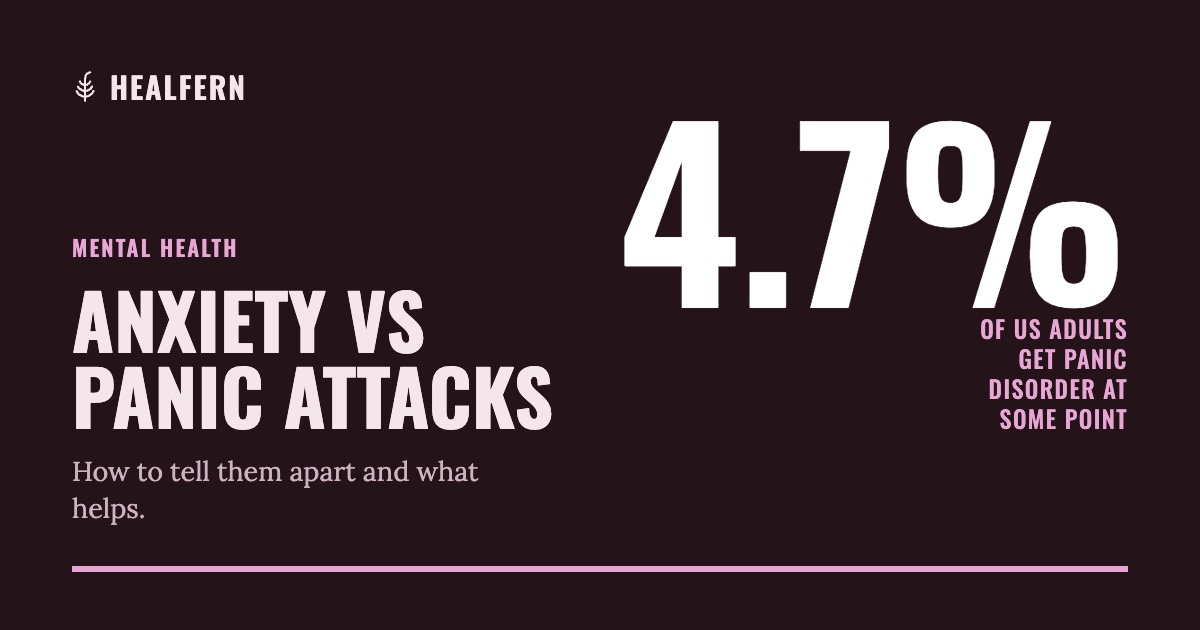
Panic disorder itself is less common. NIMH estimates that 2.7% of US adults had panic disorder in the past year, higher in women (3.8%) than men (1.6%), and that 4.7% have it at some point in their lives.[6] Of adults with panic disorder in the past year, 44.8% had serious impairment.[6]
The same survey found that people with isolated attacks usually had milder symptoms. Only 6.7% of those with panic attacks alone rated as moderate or severe on a panic severity scale. The authors still concluded that isolated attacks carry “meaningful role impairment.”[8]
Anxiety disorders as a group are very common. NIMH says about a third of US adolescents and adults experience one at some point.[4] Generalized anxiety disorder alone affected an estimated 2.7% of US adults in the past year and 5.7% at some point in life.[7] These survey numbers come from interviews done between 2001 and 2003, so they are dated, but they are the national figures NIMH still publishes.[6]
Does caffeine make panic attacks more likely?
In people with panic disorder, high doses clearly can. A 2022 meta-analysis pooled 9 blinded challenge studies with 237 patients: 51.1% had a panic attack after caffeine and none after placebo. Healthy volunteers rarely reacted, at 1.7% compared with 53.9% of patients in the head-to-head studies.[10]
The doses in those studies were large, 400 to 750 mg, which the authors describe as roughly 5 cups of coffee. Most studies used 480 mg, so the review could not say what happens with a single cup.[10] It is fair to say that big doses provoke panic in many people with the disorder. Whether a normal morning coffee does the same is unknown.
MedlinePlus is cautious anyway. It lists alcohol and stimulants such as caffeine and cocaine among substances that may trigger or worsen panic symptoms, and its self-care advice includes cutting back on caffeine, certain cold medicines and stimulants, along with regular meals, exercise and enough sleep.[2] The MedlinePlus advice for generalized anxiety also starts with reducing caffeine.[5]
If you get panic attacks, an easy experiment is to track caffeine for two weeks alongside any attacks. Check the labels on energy drinks, pre-workout powders and cold medicines as well as your coffee, since MedlinePlus names cold medicines and stimulants alongside caffeine.[2]
What treatment do doctors use first?
Doctors start with talk therapy, medicine or both. NIMH calls cognitive behavioral therapy (CBT) the “gold standard” psychotherapy for panic disorder. First-choice medicines are SSRI or SNRI antidepressants, which take several weeks to work. MedlinePlus says combining medicine and talk therapy works best.[1][2]
Cognitive behavioral therapy
CBT teaches different ways of thinking about and reacting to the body sensations of panic. NIMH says attacks can become less frequent once a person learns to react differently to those sensations. Exposure therapy, including interoceptive exposure to the feared body sensations themselves, is a common CBT method, sometimes paired with relaxation and breathing training.[1] It works in person or by telehealth.[1]
Medicines
SSRIs and SNRIs are the usual first choice and must be taken daily. Beta-blockers can blunt the racing heart, sweating and tremor in specific situations. Benzodiazepines act quickly, but NIMH warns that some people build tolerance or become dependent, so doctors prescribe them only for brief periods.[1] MedlinePlus says not to stop daily medicines without talking to your provider.[2]
What the trials show
| Study | Who and how many | Compared with | Result |
|---|---|---|---|
| Carpenter et al., 2018 meta-analysis | 41 trials, 2,843 adults with anxiety-related disorders | Pill or psychological placebo | Moderate benefit overall; response odds 2.97 times higher with CBT; smaller effect in panic disorder[11] |
| Cuijpers et al., 2025 meta-analyses | 375 trials, 32,968 adults across 10 disorders | Inactive controls | Effect sizes between 0.5 and 1.0 for panic disorder and generalized anxiety[12] |
| Kessler et al., 2006 survey | 9,282 US adults | Not a trial | Guideline-level care in the past year was low, from 18.2% (attacks only) to 54.9% (panic disorder with agoraphobia)[8] |
The Carpenter review found CBT moderately effective compared with placebo and noted that better treatments are still needed for panic disorder. The Cuijpers series found that how large the benefit looks depends on the comparison: waitlist controls make CBT look bigger than usual care does.[11][12] Both point the same way. CBT helps, and it is the best-studied option, but it is not a guaranteed fix.
Do supplements or herbal remedies help?
No supplement has been shown to stop panic attacks. NCCIH’s review of complementary approaches for anxiety finds mostly small or low-quality studies, and none of the supplements it covers is tested in panic disorder specifically. One herb, kava, carries a risk of severe liver injury.[13]
Here is what NCCIH reports for the supplements most often sold for anxiety:
- Kava: may have a small effect on anxiety, but has been linked to severe liver damage.[13]
- Lavender (oral oil product): a 2019 analysis of 65 randomized trials with 7,993 participants suggested a benefit, but the studies were small and low quality, so NCCIH says no definite conclusions can be reached.[13]
- Chamomile: two NCCIH-funded studies in generalized anxiety were preliminary, and a 2019 review of three trials found no significant drop in situational anxiety.[13]
Mind-body approaches have somewhat better data. NCCIH cites a 2023 trial in 208 adults with anxiety disorders that found mindfulness-based stress reduction was not less effective than escitalopram, a common prescription medicine. It also notes some support for yoga for anxiety symptoms, while saying it is unclear whether yoga helps anxiety disorders.[13]
We looked closely at one popular option in our review of L-theanine for anxiety: it may take a small edge off short-term stress, but trials do not show it reliably eases anxiety. If brain fog and poor focus come with your anxiety, our brain fog causes guide covers other things to check. Tell your doctor about any supplement you take, since herbs can interact with anxiety medicines.
When should you see a doctor right away?
Call 9-1-1 for chest pain or pressure, pain spreading to the arm, jaw or back, or sudden shortness of breath, even if you think it is panic. Call or text 988 if you have thoughts of suicide. Book a regular appointment if panic or worry is getting in the way of work, relationships or daily life.[9][2][1]
See a doctor right away, or call 9-1-1, if:
- You have chest pain, heaviness or pressure, especially with pain in the arm, back, neck or jaw.[9]
- You are short of breath at rest, or sweating heavily for no reason.[9]
- This is your first attack and you have heart disease, diabetes or other risk factors, or you are older. NHLBI says silent heart attacks are more common in older adults and people with diabetes.[9]
- Symptoms do not ease with rest, or do not follow your usual pattern.[9]
- You or someone you know is thinking about suicide. Call or text 988, or chat at 988lifeline.org. In a life-threatening situation, call 911.[1][2]
For non-urgent care, MedlinePlus says to contact your provider if panic attacks are interfering with your work, relationships or self-esteem.[2] NIMH suggests starting with a primary care provider, who can rule out physical causes and refer you to a psychologist, psychiatrist or clinical social worker.[1] Doctors also look at substance use, because some substances cause symptoms that resemble panic.[2]
What should you do during and after an attack?
During an attack, the goal is to ride it out safely. Most attacks peak within 10 to 20 minutes and NIMH says they are not life-threatening in themselves. Afterward, write down what happened and bring the notes to a doctor, especially if attacks repeat.[2][1]
- If you have chest pain or any doubt about your heart, call 9-1-1 first. Do not drive yourself.[9]
- Remind yourself that the attack will peak and pass. Most peak within 10 to 20 minutes.[2]
- Stay where you are if it is safe. Avoidance of places where attacks happened is one of the patterns that can feed panic disorder.[1]
- Slow, steady breathing is part of the breathing training used alongside CBT. A therapist can teach you a method that fits.[1]
- Log each attack: time, place, what you had eaten or drunk, caffeine, sleep, and how long it lasted.
- Cut back on caffeine and alcohol, keep regular meals, and aim for enough sleep and exercise.[2]
- Read supplement labels before buying anything sold for calm or stress. Our guide on how to read a supplement label explains what to check. Skip kava because of the liver risk.[13]
- If attacks keep coming, or you start avoiding places, ask your doctor about CBT and medicine options.[1]
More of our guides on mood and stress are in the mental health section, and how we research explains how we pick and grade sources.
Our verdict
A panic attack is a specific, measurable event: abrupt, intense and over in minutes to an hour. “Anxiety attack” is a loose label that people use for either a panic attack or a slower build of worry. If your episodes come on fast with a pounding heart and fear of dying, call them panic attacks when you talk to a doctor, because that is the term that leads to the right assessment and the right treatment.[1][2][3]
Our judgment call: the most useful thing you can do after a first attack is get your heart checked once, then take panic seriously as its own problem instead of waiting for it to fade. CBT and SSRIs or SNRIs have the strongest evidence. The supplements sold for calm do not have data to back them for panic, and kava adds liver risk on top of that.[1][11][13]
Questions people also ask
Is an anxiety attack the same as a panic attack?
Not exactly. A panic attack has a medical definition: sudden intense fear with at least 4 physical or mental symptoms that peaks within minutes. "Anxiety attack" is an informal phrase people use either for a panic attack or for worry that builds slowly.
How long does a panic attack last?
MedlinePlus says a panic attack most often peaks within 10 to 20 minutes, though some symptoms can last an hour or more. NIMH gives a range of a few minutes to an hour, sometimes longer, and says the physical symptoms usually pass with time.
Can a panic attack feel like a heart attack?
Yes. Chest pain, shortness of breath, sweating, nausea and a racing heart appear in both. You cannot reliably tell them apart at home, so NHLBI advises calling 9-1-1 any time you think you might be having a heart attack.
Does one panic attack mean I have panic disorder?
No. NIMH says an isolated panic attack is not a mental disorder. Panic disorder means repeated unexpected attacks plus at least a month of worrying about more attacks or changing your behavior to avoid them. About 22.7% of US adults report isolated attacks.
Can caffeine cause panic attacks?
In people with panic disorder, large doses can. A 2022 meta-analysis found 51.1% of 237 patients had a panic attack after 400 to 750 mg of caffeine and none after placebo. Effects of a single cup of coffee were not studied.
What is the best treatment for panic attacks?
NIMH calls cognitive behavioral therapy the gold standard psychotherapy for panic disorder. SSRI and SNRI antidepressants are first-choice medicines, and MedlinePlus says combining therapy and medicine works best. No supplement has been shown to stop panic attacks.
Sources
- Panic Disorder: What You Need to Know, National Institute of Mental Health, revised 2025
- Panic disorder, MedlinePlus Medical Encyclopedia, reviewed 2026
- What are Anxiety Disorders?, American Psychiatric Association, reviewed 2026
- Anxiety Disorders, National Institute of Mental Health, reviewed 2024
- Generalized anxiety disorder, MedlinePlus Medical Encyclopedia, reviewed 2025
- Panic Disorder statistics, National Institute of Mental Health (NCS-R data)
- Generalized Anxiety Disorder statistics, National Institute of Mental Health (NCS-R data)
- The epidemiology of panic attacks, panic disorder, and agoraphobia in the National Comorbidity Survey Replication, Kessler et al., Archives of General Psychiatry, 2006
- Heart Attack Symptoms, National Heart, Lung, and Blood Institute, 2022
- Effects of caffeine on anxiety and panic attacks in patients with panic disorder: a systematic review and meta-analysis, Klevebrant and Frick, General Hospital Psychiatry, 2022
- Cognitive behavioral therapy for anxiety and related disorders: a meta-analysis of randomized placebo-controlled trials, Carpenter et al., Depression and Anxiety, 2018
- Cognitive Behavior Therapy for Mental Disorders in Adults: A Unified Series of Meta-Analyses, Cuijpers et al., JAMA Psychiatry, 2025
- Anxiety and Complementary Health Approaches, National Center for Complementary and Integrative Health, 2024
This article is general information, not medical advice. These statements have not been evaluated by the FDA, and supplements are not intended to diagnose, treat, cure or prevent any disease. Talk to your doctor or pharmacist before you start a supplement. How we research.