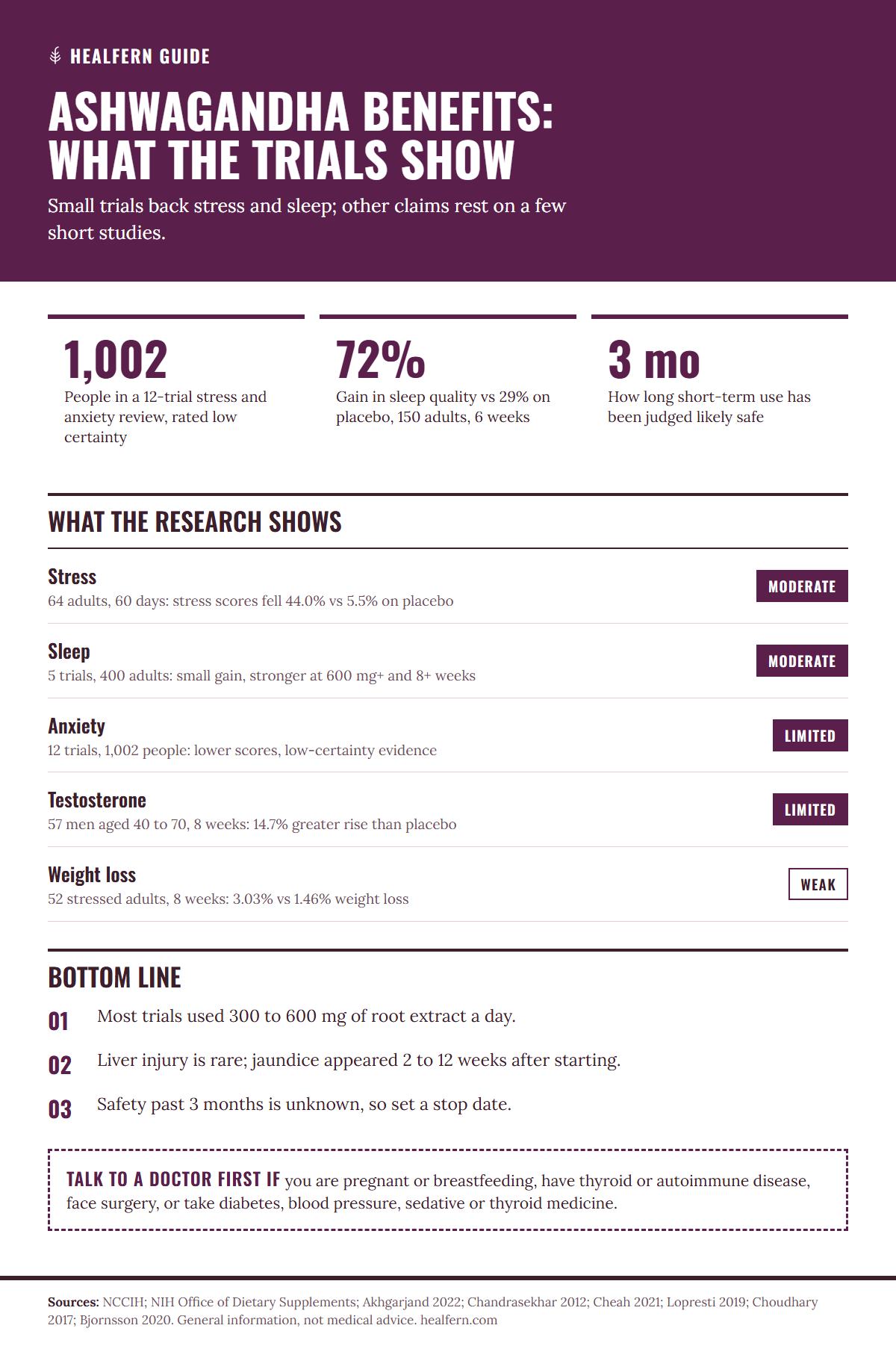
Ashwagandha benefits with the most support are lower stress and better sleep. Most trials used 300 to 600 mg of root extract a day for 6 to 12 weeks, and a review of 12 trials with 1,002 people rated the evidence low certainty. Claims about testosterone, strength and weight rest on small studies. It may be safe for up to 3 months, with rare liver injury.

Ashwagandha benefits are modest and best supported for stress and sleep, while claims about testosterone, strength, weight and sex drive rest on a few short trials. We read the NCCIH and NIH Office of Dietary Supplements pages, three pooled reviews, six clinical trials and a liver injury case series. Our research process explains how we pick and check sources.
The short answer: in a 12-trial review of 1,002 people, ashwagandha extract lowered stress and anxiety scores more than placebo, but the reviewers rated that evidence low certainty, and nobody knows if it is safe past about 3 months.[3][1]
| What it is | An evergreen shrub, Withania somnifera, sometimes called Indian ginseng, though it is not in the ginseng family[2] |
|---|---|
| Promoted for | Stress, anxiety, sleep, male infertility and athletic performance[1] |
| Amounts used in trials | 240 to 1,250 mg a day of extract; benefits looked larger at 500 to 600 mg in several studies[2] |
| Best evidence | Stress and insomnia, from small trials[1][5] |
| Safety | May be safe for up to 3 months; rare cases of liver injury[1] |
| Who should avoid it | Pregnant or breastfeeding people, people with thyroid or autoimmune disorders, anyone facing surgery, and men with hormone-sensitive prostate cancer[1] |
What are the main ashwagandha benefits?
The best-supported ashwagandha benefits are lower perceived stress and better sleep, mostly in adults who started out stressed or sleeping badly. NCCIH says some preparations may be effective for insomnia and stress, while the evidence on anxiety is unclear. Limited evidence links it to higher testosterone and sperm quality.[1]
NCCIH found too little evidence to judge its use for asthma, athletic performance, cognitive function, diabetes, menopause or female infertility.[1] Most trials were small and short, and each used its own branded extract, so a result for one product may not carry over to another.[2]
In the table we grade each use as Moderate (several pooled trials with a small, consistent effect), Limited (some trials, small or low quality) or Weak (one small or pilot trial).
| Use | Who was studied | Result | Grade |
|---|---|---|---|
| Stress | 64 stressed adults, 60 days | Stress scores fell 44.0% vs 5.5% on placebo[4] | Moderate |
| Sleep | 5 trials, 400 adults | Small but significant gain in overall sleep[5] | Moderate |
| Anxiety | 12 trials, 1,002 people | Lower anxiety scores, low-certainty evidence[3] | Limited |
| Testosterone | 57 men aged 40 to 70, 8 weeks | 14.7% greater rise than placebo[6] | Limited |
| Strength | 57 young men lifting weights, 8 weeks | Bench press gain of 46.0 kg vs 26.4 kg[7] | Limited |
| Weight | 52 stressed adults, 8 weeks | Weight fell 3.03% vs 1.46%[10] | Weak |
| Sexual function in women | 50 healthy women, 8 weeks | Higher sexual function scores[9] | Weak |
How does ashwagandha work?
Nobody knows exactly how ashwagandha works in people. It is sold as an adaptogen, a loosely defined term for something said to help the body resist stress. The root contains withanolides, which are thought to drive many of its effects, although lab studies suggest other compounds play a part too.[2]
The name is Sanskrit for smell of a horse, after the odor of the root.[2] Withanolides have been linked with anti-inflammatory and antioxidant effects, mainly in lab work.[1] Root and leaf have different chemistry, and products may use root extract, leaf extract or both.[2]
Some trials measured cortisol, the main stress hormone. In one 60-day trial, blood cortisol fell 27.9% on ashwagandha and 7.9% on placebo.[4] That fits the stress results without proving how the herb acts.
Does ashwagandha reduce stress and cortisol?
In small trials, ashwagandha lowered self-rated stress and, in several of them, blood cortisol. A 2021 review of 7 trials with 491 adults, all in India, found lower stress and anxiety scores after 6 to 8 weeks. Doses ranged from 240 to 1,250 mg a day of extract.[2]
In the most cited trial, 64 adults with chronic stress took 300 mg of root extract twice a day for 60 days. Their stress scores dropped 44.0%, against 5.5% in the placebo group.[4]
Not every trial agrees. In a 12-week trial of 120 overweight adults with low energy, an extract did not lower perceived stress, although it did reduce fatigue.[2] The 2022 review that pooled 12 trials still rated the stress evidence low certainty.[3]
If cortisol is your main worry, our guide on how to lower cortisol with sleep, exercise and daily habits covers steps that need no supplement.
Does ashwagandha help with anxiety?
Ashwagandha may ease anxiety symptoms, but NCCIH calls the evidence unclear. A 2022 review pooled 12 trials with 1,002 people and found lower anxiety scores than with placebo. The reviewers rated the certainty of that finding as low, partly because results varied a lot from trial to trial.[1][3]
In 2022 a taskforce from two psychiatry groups, WFSBP and CANMAT, gave a provisional recommendation of 300 to 600 mg a day of root extract standardized to 5% withanolides for generalized anxiety disorder.[2] The taskforce said it needed more data before it could make that recommendation stronger.[2]
If you are comparing calming supplements, see our review of L-theanine for anxiety. Sudden waves of fear with a racing heart are a separate issue, and this guide explains the difference between an anxiety attack and a panic attack.
Does ashwagandha help with sleep?
Ashwagandha extract had a small but real effect on sleep in pooled trials. A 2021 review of 5 trials with 400 adults found better overall sleep than with placebo. The effect was larger in people with insomnia, at doses of 600 mg a day or more, and when people took it for at least 8 weeks.[5]
In one of those trials, 150 adults with poor sleep took a root and leaf extract for 6 weeks. Sleep quality improved 72% in the ashwagandha group and 29% in the placebo group, and wrist monitors showed they fell asleep faster.[2]
The species name somnifera comes from the Latin for sleep-inducing.[2] Drowsiness is also a listed side effect.[1] The review authors noted that data on serious side effects are limited, so long-term nightly use has not been shown to be safe.[5]
What are ashwagandha benefits for men?
For men, the ashwagandha benefits studied most are testosterone, sperm quality and strength, and the evidence for each is limited. NCCIH says some limited evidence suggests that taking it for 2 to 4 months may raise testosterone and improve sperm quality. It is not a proven treatment for infertility.[1]
In a crossover trial of 57 overweight men aged 40 to 70, 8 weeks of an extract gave a 14.7% greater rise in testosterone than placebo.[6] Fatigue, vigor and sexual well-being did not differ between the groups.[6]
In 57 young men new to weight training, 300 mg twice a day for 8 weeks went with bigger strength gains. Bench press gains averaged 46.0 kg, against 26.4 kg on placebo.[7]
A 2021 review of 13 studies found better physical performance than placebo in healthy men and women. Two of its authors reported ties to supplement companies, and the review called for more comparable studies.[8] Because ashwagandha may raise testosterone, men with hormone-sensitive prostate cancer should avoid it.[1]
What are ashwagandha benefits for women?
Research on ashwagandha benefits for women is thin, beyond the stress and sleep trials that enrolled both sexes and one pilot study on sexual function. NCCIH says there is not enough evidence to judge its use for menopause or female infertility. Pregnant and breastfeeding women should avoid it.[1]
In the pilot study, 50 healthy women took 300 mg of root extract twice a day or a placebo for 8 weeks. The ashwagandha group scored higher on arousal, lubrication, orgasm and satisfaction.[9] A single pilot of 50 people cannot confirm a benefit.
Advice on pregnancy is cautious because some reports suggested a risk of miscarriage, and Denmark banned ashwagandha in 2023.[2] In 2024 the French food safety agency advised pregnant and breastfeeding women and people with endocrine disorders not to use it. The American Herbal Pharmacopoeia says its monograph was misrepresented and that no evidence shows the root causes abortions.[2]
Can ashwagandha help with weight loss?
One small trial found modest weight loss in stressed adults who took ashwagandha, which is too little evidence to call it a weight loss aid. In that trial, 52 adults under chronic stress took 300 mg twice a day for 8 weeks. Body weight fell 3.03%, against 1.46% on placebo.[10]
The main goals of the study were stress and food cravings, and both improved.[10] Serum cortisol in the ashwagandha group fell 22.2% from the starting level by week 8.[10]
On average, the ashwagandha group lost about 2.3 kg on average and the placebo group about 1.1 kg.[10] We found no trial on weight loss in women alone, so claims about ashwagandha for female weight loss have nothing specific behind them.
How much ashwagandha per day?
Most trials used 300 to 600 mg a day of root extract, often split into two doses, for 6 to 12 weeks. No official dose exists. The NIH Office of Dietary Supplements says the many different extracts and doses tested make it hard to name a recommended amount.[2]
| Goal | Dose in the trial | Length | Source |
|---|---|---|---|
| Stress | 300 mg root extract twice a day | 60 days | Chandrasekhar 2012[4] |
| Generalized anxiety | 300 to 600 mg root extract, 5% withanolides | Provisional advice, 2022 | WFSBP and CANMAT[2] |
| Sleep | 600 mg a day or more did better | 8 weeks or longer | Cheah 2021[5] |
| Testosterone | Extract giving 21 mg withanolide glycosides a day | 8 weeks | Lopresti 2019[6] |
| Strength | 300 mg root extract twice a day | 8 weeks | Wankhede 2015[7] |
In several studies, effects looked larger at 500 to 600 mg a day than at lower doses, but no trial shows that more is better as a rule.[2] The liver injury cases involved 450 to 1,350 mg a day.[2]
Trials used standardized extracts, so a spoon of powder is not the same as a trial dose. One trial used 12,000 mg a day of root granules, equal to 6,000 mg of root powder.[2] No trial we found compared morning and evening doses; studies gave it once or twice a day.[4][6]
What are the side effects of ashwagandha, and who should avoid it?
Ashwagandha seems well tolerated for up to about 3 months, but its long-term safety is unknown. Reported side effects include drowsiness, stomach upset, loose stools, nausea, diarrhea and vomiting. Rare cases of liver injury have been reported, and it may change thyroid hormone levels.[1][2]
In the clinical trials, side effects were usually mild. Evidence on use over many months or years is lacking, and ashwagandha may also interact with several common medicines.[2]
Liver injury
A 2020 case series from Iceland and the US described 5 people who developed jaundice 2 to 12 weeks after they started ashwagandha.[12] None developed liver failure, and liver tests returned to normal within 1 to 5 months in 4 of them.[12] Lab tests of the products found ashwagandha and no other toxic compounds.[12]
Stop taking it and call a doctor if you notice yellow skin or eyes, itching, nausea, unusual tiredness or belly discomfort. Those were the symptoms in the case series.[12] In other reports, the product contents were not always checked, and some were blends with other herbs.[2]
Thyroid
In a trial of 50 adults with subclinical hypothyroidism, 600 mg a day for 8 weeks changed TSH, T3 and T4 levels compared with placebo.[11] Only one person on ashwagandha reported mild, short-lived side effects in that trial.[11] Three case reports describe thyrotoxicosis, an overactive thyroid state, in women taking ashwagandha.[2] Stopping the herb resolved the symptoms in all three, and the findings suggest it might interact with thyroid hormone medicine.[2]
Who should avoid it
NCCIH and the NIH Office of Dietary Supplements name these groups.[1][2] In 2024 the French food safety agency also advised people with endocrine disorders not to use it.[2]
- People who are pregnant or breastfeeding.[1]
- People with thyroid or autoimmune disorders, or anyone about to have surgery.[1]
- Men with hormone-sensitive prostate cancer.[1]
- People with liver disease, since some liver injury cases involved existing liver disease.[2]
- Anyone taking medicines for diabetes, blood pressure or seizures, immunosuppressants, sedatives or thyroid hormone, unless a doctor agrees.[1]
What do doctors use first for stress, anxiety and insomnia?
For anxiety disorders and long-term insomnia, doctors start with proven treatments, and ashwagandha is not one of them. Generalized anxiety disorder is usually treated with psychotherapy, medicine or both. For chronic insomnia, cognitive behavioral therapy for insomnia, or CBT-I, is usually the first option.[13][14]
NIMH calls cognitive behavioral therapy the gold standard psychotherapy for generalized anxiety disorder. SSRI and SNRI medicines may take several weeks to start working.[13] CBT-I is a 6- to 8-week plan that a doctor, nurse or therapist can deliver in person, by phone or online.[14]
Never stop a prescribed medicine to try a supplement. Dietary supplements are not approved by the FDA before they are sold.[1] You can find more on these conditions in our mental health guides.
Ashwagandha checklist before you buy
Before you buy ashwagandha, check the label, your medicines and your health history. Supplements are not approved by the FDA before they are sold, and the extracts in the trials differ from one another. These steps follow the cautions from NCCIH and the NIH Office of Dietary Supplements.[1][2]
- Ask your doctor or pharmacist first if you take any regular medicine.[1]
- Pick a product that names the plant part (root, leaf or both) and the extract amount in mg.[2]
- Look for the withanolide percentage; the anxiety taskforce dose was standardized to 5%.[2]
- Most trials stayed within 300 to 600 mg a day of extract, so treat larger amounts with caution.[2]
- Set a stop date at 3 months, the limit of the short-term safety data.[1]
- Skip it if you are pregnant, breastfeeding or have a thyroid or autoimmune disorder.[1]
- Stop at once if yellow skin or eyes, itching or nausea appear.[12]
Bottom line
Ashwagandha benefits for stress and sleep have support from several small trials, mostly run in India, and the effects were modest in size. Claims about testosterone, strength, weight and sex drive each rest on one or two short studies, often of branded extracts.[1][2]
For most people with long-term sleep trouble, CBT-I is the better first step, because it is the usual first treatment for chronic insomnia and carries no liver or thyroid risk.[14][12] If you want to try ashwagandha for stress, clear it with a doctor, choose a labeled root extract and stop after 3 months.[1]
Questions people also ask
Can ashwagandha be taken daily?
In trials, people took it every day for 6 to 12 weeks, and it seemed well tolerated for up to about 3 months. Long-term daily use has not been studied enough to call it safe, so ask a doctor before going past 3 months.
When should you take ashwagandha, morning or night?
No trial we found compared morning and evening doses. Studies gave it once or twice a day. Drowsiness is a known side effect, so an evening dose may suit you if it makes you sleepy, though that has not been tested.
Does ashwagandha make you sleepy?
It can. NCCIH lists drowsiness as a possible side effect, and sleep trials found people fell asleep faster on it. It may interact with sedatives, so do not combine it with sleep medicines unless your doctor agrees.
Is ashwagandha a drug?
No. In the US it is usually sold as a dietary supplement. Supplements are not approved by the FDA before they are sold, and the rules for making them are less strict than for drugs, so products can vary.
How long does ashwagandha take to work?
No study has pinned down an onset time. Most trials measured results after 6 to 8 weeks, and the sleep review found larger effects after at least 8 weeks. One stress trial reported changes after 30 days.
Sources
- Ashwagandha: Usefulness and Safety, NCCIH, National Institutes of Health
- Ashwagandha: Fact Sheet for Health Professionals, NIH Office of Dietary Supplements, 2025
- Does Ashwagandha supplementation have a beneficial effect on the management of anxiety and stress? A systematic review and meta-analysis of randomized controlled trials, Akhgarjand C et al., Phytotherapy Research, 2022
- A prospective, randomized double-blind, placebo-controlled study of safety and efficacy of a high-concentration full-spectrum extract of ashwagandha root in reducing stress and anxiety in adults, Chandrasekhar K et al., Indian Journal of Psychological Medicine, 2012
- Effect of Ashwagandha (Withania somnifera) extract on sleep: A systematic review and meta-analysis, Cheah KL et al., PLoS One, 2021
- A Randomized, Double-Blind, Placebo-Controlled, Crossover Study Examining the Hormonal and Vitality Effects of Ashwagandha in Aging, Overweight Males, Lopresti AL et al., American Journal of Men's Health, 2019
- Examining the effect of Withania somnifera supplementation on muscle strength and recovery: a randomized controlled trial, Wankhede S et al., Journal of the International Society of Sports Nutrition, 2015
- Effects of Ashwagandha (Withania somnifera) on Physical Performance: Systematic Review and Bayesian Meta-Analysis, Bonilla DA et al., Journal of Functional Morphology and Kinesiology, 2021
- Efficacy and Safety of Ashwagandha (Withania somnifera) Root Extract in Improving Sexual Function in Women: A Pilot Study, Dongre S et al., BioMed Research International, 2015
- Body Weight Management in Adults Under Chronic Stress Through Treatment With Ashwagandha Root Extract: A Double-Blind, Randomized, Placebo-Controlled Trial, Choudhary D et al., Journal of Evidence-Based Complementary and Alternative Medicine, 2017
- Efficacy and Safety of Ashwagandha Root Extract in Subclinical Hypothyroid Patients: A Double-Blind, Randomized Placebo-Controlled Trial, Sharma AK et al., Journal of Alternative and Complementary Medicine, 2018
- Ashwagandha-induced liver injury: A case series from Iceland and the US Drug-Induced Liver Injury Network, Bjornsson HK et al., Liver International, 2020
- Generalized Anxiety Disorder: When Worry Gets Out of Control, National Institute of Mental Health
- Insomnia: Treatment, NHLBI, National Institutes of Health
This article is general information, not medical advice. These statements have not been evaluated by the FDA, and supplements are not intended to diagnose, treat, cure or prevent any disease. Talk to your doctor or pharmacist before you start a supplement. How we research.