
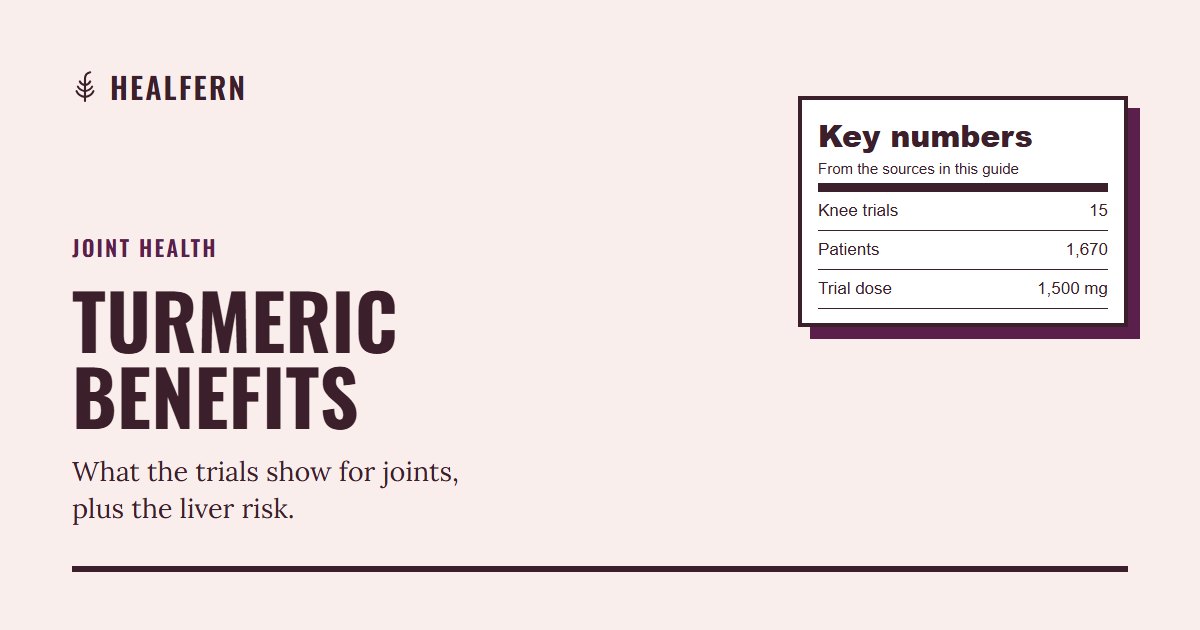
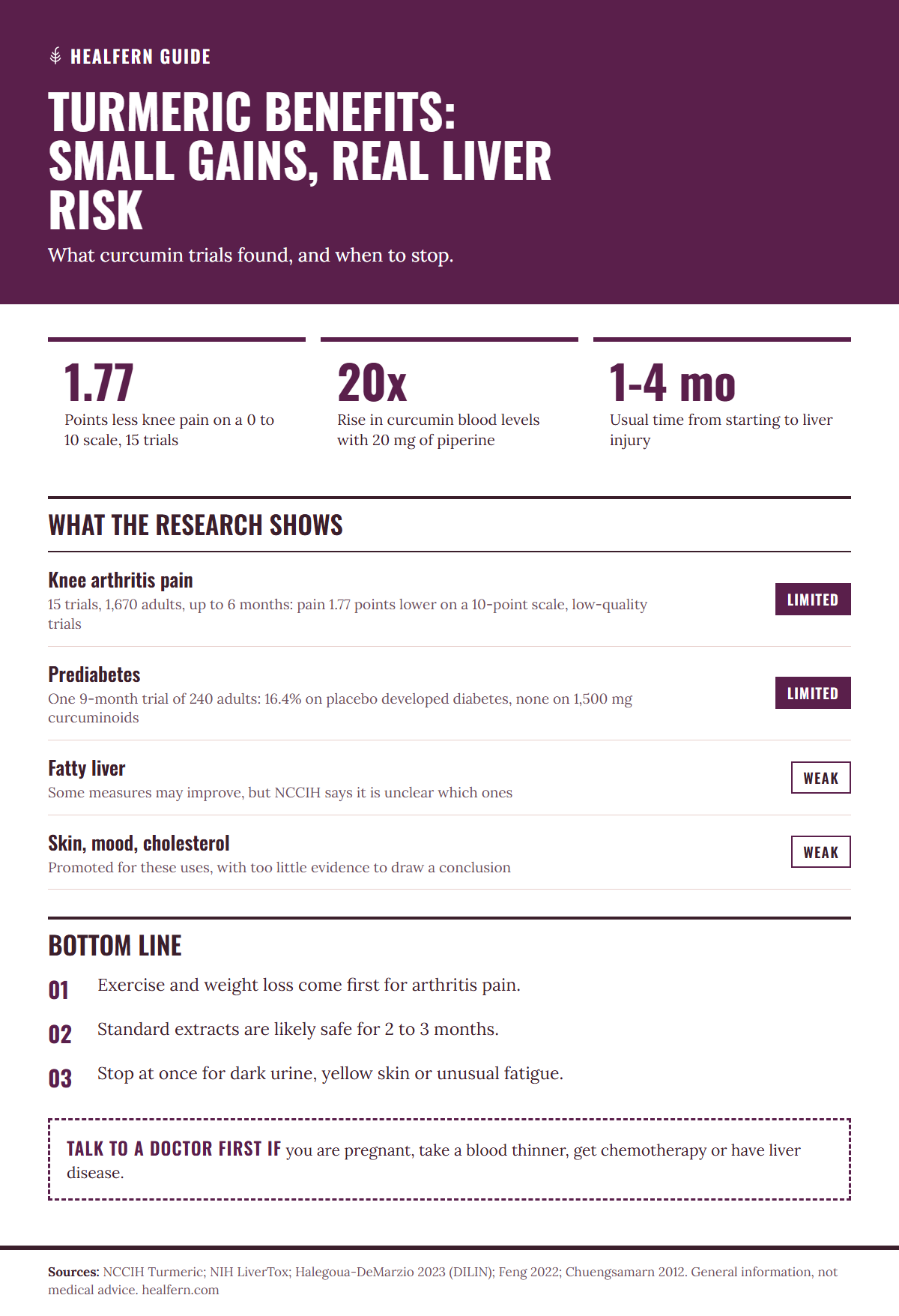
Turmeric's best-studied benefit is modest relief of knee arthritis pain. In 15 trials with 1,670 people, curcumin lowered pain by about 1.77 points on a 10-point scale over up to 6 months, but the trials were low in quality. Evidence for fatty liver, blood sugar and skin is thin, and high-absorption products with black pepper are linked to rare liver injury.
Turmeric benefits are real enough to study but smaller and less certain than most labels suggest. We read the NCCIH turmeric page, the NIH LiverTox entry, a US liver injury case series, two arthritis reviews, a head-to-head trial against ibuprofen and a prediabetes trial. Our research and fact-checking process explains how we choose sources.
The short answer: curcumin, the main compound in turmeric, lowered knee arthritis pain by about 1.8 points on a 10-point scale in pooled short trials, but strong, better-absorbed products have been linked to rare liver injury.[4][2]
| What it is | The root of a plant in the ginger family; curcumin gives it its yellow color[1] |
|---|---|
| Most studied for | Knee osteoarthritis, fatty liver and mouth sores from cancer treatment[1] |
| Typical amounts | Labels range from about 100 to more than 1,000 mg a day; trials used 120 to 1,500 mg[2][5] |
| Best evidence | 15 trials in 1,670 people with knee arthritis showed less pain over up to 6 months[4] |
| Main safety concern | Rare liver injury, mostly with high-absorption products, usually 1 to 4 months after starting[2][3] |
| Who should avoid | Pregnant women, and people on blood thinners unless a doctor agrees[1][10] |
| Product quality | About 1 in 5 tested turmeric products was adulterated[11] |
What are the main turmeric benefits?
The best-supported turmeric benefits are modest pain relief for knee osteoarthritis and possible changes in some fatty liver measures.[1] Even so, NCCIH says there is not enough evidence to say for certain that turmeric or curcumin helps any health condition, though early arthritis results look positive.[1]
Most research tests curcumin extracts in capsules, not the spice in food. Curcumin and related curcuminoids are thought to drive turmeric’s effects, and products vary widely in how much they contain.[1] Many also add piperine from black pepper to raise absorption.[1]
Here is how NCCIH sums up the main uses people take it for:
- Knee osteoarthritis: early evidence is positive, but better studies are needed.[1]
- Nonalcoholic fatty liver disease: some measures may improve, but it is unclear which ones.[1]
- Mouth sores from cancer treatment: early studies suggest a capsule or mouthwash might ease symptoms.[1]
- Depression, allergies, itching and high cholesterol: promoted for these, with too little evidence to draw a conclusion.[1]
Does turmeric help joint pain and inflammation?
Curcumin lowered knee arthritis pain more than a placebo in pooled trials, by about 1.77 points on a 0 to 10 pain scale.[4] That 2022 review covered 15 trials and 1,670 patients followed for no longer than 6 months, and its authors rated the studies as low in quality.[4]
A second 2022 review pooled 29 trials with 2,396 people across five types of arthritis, including rheumatoid arthritis and gout. Doses ran from 120 to 1,500 mg a day for 4 to 36 weeks. Pain and inflammation improved, but the authors warned that the trials were small and low in quality.[5]
The best-known head-to-head trial, from Thailand in 2014, gave 367 people with knee arthritis either 1,500 mg of turmeric extract or 1,200 mg of ibuprofen a day for 4 weeks. Both groups improved by similar amounts, and the ibuprofen group reported more stomach pain.[6] One short trial cannot show the two are equal over months or years.
In the 2022 knee review, the pain effect dropped below a level patients would notice in trials run outside Asia and in trials of plain extracts.[4] If you are still working out what is behind your knee pain, our guide to symptoms of arthritis in knees explains what to watch for.
Key turmeric studies at a glance
| Study | Who and how long | Daily dose | Result |
|---|---|---|---|
| Feng and colleagues, 2022 review[4] | 15 trials, 1,670 adults with knee arthritis, up to 6 months | Curcuminoids alone, various amounts | Pain 1.77 points lower than placebo; side effects similar to placebo; low-quality trials |
| Zeng and colleagues, 2022 review[5] | 29 trials, 2,396 people, 5 types of arthritis, 4 to 36 weeks | 120 to 1,500 mg | Less pain and inflammation; small, low-quality trials |
| Kuptniratsaikul and colleagues, 2014[6] | 367 adults with knee arthritis, 4 weeks | 1,500 mg extract or 1,200 mg ibuprofen | Similar improvement; fewer stomach complaints on turmeric |
| Chuengsamarn and colleagues, 2012[7] | 240 adults with prediabetes, 9 months | 1,500 mg curcuminoids | 16.4% on placebo developed type 2 diabetes, none on curcumin |
| US liver injury network, 2023[3] | 10 people with liver injury, enrolled 2011 to 2022 | Various products | 5 hospitalized, 1 death; 7 carried the HLA-B*35:01 gene variant |
Is turmeric good for fatty liver, blood sugar or skin?
Early research hints that curcumin might improve some fatty liver measures, but NCCIH says it is unclear which ones improve consistently.[1] The blood sugar evidence rests mostly on a single trial, and we found no strong human trials on turmeric for skin.[1][7]
In the 2012 Thai trial, 240 adults with prediabetes took 1,500 mg of curcuminoids or a placebo for 9 months. By the end, 16.4% of the placebo group had type 2 diabetes and no one in the curcumin group did.[7] It is a striking result, though it comes from a single study in Thailand.
People search for turmeric to help the liver, yet strong curcumin products are also a known cause of liver injury.[1][2] Anyone with liver disease should talk with a doctor before trying it.
For skin, many searches ask about dark spots, acne and tanning. NCCIH lists no proven skin benefit and notes that curcumin applied to the skin can cause hives or itching.[1]
Why do supplements pair turmeric with black pepper?
Piperine, a compound in black pepper, helps the body absorb curcumin, which on its own is poorly absorbed.[1][2] The authors of the US liver injury series note that only 20 mg of piperine taken with turmeric is reported to raise blood levels about 20-fold.[3]
LiverTox explains that poor absorption was one reason curcumin was long thought safe for the liver. High-absorption forms made with piperine or nanoparticles were later linked to liver injury cases.[2]
In the US case series, 3 of the 7 products tested contained piperine.[3] A 2025 case report described a 40-year-old woman who developed liver injury after drinking turmeric and black pepper wellness shots.[9] NCCIH also warns that highly bioavailable curcumin formulations may harm the liver.[1]
Turmeric has a long record of safe use as a cooking spice, and the reported cases involve dietary supplements.[2][3]
How much turmeric per day is safe?
No official safe daily dose is set for turmeric supplements, and labels range from about 100 to more than 1,000 mg a day.[2] NCCIH says standard turmeric or curcumin, not modified for absorption, is likely safe in recommended amounts for up to 2 or 3 months.[1]
Clinical trials mostly used 120 to 1,500 mg a day.[5] The 2022 knee review found no clear sign that 1,000 mg or more worked better than smaller amounts, so a bigger dose is not a better bet.[4] NCCIH frames its breastfeeding caution around amounts larger than those found in food.[1]
Labels can be confusing. Some list grams of plain turmeric root powder, while others list a standardized extract or a set amount of curcuminoids per capsule. The trial doses in this article refer to extracts and curcuminoids, such as the 250 mg curcuminoid capsules taken six a day in the prediabetes trial.[6][7]
Should you try a turmeric supplement? A decision guide
| If you | Then |
|---|---|
| Have knee arthritis pain and no liver or bleeding problems | A standard extract for 2 to 3 months is a reasonable trial with your doctor’s okay[1][4] |
| Take warfarin or another blood thinner | Ask your doctor first, since turmeric may raise bleeding risk[10] |
| Are pregnant | Skip supplements, which NCCIH says may be unsafe in pregnancy[1] |
| Are breastfeeding | Stick to food amounts, since little is known about larger doses[1] |
| Have liver disease or a past liver reaction to a supplement | Avoid high-absorption products and talk with your doctor[1][2] |
| Are getting chemotherapy | Tell your cancer team; in lab tests turmeric blocked some chemotherapy drugs[10] |
| Have a family history of kidney stones | Talk with your doctor before taking supplements[10] |
Can turmeric damage your liver?
Yes, in rare cases: turmeric supplements are a recognized cause of drug-induced liver injury, which usually appears 1 to 4 months after starting.[2] LiverTox rates turmeric as a likely cause of clinically apparent liver injury, and most people recover within 1 to 3 months of stopping.[2]
The US Drug-Induced Liver Injury Network found 10 turmeric cases, all enrolled since 2011 and 6 of them since 2017. Five people were hospitalized and one died of acute liver failure.[3] Seven of the 10 carried a gene variant called HLA-B*35:01, which points to an immune reaction rather than a simple overdose.[2][3] Eight of the 10 patients were women, and the median age was 56.[3]
Blood tests at onset often show very high liver enzyme levels, and the illness can look like autoimmune hepatitis.[2] A severe outcome is more likely when people keep taking turmeric after symptoms start.[2]
Liver injury from turmeric is rare, but many people take it. A 2024 national survey estimated that 15.6 million US adults had used at least one of six botanicals tied to liver injury in the past 30 days, and turmeric was the one used most.[8]
Other side effects and who should avoid it
Most complaints are mild: nausea, vomiting, acid reflux, stomach upset, diarrhea or constipation.[1] Memorial Sloan Kettering lists warfarin and other blood thinners, some chemotherapy drugs and a family history of kidney stones as reasons to check with a doctor first.[10] Turmeric supplements may be unsafe in pregnancy.[1]
Stop turmeric and call your doctor right away if you notice:
- Unusual tiredness[1]
- Nausea or poor appetite[2]
- Dark urine[1]
- Yellow skin or eyes, called jaundice[1]
Do not restart the same product after a liver reaction. LiverTox warns that the injury can come back and be more severe.[2]
What do doctors use first for joint pain?
For osteoarthritis, treatment usually begins with exercise, weight loss if needed, and braces or shoe inserts, not supplements.[13] The 2019 American College of Rheumatology guideline strongly recommends exercise, weight loss for knee or hip arthritis in people with overweight, tai chi, canes and NSAID pain relievers.[12]
The guideline says topical NSAIDs should be considered before pills for knee arthritis, because they expose the body to less drug.[12] Steroid shots into the knee are another strongly recommended option.[12] Turmeric does not replace any of these. If you add a supplement, tell your doctor, because turmeric can interact with blood thinners and pain relievers that some people with arthritis take.[10]
To compare turmeric with other options people try, see our review of the best supplements for joint pain. For another plant compound sold for similar reasons, read our guide to quercetin benefits. You can find more in our joint health articles.
What should you check before buying turmeric?
Check the form of curcumin, the amount per serving and whether the product adds black pepper or another absorption booster.[1][2] Quality matters too: a 2026 review of 2,235 commercial turmeric samples found that 20.0% were adulterated, including 22.0% of supplements.[11]
- Look for the amount of curcuminoids per serving, not just the weight of turmeric root.[1]
- Note any piperine, black pepper extract, nanoparticle or enhanced-absorption claim, since these forms are tied to the liver cases.[2][3]
- Compare the daily amount with the trial range of 120 to 1,500 mg.[5]
- Prefer brands that publish independent testing, since adulterants found in turmeric include artificial dyes, undeclared fillers and synthetic curcumin.[11]
- Tell your doctor and pharmacist, especially if you take a blood thinner.[10]
- Set a check-in after 2 to 3 months, the period NCCIH describes as likely safe for standard forms.[1]
Bottom line
Turmeric benefits look modest and short term. The best evidence is for knee arthritis pain, where pooled trials found a small drop in pain over a few weeks to months, in studies the reviewers rated as low in quality.[4][5] Claims for skin, mood, weight loss and cholesterol have little support so far.[1]
For most people with joint pain, exercise and weight loss are the better first step, because they have strong guideline backing and no liver risk.[12] If you still want to try turmeric, a standard extract for 2 to 3 months is a more cautious choice than a high-absorption formula, and any sign of liver trouble means stopping at once.[1][2]
Questions people also ask
How long does turmeric take to work for joint pain?
In the 2014 knee trial, pain and function scores had improved by week 2 and again by week 4 on 1,500 mg of extract a day. Most trials ran 4 to 36 weeks, so give a standard product a few weeks, not days.
Can turmeric cause jaundice?
Yes, rarely. Turmeric supplements can cause liver injury, and jaundice, meaning yellow skin or eyes, is one sign. It often follows fatigue, nausea, poor appetite and dark urine. Stop the product and see a doctor promptly if any of these appear.
Is turmeric bad for your kidneys?
Memorial Sloan Kettering advises talking with your doctor before taking turmeric supplements if you have a family history of kidney stones. It also notes a kidney injury case linked to long-term use in a 69-year-old man that stabilized after stopping.
Does turmeric help with weight loss?
We found no strong trials showing that turmeric helps with weight loss, and NCCIH does not list weight loss among its studied uses. Exercise and diet changes have far better support, especially for knee and hip arthritis.
Can turmeric upset your stomach?
Yes. NCCIH lists nausea, vomiting, acid reflux, stomach upset, diarrhea and constipation as possible side effects of turmeric taken by mouth. In the 2014 trial, stomach pain was less common with turmeric extract than with ibuprofen.
Sources
- Turmeric: Usefulness and Safety, NCCIH, National Institutes of Health
- Turmeric (LiverTox: Clinical and Research Information on Drug-Induced Liver Injury), NIDDK and National Library of Medicine, 2024
- Liver Injury Associated with Turmeric, a Growing Problem: Ten Cases from the Drug-Induced Liver Injury Network, Halegoua-DeMarzio D et al., American Journal of Medicine, 2023
- Efficacy and safety of curcuminoids alone in alleviating pain and dysfunction for knee osteoarthritis: a systematic review and meta-analysis, Feng J et al., BMC Complementary Medicine and Therapies, 2022
- Efficacy and Safety of Curcumin and Curcuma longa Extract in the Treatment of Arthritis: A Systematic Review and Meta-Analysis, Zeng L et al., Frontiers in Immunology, 2022
- Efficacy and safety of Curcuma domestica extracts compared with ibuprofen in patients with knee osteoarthritis, Kuptniratsaikul V et al., Clinical Interventions in Aging, 2014
- Curcumin extract for prevention of type 2 diabetes, Chuengsamarn S et al., Diabetes Care, 2012
- Estimated Exposure to 6 Potentially Hepatotoxic Botanicals in US Adults, Likhitsup A et al., JAMA Network Open, 2024
- Drug-Induced Liver Injury Associated with Turmeric and Piperine: A Case and Review, Shrestha A et al., Case Reports in Gastroenterology, 2025
- Turmeric (About Herbs), Memorial Sloan Kettering Cancer Center
- A scoping review of turmeric adulteration based on data from six continents, Gafner S et al., Pharmaceutical Biology, 2026
- 2019 American College of Rheumatology/Arthritis Foundation Guideline for the Management of Osteoarthritis of the Hand, Hip, and Knee, Kolasinski SL et al., Arthritis and Rheumatology, 2020
- Osteoarthritis, MedlinePlus, National Library of Medicine
This article is general information, not medical advice. These statements have not been evaluated by the FDA, and supplements are not intended to diagnose, treat, cure or prevent any disease. Talk to your doctor or pharmacist before you start a supplement. How we research.