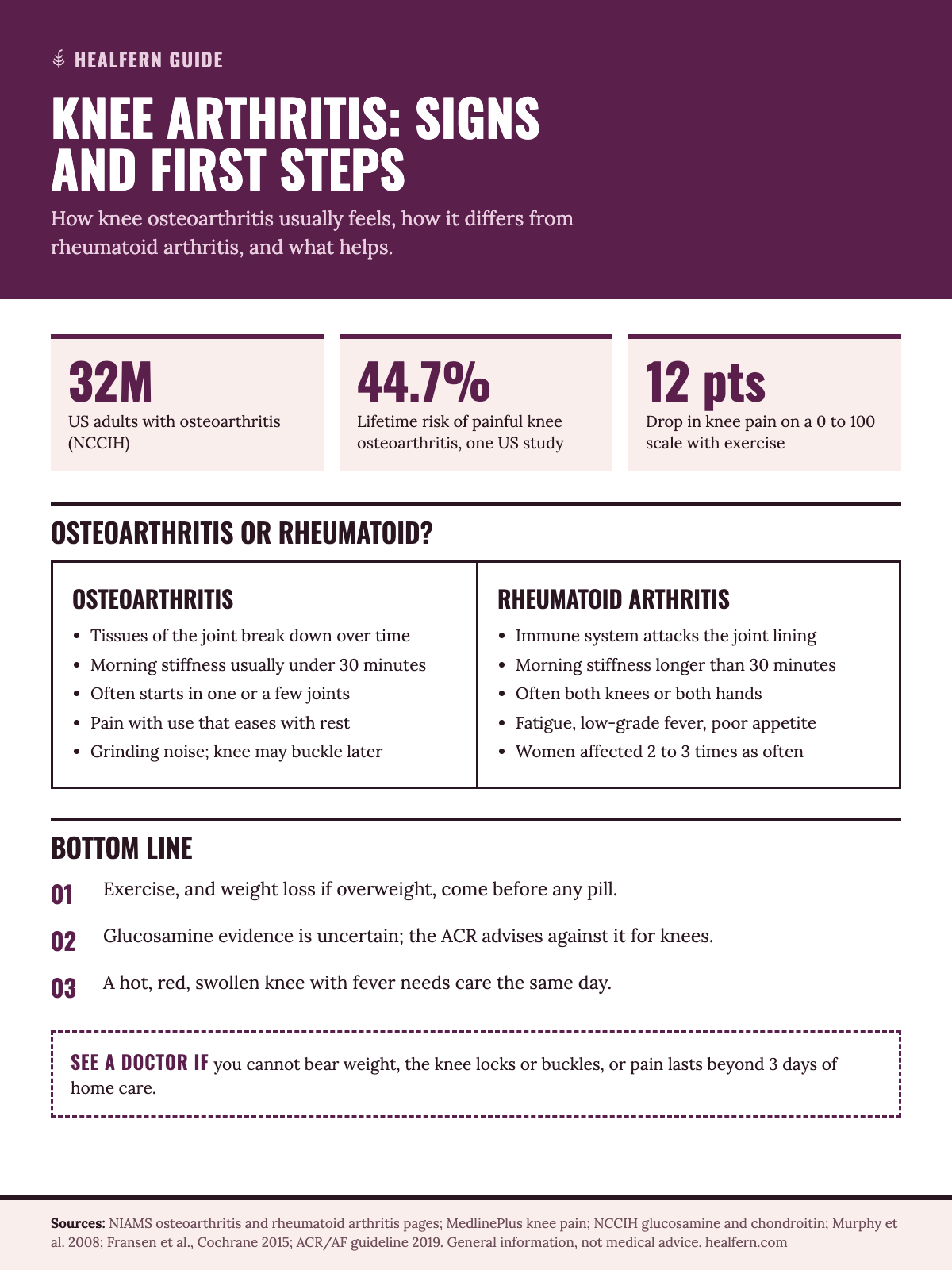
The usual first signs of knee arthritis are pain when you use the knee that eases with rest, stiffness after waking or sitting that fades within 30 minutes, a grinding feeling, and swelling after activity. Buckling and night pain come later. Stiffness lasting longer, both knees at once, or a hot red joint with fever point to another cause. Exercise and weight loss help most.

We read the NIAMS pages on osteoarthritis and rheumatoid arthritis, the MedlinePlus entries on osteoarthritis, knee pain and septic arthritis, the 2019 American College of Rheumatology and Arthritis Foundation guideline, the Cochrane review of exercise for knee osteoarthritis, the IDEA weight-loss trial, a lifetime-risk study of 3,068 adults, the Global Burden of Disease estimate, and NCCIH’s pages on supplements for osteoarthritis.
The short answer: knee arthritis usually starts as pain when you use the knee, brief stiffness after rest (often under 30 minutes), and a grinding feeling, with swelling and buckling coming later. Exercise and weight loss help most people more than any pill.
| Most common type | Osteoarthritis, a disease in which the tissues of the joint break down over time. It is the most common kind of arthritis.[1] |
|---|---|
| Early symptoms | Pain with use that eases with rest, stiffness lasting under 30 minutes after waking or sitting, and swelling after heavy use.[1] |
| Knee-specific signs | A grinding or scraping noise when you walk, and over time a knee that can buckle.[1] |
| How common | More than 32 million US adults have osteoarthritis.[6] In one North Carolina study, lifetime risk of painful knee osteoarthritis was 44.7%.[7] |
| Best-supported first steps | Exercise, weight loss if overweight, self-management programs, tai chi and a cane, all strongly recommended by the ACR guideline.[9] |
| Supplements | Still uncertain whether glucosamine or chondroitin help in a meaningful way. The ACR guideline advises against them for the knee.[6] |
| Get help fast if | The knee is hot, red and swollen with a fever, or you cannot bear weight on it.[12][13] |
What are the first symptoms of arthritis in the knee?
The first sign is usually pain when you use the knee, such as on stairs or a long walk, that improves when you rest. Many people also notice stiffness when they first get up in the morning or stand after sitting, which usually loosens within 30 minutes.[1]
NIAMS says osteoarthritis symptoms “often begin slowly” and usually start in one or a few joints.[1] That slow start is why people often put early knee arthritis down to a hard workout or a bad week.
Other early signs NIAMS lists:[1]
- Swelling in and around the knee, especially after a lot of activity.
- Changes in how far you can bend or straighten the knee.
- A feeling that the joint is loose or unstable.
MedlinePlus adds that the pain is often worse after exercise and when you put weight or pressure on the joint.[3] You may also notice a rubbing, grating or crackling sound when you move it, which doctors call crepitation.[3]
Some people have none of this. MedlinePlus notes that x-rays or an exam can show the changes of osteoarthritis in people who feel no symptoms at all.[3] The reverse can be true as well: NIAMS says early joint damage usually does not show up on x-rays.[2]
Each symptom gives a clue. Short stiffness that eases within 30 minutes points toward osteoarthritis. Stiffness lasting longer than 30 minutes suggests inflammation. Grinding is common in osteoarthritis. A hot, red knee with fever points to a different problem altogether.[1][3][5]
Stiffness
Osteoarthritis stiffness usually lasts less than 30 minutes in the morning or after rest.[1] MedlinePlus says it can last longer when the joint is inflamed, and it often improves once the joint warms up with activity.[3] Rheumatoid arthritis, by contrast, typically causes stiffness lasting longer than 30 minutes after waking.[4]
Grinding and clicking
NIAMS describes a grinding or scraping noise when walking or moving as a knee-specific sign of osteoarthritis.[1] On its own, noise without pain is not a reason for alarm. A knee that clicks and also locks or buckles is a different matter, and MedlinePlus lists that as a reason to contact your provider.[12]
Swelling, warmth and redness
Mild swelling after a lot of activity fits osteoarthritis.[1] NCCIH says that if you feel hot, your skin turns red, or joint pain comes with a rash or fever, “you probably have a different problem.”[5] That could mean gout, rheumatoid arthritis or an infected joint.
How do knee arthritis symptoms change over time?
Knee arthritis usually worsens slowly over years. Early on, pain comes with activity and fades with rest. Later, the knee may ache even at rest, wake you at night, swell more often and buckle as the muscles and ligaments around it weaken.[1][3]
The pace varies a lot. NIAMS says joint damage usually develops gradually over years, although it can worsen quickly in some people. For some, osteoarthritis stays mild and never affects daily life; for others it causes real pain and disability.[1]
Early stage
Pain with use, short morning stiffness and occasional swelling after a busy day. MedlinePlus says pain tends to get worse when you are active and feel better when you rest.[3]
Later stage
As damage spreads to cartilage, ligaments, the joint lining and the meniscus, pain, swelling and loss of motion build. Less activity leads to weaker muscles, which puts more stress on the joint. Bone spurs can form at the edges, and bits of bone or cartilage can break off and float in the joint.[1]
Simple tasks get harder. NIAMS lists stepping up, getting on or off the toilet, getting in and out of a chair, and walking across a parking lot.[1] In later stages pain may be worse at night, and MedlinePlus says it can wake you up.[1][3]
Effects beyond the knee
Ongoing pain can leave you tired, sleeping badly and feeling depressed, according to NIAMS.[1] These are worth raising with a doctor, because they are part of the condition and can be addressed.
What causes arthritis in the knees?
Osteoarthritis happens when cartilage and other tissues inside the joint break down or change structure. NIAMS is clear that this “does not happen because of simple wear and tear.” Changes in the tissue trigger the breakdown, and age, weight, injury, overuse and family history all raise the odds.[1]
Researchers still do not know what starts the breakdown.[1] Once it begins, it can affect every part of the knee: the cartilage that covers the bone ends, the tendons and ligaments, the synovium (the joint lining), the bone and the meniscus.[1]
Older explanations described osteoarthritis as cartilage simply grinding away. MedlinePlus still uses that wording, describing cartilage that breaks down so that bone fragments rub together and cause pain, swelling and stiffness.[3] The newer NIAMS view sees it as a disease of the whole joint, which helps explain why strengthening the muscles around the knee makes such a difference.
Other forms of arthritis also hit the knee. Rheumatoid arthritis is an autoimmune disease in which the immune system attacks the joint lining.[4] Gout comes from urate crystals and can flare in the knee; our guide to foods to avoid with gout covers that in detail. MedlinePlus also lists lupus, pseudogout and bleeding disorders such as hemophilia as conditions that can damage the joint or mimic osteoarthritis.[3][12]
Who is most likely to get knee arthritis?
Age, extra body weight and a past knee injury are the biggest risk factors. In a study of 3,068 adults aged 45 and older, lifetime risk of painful knee osteoarthritis was 44.7%, rising to 56.8% after a knee injury and to about 2 in 3 among people with obesity.[7]
That study, from the Johnston County Osteoarthritis Project in rural North Carolina, estimated the risk of developing symptoms by age 85.[7] It describes one region, so treat the exact figure as a guide rather than a national number.
Other risk factors from NIAMS and MedlinePlus:
- Sex. Women are more likely than men to develop osteoarthritis, especially after age 50.[1] MedlinePlus says it occurs equally before age 55 and is more common in women after that.[3]
- Age. MedlinePlus says almost everyone has some symptoms of osteoarthritis by age 70.[3]
- Work. Jobs that involve kneeling or squatting for more than an hour a day, or lifting, climbing stairs and walking, raise the risk.[3]
- Sports. Direct impact (football), twisting (basketball, soccer) or throwing raise the risk.[3]
- Family history and joints that did not form correctly.[1]
Worldwide, the Global Burden of Disease study counted 595 million people with osteoarthritis in 2020, about 7.6% of the world’s population. The knee was the most common site, and knee cases are projected to rise 74.9% by 2050. High body mass index accounted for 20.4% of the osteoarthritis burden.[11]
Is it osteoarthritis or rheumatoid arthritis?
Osteoarthritis usually affects one or a few joints, causes short stiffness and gets worse with use. Rheumatoid arthritis tends to hit both knees or both hands at once, causes morning stiffness lasting more than 30 minutes, and often brings fatigue and low-grade fever.[1][4]
| Feature | Osteoarthritis | Rheumatoid arthritis |
|---|---|---|
| What it is | Breakdown of joint tissues over time[1] | Autoimmune attack on the joint lining[4] |
| Morning stiffness | Usually under 30 minutes[1] | Longer than 30 minutes[4] |
| Pattern | Often starts in one or a few joints[1] | Often symmetrical, both sides[4] |
| Whole-body signs | Tiredness and poor sleep from pain[1] | Fatigue, occasional fever, poor appetite[4] |
| Who gets it | More common with age, women after 50[1] | Women 2 to 3 times as often as men[4] |
The difference matters because rheumatoid arthritis needs early medicine from a specialist to control the immune response. NIAMS says the goal of treatment is remission or near remission.[4] Rheumatoid arthritis can also affect the heart, lungs, eyes and skin, which osteoarthritis does not.[4]
What else can cause knee pain that feels like arthritis?
Plenty of knee pain is not arthritis. MedlinePlus lists bursitis, tendinitis, a torn meniscus, ligament injuries, kneecap pain, iliotibial band syndrome, a Baker cyst and, rarely, infection or bone tumors. A recent injury, sudden swelling or locking points away from slowly building osteoarthritis.[12]
Some clues help sort them out:
- Bursitis often follows long periods of kneeling or repeated pressure on the knee.[12]
- A torn meniscus tends to cause pain on the inside or outside of the joint.[12]
- An ACL or MCL tear can cause bleeding into the knee, swelling and an unstable joint.[12]
- Patellofemoral syndrome causes pain at the front of the knee around the kneecap.[12]
- A Baker cyst is a fluid-filled swelling behind the knee that can come with arthritis.[12]
Hip arthritis can fool you, too. NIAMS notes that pain from hip osteoarthritis can spread to the knees.[1] If your knee exam looks normal but the pain persists, a doctor may check the hip.
Septic arthritis is the one not to miss. It is an infection inside the joint, and the knee and hip are the joints most often affected. Symptoms usually come on quickly, with fever, swelling usually in one joint, and intense pain that worsens with movement.[13]
How do doctors diagnose arthritis in the knee?
There is no single test for osteoarthritis. A doctor takes your history, examines the knee and may order an x-ray. Blood tests and joint fluid samples rule out rheumatoid arthritis, gout or infection rather than confirm osteoarthritis.[2][3]
During the exam, MedlinePlus says the doctor looks for crackling with movement, swelling, limited range of motion, tenderness when the joint is pressed, and pain with normal movement.[3]
Imaging
X-rays can show loss of joint space, bone damage, bone remodeling and bone spurs, although early damage usually does not appear.[2] MedlinePlus adds wearing down of the bone ends and small cysts near the joint to that list.[3] MRI shows soft tissue damage and is mainly used for a knee that locks or gives out.[2]
Blood and fluid tests
MedlinePlus states plainly that blood tests are not helpful for diagnosing osteoarthritis. They are used to look for other conditions such as rheumatoid arthritis or gout.[3] A joint fluid sample can check for infection or gout crystals.[2]
Bring notes to the visit: when the pain started, how long morning stiffness lasts, whether both knees hurt, any past injury, and what makes it better or worse. These details carry much of the diagnosis.
What helps knee arthritis the most?
Exercise comes first. The 2019 ACR and Arthritis Foundation guideline strongly recommends exercise, weight loss for people who are overweight, self-management programs, tai chi, a cane, and bracing for the main knee joint. A Cochrane review found exercise cut knee pain by about 12 points on a 100-point scale.[8][9]
| Study | Who and how many | What was tested | Result |
|---|---|---|---|
| Cochrane review, 2015[8] | 44 trials, 3,537 people (pain) | Land-based exercise vs no exercise | Pain down about 12 points and function up about 10 points on 0 to 100 scales |
| IDEA trial, 2013[10] | 454 adults 55+, overweight or obese, 18 months | Diet plus exercise, diet alone, exercise alone | Diet plus exercise group lost 10.6 kg (11.4%) and had less pain and better function than either alone |
| Tai chi vs physical therapy, 2016[5] | People with knee osteoarthritis | 12 weeks of tai chi or physical therapy | Both groups improved in pain for a full year |
| Glucosamine or chondroitin analysis, 2018[6] | 29 studies, 6,120 people | Each alone or combined | Pain reduced when taken separately but not together; individual results inconsistent |
NIAMS suggests a mix of range-of-motion stretches, strengthening with weights or bands, water exercise, balance work, and low-impact activity such as walking, cycling, swimming or tai chi.[2] Start slowly and build up.
Physical therapy needs a fair trial. MedlinePlus says if therapy does not help after 6 to 12 weeks, it likely will not.[3] NCCIH notes that tai chi can briefly increase knee pain in some people, so adjust the moves as needed.[5]
Does losing weight help arthritic knees?
Yes, for people who are overweight. The ACR guideline strongly recommends weight loss for knee osteoarthritis. In the 18-month IDEA trial, adults who combined diet and exercise lost about 11% of their body weight and reported less pain and better function than those who only exercised.[9][10]
MedlinePlus says every pound you are overweight puts about 5 extra pounds of pressure on your kneecap when you go up and down stairs.[12] In IDEA, the diet group had lower compressive force on the knee than the exercise-only group after 18 months.[10]
IDEA was large and long. It enrolled 454 adults aged 55 and older with a body mass index of 27 to 41, and 399 (88%) finished.[10] The diet-plus-exercise group lost 10.6 kg on average, the diet-only group 8.9 kg, and the exercise-only group 1.8 kg.[10]
Diet and exercise worked better together than either alone. Weight also affects who gets knee arthritis in the first place: lifetime risk reached about 2 in 3 among people with obesity in the Johnston County study.[7]
If you want a realistic calorie target, our guide to how many calories to eat for weight loss walks through the numbers.
Which medicines and procedures do doctors use?
For knee osteoarthritis the ACR guideline strongly recommends topical NSAIDs, oral NSAIDs and steroid injections into the knee. Acetaminophen, duloxetine, tramadol, topical capsaicin and acupuncture get conditional recommendations. Joint replacement is for extensive damage when other treatments fail.[2][9]
Pain relievers
Over-the-counter options include acetaminophen and NSAIDs such as ibuprofen and naproxen.[3] MedlinePlus advises no more than 4,000 mg of acetaminophen a day from all sources, and talking with your provider first if you have liver disease or before taking an NSAID regularly.[3] Topical creams and gels applied over the joint are another choice.[2]
Injections
Steroid injections can give significant short to medium-term relief, according to MedlinePlus.[3] NIAMS says your doctor decides how many and how often, because they are potent drugs. Hyaluronic acid injections are sometimes used for the knee.[2]
Devices and surgery
A cane, a fitted brace and shoe inserts can reduce pain. MedlinePlus warns to use a brace only when a provider recommends one, because using it wrongly can cause stiffness and pain.[3] Surgical options include osteotomy and partial or total knee replacement. Age, pain, disability and work all factor into that decision.[2]
Do supplements like glucosamine help knee arthritis?
The evidence is mixed and mostly disappointing. NCCIH says it is still uncertain whether glucosamine and chondroitin have a meaningful effect on symptoms or joint structure. The 2019 ACR guideline strongly recommends against both for knee osteoarthritis. The 2021 AAOS guideline says they may help, while warning that the evidence is inconsistent.[5][6]
The 2018 pooled analysis of 29 studies and 6,120 people found less pain with glucosamine or chondroitin alone, but not with the combination that most store products contain.[6] NCCIH also notes that the favorable glucosamine studies mostly used a prescription formulation, were older and were company funded.[6]
Other supplements are thinner still. NCCIH reports that avocado-soybean unsaponifiables and Boswellia serrata may produce slight improvements, so small that patients might not notice. The evidence on most other herbal products is too limited to judge.[5]
On safety, glucosamine and chondroitin may interact with the blood thinner warfarin.[6] The FDA has also warned about arthritis and pain supplements secretly tainted with prescription drugs.[5] Our ranking of the best supplements for joint pain grades each option by evidence.
When should you see a doctor for knee pain?
See a provider if knee symptoms bother you or keep getting worse, or if pain lasts more than 3 days of home care. Go urgently if the knee is hot, red and swollen with a fever, you cannot bear weight, or the calf below is swollen, numb or bluish.[3][12]
See a doctor right away if:[12][13]
- You cannot put weight on the knee, or the pain is severe even at rest.
- The knee looks deformed, or it buckles, clicks or locks.
- You have a fever, redness, warmth or a lot of swelling.
- The calf below the sore knee has pain, swelling, numbness, tingling or a bluish color.
- You cannot flex the knee or fully straighten it.
A fast-onset hot, swollen knee with fever can be septic arthritis, which is treated with antibiotics and sometimes drained with a needle.[13] Risk is higher with an artificial joint, recent joint surgery, diabetes, rheumatoid arthritis or immune-suppressing medicine.[13]
Ask your doctor before starting supplements if you take warfarin, are pregnant, or have liver or kidney disease. Check with them before taking NSAIDs on a regular basis.[3][6]
Knee arthritis checklist: what to do this week
Most of what helps is in your hands. Use this list to turn the guideline into habits, and bring it to your next appointment.[2][9]
- Write down how long morning stiffness lasts. Under 30 minutes fits osteoarthritis; longer is worth mentioning.[1][4]
- Ask for a physical therapy referral and give it 6 to 12 weeks.[3]
- Add strengthening for the thigh muscles and some low-impact cardio, such as cycling, swimming or walking.[2]
- If you are overweight, set a modest goal and pair diet with exercise, as in the IDEA trial.[10]
- Try heat for stiffness and cold for pain after activity.[2]
- Walk downhill instead of running it, and choose soft surfaces over pavement.[12]
- Count every acetaminophen source so you stay under 4,000 mg a day.[3]
- If you still want a supplement, read the label for the form and amount, and see our label reading guide.
For more on joints, browse our joint health guides, and see how we research each article.
Verdict
Knee arthritis usually announces itself slowly: pain with use, stiffness that fades within half an hour, grinding, and swelling after a busy day. Long morning stiffness in both knees, fever or a hot red joint point to something else and deserve a prompt visit.
Our judgment: the least exciting advice is also the best supported. Steady exercise, and weight loss if you need it, beat every supplement on the shelf, and glucosamine is not worth the money for most people with knee pain.
Questions people also ask
What are the first signs of arthritis in the knee?
Pain when you use the knee that improves with rest, stiffness after waking or sitting that usually lasts under 30 minutes, swelling after a lot of activity, and a grinding or scraping noise when you walk. Symptoms often begin slowly in one knee.
How can I tell osteoarthritis from rheumatoid arthritis in my knees?
Osteoarthritis stiffness usually fades within 30 minutes and often starts in one joint. Rheumatoid arthritis tends to affect both knees or hands, causes morning stiffness lasting longer than 30 minutes, and can bring fatigue and low-grade fever. A doctor confirms which one with an exam and tests.
Can an x-ray miss knee arthritis?
Yes. NIAMS says early joint damage usually does not show on x-rays, and some people with clear x-ray changes feel no symptoms. Doctors combine your history, an exam and imaging, and use blood or joint fluid tests to rule out other causes.
Does losing weight help arthritic knees?
For people who are overweight, yes. In the 18-month IDEA trial, adults who combined diet and exercise lost about 11% of their weight and had less pain and better function than those who only exercised. The ACR guideline strongly recommends weight loss.
Does glucosamine help knee arthritis?
It is uncertain. A 2018 analysis of 29 studies found less pain with glucosamine or chondroitin alone but not combined, and results varied. The 2019 ACR guideline strongly recommends against both for the knee. They may interact with warfarin.
When is knee pain an emergency?
Get care quickly if the knee is hot, red and very swollen with a fever, you cannot bear weight, the knee looks deformed, or the calf below it is swollen, numb or bluish. A fast-onset hot swollen joint can be an infection.
Sources
- Osteoarthritis: Symptoms, Causes, and Risk Factors, NIAMS, NIH, reviewed 2023
- Osteoarthritis: Diagnosis, Treatment, and Steps to Take, NIAMS, NIH, reviewed 2023
- Osteoarthritis, MedlinePlus Medical Encyclopedia, NLM
- Rheumatoid Arthritis, NIAMS, NIH
- Osteoarthritis and Complementary Health Approaches, NCCIH, NIH
- Glucosamine and Chondroitin for Osteoarthritis, NCCIH, NIH
- Lifetime risk of symptomatic knee osteoarthritis, Murphy et al., Arthritis and Rheumatism, 2008
- Exercise for osteoarthritis of the knee, Fransen et al., Cochrane Database of Systematic Reviews, 2015
- 2019 ACR/Arthritis Foundation Guideline for the Management of Osteoarthritis of the Hand, Hip, and Knee, Kolasinski et al., Arthritis Care and Research, 2020
- Effects of intensive diet and exercise on knee joint loads, inflammation, and clinical outcomes: the IDEA randomized clinical trial, Messier et al., JAMA, 2013
- Global, regional, and national burden of osteoarthritis, 1990-2020 and projections to 2050, GBD 2021 Osteoarthritis Collaborators, Lancet Rheumatology, 2023
- Knee pain, MedlinePlus Medical Encyclopedia, NLM
- Septic arthritis, MedlinePlus Medical Encyclopedia, NLM
This article is general information, not medical advice. These statements have not been evaluated by the FDA, and supplements are not intended to diagnose, treat, cure or prevent any disease. Talk to your doctor or pharmacist before you start a supplement. How we research.