The main foods to avoid with gout are beer and other alcohol (including nonalcoholic beer), sugar-sweetened drinks, red and organ meats, and shellfish, sardines and anchovies. Low-fat dairy and vegetables were not linked to higher risk. Cherry extract and vitamin C have weak evidence, and diet lowers uric acid only a little, so frequent flares need urate-lowering medicine.
We read the NIAMS gout pages, the MedlinePlus gout entry, the 2020 American College of Rheumatology gout guideline, three large Harvard cohort studies on food, alcohol and soft drinks, and the Cochrane review of dietary supplements for gout. We also read the cherry study and two vitamin C trials that supplement sellers often cite.
The short answer: limit beer and other alcohol, sugar-sweetened drinks, red and organ meats, and some seafood such as shellfish, sardines and anchovies, but expect diet to lower uric acid only a little, and no supplement has strong trial evidence.
| What gout is | Inflammatory arthritis caused by urate crystals in and around joints, often starting in the big toe.[1] |
|---|---|
| Where urate comes from | Purines, found in your body’s tissues and many foods.[1] |
| Foods and drinks to limit | Alcohol (including nonalcoholic beer), sugar-sweetened drinks, red and organ meats, shellfish, sardines, anchovies.[2] |
| Foods not linked to higher risk | Low-fat dairy, purine-rich vegetables and overall protein, in a 12-year study of 47,150 men.[5] |
| Supplements studied | Cherry extract, vitamin C and enriched skim milk powder. Only two randomized trials qualified for the Cochrane review.[9] |
| What the guideline says | Limit alcohol, purines and high-fructose corn syrup; lose weight if overweight; do not add vitamin C.[4] |
| Main treatment | Urate-lowering medicine such as allopurinol for frequent flares or tophi.[4] |
How does food turn into uric acid?
Uric acid is the waste left when your body breaks down purines. Purines come from two places: your own cells, which make and recycle them constantly, and food. Most uric acid dissolves in the blood, reaches the kidneys and leaves in urine. Trouble starts when the body makes too much or clears too little.[18][1]
MedlinePlus lists liver, anchovies, mackerel, red meat, shellfish, dried beans and peas, and beer as foods with a high purine content.[18] That overlaps closely with the NIAMS list, with one exception. Beans and peas sit on the purine list, yet in the 12-year study of 47,150 men, purine-rich vegetables were not tied to more gout.[5] That is why guidelines target meat, seafood and beer rather than legumes.
Food is only one input. The same MedlinePlus page lists alcohol, dehydration, fructose, obesity and a purine-rich diet among the causes of a high uric acid reading, along with medicines including diuretics, low-dose salicylates such as aspirin, cyclosporine and niacin. Hypothyroidism, psoriasis, kidney failure and lead poisoning are on the list too.[18]
When uric acid stays high, urate crystals can form in and around joints, and the body’s reaction to those crystals is the flare, often in the big toe.[1] High levels can also harm the kidneys.[18] This is why doctors judge a plan by a blood test rather than a food diary, which we cover further down.
What foods should you avoid with gout?
NIAMS advises people with gout to cut back on red meats, organ meats such as liver, kidney, tongue and sweetbreads, and seafood such as shrimp, lobster, sardines and anchovies. It also advises drinking fewer alcoholic drinks, including nonalcoholic beer, and avoiding sugar-sweetened drinks like soda.[2]
Meats such as organ meats are higher in purines, and sweet drinks add fructose.[2][7] Flares themselves can be set off by certain foods, alcohol, some medicines, injury or illness.[1]
Gout is common. In 2015-2016 it affected 5.2% of US men and 2.7% of US women.[12] It is more likely in men, in women after menopause and in people who drink alcohol.[3]
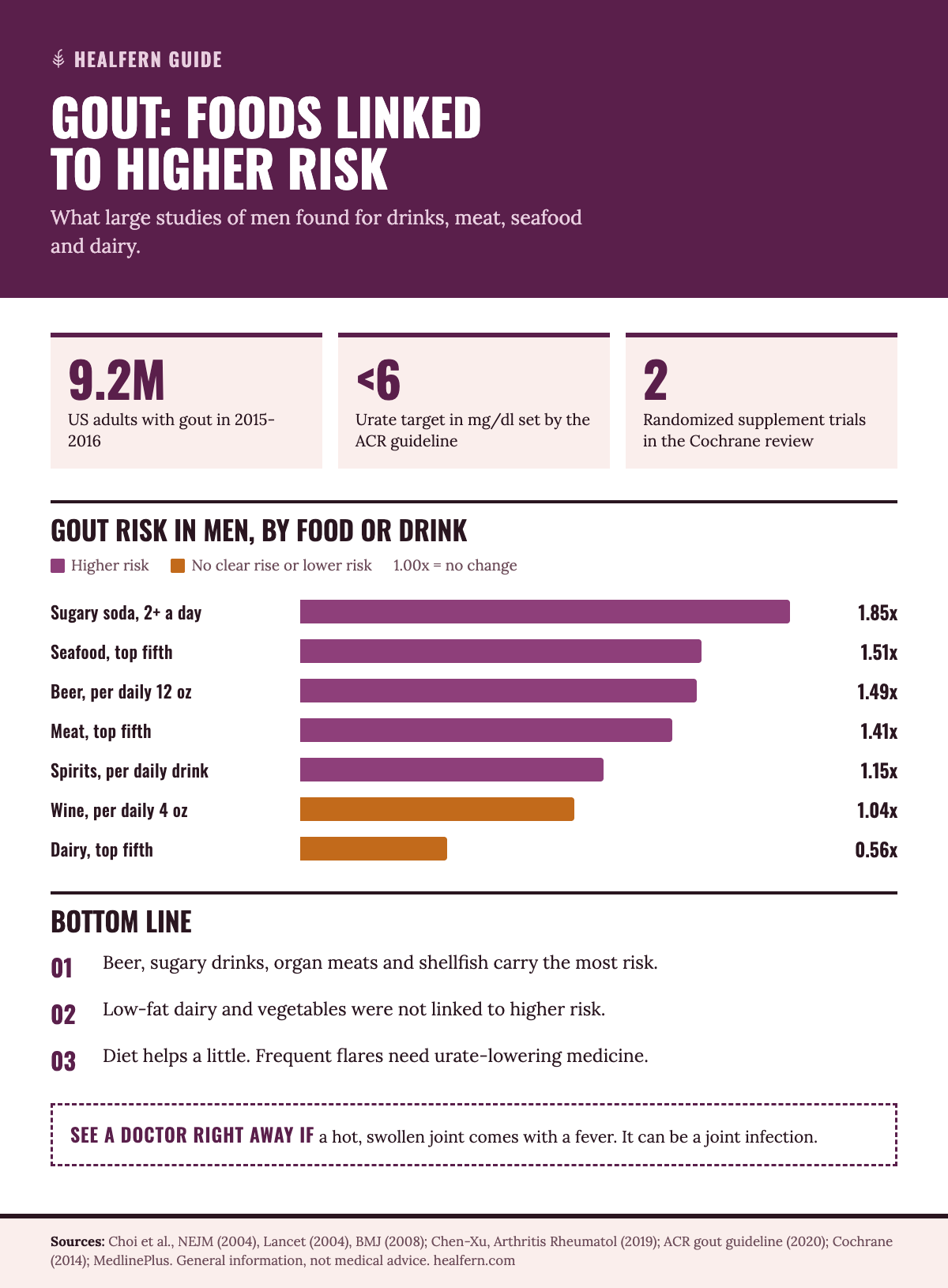
The best data on everyday eating come from the Health Professionals Follow-up Study. Over 12 years it tracked 47,150 men with no gout at the start, and 730 developed it.[5] Men who ate the most meat had a 41% higher risk than men who ate the least (relative risk 1.41), and the top seafood eaters had a 51% higher risk (1.51).[5]
| Food or drink | What the evidence shows | Source type |
|---|---|---|
| Beer, including nonalcoholic beer | Risk up 49% per daily 12-ounce serving; NIAMS advises cutting back on nonalcoholic beer too[6][2] | Cohort study, NIH advice |
| Sugar-sweetened soft drinks | Two or more a day: 85% higher risk; diet soda not linked[7] | Cohort study |
| Red meat and organ meats | Top meat eaters: 41% higher risk[5] | Cohort study, NIH advice |
| Shellfish, sardines, anchovies | Top seafood eaters: 51% higher risk[5] | Cohort study, NIH advice |
| Fruit juice and high-fructose fruit | Juice, apples and oranges also tied to higher risk[7] | Cohort study |
These are observational studies in male health professionals, so they show links, not proof. The ACR still rates the advice to limit purines as reasonable, with low certainty.[4]
Does alcohol trigger gout?
Yes, alcohol is one of the clearest dietary links, and beer is the strongest. In the same 12-year study of 47,150 men, each daily 12-ounce beer raised gout risk by 49% (relative risk 1.49). Each daily shot of spirits raised it 15% (1.15), while a daily 4-ounce glass of wine showed no significant link (1.04).[6]
Risk climbed with the amount. Men drinking 50 grams of alcohol or more a day had about 2.5 times the risk of non-drinkers.[6]
MedlinePlus lists drinking alcohol as one of the factors that make gout more common.[3] The 2020 ACR guideline conditionally recommends limiting alcohol for everyone with gout, whether flares are frequent or rare.[4]
NIAMS specifically includes nonalcoholic beer in its advice to cut back.[2] If you have gout and are switching from beer, a different drink is a better swap than a zero-alcohol beer.
How many drinks does it take to set off a flare?
The cohort data above are about who develops gout. A 2014 study asked a different question: what triggers an attack in people who already have it. It followed 724 people with gout online for a year and compared drinking in the 24 hours before an attack with drinking on ordinary days.[15]
More than 1 and up to 2 drinks in a day raised the odds of an attack by 36%, and more than 2 and up to 4 drinks raised them by 51%, compared with no alcohol. Wine, beer and liquor were each tied to higher odds, so wine’s clean record in the cohort studies did not hold for flares.[15] The authors advised people with gout to limit alcohol of all types.
Are sugary drinks and fruit juice a problem with gout?
They appear to be. A 12-year study of 46,393 men found that drinking two or more sugar-sweetened soft drinks a day was linked to an 85% higher gout risk compared with less than one a month (relative risk 1.85). Diet soft drinks showed no link.[7]
The culprit seems to be fructose. Men in the top fifth of fructose intake had about twice the risk of men in the bottom fifth, and fruit juice and fructose-rich fruits such as apples and oranges were also tied to higher risk.[7]
That does not mean whole fruit is off the table. The DASH eating plan, which NIAMS recommends for people with gout, includes plenty of fruit and vegetables.[2] The practical target is sweetened drinks and large amounts of juice. The ACR guideline conditionally recommends limiting high-fructose corn syrup.[4]
Does coffee help or hurt gout?
Coffee drinkers developed gout less often in the same Harvard cohort, and the more they drank, the lower the risk. Men drinking 4 to 5 cups a day had a 40% lower risk than non-drinkers, and men drinking 6 or more cups had a 59% lower risk. Tea and total caffeine showed no link.[14]
The 2007 study tracked 45,869 men for 12 years, with 757 new cases of gout. Decaffeinated coffee pointed the same way: 1 to 3 cups a day went with a 33% lower risk (relative risk 0.67). Since caffeine from all sources was not tied to risk, something else in coffee seems to matter.[14]
This is observational data in male health professionals, with the same limits as the food and alcohol studies above. It shows that coffee drinkers got gout less often. It does not show that starting coffee would lower anyone’s urate, and we found no randomized trial that tested that.
If you already drink coffee, there is no gout reason to stop. If you do not, the evidence is too thin to start for your joints. Sweetened coffee drinks also count as sugar-sweetened drinks, which the soft drink data above argue against.[7]
Which foods are fine to eat with gout?
Low-fat dairy, vegetables, whole grains and moderate protein all fit a gout-friendly diet. In the 12-year Harvard study, men with the highest dairy intake had a 44% lower risk of gout than those with the lowest (relative risk 0.56). Purine-rich vegetables and total protein were not linked to higher risk.[5]
That second finding means you do not need to strip vegetables from your plate. The authors concluded that moderate intake of purine-rich vegetables or protein was not linked to gout.[5]
NIAMS recommends the DASH eating plan, especially for the many people with gout who also have high blood pressure. DASH means plenty of vegetables, fruits and whole grains, low-fat or fat-free dairy, poultry and oils, and fewer foods high in saturated fat or added sugar. NIAMS says it may help lower blood urate.[2]
Weight matters too. NIAMS notes that losing weight through fewer calories and more exercise helps reduce urate if you are overweight.[2] The ACR conditionally recommends a weight loss program for people with gout who are overweight, without endorsing any particular plan.[4]
Does the DASH diet actually lower uric acid?
Yes, by a measurable but small amount. In a randomized feeding trial of 103 adults with high or borderline blood pressure, the DASH diet lowered serum uric acid by 0.35 mg/dl compared with a typical American diet. Among the 8 participants who started at 7 mg/dl or higher, the drop was 1.29 mg/dl.[16]
This 2016 trial is one of the few randomized tests of a diet on urate. Participants ate each diet for 30 days in random order, every meal was provided, and body weight was held constant, so the change came from what was on the plate rather than from weight loss.[16]
For comparison, vitamin C pills lowered urate by 0.23 mg/dl in people with gout, and allopurinol by 1.9 mg/dl.[10] DASH lands between them for the average person, and closer to medicine for people whose urate is already high, though that subgroup was only 8 people.[16]
The trial had an odd second finding: higher sodium intake lowered urate by 0.3 to 0.4 mg/dl. The authors reported it as a clue to how the body handles urate, not as advice to eat more salt.[16]
NIAMS recommends DASH partly because so many people with gout also have high blood pressure.[2] This trial is the best reason to pick it over a strict low-purine list, which, as the trial authors noted, has little randomized data behind it.[16]
Do cherries or vitamin C help gout?
The evidence is weak for both. The Cochrane review of dietary supplements for chronic gout found only two randomized trials with 160 people in total, and neither gave clear evidence of fewer flares. The ACR found cherry data too limited to recommend and advises against adding vitamin C.[9][4]
Cherries. A 2012 study followed 633 people with gout online for a year. Eating cherries in the previous two days was linked to 35% lower odds of a gout attack, and cherry extract showed a similar link.[8] This was an observational case-crossover design, not a placebo-controlled trial, and people chose what they ate. Periods when people ate cherries and also took allopurinol had 75% lower odds of an attack than periods with neither.[8] The ACR rated the cherry evidence low or very low certainty.[4]
Vitamin C. A pooled analysis of 13 trials (556 people, median 500 mg a day) lowered uric acid by 0.35 mg/dl, mostly in people without gout.[11] A 20-year cohort of 46,994 men found those taking 1,500 mg or more of supplemental vitamin C a day developed gout 45% less often than non-users, but that is an observational finding in men who had no gout at the start.[17] In people who actually had gout, a 2013 trial found 500 mg a day for 8 weeks cut urate by just 0.23 mg/dl, versus 1.9 mg/dl when allopurinol was started or increased.[10] If you take vitamin C for other reasons, our article on vitamin C for colds covers that evidence.
Enriched skim milk powder. The other Cochrane trial gave 120 people with severe gout a skim milk powder enriched with milk proteins for three months. The effect on flares was uncertain. Pain improved slightly more than with the control powders, about a 10% absolute difference, which the reviewers said may not matter clinically.[9]
| Study | Who and how long | What was tested | Result |
|---|---|---|---|
| Zhang, 2012 case-crossover | 633 people with gout, 1 year | Cherries or cherry extract in the 2 days before | 35% lower odds of attack; observational[8] |
| Stamp, 2013 trial | 40 people with gout, 8 weeks | Vitamin C 500 mg a day vs allopurinol | Urate down 0.23 vs 1.9 mg/dl[10] |
| Juraschek, 2011 meta-analysis | 13 trials, 556 people, median 30 days | Vitamin C, median 500 mg a day | Uric acid down 0.35 mg/dl[11] |
| Cochrane review, 2014 | 2 trials, 160 people | Enriched skim milk powder; vitamin C | Effect on flares uncertain, low-quality evidence[9] |
Is a gout diet safe, and when should you see a doctor?
Diet changes do not replace medical care. MedlinePlus advises contacting your provider if you have symptoms of a gout attack or develop tophi, the hard lumps of urate crystals under the skin.[3][1] Gout is also linked to kidney stones, high blood pressure and kidney disease, so a checkup covers more than the joint.[1]
See a doctor right away if:
- A hot, swollen joint comes with a fever. Septic arthritis, a joint infection, causes fever and swelling, usually in one joint, and delayed treatment can cause permanent damage.[13]
- Joint pain is so intense you cannot bear a sheet touching the joint, especially if it is your first attack. MedlinePlus describes this level of pain in acute gout and advises contacting a provider.[3]
Some medicines matter as well. Water pills such as hydrochlorothiazide can raise gout risk.[3] The ACR suggests switching from hydrochlorothiazide when feasible but advises against stopping low-dose aspirin taken for a good reason.[4] Do not change any prescription on your own.
High-dose vitamin C and cherry extract products have no strong safety or benefit data for gout.[9] Tell your doctor about anything you take, especially if you are pregnant or have kidney disease.
What do doctors use for gout, and how much does diet help?
Diet helps a little, and medicine does most of the work. The ACR says dietary changes likely produce only small changes in urate, though foods can trigger flares. For people with frequent flares, tophi or joint damage, it strongly recommends urate-lowering medicine, with allopurinol as the first choice and a target urate below 6 mg/dl.[4]
Genes also play a large part. The ACR panel pointed to strong genetic effects on urate levels and gout severity, and warned that diet advice should not turn into blaming patients for their disease.[4]
NIAMS makes the same point about diet: when gout causes frequent flares or tophi, lifestyle changes alone are not enough, and taking the prescribed urate-lowering medicine regularly is what prevents flares.[2]
For a flare itself, doctors use anti-inflammatory drugs, colchicine or corticosteroids.[2] MedlinePlus notes pain often eases within 12 hours of starting treatment and is usually gone within 48 hours.[3] Ice, rest and raising the joint can help in the meantime.[2]
Undertreatment is common. About 9.2 million US adults (3.9%) had gout in 2015-2016, yet only about a third of people with gout were taking urate-lowering medicine.[12] For more joint topics, see our joint health section and our ranking of the best supplements for joint pain.
What should you track to know the diet is working?
Track two things: your serum urate and your flare count. The blood test is the only way to know whether urate is falling. MedlinePlus gives normal ranges of 3.0 to 7.1 mg/dl for women and 4.0 to 8.6 mg/dl for men, and a treatment goal under 6 mg/dl, or under 5 in some cases, for people with gout.[18]
The ACR sets the same target, below 6 mg/dl, for anyone on urate-lowering medicine.[4] Diet alone rarely moves a high reading that far, which is why the guideline calls dietary change a small lever.[4]
- Ask for a serum uric acid test before changing your diet, so you have a baseline.[18]
- Do not eat or drink for 4 hours before the test unless told otherwise.[18]
- Keep taking your medicines unless your provider says to stop. Many of them change the result.[18]
- Repeat the test later and compare. In the DASH trial, 30 days on the diet was enough to show a change.[16]
- Log each flare with what you ate and drank in the 24 hours before, since alcohol in that window raised attack odds.[15]
Normal ranges vary slightly between labs, so compare your own results over time rather than against someone else’s number.[18] A reading that stays above 6 mg/dl despite diet changes is the signal to talk about medicine rather than tighten the diet further.[4]
Gout diet checklist
A practical list based on NIAMS advice and the ACR guideline. Our how we research page explains how we grade studies.
- Cut back on beer, including nonalcoholic beer, and on spirits.[2][6]
- Swap soda and sweet drinks for water or diet versions.[7]
- Keep organ meats, shellfish, sardines and anchovies occasional.[2]
- Build meals around vegetables, whole grains, low-fat dairy and poultry, in line with DASH.[2]
- Work toward a healthy weight if you are overweight.[4]
- Skip vitamin C pills taken for gout; the ACR advises against them.[4]
- If you buy a cherry product anyway, check the label for added sugar using our label reading guide, since sweetened juice adds fructose.[7]
- Ask your doctor about a urate blood test and whether you need medicine.[4]
Verdict: what to eat and avoid with gout
The foods to avoid are well established: beer and other alcohol, sugar-sweetened drinks, organ and red meats, and shellfish and oily small fish. Dairy and vegetables are fine. Supplements like cherry extract and vitamin C have not shown clear benefit in trials.[5][9]
Our judgment call: cutting beer and sweet drinks is the diet change with the most data behind it, so start there. If flares keep coming, the honest answer is a conversation about urate-lowering medicine, not a stricter diet or another supplement.
Questions people also ask
What foods trigger gout flares?
NIAMS lists alcohol (including nonalcoholic beer), sugar-sweetened drinks, red meats, organ meats such as liver and kidney, and seafood such as shrimp, lobster, sardines and anchovies. Certain medicines, injury and illness can also set off flares.
Is beer worse than wine for gout?
In a 12-year study of 47,150 men, each daily 12-ounce beer raised gout risk by 49% and each daily shot of spirits by 15%. A daily 4-ounce glass of wine showed no significant link.
Can I eat dairy and vegetables if I have gout?
Yes. Men with the highest dairy intake had a 44% lower gout risk than those with the lowest, and purine-rich vegetables and total protein were not linked to higher risk. NIAMS recommends the DASH eating plan.
Does tart cherry juice help gout?
The evidence is weak. One observational study of 633 people linked recent cherry intake to 35% lower odds of an attack, but there are no strong placebo-controlled trials, and the ACR found the evidence too limited to recommend.
Should I take vitamin C for gout?
The 2020 ACR guideline advises against adding vitamin C. In a trial of people with gout, 500 mg a day for 8 weeks lowered urate by only 0.23 mg/dl, compared with 1.9 mg/dl for allopurinol.
Can diet alone control gout?
Usually not when flares are frequent. The ACR says diet changes produce only small changes in urate, and NIAMS says people with frequent flares or tophi need urate-lowering medicine taken regularly, with a target urate below 6 mg/dl.
Sources
- Gout: Symptoms, Causes, and Risk Factors, NIAMS, NIH
- Gout: Diagnosis, Treatment, and Steps to Take, NIAMS, NIH
- Gout, MedlinePlus Medical Encyclopedia, 2025
- 2020 American College of Rheumatology Guideline for the Management of Gout, FitzGerald et al., Arthritis Care Res, 2020
- Purine-rich foods, dairy and protein intake, and the risk of gout in men, Choi et al., N Engl J Med, 2004
- Alcohol intake and risk of incident gout in men: a prospective study, Choi et al., Lancet, 2004
- Soft drinks, fructose consumption, and the risk of gout in men: prospective cohort study, Choi and Curhan, BMJ, 2008
- Cherry consumption and decreased risk of recurrent gout attacks, Zhang et al., Arthritis Rheum, 2012
- Dietary supplements for chronic gout, Andrés et al., Cochrane Database Syst Rev, 2014
- Clinically insignificant effect of supplemental vitamin C on serum urate in patients with gout: a pilot randomized controlled trial, Stamp et al., Arthritis Rheum, 2013
- Effect of oral vitamin C supplementation on serum uric acid: a meta-analysis of randomized controlled trials, Juraschek et al., Arthritis Care Res, 2011
- Contemporary Prevalence of Gout and Hyperuricemia in the United States and Decadal Trends, Chen-Xu et al., Arthritis Rheumatol, 2019
- Bacterial (septic) arthritis, MedlinePlus Medical Encyclopedia
- Coffee consumption and risk of incident gout in men: a prospective study, Choi, Willett and Curhan, Arthritis Rheum, 2007
- Alcohol quantity and type on risk of recurrent gout attacks: an internet-based case-crossover study, Neogi et al., Am J Med, 2014
- Effects of the Dietary Approaches to Stop Hypertension (DASH) Diet and Sodium Intake on Serum Uric Acid, Juraschek et al., Arthritis Rheumatol, 2016
- Vitamin C intake and the risk of gout in men: a prospective study, Choi, Gao and Curhan, Arch Intern Med, 2009
- Uric acid - blood, MedlinePlus Medical Encyclopedia, reviewed 2025
This article is general information, not medical advice. These statements have not been evaluated by the FDA, and supplements are not intended to diagnose, treat, cure or prevent any disease. Talk to your doctor or pharmacist before you start a supplement. How we research.