
Exercise is a first-choice treatment for lower back pain that lasts beyond a few weeks. A 2021 Cochrane review of 249 trials found it lowered pain by about 15 points on a 0 to 100 scale. Gentle moves like pelvic tilts and knee-to-chest stretches, walking, yoga, Pilates and tai chi all help, and none clearly beats the others. Pick one you will keep doing.
We read the 2017 American College of Physicians guideline on low back pain, the NICE guideline NG59 (updated in July 2026), the 2021 Cochrane review of exercise therapy covering 249 trials, the Cochrane reviews of yoga and Pilates, the WalkBack walking trial, and the back pain pages from NIAMS, MedlinePlus, NCCIH and the NHS. We also took the exercise instructions from the Chartered Society of Physiotherapy.
The short answer: exercise is a first-choice treatment for lower back pain that lasts, and no single type has been shown to beat the rest. Gentle moves like pelvic tilts and knee-to-chest stretches, regular walking, yoga, Pilates and tai chi all have trial support. Pick the one you will keep doing.
| What it is | Movement used as treatment: stretching, strengthening, aerobic activity such as walking, and mind-body practices such as yoga and tai chi.[8][1] |
|---|---|
| Used for | Back pain lasting more than 12 weeks (chronic), and getting back to normal activity after a short flare.[4][6] |
| Typical program | Aerobic activity such as walking, swimming or a stationary bike, plus stretching and strength training, ideally guided by a physical therapist.[8] |
| Best evidence | A 2021 Cochrane review of 249 trials found exercise cut chronic back pain by about 15 points on a 0 to 100 scale compared with no treatment or usual care.[3] |
| What guidelines say | The ACP tells doctors to start with exercise and other nondrug care for chronic low back pain. NICE recommends considering group exercise programs.[1][2] |
| Safety | Side effects are mostly minor, such as muscle soreness. Stop any move that makes your pain worse.[3][14] |
| See a doctor first if | Back pain comes with leg weakness or numbness, trouble urinating, fever, weight loss you did not intend, or follows a fall.[4] |
Do exercises actually help lower back pain?
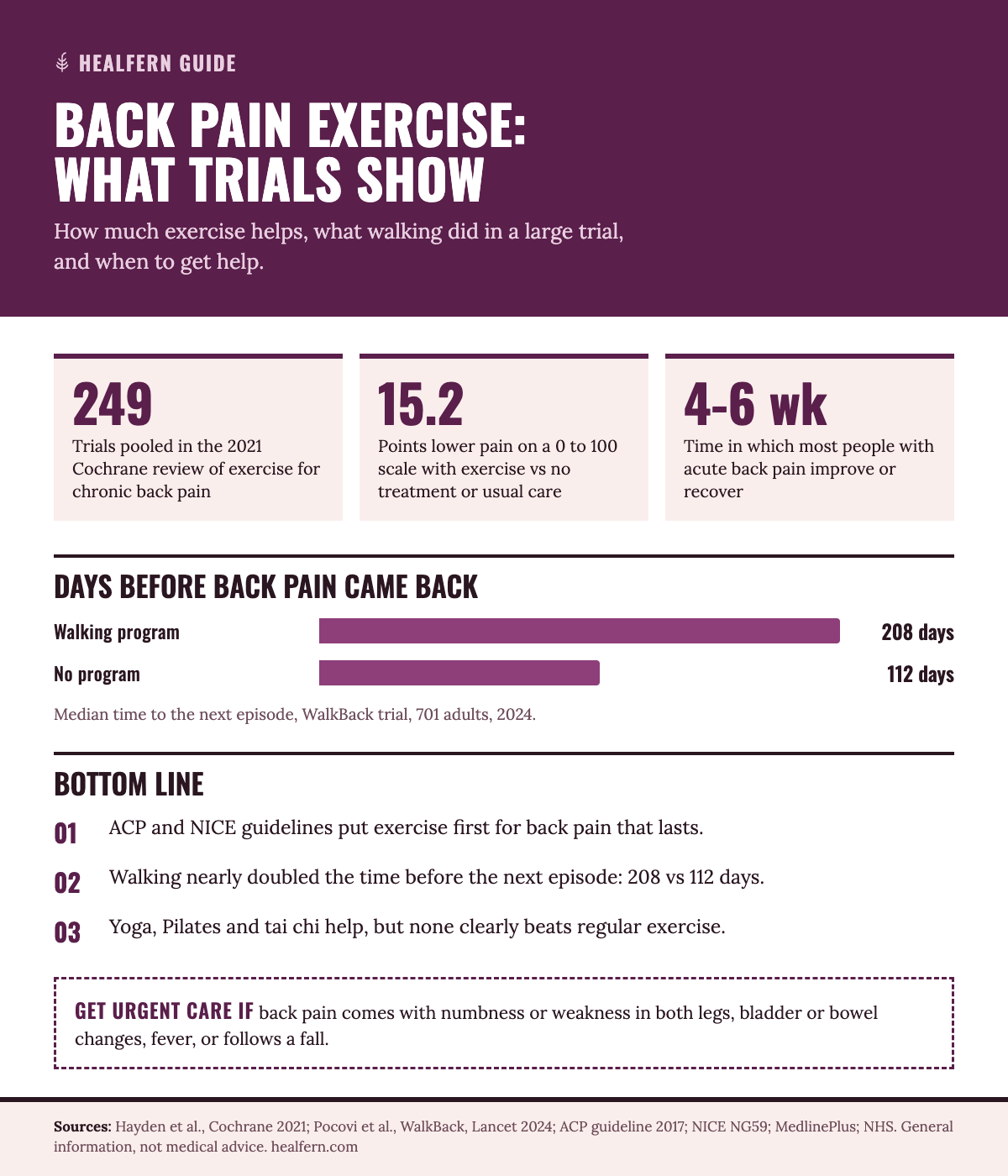
Yes, for back pain that has lasted more than three months. The 2021 Cochrane review pooled 249 trials and found moderate-certainty evidence that exercise reduces pain compared with no treatment, usual care or placebo. The average drop was 15.2 points on a 0 to 100 pain scale, which the authors counted as a meaningful change.[3]
The effect on daily function was smaller. People scored 6.8 points better on function scales, below the 10 points the reviewers set as clinically important.[3] So in the short term, exercise eases pain more than it changes what you can do in a day.
The review also compared exercise with other options. Exercise probably worked better than education alone and better than non-exercise physical therapy such as electrotherapy. It performed about the same as manual therapy, such as spinal manipulation.[3]
The people in these trials averaged 43.7 years old, and 59% were women.[3] Most trials could not blind participants, since you know whether you are exercising, which lowers confidence a little.
Formal exercise matters less for sudden, short-lived pain. The ACP notes that most people with acute or subacute low back pain get better over time no matter what treatment they use.[1] For that stage, staying active matters more than a formal routine.
What do medical guidelines recommend for back pain exercise?
Both major guidelines put exercise near the front of the line. The American College of Physicians tells doctors and patients to start chronic low back pain care with nondrug options, with exercise listed first. NICE in the UK recommends considering a group exercise program and keeping up normal activities.[1][2]
The ACP guideline (2017)
The ACP issued a strong recommendation that people with chronic low back pain first try exercise, multidisciplinary rehabilitation, acupuncture or mindfulness-based stress reduction, all backed by moderate-quality evidence. Tai chi, yoga, motor control exercise, progressive relaxation and several other options made the list on low-quality evidence.[1]
Drugs come later. The ACP suggests NSAIDs as first-line medicine only after nondrug care has not worked well enough.[1]
The NICE guideline NG59
NICE advises clinicians to consider a group exercise program for a specific episode or flare of low back pain. It can be biomechanical (strength and stretching), aerobic, mind-body, or a mix. The type should fit the person’s needs, preferences and abilities.[2]
NICE also says manual therapy such as massage or spinal manipulation should be offered only as part of a package that includes exercise. It advises against belts, corsets and traction.[2]
What US health agencies add
NIAMS tells people to avoid bed rest and to increase activity gradually as tolerated, and says strengthening exercises can help decrease pain. It also advises checking with a doctor or physical therapist before starting any exercise routine.[5] MedlinePlus says a complete program should include aerobic activity plus stretching and strength training.[8]
Which exercises help lower back pain at home?
Simple floor exercises that gently move and support the lower back are the usual starting point. The Chartered Society of Physiotherapy, the UK body for physical therapists, describes a pelvic tilt, a knee-to-chest stretch, a heel slide with core activation, a side-lying thigh stretch and a lunge. Walking, swimming and a stationary bike cover the aerobic side.[9][8]
The steps below come from the CSP’s exercise pages. The CSP does not set a number of repetitions or hold times, and neither do we. A physical therapist can set those for you. The CSP advises getting professional advice before you start, and seeking urgent advice if any exercise makes your pain worse.[9]
- Pelvic tilt. Lie on your back with your knees bent. Draw your belly button in and gently tighten your pelvic floor. Keep breathing steadily while you tilt your pelvis and flatten your back to the floor. Return slowly. Then arch your back gently the other way, return to neutral, and pause before repeating.[9]
- Knee to chest. Lie on your back with knees bent and feet flat. Bring one knee toward your chest, helping with your hands under your thigh. Return to the start and repeat with the same leg, then switch.[9]
- Heel slide with core activation. Lie on your back, knees bent, back in neutral (halfway between flat and arched). Tighten your pelvic floor and deep stomach muscles. Breathing steadily, slide one foot out until the leg is straight, then slowly return. Repeat with the other leg. Your back stays in neutral the whole time.[9]
- Side-lying thigh stretch. Lie on your side with the bottom knee bent in front of you to protect your back. Reach back, hold the ankle of your top leg and gently pull it toward your buttocks until you feel a stretch in the front of the thigh. Do not arch your back. A towel or belt around the ankle helps if you cannot reach.[9]
- Extension lunge. Stand with your feet together and step forward with one leg, keeping the back heel down on the floor. Return to the start and repeat.[9]
- Walking. Light aerobic activity such as walking improves blood flow to the back and builds stomach and back muscles, according to MedlinePlus.[6]
- Swimming or a stationary bike. MedlinePlus lists both as good light aerobic choices and suggests an upright stationary bike rather than a recumbent one during recovery.[8]
NIAMS explains why strength work matters. Weak back and stomach muscles may not support the spine properly, and back pain is more common in people who are not physically fit.[4] Strengthening your stomach muscles can ease the stress on your back, MedlinePlus says.[8]
Is walking good for lower back pain?
Walking is one of the best-tested low-cost options, especially for keeping pain from coming back. In the WalkBack trial, published in The Lancet in 2024, adults who had just recovered from a back pain episode and followed a walking and education program went nearly twice as long before their next episode as people with no program.[10]
The trial enrolled 701 Australian adults with an average age of 54. Half got an individualized, gradually increasing walking plan plus education, supported by six physical therapist sessions over six months. The other half got no treatment.[10]
The median time to the next activity-limiting episode was 208 days in the walking group and 112 days in the control group. That worked out to a 28% lower risk of recurrence at any point (hazard ratio 0.72).[10] The program was also judged cost-effective.[10]
Overall adverse events were similar between groups, though the walkers reported more problems in the legs and feet: 100 lower-limb events versus 54 in the control group.[10] Good shoes and a gradual build-up make sense.
Walking also suits the early days of a flare. MedlinePlus says that after two to three weeks you should gradually start exercising again, beginning with light aerobic activity such as walking.[6] If knee pain makes walking hard, our guide to arthritis in the knees covers what helps there.
Do yoga, Pilates and tai chi work better than regular exercise?
Not clearly. Each has trial evidence that it helps compared with doing little or nothing, but the Cochrane reviews found no proof that any of them beats ordinary exercise. The Pilates reviewers concluded that the choice can come down to personal preference and cost.[11][12]
Yoga: a Cochrane review of 12 trials with 1,080 people found small to moderate improvements in back-related function at three and six months compared with non-exercise controls. Pain improved slightly but did not reach the reviewers’ 15-point threshold.[11] Yoga caused more side effects than non-exercise controls, mostly a temporary increase in back pain, with a 5% higher risk. There were no serious adverse events.[11]
Pilates: a Cochrane review of 10 trials with 510 people found low-quality evidence of a medium short-term pain reduction (14.05 points on a 0 to 100 scale) compared with minimal intervention. The reviewers found no conclusive evidence that Pilates is better than other exercise.[12]
Tai chi: NCCIH cites a 2016 review of three studies with 385 participants, each lasting at least 10 weeks, which found tai chi helpful for low back pain. The ACP lists it as an option based on low-quality evidence.[13][1]
| Review or trial | Who and how many | Compared with | Main result |
|---|---|---|---|
| Cochrane, exercise therapy, 2021 | 249 trials, adults with pain over 12 weeks | No treatment, usual care or placebo | Pain 15.2 points lower on a 0 to 100 scale; function 6.8 points better[3] |
| WalkBack trial, 2024 | 701 adults recently recovered from an episode | No treatment | Median 208 vs 112 days before the next episode[10] |
| Cochrane, yoga, 2017 | 12 trials, 1,080 people | Non-exercise controls | Small to moderate function gains at 3 and 6 months[11] |
| Cochrane, Pilates, 2015 | 10 trials, 510 people | Minimal intervention | Pain 14.05 points lower short term; not better than other exercise[12] |
When should you start exercising after a back pain flare?
Ease off for the first couple of days, then get moving. MedlinePlus advises reducing normal activity only for the first few days, avoiding heavy lifting or twisting for six weeks, and gradually starting exercise again after two to three weeks, beginning with light aerobic activity.[6]
Bed rest is out. MedlinePlus calls the idea that you need long rest a common misbelief, and says that if there is no sign of a serious cause you should stay as active as possible to keep your back and stomach muscles from weakening.[6] The NHS gives the same advice: stay active, keep up daily activities, and do not stay in bed for long periods.[14]
Stretching and strengthening need more care with timing. MedlinePlus warns that starting those exercises too soon after an injury can make pain worse, and that a physical therapist can tell you when and how to begin.[6]
Most people with acute back pain improve or recover within four to six weeks, often sooner.[6] Doctors call pain lasting four to 12 weeks subacute, and pain lasting longer than 12 weeks chronic.[4] Chronic pain is where the formal exercise evidence is strongest.[3]
NIAMS adds a warning for people who have been inactive: back pain is more likely if you exercise too hard after a long break.[4] Start small and build up.
Which exercises should you avoid with lower back pain?
During recovery, MedlinePlus advises skipping jogging, contact sports, racquet sports, golf, dancing, weight lifting, leg lifts while lying on your stomach, and sit-ups, unless your doctor or physical therapist says they are fine.[8] Heavy lifting and twisting should wait about six weeks after the pain starts.[6]
Each of these loads or twists the spine hard while it is still sore. Once you are moving freely, a therapist can help you return to them step by step.
Some things people buy for back pain are not worth it. NICE advises against belts or corsets, foot orthotics, rocker-sole shoes and traction for low back pain.[2]
How you lift during daily life also counts as part of the routine. MedlinePlus suggests these habits:[8]
- Get help if an object is too heavy or awkward.
- Stand close to the object with your feet apart for a wide base.
- Bend at the knees, not the waist, and tighten your stomach muscles as you lift.
- Hold the load close to your body and lift with your legs.
- Do not twist while bending, lifting or carrying.
How do you know if your back exercises are working?
Track two things: pain and what you can do. Trials measure both, and they do not always move together. In the Cochrane review, exercise reduced pain by a meaningful amount, while the gain in daily function was smaller.[3] A simple weekly note of both gives you a fairer picture than how one day feels.
A practical way to do this is to rate your pain from 1 to 10 at the same time each day, the scale NIAMS says doctors often use.[5] Then list a few tasks that matter to you, such as putting on socks, sitting through a meal or walking to the store, and check them weekly.
Some soreness after new exercise is expected. In the Cochrane review, adverse effects were reported in 33% of exercise groups and 29% of comparison groups, and most were minor, such as muscle soreness.[3] That is different from pain that gets steadily worse. The NHS says to stop if your pain gets worse and see a doctor.[14]
Expect changes to take weeks. The yoga trials showed function gains at three and six months, and the tai chi studies all ran for at least 10 weeks.[11][13] If nothing has changed after several weeks of steady effort, or the pain lasts longer than four weeks, MedlinePlus says to contact your provider.[6]
Who should check with a doctor before starting?
Anyone with new, severe or unusual back pain should get checked before starting an exercise plan. NIAMS advises asking a doctor or physical therapist before any exercise routine, and the CSP recommends professional advice before starting new back exercises.[5][9]
MedlinePlus says to contact your provider if you have lost weight without trying, use steroids or inject drugs, or have had back pain before but this episode feels different and worse.[6] Back pain becomes more common after age 45, according to NIAMS.[4]
See a doctor right away if
Some signs point to a serious cause, such as nerve compression, infection, fracture or cancer, that exercise will not fix. NICE tells clinicians to rule out cancer, infection, trauma and inflammatory disease first.[2] Get urgent care if back pain comes with any of these:
- Numbness, tingling or weakness in both legs, or loss of feeling around the genitals or anus. The NHS says to call emergency services for these.[14]
- New trouble peeing, or losing control of your bladder or bowels.[14][6]
- Fever, chills, or feeling generally unwell with back pain.[4][14]
- Pain after a fall, a hard blow or a serious accident.[6][14]
- Weight loss you did not intend, or a history of cancer.[4][6]
- Pain that wakes you at night, is worse lying down, or travels below the knee.[6]
- Severe pain that starts suddenly or gets worse quickly.[14]
What other treatments do doctors use with exercise?
Doctors usually pair exercise with other simple care. For new pain, the ACP recommends heat, and if medicine is wanted, NSAIDs or muscle relaxants. NICE suggests oral NSAIDs at the lowest effective dose for the shortest time, and advises against acetaminophen (paracetamol) alone.[1][2]
MedlinePlus suggests ice for the first 48 to 72 hours, then heat.[8] For chronic pain, it lists physical therapy with stretching and strengthening exercises, cold and heat, and counseling to help manage pain.[7]
Imaging is often not needed. NICE advises against routine scans in non-specialist settings, and NIAMS notes that most people do not need extra testing.[2][5] Surgery is considered only when other treatments have not relieved the pain.[5]
A short note on supplements
This is a supplement site, so we checked. NCCIH reports that a 2018 review of eight studies with 747 participants did not find vitamin D helpful for low back pain.[13] Some herbal products, such as devil’s claw and white willow bark, may be beneficial, but they can cause side effects or interact with medicines.[13] None has the evidence base that exercise has. Our supplements for joint pain guide grades the options, and our label reading guide helps if you buy one.
Practical checklist for starting back exercises
- Rule out red flags first: leg weakness or numbness, bladder or bowel changes, fever, unexplained weight loss, or pain after a fall.[4][14]
- Stay active from the start and skip bed rest.[5][14]
- Begin with light aerobic activity, such as walking, swimming or an upright stationary bike, about two to three weeks after a flare begins.[6][8]
- Add gentle floor exercises such as pelvic tilts, knee to chest and heel slides, and stop any move that makes the pain worse.[9]
- Ask a physical therapist to set repetitions and to tell you when to start strengthening.[5][6]
- Pick a style you enjoy. Yoga, Pilates, tai chi and plain exercise all have support, and none is clearly best.[11][12][13]
- Hold off on sit-ups, leg lifts on your stomach, heavy lifting and contact sports during recovery.[8]
- Track pain (1 to 10) and a few daily tasks weekly, and call your provider if an episode lasts longer than four weeks.[5][6]
- Keep walking after you recover. It lengthened the time before the next episode in WalkBack.[10]
Read more on joint health, and see how we research our guides.
Verdict: which exercise is best for lower back pain?
The best exercise for lower back pain is the one you will do most weeks. Guidelines from the ACP and NICE put exercise first for lasting back pain, and the largest review found a real, if modest, cut in pain. No style has beaten the others in head-to-head trials.[1][2][3]
Our judgment call: if you are starting from nothing, start with walking and a few gentle floor moves. Walking is free, it has a large 2024 trial behind it, and it fits any schedule.[10] Add yoga, Pilates or tai chi if you like a class, and see a physical therapist if pain lingers past a month.
Questions people also ask
What is the best exercise for lower back pain?
No single exercise has been shown to beat the others. Cochrane reviews found yoga, Pilates and general exercise all help, and suggest choosing by preference and cost. Walking, gentle floor exercises and tai chi are reasonable starting points.
Should I rest or exercise with lower back pain?
Bed rest is not recommended. MedlinePlus advises reducing activity only for the first few days, then gradually starting light exercise such as walking, swimming or a stationary bike after two to three weeks, unless you have signs of a serious cause.
Is walking good for lower back pain?
Yes. In the 2024 WalkBack trial of 701 adults, a progressive walking and education program meant people went a median 208 days before their next episode, compared with 112 days in the group with no program.
Which exercises should I avoid with lower back pain?
During recovery, MedlinePlus suggests avoiding jogging, contact and racquet sports, golf, dancing, weight lifting, sit-ups and leg lifts lying on your stomach unless your doctor or therapist approves. Avoid heavy lifting and twisting for about six weeks.
When is back pain an emergency?
Get urgent care if back pain comes with numbness or weakness in both legs, numbness around the genitals or anus, new bladder or bowel problems, fever, or follows a serious fall or accident. These can signal nerve compression or infection.
How long does it take for back exercises to work?
Most acute back pain improves within four to six weeks anyway. For chronic pain, yoga trials showed function gains at three and six months, and tai chi studies ran at least 10 weeks. Contact your provider if an episode lasts beyond four weeks.
Sources
- Noninvasive Treatments for Acute, Subacute, and Chronic Low Back Pain: A Clinical Practice Guideline, American College of Physicians, Annals of Internal Medicine, 2017
- Low back pain and sciatica in over 16s: assessment and management (NG59), Recommendations, NICE, 2016, updated 2026
- Exercise therapy for chronic low back pain, Cochrane Database of Systematic Reviews, Hayden et al., 2021
- Back Pain: Symptoms, Types, and Causes, NIAMS, NIH, reviewed 2023
- Back Pain: Diagnosis, Treatment, and Steps to Take, NIAMS, NIH, 2023
- Low back pain, acute, MedlinePlus Medical Encyclopedia, NLM
- Low back pain, chronic, MedlinePlus Medical Encyclopedia, NLM, reviewed 2025
- Taking care of your back at home, MedlinePlus Medical Encyclopedia, NLM
- Video exercises for back pain, Chartered Society of Physiotherapy, reviewed 2020
- Effectiveness and cost-effectiveness of an individualised, progressive walking and education intervention for the prevention of low back pain recurrence (WalkBack), The Lancet, Pocovi et al., 2024
- Yoga treatment for chronic non-specific low back pain, Cochrane Database of Systematic Reviews, Wieland et al., 2017
- Pilates for low back pain, Cochrane Database of Systematic Reviews, Yamato et al., 2015
- Low-Back Pain and Complementary Health Approaches: What You Need To Know, NCCIH, NIH, 2020
- Back pain, NHS, reviewed 2026
This article is general information, not medical advice. These statements have not been evaluated by the FDA, and supplements are not intended to diagnose, treat, cure or prevent any disease. Talk to your doctor or pharmacist before you start a supplement. How we research.