
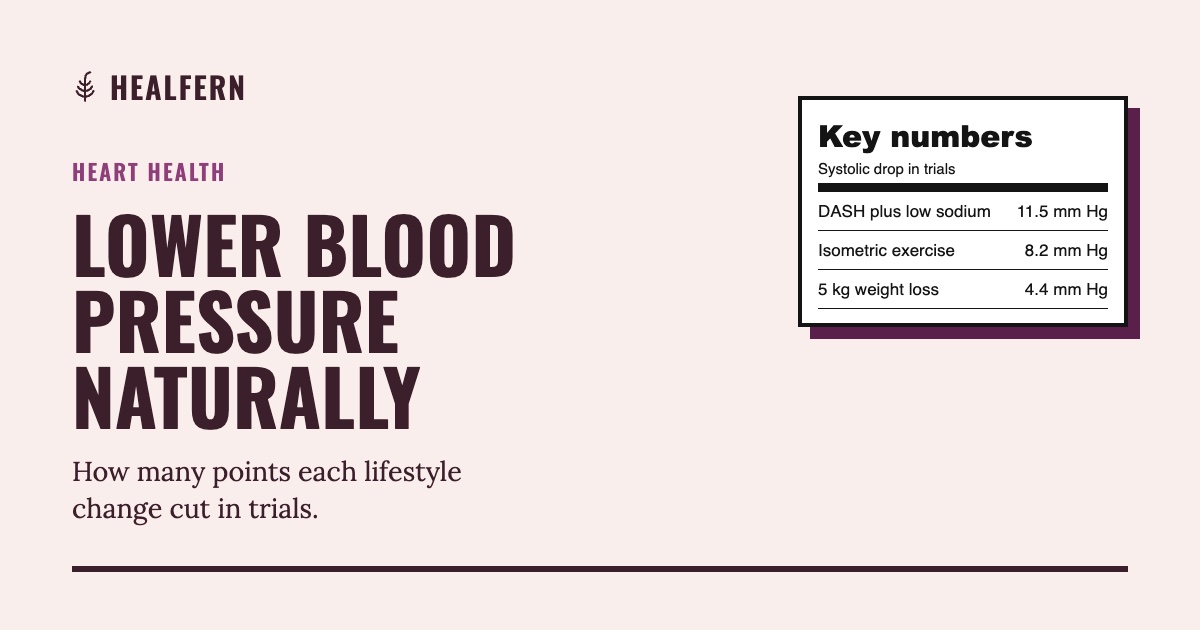
The changes with the strongest evidence are the DASH eating plan, less sodium, more potassium from food, losing extra weight, regular exercise and drinking less alcohol. In trials, DASH with low sodium lowered systolic pressure by 11.5 mm Hg in people with hypertension. Supplements add little. Keep taking any prescribed medicine and track your numbers at home.
We read the National Heart, Lung, and Blood Institute pages on treatment, the DASH eating plan and sleep, the MedlinePlus entries on DASH and blood pressure medicines, and the American Heart Association guidance on sodium and home monitoring. We also read the abstracts of the DASH and DASH-Sodium trials, a Cochrane review on salt, and meta-analyses on potassium, weight loss, exercise, alcohol and three popular supplements.[1][2][4][6][16]
The short answer: the DASH eating plan with less sodium, more potassium from food, losing extra weight, regular exercise and drinking less alcohol each lower blood pressure by a few points, and together they can rival a medicine. Supplements add little, and none replaces a prescription.[1][5][18]
| What it means | Heart-healthy lifestyle changes, used alone at elevated or stage 1 levels or alongside medicine at stage 2.[1][17] |
|---|---|
| Biggest single change | DASH eating plan with low sodium: systolic pressure 11.5 mm Hg lower in people with hypertension.[5] |
| Sodium goal | No more than 2,300 mg a day, ideally 1,500 mg. Americans average over 3,300 mg.[7] |
| Movement | At least 150 minutes of moderate exercise a week. Even 10 minutes of walking a day may help.[3][1] |
| Weight | About 1 mm Hg lower systolic pressure for each kilogram lost.[11] |
| Supplements | Magnesium lowered systolic pressure about 2 mm Hg in pooled trials. Garlic and beetroot evidence is thin or short.[18][20][21] |
| Who should be careful | People with kidney disease or on ACE inhibitors or potassium-sparing diuretics before using potassium salt substitutes.[10] |
How much can natural changes lower blood pressure?
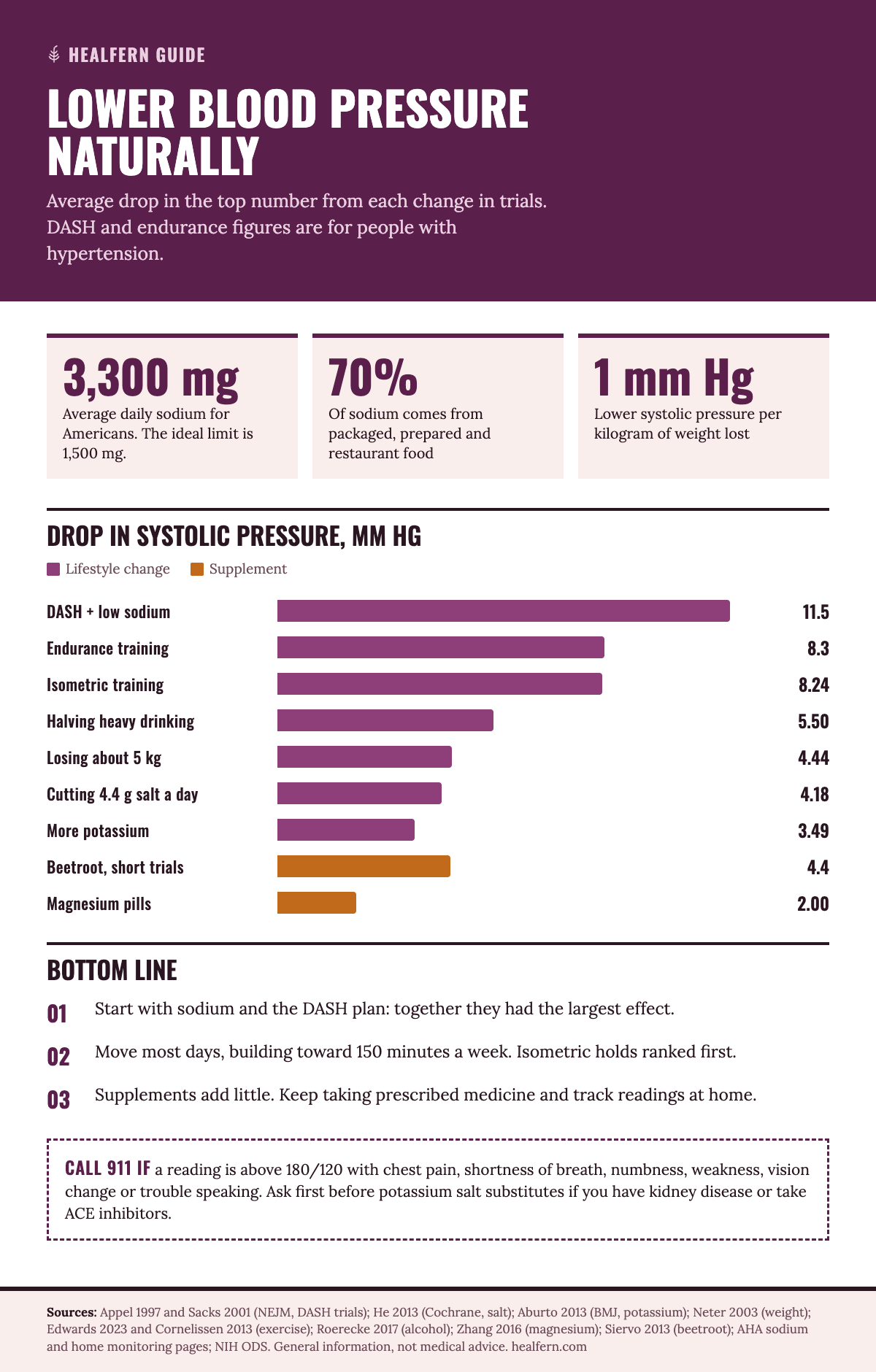
Each change lowers systolic pressure (the top number) by roughly 2 to 11 mm Hg in trials, depending on the change and on how high your pressure starts. The NHLBI says DASH combined with a low-salt eating plan can be as effective as medicines for lowering high blood pressure.[1][5][12]
The effects are largest in people who already have hypertension. In the DASH trial, the diet cut systolic pressure by 11.4 mm Hg in people with hypertension and by 3.5 mm Hg in people without it.[4] Endurance exercise showed the same pattern in a 93-trial review.[13]
The table below collects the main trials we read. Each result is the average drop compared with a control group, so your own result can be larger or smaller. These effects also do not simply add up; no trial we found tested every change at once.
| Change | Study | Who and how long | Average drop (systolic/diastolic) |
|---|---|---|---|
| DASH diet | DASH trial, 1997[4] | 459 adults, 8 weeks | 5.5/3.0 mm Hg overall; 11.4/5.5 with hypertension |
| DASH plus low sodium | DASH-Sodium, 2001[5] | 412 adults, 30 days per sodium level | 11.5 systolic with hypertension; 7.1 without |
| Less salt | Cochrane review, 2013[6] | 34 trials, 3,230 people, 4 weeks or more | 4.18/2.06 mm Hg |
| More potassium | BMJ meta-analysis, 2013[8] | 22 trials, 1,606 people | 3.49/1.96 mm Hg |
| Weight loss of about 5 kg | Hypertension meta-analysis, 2003[11] | 25 trials, 4,874 people | 4.44/3.57 mm Hg |
| Exercise training | BJSM network meta-analysis, 2023[12] | 270 trials, 15,827 people | About 4 to 6 systolic; 8.24 for isometric |
| Cutting heavy drinking by half | Lancet Public Health, 2017[14] | 36 trials, 2,865 people | 5.50/3.97 mm Hg in people having 6 or more drinks a day |
Does the DASH diet lower blood pressure?
Yes, and it has the best evidence of any eating pattern. In the 1997 DASH trial, 459 adults ate a diet rich in fruits, vegetables and low-fat dairy for 8 weeks. Systolic pressure fell 5.5 mm Hg more than on a typical American diet, even though sodium and body weight were held steady.[4]
DASH stands for Dietary Approaches to Stop Hypertension. The NHLBI describes it as a flexible plan that needs no special foods, only daily and weekly targets. It is rich in potassium, calcium, magnesium, fiber and protein, and low in saturated fat.[2] MedlinePlus adds that it can help with weight loss too.[3]
What a DASH day looks like
For a 2,000-calorie day, the NHLBI targets are:[2]
- Vegetables: 4 to 5 servings a day
- Fruit: 4 to 5 servings a day
- Grains: 6 to 8 servings a day, mostly whole grain
- Low-fat or fat-free dairy: 2 to 3 servings a day
- Meat, poultry and fish: 6 servings or fewer a day
- Fats and oils: 2 to 3 servings a day
- Nuts, seeds, beans and peas: 4 to 5 servings a week
- Sweets: 5 servings or fewer a week
A serving is smaller than most people expect. MedlinePlus lists 1 cup of raw leafy greens, half a cup of cooked vegetables, one medium fruit, or 1 ounce of cooked meat or fish.[3] It suggests limiting lean meat to 6 ounces a day and cooking without meat at least twice a week.[3]
You do not have to switch overnight. MedlinePlus says gradual change is fine, such as adding a salad at lunch or fruit to breakfast cereal.[3] If you want more magnesium from food, our list of magnesium-rich foods fits the DASH pattern.
How much sodium should you cut to lower blood pressure?
Aim for no more than 2,300 mg of sodium a day, and 1,500 mg if you can. The AHA says the average American eats over 3,300 mg, and that cutting back by just 1,000 mg a day can improve blood pressure. You do not need to hit the ideal number on day one.[7]
The evidence is consistent. A Cochrane review pooled 34 trials with 3,230 people that lasted at least 4 weeks. Eating about 4.4 grams less salt a day lowered pressure by 4.18/2.06 mm Hg, and larger cuts brought larger drops.[6]
Sodium and DASH work best together. In the DASH-Sodium trial, 412 adults ate each of three sodium levels for 30 days. Compared with a typical diet high in sodium, DASH at the lowest sodium level cut systolic pressure by 11.5 mm Hg in people with hypertension and 7.1 mm Hg in those without.[5]
MedlinePlus says your provider may suggest the 1,500 mg target if you already have high blood pressure, have diabetes or chronic kidney disease, are African American, or are 51 or older.[3]
Where the sodium hides
The salt shaker is a small part of the problem. More than 70% of the sodium Americans eat comes from packaged, prepared and restaurant foods.[7] MedlinePlus names frozen dinners, soups, salad dressings and prepared foods, plus pickles, olives, cured meats, ketchup, soy sauce, mustard and barbecue sauce.[3]
Read the Nutrition Facts panel for sodium per serving, then check how many servings are in the package.[7] MedlinePlus suggests choosing foods with less than 5% of the daily value for sodium.[3] On the front of the pack, “low sodium” means 140 mg or less per serving, while “reduced sodium” only means 25% less than the usual version of that product.[7] Our label reading guide explains the rest of the panel.
Does eating more potassium lower blood pressure?
It does in people who already have high blood pressure. A BMJ meta-analysis of 22 trials with 1,606 people found that eating more potassium lowered pressure by 3.49/1.96 mm Hg on average. The effect showed up in people with hypertension and not in people without it.[8]
The same review found that systolic pressure fell 7.16 mm Hg when potassium intake reached 90 to 120 mmol a day, but it found no dose response, so more is not automatically better.[8] The NIH Office of Dietary Supplements sets the adequate intake at 3,400 mg a day for men and 2,600 mg for women.[10] Fruits, vegetables, beans, dairy and fish all supply it, which is one reason DASH works.[2][10]
What about potassium salt substitutes?
Salt substitutes swap some sodium for potassium. The largest trial, SSaSS, followed 20,995 people in 600 rural Chinese villages for an average of 4.74 years. Everyone had high blood pressure and was 60 or older, or had already had a stroke. A substitute made of 75% sodium chloride and 25% potassium chloride lowered the rate of stroke (rate ratio 0.86), major cardiovascular events (0.87) and death (0.88).[9]
That is strong evidence, but substitutes are not for everyone. The ODS warns that if you have kidney disease or take certain medicines, such as ACE inhibitors or potassium-sparing diuretics, they can push your potassium too high. Talk to your provider before you use one.[10]
How much weight do you need to lose to lower blood pressure?
Less than you might think. A meta-analysis of 25 trials with 4,874 people found that losing about 5.1 kg (about 11 pounds) lowered pressure by 4.44/3.57 mm Hg. That works out to about 1 mm Hg lower systolic pressure for every kilogram lost.[11]
The NHLBI says that losing just 3% to 5% of your body weight can improve blood pressure. For a 200-pound adult, that is 6 to 10 pounds. Losing 5% to 10% over 6 months improves health more broadly.[1]
Bigger losses brought bigger drops in the same review. Trials where people lost more than 5 kg saw systolic pressure fall 6.63 mm Hg, compared with 2.70 mm Hg in trials with smaller losses.[11] People already on blood pressure medicine saw a larger drop in diastolic pressure (5.31 vs 2.91 mm Hg).[11]
Weight loss in these trials came from eating fewer calories, moving more, or both.[11] The DASH plan can help here as well, since it is built around vegetables, fruit and whole grains and limits sweets.[2][3]
What exercise lowers blood pressure the most?
Almost every kind helps. A 2023 network meta-analysis of 270 trials with 15,827 people found that aerobic, resistance, combined and interval training each lowered systolic pressure by about 4 to 6 mm Hg. Isometric exercise, where you hold a muscle still under tension, ranked first at 8.24 mm Hg.[12]
The detailed results were: aerobic training 4.49/2.53 mm Hg, dynamic resistance training 4.55/3.04, combined training 6.04/2.54, high-intensity interval training 4.08/2.50 and isometric training 8.24/4.00.[12]
Walking and other aerobic exercise
MedlinePlus recommends at least 30 minutes of moderate exercise most days, such as brisk walking or cycling, for a total of at least 2 hours and 30 minutes a week.[3] If that sounds like a lot, the NHLBI says even 10 minutes of walking a day may help, and so can sitting less.[1]
People with high blood pressure gain the most. In a 2013 review of 93 trials, endurance training lowered pressure by 8.3/5.2 mm Hg in groups with hypertension. In groups with normal pressure, the systolic drop was too small to be sure of.[13]
Isometric exercise and wall squats
Isometric work includes wall squats, planks and handgrip holds. In the 2023 analysis, the isometric wall squat was the single most effective type for systolic pressure.[12] The isometric trials are fewer and smaller than the aerobic ones, so treat this as promising rather than settled.[13] Ask your provider what level of activity is right for you before you start a new program.[1]
Does cutting back on alcohol lower blood pressure?
For heavier drinkers, yes. A 2017 meta-analysis of 36 trials with 2,865 people found that cutting back helped people who drank more than two drinks a day. Those who had six or more a day and cut their intake by about half lowered their pressure by 5.50/3.97 mm Hg.[14]
In people who drank two or fewer drinks a day, cutting back did not lower blood pressure significantly in that review.[14] Most participants were men (2,464 of 2,865), so the results for women are less certain.[14]
MedlinePlus cites the Dietary Guidelines for Americans: no more than 1 to 2 drinks a day for men and 1 or fewer for women, and no reason to start if you do not drink.[3] The NHLBI suggests talking to your provider about how much you drink, because you may need to limit it or stop.[1]
Do sleep, stress and smoking affect blood pressure?
They are part of the NHLBI treatment plan for high blood pressure, alongside diet, exercise and weight. The NHLBI recommends 7 to 9 hours of sleep a night, managing stress and quitting smoking. We did not find trials that put a reliable mm Hg number on stress or smoking changes, so we do not give one here.[1]
Sleep
NHLBI-funded research found that adults who regularly sleep 7 to 8 hours a night have a lower risk of high blood pressure. Untreated sleep disorders raise the risk of heart problems, including high blood pressure.[15] Loud snoring with pauses in breathing is worth raising with your doctor; our guide to sleep apnea symptoms lists the signs.
The NHLBI suggests going to bed and getting up at regular times, a calming bedtime routine, and a cool, dark bedroom.[1]
Stress and smoking
For stress, the NHLBI lists relaxation techniques, talking to a counselor and joining a support group.[1] For smoking, it points to the National Cancer Institute quitline at 1-877-448-7848.[1]
Do natural remedies like magnesium, garlic or beetroot work?
Some lower pressure a little, but none comes close to the lifestyle changes above, and none replaces medicine. Magnesium has the best data, with an average systolic drop of about 2 mm Hg. Garlic and beetroot have small, short or thin trials behind them.[18][20][21]
| Supplement | Evidence | Result | Our read |
|---|---|---|---|
| Magnesium | 34 trials, 2,028 people, median 368 mg a day for 3 months[18] | 2.00/1.78 mm Hg lower | Small but real; food first |
| Garlic | Cochrane review, 2 trials, 87 people[20] | Too little evidence on heart attacks, strokes or deaths | Unproven |
| Beetroot juice or nitrate | 16 crossover trials, 254 people, 2 hours to 15 days[21] | 4.4 mm Hg lower systolic; diastolic change not significant | Short-term only |
Magnesium
A 2016 meta-analysis of 34 double-blind trials found magnesium lowered pressure by 2.00/1.78 mm Hg.[18] The ODS sets the upper limit for magnesium from supplements at 350 mg a day for adults. High intakes can cause diarrhea, nausea and cramping, and magnesium interacts with some medicines.[19]
Garlic
A Cochrane review found only two trials with 87 people that met its standards. One showed a drop, but the reviewers concluded there was not enough evidence to say whether garlic lowers the risk of heart attack, stroke or death.[20]
Beetroot juice
A 2013 review of 16 small crossover trials found a 4.4 mm Hg drop in systolic pressure, but the studies lasted from 2 hours to 15 days. The authors called for long-term trials.[21]
How do you know if natural changes are working?
Measure at home. The AHA says people diagnosed with high blood pressure should monitor it regularly, using an automatic, validated cuff that fits on the upper arm. Tracking your numbers over time shows whether your changes are working and helps your provider judge your treatment.[16]
Wrist and finger monitors are not recommended because their readings are less reliable. You can check whether a monitor has been validated at validatebp.org or ask your pharmacist.[16]
How to take an accurate reading
- Do not smoke, drink caffeine or exercise for 30 minutes before.[16]
- Empty your bladder and put the cuff on bare skin, not over clothes.[16]
- Rest quietly for at least 5 minutes with your arm supported on a flat surface at heart level. Do not talk or use your phone.[16]
- Take two readings one minute apart, at the same time each day, and write them down.[16]
Give each change time before judging it. The DASH-Sodium trial measured each diet after 30 days, and the original DASH trial ran 8 weeks.[5][4]
When do you need medicine instead of lifestyle alone?
It depends on your numbers and your risk. MedlinePlus says elevated pressure (120 to 129 systolic and under 80 diastolic) is managed with lifestyle changes, and medicines are rarely used. Stage 1 may start with lifestyle alone. Stage 2, 140/90 or higher, usually means medicine plus lifestyle changes.[17]
At stage 1 (130 to 139 or 80 to 89), a provider may recommend lifestyle changes and recheck in a few months. If pressure stays at 130/80 or above, medicine may be added. People with heart disease, diabetes or a past stroke may start medicine at lower readings.[17]
The NHLBI says many people need two or more medicines to manage high blood pressure, and that lifestyle changes should continue while you take them.[1] Common classes include diuretics, ACE inhibitors, angiotensin receptor blockers and calcium channel blockers.[17]
You can use both. MedlinePlus says never to change your dose or stop a medicine on your own, and to tell your provider if you start the DASH diet.[17][3] If your readings fall, your provider may be able to adjust your treatment. If you are not sure whether your numbers are high, our guide to high blood pressure symptoms explains why most people feel nothing.
Who should be careful, and when should you see a doctor?
Most of these changes are safe for most adults, but a few need a provider’s input. Check first before using potassium salt substitutes, taking magnesium or other supplements, or starting a hard new exercise program, especially if you have kidney, heart or other long-term conditions or take daily medicine.[10][19][1]
- Kidney disease or certain medicines: potassium salt substitutes can raise potassium too high with kidney disease, ACE inhibitors or potassium-sparing diuretics.[10]
- Supplements with medicines: vitamins, supplements, foods and alcohol can change how blood pressure drugs act. Ask before adding any.[17]
- Magnesium: stay at or under 350 mg a day from supplements unless your provider advises otherwise.[19]
Call 911 right away if
Your reading is higher than 180 systolic and/or 120 diastolic and you have chest pain, shortness of breath, back pain, numbness, weakness, a change in vision or trouble speaking. If the reading is that high without symptoms, call your health care professional.[16]
What is a practical plan to start this week?
Pick one or two changes, keep them up, then add another. The NHLBI suggests making one change at a time and adding the next when the first feels comfortable, because habits you can keep matter more than a perfect start.[1]
- Buy a validated upper-arm cuff and log two morning readings a day for a week.[16]
- Read the sodium line on five foods you eat often, and swap the worst one for a low-sodium version.[7]
- Add one serving of vegetables or fruit to each meal, working toward 4 to 5 servings of each a day.[2]
- Walk 10 minutes a day, then build toward 150 minutes a week.[1][3]
- If you drink more than two drinks a day, cut back by half.[14]
- Aim for 7 to 9 hours of sleep on a regular schedule.[1]
- Ask your provider before trying a potassium salt substitute or a supplement.[10][17]
- Keep taking any prescribed medicine and bring your log to your next visit.[17]
For more on heart topics, browse our heart health guides, or see how we research our articles.
The verdict: what actually works?
Food and movement do most of the work. The DASH plan with low sodium had the largest effect we found, an 11.5 mm Hg drop in systolic pressure in people with hypertension, and weight loss, exercise, potassium and less alcohol each add a few points more.[5][11][12][8][14]
Our judgment: if you only change one thing, cut sodium from packaged and restaurant food, since that is where over 70% of it comes from.[7] Skip the garlic pills and beetroot shots until longer trials arrive, measure at home so you can see what is working, and let your provider decide whether medicine is still needed.[20][21][16]
Questions people also ask
What is the fastest natural way to lower blood pressure?
In feeding trials, the DASH diet lowered pressure within weeks. The original DASH study ran 8 weeks, and the DASH-Sodium trial tested each sodium level for 30 days. Combining DASH with low sodium cut systolic pressure by 11.5 mm Hg in people with hypertension.
How much does cutting salt lower blood pressure?
A Cochrane review of 34 trials found that eating about 4.4 grams less salt a day lowered systolic pressure by about 4 mm Hg and diastolic by about 2 mm Hg. The AHA says cutting just 1,000 mg of sodium a day can help.
Can exercise lower blood pressure without medicine?
Exercise lowers it, though often not enough on its own. A 2023 analysis of 270 trials found drops of about 4 to 6 mm Hg systolic from aerobic, resistance or combined training, and about 8 mm Hg from isometric work such as wall squats.
Does losing weight lower blood pressure?
Yes. A meta-analysis of 25 trials found that losing about 5 kg (11 pounds) lowered systolic pressure by about 4.4 mm Hg, roughly 1 mm Hg per kilogram lost. The NHLBI says losing just 3% to 5% of body weight can help.
Do magnesium, garlic or beetroot lower blood pressure?
The effects are small or uncertain. Magnesium lowered systolic pressure by about 2 mm Hg across 34 trials. A Cochrane review found too little evidence on garlic, and beetroot trials lasted 15 days or less. None replaces medicine.
Should I stop my blood pressure medicine if I change my lifestyle?
No. MedlinePlus says never to change the dose or stop a medicine on your own. Keep your lifestyle changes going, track your readings at home, and let your provider decide whether the dose can change.
Sources
- High Blood Pressure: Treatment, National Heart, Lung, and Blood Institute (NIH), 2024
- DASH Eating Plan, National Heart, Lung, and Blood Institute (NIH), updated 2026
- DASH diet to lower high blood pressure, MedlinePlus Medical Encyclopedia, National Library of Medicine
- A clinical trial of the effects of dietary patterns on blood pressure (DASH), Appel LJ et al., New England Journal of Medicine, 1997
- Effects on blood pressure of reduced dietary sodium and the DASH diet (DASH-Sodium), Sacks FM et al., New England Journal of Medicine, 2001
- Effect of longer-term modest salt reduction on blood pressure, He FJ et al., Cochrane Database of Systematic Reviews, 2013
- How much sodium should I eat per day?, American Heart Association, 2025 (archived copy)
- Effect of increased potassium intake on cardiovascular risk factors and disease: systematic review and meta-analyses, Aburto NJ et al., BMJ, 2013
- Effect of Salt Substitution on Cardiovascular Events and Death (SSaSS), Neal B et al., New England Journal of Medicine, 2021
- Potassium: Fact Sheet for Consumers, NIH Office of Dietary Supplements (archived copy)
- Influence of weight reduction on blood pressure: a meta-analysis of randomized controlled trials, Neter JE et al., Hypertension, 2003
- Exercise training and resting blood pressure: a large-scale pairwise and network meta-analysis of randomised controlled trials, Edwards JJ et al., British Journal of Sports Medicine, 2023
- Exercise training for blood pressure: a systematic review and meta-analysis, Cornelissen VA, Smart NA, Journal of the American Heart Association, 2013
- The effect of a reduction in alcohol consumption on blood pressure: a systematic review and meta-analysis, Roerecke M et al., Lancet Public Health, 2017
- Sleep Deprivation and Deficiency: How Sleep Affects Your Health, National Heart, Lung, and Blood Institute (NIH)
- Monitoring Your Blood Pressure at Home, American Heart Association, 2025 (archived copy)
- High blood pressure medications, MedlinePlus Medical Encyclopedia, National Library of Medicine
- Effects of Magnesium Supplementation on Blood Pressure: A Meta-Analysis of Randomized Double-Blind Placebo-Controlled Trials, Zhang X et al., Hypertension, 2016
- Magnesium: Fact Sheet for Consumers, NIH Office of Dietary Supplements (archived copy)
- Garlic for the prevention of cardiovascular morbidity and mortality in hypertensive patients, Stabler SN et al., Cochrane Database of Systematic Reviews, 2012
- Inorganic nitrate and beetroot juice supplementation reduces blood pressure in adults: a systematic review and meta-analysis, Siervo M et al., Journal of Nutrition, 2013
This article is general information, not medical advice. These statements have not been evaluated by the FDA, and supplements are not intended to diagnose, treat, cure or prevent any disease. Talk to your doctor or pharmacist before you start a supplement. How we research.


