To lower LDL cholesterol, cut saturated fat, add soluble fiber (7 g of psyllium or 3 g of oat beta-glucan a day), eat foods with plant sterols, stay active and lose 3% to 5% of your weight if you need to. Under 100 mg/dL is optimal. If your LDL is 190 or higher, or you have heart disease or diabetes, the guideline calls for a statin.
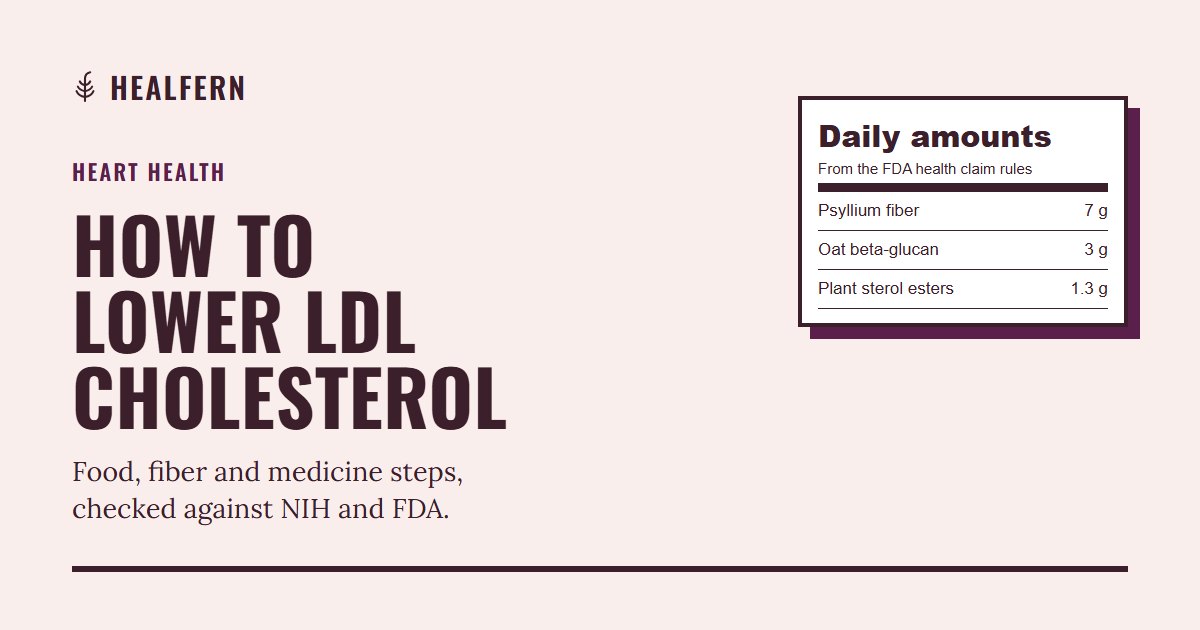
If you want to know how to lower LDL cholesterol, the steps with the best support are less saturated fat, more soluble fiber, plant sterols, regular activity, modest weight loss if you need it, and a statin when your risk calls for one. We read the NHLBI and MedlinePlus pages on LDL, the 2018 ACC/AHA cholesterol guideline, the FDA rules for fiber and sterol health claims, a Cochrane review, four meta-analyses and the NCCIH fact sheet on red yeast rice. You can see how we research health topics.
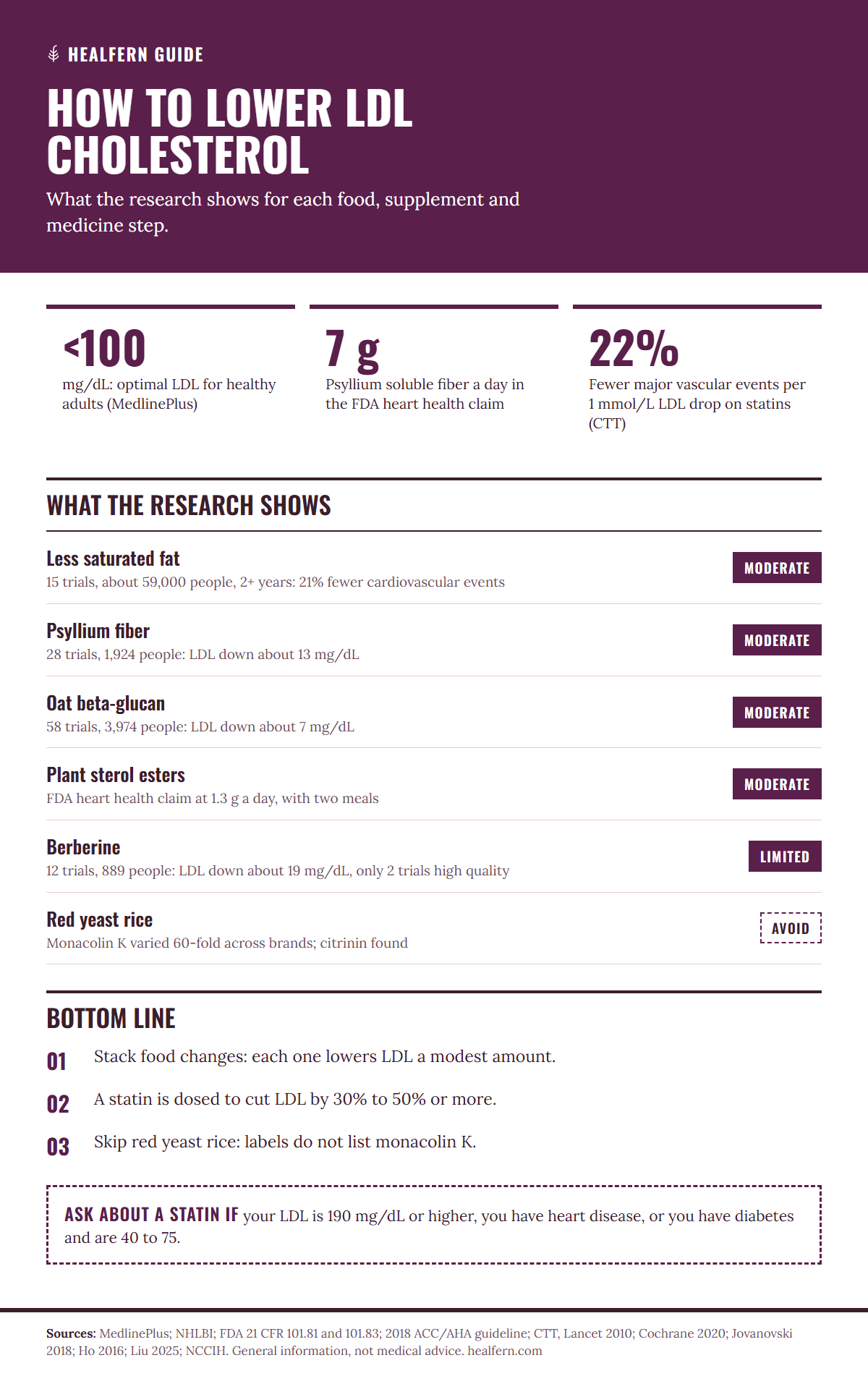
The short answer: single food changes lowered LDL by about 7 to 13 mg/dL in pooled trials, while a statin is meant to cut it by 30% or more, and by 50% or more at high intensity.[9][10][4]
| What LDL is | The “bad” cholesterol; too much of it builds plaque in the arteries[2] |
|---|---|
| Healthy level | Under 100 mg/dL is optimal for healthy adults; 190 mg/dL and above is very high[2] |
| Food changes | Limit saturated fat; eat whole grains, fruits, vegetables and nuts[1] |
| Fiber amounts | 3 g a day of beta-glucan from oats or barley, or 7 g a day of soluble fiber from psyllium[6] |
| Plant sterols | 1.3 g a day of plant sterol esters, eaten across two meals[7] |
| Standard medicine | Statins, the most common drug for high cholesterol[1][4] |
| Supplement to skip | Red yeast rice: unknown dose, statin-type side effects and possible citrinin contamination[11] |
What is a healthy LDL cholesterol level?
For healthy adults, an LDL cholesterol level under 100 mg/dL is optimal, and 190 mg/dL or higher is very high.[2] LDL gets the “bad” label because extra LDL joins other substances in the blood to form plaque, which narrows and hardens the arteries over time.[2]
| LDL level | Category |
|---|---|
| Less than 100 mg/dL | Optimal |
| 100 to 129 mg/dL | Near optimal or above optimal |
| 130 to 159 mg/dL | Borderline high |
| 160 to 189 mg/dL | High |
| 190 mg/dL and above | Very high |
If you already have coronary artery disease or a high risk of it, your doctor may set a lower goal.[2] For people at very high risk, the 2018 guideline uses 70 mg/dL as the point at which to consider adding a second drug to a statin.[4]
MedlinePlus suggests a cholesterol test every 1 to 2 years for men aged 45 to 65 and women aged 55 to 65. You may need it more often if you have heart disease, diabetes or a family history of high cholesterol.[2]
How to lower LDL cholesterol: 8 steps in order
The most reliable way to lower LDL cholesterol is to combine several food and habit changes and, when your risk is high, add a statin your doctor prescribes.[1][4] Each step below comes from an NIH page, an FDA rule or the national guideline. The first four cost little or nothing.
- Get a lipid blood test so you know your LDL number and category.[2]
- Cut back on saturated fat from fatty cuts of meat, full-fat dairy and desserts.[1]
- Add soluble fiber: oats or barley that supply 3 g of beta-glucan a day, or psyllium that supplies 7 g of soluble fiber a day.[6]
- Eat foods with added plant sterol esters, 1.3 g a day split over two meals.[7]
- Be active most days. Physical activity can lower LDL and triglycerides and raise HDL.[1]
- If you carry extra weight, aim to lose 3% to 5% of it.[1]
- Sleep 7 to 9 hours a night, and quit smoking if you smoke.[1][3]
- Recheck your levels with your doctor and ask whether you need a statin. After starting one, the guideline calls for a repeat test in 4 to 12 weeks.[4]
In pooled trials, psyllium and oats each moved LDL by a modest amount, so people who use several steps at once tend to see a bigger change than people who rely on one food.[9][10] If you take a cholesterol medicine, keep the habits going. NHLBI says the drugs and the lifestyle changes work best together.[1]
What foods lower LDL cholesterol the most?
Soluble fiber from oats, barley and psyllium, foods with added plant sterols, and swapping saturated fat for unsaturated fat have the strongest evidence for lowering LDL.[6][7][8] The FDA lets food labels carry a heart health claim for soluble fiber and for plant sterols, but only for foods that fit a diet low in saturated fat and cholesterol.[6][7]
Cut saturated fat
MedlinePlus says saturated fat and cholesterol in food make your LDL rise.[2] The NHLBI’s Therapeutic Lifestyle Changes and DASH plans both limit fatty meats, dairy and desserts, and they encourage whole grains, fruits, vegetables and a variety of nuts.[1]
A 2020 Cochrane review pooled 15 randomized trials with about 59,000 people. Cutting saturated fat for at least 2 years lowered combined cardiovascular events by 21% and produced small drops in LDL.[8] It did not clearly change the number of deaths.[8] Replacing the lost calories with polyunsaturated fat or with carbohydrate both looked useful.[8]
Add soluble fiber
Under the FDA rule, a heart health claim needs at least 3 g a day of beta-glucan from whole oats or barley, or at least 7 g a day of soluble fiber from psyllium seed husk.[6] A qualifying oat or barley food has at least 0.75 g of soluble fiber per serving, and a psyllium food has at least 1.7 g.[6] At 0.75 g a serving, you would need four servings of a qualifying oat food to reach 3 g.
The trial data back this up. A 2018 meta-analysis of 28 psyllium trials with 1,924 people found that a median of about 10.2 g a day lowered LDL by 0.33 mmol/L, or roughly 13 mg/dL.[9] A 2016 analysis of 58 oat trials with 3,974 people found that 3.5 g a day of oat beta-glucan lowered LDL by 0.19 mmol/L, roughly 7 mg/dL, though results varied a lot between trials.[10]
Use plant sterols and stanols
For plant sterols, the FDA claim calls for foods with at least 0.65 g of plant sterol esters per serving, eaten twice a day with meals, for a total of at least 1.3 g a day. The stanol ester version needs 3.4 g a day.[7] MedlinePlus says plant stanol and sterol supplements taken with meals can reduce cholesterol.[3]
A few other foods have smaller effects. Soy foods lower cholesterol a little, and they work better than soy supplements. Whole flaxseed may help, though flaxseed oil does not. Garlic supplements may lower cholesterol, but the effect is small next to cholesterol medicines.[3]
Can you lower LDL cholesterol without medication?
Many people can lower LDL without medication, but lifestyle changes alone may not bring a very high LDL, or a high heart risk, down far enough.[2][4] MedlinePlus says that if lifestyle changes alone do not lower your LDL enough, you may also need medicine.[2] The guideline calls a healthy lifestyle the foundation of risk reduction at every age.[4]
Exercise
NHLBI says physical activity can lower LDL and triglycerides and raise HDL, the “good” cholesterol. In one example it cites, resistance training in postmenopausal women may lower total cholesterol, LDL and triglycerides.[1] Ask your provider what level of activity is right for you before you start a new program.[1] The same habits show up in our guide on how to lower blood pressure naturally, which helps if you are working on both numbers.
Weight
Being overweight tends to raise LDL and lower HDL.[2] NHLBI says adults with overweight or obesity can lower LDL and raise HDL by losing only 3% to 5% of their body weight.[1] For a 200-pound adult, that is 6 to 10 pounds.
Sleep, stress and smoking
Getting 7 to 9 hours of sleep lowers your risk of high LDL and total cholesterol, and chronic stress can raise LDL and lower HDL.[1][3] Quitting smoking raises HDL. Because HDL helps remove LDL from the arteries, more HDL can help bring LDL down.[3]
How much does each change lower LDL?
In pooled trials, single food changes lowered LDL by roughly 7 to 13 mg/dL, while statins are dosed to cut LDL by 30% to 50% or more.[9][10][4] The table shows who was studied and what changed. One mmol/L of LDL is about 39 mg/dL.
| Approach and review | Who and how many | Dose and length | LDL result |
|---|---|---|---|
| Psyllium (Jovanovski, 2018) | 28 trials, 1,924 people | Median about 10.2 g a day, at least 3 weeks | Down 0.33 mmol/L, about 13 mg/dL[9] |
| Oat beta-glucan (Ho, 2016) | 58 trials, 3,974 people | Median 3.5 g a day, at least 3 weeks | Down 0.19 mmol/L, about 7 mg/dL[10] |
| Less saturated fat (Cochrane, 2020) | 15 trials, about 59,000 people | Diet advice or provided food, at least 2 years | Small LDL drop; 21% fewer cardiovascular events[8] |
| Berberine (Liu, 2025) | 12 trials, 889 people with metabolic syndrome | Doses varied | Down 0.495 mmol/L, about 19 mg/dL; only 2 trials high quality[12] |
| Statins (CTT, 2010) | 26 trials, about 170,000 people | Median follow-up about 5 years | Each 1 mmol/L drop cut major vascular events by about 22%[5] |
These are averages. Your own drop depends on where you start, your genes and how closely you follow the change. Genes partly decide how much cholesterol your body makes, which is why some lean, active people still have high LDL.[2]
What lowers LDL cholesterol the fastest?
A statin lowers LDL faster and further than any food change, and the 2018 ACC/AHA guideline makes statins the first drug treatment for people who need one.[4] Statins reduce the cholesterol your liver makes, and studies show they lower the risk of heart attack and stroke in people with high LDL.[1]
The guideline sorts statins by intensity. A moderate-intensity statin is meant to lower LDL by 30% or more, and a high-intensity statin by 50% or more.[4] The Cholesterol Treatment Trialists pooled 26 trials and found that each 1 mmol/L drop in LDL cut the yearly rate of major vascular events by just over a fifth. All-cause deaths fell by 10% per 1 mmol/L, with no rise in cancer.[5]
Other drugs are used when statins are not enough or cause side effects. Ezetimibe blocks cholesterol absorption, and bempedoic acid, bile acid sequestrants and injected PCSK9 inhibitors are other options.[1] Statins usually do not cause side effects. They may raise diabetes risk, mostly in people already at high risk, and real liver damage is extremely rare. Muscle damage is a rare side effect.[1] If muscle aches are your worry, see our look at CoQ10 and statin muscle pain.
Who should be on cholesterol medicine?
The 2018 guideline recommends a statin for people with heart or blood vessel disease, for anyone with LDL of 190 mg/dL or higher, and for adults aged 40 to 75 with diabetes and LDL of 70 mg/dL or higher.[4] For other adults aged 40 to 75, the choice rests on 10-year risk and a talk with your doctor.[4]
| If this describes you | What the guideline says |
|---|---|
| You have had a heart attack, stroke or other artery disease | High-intensity or highest tolerated statin, aiming to cut LDL by 50% or more |
| LDL of 190 mg/dL or higher | High-intensity statin without a risk calculation; ezetimibe is reasonable if LDL stays at 100 mg/dL or higher |
| Diabetes, age 40 to 75, LDL of 70 mg/dL or higher | Moderate-intensity statin without a risk calculation |
| Age 40 to 75, 10-year risk of 7.5% or higher | Talk through risk; a moderate-intensity statin if the talk favors it, aiming to cut LDL by 30% or more |
| Risk unclear, LDL 70 to 189 mg/dL | A coronary artery calcium scan can help; a score of zero may allow waiting, except in smokers, people with diabetes or a strong family history |
| Age 20 to 39 | Lifestyle first, with a talk about lifetime risk |
The guideline also lists risk-enhancing factors that tip the choice toward a statin. They include a family history of early heart disease, LDL that stays at 160 mg/dL or higher, metabolic syndrome, chronic kidney disease, preeclampsia or menopause before 40, chronic inflammatory disease and South Asian ancestry.[4] Blood pressure is part of the same risk talk, so it helps to know the symptoms of high blood pressure.[4]
Do red yeast rice and berberine lower LDL cholesterol?
Red yeast rice lowers LDL only when it contains monacolin K, which is chemically identical to the prescription statin lovastatin, and labels do not tell you how much is inside.[11] Berberine has some trial data, but the trials are small and mostly low quality.[12]
Red yeast rice
A 2017 review of 28 U.S. brands found that none listed the amount of monacolin K. Two had none at all, and in the other 26 the amount ranged more than 60-fold, from 0.09 to 5.48 mg per 1,200 mg.[11] The FDA says products with added or enhanced lovastatin cannot be sold as dietary supplements, and it has sent warning letters to companies that sold them.[11]
Products with real amounts of monacolin K carry the same risks as statins, including muscle, kidney and liver damage, and the same drug interactions.[11] Some products also contain citrinin, a toxin that can harm the kidneys. In a 2021 analysis of 37 products, only one had citrinin below the European Union limit, and four labeled citrinin-free were contaminated.[11] If you need a statin-level effect, a prescribed statin gives you a known dose and follow-up blood tests.
Berberine
A 2025 meta-analysis pooled 12 placebo-controlled trials with 889 adults who had metabolic syndrome. Berberine lowered LDL by 0.495 mmol/L, about 19 mg/dL, and side effects were similar to placebo in these trials.[12] Only 2 of the 12 trials were rated high quality, and the authors called for better trials.[12] We rate this evidence as limited. No trial we read tested whether berberine lowers heart attacks, and supplements can interact with medicines, so check with your provider first.[3]
Who should be careful, and when should you see a doctor?
Talk to a doctor before you change a cholesterol medicine or add a supplement, and get tested sooner if heart disease, diabetes or high cholesterol runs in your family.[2][3] Keep these points in mind:
- Do not stop a prescribed statin to try a supplement. Medicine and lifestyle changes work together.[1][3]
- Skip red yeast rice if you are pregnant or breastfeeding. There are no safety studies.[11]
- If you take other medicines, ask before adding red yeast rice or any supplement, since interactions are possible.[11][3]
- Some medicines raise LDL, including steroids, some blood pressure drugs and HIV drugs. Ask your doctor whether yours could play a part.[2]
- An LDL of 190 mg/dL or higher can point to familial hypercholesterolemia, an inherited form of high cholesterol. Ask about it, and about testing your relatives.[2][4]
- High LDL leads to plaque that can cause chest pain or a heart attack. Get emergency care for chest pain.[2]
Your LDL cholesterol checklist
- Write down your last LDL number and its category from the table above.[2]
- Check the saturated fat line on food labels and pick lower options for meat, dairy and desserts.[1]
- On oat and barley foods, look for at least 0.75 g of soluble fiber per serving; on psyllium foods, at least 1.7 g.[6]
- On sterol-enriched foods, look for at least 0.65 g of plant sterol esters per serving and eat them with two meals.[7]
- Pass on red yeast rice. Labels do not list monacolin K.[11]
- Book a recheck, and if you start a statin, retest in 4 to 12 weeks.[4]
For more on blood pressure, statins and diet, browse our heart health guides.
Bottom line
Food and habit changes each lower LDL by a modest amount, and the effects add up. Cutting saturated fat, adding soluble fiber and plant sterols, staying active and losing a little weight is the right start for nearly everyone.[1][6][7]
For people with heart disease, an LDL of 190 mg/dL or more, or diabetes after 40, a statin is the better first step than any supplement, because it has a known dose and large outcome trials behind it, while red yeast rice has neither.[4][5][11] The food and activity habits still count once you are on a statin.
Questions people also ask
How long does it take to lower LDL cholesterol?
It depends on the method. The fiber trials we read ran at least 3 weeks before measuring LDL. For statins, the 2018 guideline calls for a repeat cholesterol test 4 to 12 weeks after you start or change the dose.
How do you lower LDL cholesterol and raise HDL?
Regular physical activity, losing 3% to 5% of your weight if you are overweight and quitting smoking can raise HDL while LDL goes down. NHLBI lists all three as heart-healthy changes for unhealthy cholesterol levels.
What supplements lower LDL cholesterol?
MedlinePlus says plant sterol and stanol supplements taken with meals can reduce cholesterol. Psyllium fiber also lowered LDL in pooled trials. Soy, whole flaxseed and garlic have small effects. Check with your provider, since supplements can interact with medicines.
Is oatmeal good for lowering LDL cholesterol?
Yes, in modest amounts. Oats supply beta-glucan, and the FDA heart health claim needs 3 g a day. In 58 trials, 3.5 g a day lowered LDL by about 7 mg/dL on average, with wide variation between studies.
Can thin people have high LDL cholesterol?
Yes. Your genes partly decide how much cholesterol your body makes, and familial hypercholesterolemia is an inherited form of high cholesterol. Age, menopause and some medicines can also raise LDL regardless of your weight.
Sources
- Blood Cholesterol: Treatment, National Heart, Lung, and Blood Institute (NHLBI), NIH, 2024
- LDL: The "Bad" Cholesterol, MedlinePlus, National Library of Medicine
- How to Lower Cholesterol, MedlinePlus, National Library of Medicine
- 2018 AHA/ACC Guideline on the Management of Blood Cholesterol, Grundy SM et al., Circulation, 2019
- Efficacy and safety of more intensive lowering of LDL cholesterol: a meta-analysis of 170,000 participants in 26 randomised trials, Cholesterol Treatment Trialists' Collaboration, The Lancet, 2010
- 21 CFR 101.81: Health claims, soluble fiber from certain foods and risk of coronary heart disease, U.S. Food and Drug Administration, Code of Federal Regulations
- 21 CFR 101.83: Health claims, plant sterol/stanol esters and risk of coronary heart disease, U.S. Food and Drug Administration, Code of Federal Regulations
- Reduction in saturated fat intake for cardiovascular disease, Hooper L et al., Cochrane Database of Systematic Reviews, 2020
- Effect of psyllium fiber on LDL cholesterol and alternative lipid targets: a systematic review and meta-analysis, Jovanovski E et al., American Journal of Clinical Nutrition, 2018
- The effect of oat beta-glucan on LDL-cholesterol, non-HDL-cholesterol and apoB: a systematic review and meta-analysis, Ho HV et al., British Journal of Nutrition, 2016
- Red Yeast Rice: What You Need To Know, National Center for Complementary and Integrative Health (NCCIH), 2022
- Efficacy and safety of berberine on the components of metabolic syndrome: a meta-analysis of randomized placebo-controlled trials, Liu D et al., Frontiers in Pharmacology, 2025
This article is general information, not medical advice. These statements have not been evaluated by the FDA, and supplements are not intended to diagnose, treat, cure or prevent any disease. Talk to your doctor or pharmacist before you start a supplement. How we research.