CoQ10 probably will not fix statin muscle pain. Statins do lower blood CoQ10, but trials of 100 to 600 mg a day disagree, and NCCIH says the overall evidence does not support it. A trial in people with confirmed statin pain found no benefit, and large studies show most aches on statins are not caused by the drug. Talk to your doctor first.
We read the NCCIH and National Cancer Institute pages on coenzyme Q10 (CoQ10), five meta-analyses published between 2015 and 2025, and the 2015 Taylor trial that tested 600 mg a day in people with confirmed statin muscle pain. We also read two large studies on how often statins cause muscle pain at all, from the Lancet and the BMJ.[1][2][8][9][10]
The short answer: CoQ10 is unlikely to ease statin muscle pain for most people, because the trials disagree and the best-controlled ones found no benefit.[1][5][8]
| What it is | A substance made in the body, highest in the heart, liver, kidneys and pancreas, sold as a supplement[1] |
|---|---|
| Why it is paired with statins | Statins lowered blood CoQ10 in trials, from 1.3 to 0.8 mcg/mL on simvastatin[8] |
| Amounts studied | 100 to 600 mg a day for 30 to 90 days[7] |
| Best evidence | Mixed: two meta-analyses found less pain, three found no clear benefit[3][4][5][6][7] |
| NCCIH summary | Overall evidence does not support CoQ10 for statin muscle pain[1] |
| Safety | No serious side effects reported; mild insomnia or stomach upset possible[1] |
| Who should check first | People on warfarin or insulin, and anyone in cancer treatment[1][2] |
Why do people take CoQ10 with statins?
People take CoQ10 with statins because statins lower the body’s CoQ10, and low CoQ10 is a suspected reason for statin muscle aches. CoQ10 is a natural substance found in every cell, with the highest levels in the heart, liver, kidneys and pancreas.[1] Because people with some diseases have lower levels, researchers have long wondered whether supplements could help, and statin users became one of the most studied groups.[1][3]
In the 2015 Taylor trial, blood CoQ10 fell from 1.3 to 0.8 mcg/mL in people taking simvastatin with a placebo. People who took simvastatin with 600 mg of CoQ10 a day saw their levels climb from 1.3 to 5.2 mcg/mL.[8]
The National Cancer Institute also notes that cholesterol-lowering drugs, among others, may decrease the effects of CoQ10.[2]
The open question is whether raising blood CoQ10 changes how your muscles feel, and the trials below measured pain directly.
Statins themselves are well studied. MedlinePlus notes they lower the risk of heart attack and stroke in people with high LDL cholesterol, so anything that makes people quit them carries a cost.[11]
Does CoQ10 help statin muscle pain?
Probably not for most people. NCCIH says that although individual studies have varied, the overall evidence does not support the idea that CoQ10 reduces muscle pain caused by statins.[1] The meta-analyses split, and the trials that confirmed the pain came from the statin found no benefit.[8]
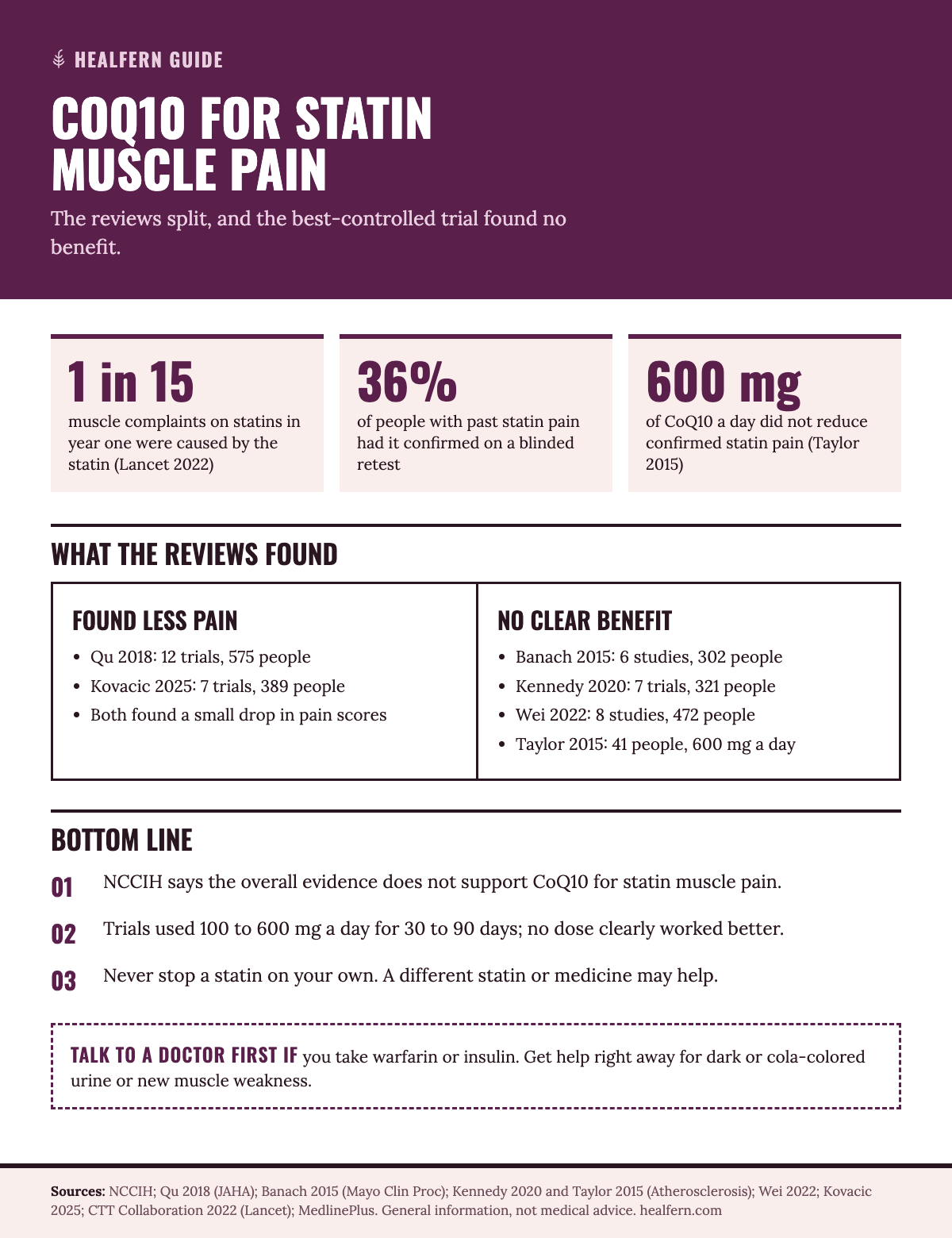
On the positive side, a 2018 meta-analysis in the Journal of the American Heart Association pooled 12 trials with 575 people. It found less muscle pain, weakness, cramps and tiredness with CoQ10, though no change in creatine kinase, a blood marker of muscle damage.[3] A 2025 review of 7 trials with 389 people also found a small drop in pain scores, with 4 trials positive and 3 showing no change.[7]
On the negative side, a 2015 Mayo Clinic Proceedings review of 6 studies with 302 people found no significant effect on pain.[4] A 2020 review of 7 trials with 321 people found no benefit and no change in how many people stayed on their statin.[5] A 2022 review of 8 studies with 472 people also found no significant benefit.[6]
What did the main studies find?
The main studies found mixed results on pain and no effect on blood markers of muscle damage. The trials in the 2025 review were small, with 35 to 76 people each, and lasted 30 to 90 days, which is too small and too short for a firm answer.[7]
| Study | Who and how many | Dose and length | Result |
|---|---|---|---|
| Banach, Mayo Clinic Proceedings, 2015 | 6 studies, 302 people on statins | Varied; no dose effect found | No significant effect on muscle pain or creatine kinase[4] |
| Taylor, Atherosclerosis, 2015 | 41 people with blinded, confirmed statin pain | 600 mg a day for 8 weeks with simvastatin 20 mg | Pain rose on the statin whether or not people took CoQ10[8] |
| Qu, Journal of the American Heart Association, 2018 | 12 trials, 575 people | Varied | Less pain, weakness, cramps and tiredness; creatine kinase unchanged[3] |
| Kennedy, Atherosclerosis, 2020 | 7 trials, 321 people | Varied | No benefit for pain; staying on a statin unchanged (risk ratio 0.99)[5] |
| Wei, Irish Journal of Medical Science, 2022 | 8 studies, 472 people | Varied | No significant benefit for pain or creatine kinase[6] |
| Kovacic, Journal of Nutritional Science, 2025 | 7 trials, 389 people | 100 to 600 mg a day for 30 to 90 days | Small drop in pain scores; more research needed[7] |
Why do the reviews disagree? They pooled different sets of small trials with different doses and pain scales. Only two of the trials in the 2020 review showed a positive effect on muscle pain.[5]
The positive reviews also come with limits. The 2018 review split its 575 people into 294 on CoQ10 and 281 on placebo, and pain fell by a weighted average of 1.60 points.[3] The 2025 review found a smaller drop of 0.96 points, and its confidence interval came close to zero, so its authors said more research is needed before anyone can make firm recommendations.[7]
Is your muscle pain really from the statin?
Often it is not. A 2022 Lancet analysis of 19 blinded trials with 123,940 people found that 27.1% of people on a statin and 26.6% on placebo reported muscle pain or weakness. More than 90% of muscle complaints in the statin groups were not caused by the statin.[9]
The statin effect was concentrated in the first year, with about 11 extra reports per 1,000 people per year. That works out to only 1 in 15 muscle reports in the statin groups being due to the drug in year one.[9] Risk was a little higher on intensive regimens, such as 40 to 80 mg of atorvastatin or 20 to 40 mg of rosuvastatin a day, than on moderate doses.[9]
The BMJ StatinWISE trial tested this in 200 people who had quit or nearly quit statins because of muscle symptoms. Each person switched between atorvastatin 20 mg and placebo across six 2-month periods without knowing which was which. Muscle symptom scores were no different between statin and placebo periods, and two thirds of those who finished restarted statins.[10] Dropouts for intolerable muscle symptoms were similar too: 18 people (9%) during statin periods and 13 (7%) during placebo periods.[10]
The Taylor trial found the same pattern: of 120 people with past statin muscle pain, only 41 (36%) had pain on simvastatin but not on placebo when tested blind.[8]
If most aches are not caused by the statin, a supplement aimed at a statin side effect has little to fix in most people.
How much CoQ10 was used in studies?
Trials used 100 to 600 mg of CoQ10 a day, usually for 30 to 90 days.[7] No dose clearly worked better. The 2015 Banach review looked for a link between dose and effect on pain or creatine kinase and found none.[4]
The highest-dose trial was also the most carefully designed. Taylor and colleagues gave 600 mg a day of ubiquinol, one form of CoQ10, to people whose statin pain had been confirmed in a blinded test. Blood CoQ10 rose about fourfold, yet pain on simvastatin rose just as much as it did on placebo.[8] Slightly more people reported pain on CoQ10 (14 of 20) than on placebo (7 of 18).[8]
That result argues against buying a bigger dose in the hope it will work better. If you and your doctor decide to try CoQ10, the amounts in the trials are the only guide, and none of them showed a clear, reliable benefit.[4][8]
Ubiquinol or ubiquinone: which form should you buy?
Either, as long as the label states the milligrams. Ubiquinone is the standard, cheaper form and ubiquinol is the reduced form sold at a premium. In a 2020 crossover study, ubiquinol capsules did not raise blood levels significantly more than ubiquinone capsules, and the body converts one to the other anyway.[17]
That study, run in Slovenia and Spain, gave 21 healthy adults aged 65 to 74 a single 100 mg dose of three products a week apart: a standard ubiquinone capsule, a ubiquinol capsule, and a water-soluble ubiquinone syrup. Against the standard capsule, the syrup delivered 2.4 times as much CoQ10 into the blood over 48 hours. The ubiquinol capsule reached 1.7 times, a gap that did not reach statistical significance.[17]
The same study found that CoQ10 showed up in the blood mostly as ubiquinol no matter which form people swallowed.[17] Paying extra for ubiquinol buys a form your body would have made on its own.
Form also did not rescue the pain result. The 2015 Taylor trial used ubiquinol at 600 mg a day, raised blood CoQ10 about fourfold, and still found no relief in people with confirmed statin pain.[8]
Reading the label
Cochrane describes CoQ10 as a fat-soluble molecule, which is why oil-based softgels and water-dispersible syrups absorb better than dry powder in a capsule.[15][17] Look for the CoQ10 amount in milligrams per serving, the form (ubiquinone or ubiquinol), and whether it is in oil or powder. Trials used 100 to 600 mg a day, so a 30 mg tablet is far below anything studied.[7] The FDA does not check these claims before sale.[14]
Is CoQ10 safe to take with a statin?
CoQ10 appears safe for most adults. NCCIH reports no serious side effects, with mild insomnia or digestive upset possible.[1] The main cautions are about other medicines, not the statin itself.
NCCIH and the National Cancer Institute both say CoQ10 may interact with the blood thinner warfarin and with insulin.[1][2] NCCIH adds that it may not be compatible with some cancer treatments.[1] Many supplements have not been tested in pregnant or nursing women, and statins themselves are not used in pregnancy or breastfeeding.[11][14]
The bigger risk is stopping your statin. MedlinePlus warns against stopping a statin on your own, since that can lead to serious problems and, rarely, death.[11] Talk to your provider before changing anything.[11]
See a doctor right away if
- Your urine turns dark, red or cola-colored.[13]
- You pass much less urine than usual.[13]
- You have muscle weakness or tender, aching muscles that are new or getting worse.[13]
These can be signs of rhabdomyolysis, a rare form of muscle breakdown that statins can cause and that can damage the kidneys.[11][13]
Who should and should not try CoQ10 with a statin?
It suits someone whose doctor has confirmed the statin is causing the pain, who has already discussed switching statins, and who wants a low-risk add-on with the odds understood. It does not suit anyone on warfarin or insulin, anyone in cancer treatment, or anyone hoping to use it instead of a statin.[1][2][8][11]
Reasonable candidates
People whose pain came back on a blinded retest or improved off the statin have the best reason to think the drug is involved.[8][10] Even in that group, the Taylor trial found no benefit from 600 mg a day, so the expectation should be low.[8] Older adults make less CoQ10 of their own, and the 2020 absorption study was run in people aged 65 to 74, so the product data at least apply to them.[17]
People who should check first or skip it
- Anyone on warfarin: NCCIH and the National Cancer Institute both flag a possible interaction.[1][2]
- Anyone on insulin, for the same reason.[1][2]
- Anyone in cancer treatment, since CoQ10 may not be compatible with some therapies.[1]
- Anyone pregnant or nursing: most supplements are untested in that group, and statins are not used in pregnancy anyway.[11][14]
- Anyone with dark urine, new weakness or severe muscle pain, who needs a doctor, not a supplement.[13]
The biggest group that should skip it is people whose aches are not from the statin at all. The Lancet analysis put that at more than 90% of muscle complaints on statins.[9] For them, CoQ10 has nothing to act on.
What do doctors do first for statin muscle pain?
Doctors usually check for muscle damage with a blood test and then adjust the statin rather than add a supplement. MedlinePlus says your provider may order a blood test, and the pain may go away if you switch to a different statin.[11]
Muscle damage from statins is rare, and muscles may heal after a switch to a different medicine.[11] Your provider will also ask about other medicines, supplements and foods, since some, such as grapefruit, change how the liver breaks down certain statins.[11]
NHLBI notes that statins usually do not cause side effects, and lists muscle damage among the rare ones.[12] If statins still cause side effects, NHLBI lists other options. Ezetimibe or bempedoic acid may be used if statins cause side effects, bile acid sequestrants may help people who cannot take statins, and PCSK9 inhibitors are injected medicines for higher-risk patients.[12]
StatinWISE also showed that a blinded retest, switching between a statin and a placebo without knowing which is which, can help sort out whether the statin is really the cause.[10]
Does CoQ10 help the heart in other ways?
The two best reviews reach different conclusions for different conditions. A 2021 Cochrane review found CoQ10 probably reduces deaths and hospital stays in people with heart failure, on moderate-quality evidence from a few trials. A 2016 Cochrane review found it does not meaningfully lower blood pressure.[15][16]
Heart failure
The heart failure review pooled 11 trials with 1,573 people. One trial of 420 people drove the mortality finding: all-cause deaths fell, with a risk ratio of 0.58, meaning about 13 people would need treatment for one extra survivor. Two trials with 1,061 people showed fewer heart failure hospitalizations, risk ratio 0.62.[15]
The authors still rated every included study as having unclear or high risk of bias in at least one area, and they called the evidence on pumping strength (ejection fraction) very low quality. Their closing line was that there is “no convincing evidence to support or refute” CoQ10 for heart failure.[15] People with heart failure are under a cardiologist’s care, and this is a conversation to have there.
Blood pressure
The blood pressure review could pool only two trials with 50 people in total. Systolic pressure fell 3.68 mmHg and diastolic 2.03 mmHg, and neither change was statistically significant. The authors rated this moderate-quality evidence that CoQ10 has no clinically significant effect on blood pressure.[16]
For someone taking a statin, these findings do not change the main question. They show that CoQ10 has been studied seriously for heart conditions, with one promising signal in heart failure and one clear negative for blood pressure, and that none of it bears on whether it eases muscle pain.[15][16]
Does CoQ10 change your cholesterol numbers?
A little, and far less than a statin. A 2022 meta-analysis of 50 randomized trials with 2,794 adults found CoQ10 lowered total cholesterol by about 5.5 mg/dL and LDL by about 3 mg/dL. Those are small shifts. CoQ10 is not a cholesterol medicine and does not replace one.[18][11]
The full set of results from that review: total cholesterol down 5.53 mg/dL, LDL cholesterol down 3.03 mg/dL, triglycerides down 9.06 mg/dL, and HDL cholesterol up 0.83 mg/dL. The trials disagreed with each other a good deal, so the pooled figures carry wide uncertainty. The largest total cholesterol effect appeared at 400 to 500 mg a day.[18]
To put the LDL figure in context, MedlinePlus describes statins as drugs that lower LDL enough to cut the risk of heart attack and stroke, and warns against stopping them without a provider’s advice.[11] A 3 mg/dL change from a supplement is not in that league.
What this does tell you is that CoQ10 will not push your cholesterol the wrong way while you take it alongside a statin. Beyond that, the lipid data give no reason to add it.[18]
What should you check before buying CoQ10?
Check with your doctor first, then look for a product that lists its CoQ10 amount clearly. The FDA does not review supplements for safety or effectiveness before they are sold, so quality varies.[14] Our label reading guide explains what to look for.
- Tell your doctor about muscle pain before reaching for a supplement; it may need a blood test.[11]
- Never stop your statin on your own.[11]
- If you take warfarin or insulin, ask before starting CoQ10.[1][2]
- If you are in cancer treatment, check with your oncology team.[1][2]
- Check the label for milligrams per serving; trials used 100 to 600 mg a day.[7]
- Skip mega-doses; the 600 mg trial found no benefit.[8]
- Give it a fixed trial period and stop if nothing changes; trials ran 30 to 90 days.[7]
For more on heart supplements, see our heart health guides, our look at whether multivitamins work, and why L-arginine is a poor fit after a heart attack in our L-arginine trial review. Our methods are on the how we research page.
Verdict: should you take CoQ10 with your statin?
The evidence is split, and the most careful trial, which confirmed that the pain came from the statin, found that 600 mg of CoQ10 a day did nothing for it.[8] NCCIH sums up the research as not supporting CoQ10 for statin muscle pain.[1]
Our judgment: CoQ10 is a low-risk thing to try only after your doctor has ruled out muscle damage and other causes, and it should never replace a statin switch or a talk about other cholesterol medicines. For most people with aches on a statin, a blinded retest or a different statin is the better first move.[10][11][12]
Questions people also ask
Should I take CoQ10 if I am on a statin?
Not routinely. NCCIH says the overall evidence does not support CoQ10 for statin muscle pain. If you have aches, see your doctor first; a blood test, a different statin or another cholesterol medicine are the usual next steps.
How much CoQ10 should I take with a statin?
Trials used 100 to 600 mg a day for 30 to 90 days. No dose clearly worked better, and the trial that used 600 mg a day in people with confirmed statin pain found no benefit, so ask your doctor.
Do statins lower CoQ10 levels?
Yes, in trials. In the 2015 Taylor study, blood CoQ10 fell from 1.3 to 0.8 mcg/mL in people taking simvastatin with a placebo. Raising the level with a supplement did not reduce their muscle pain.
Can I take CoQ10 with warfarin?
Ask your doctor first. NCCIH and the National Cancer Institute both say CoQ10 may interact with the blood thinner warfarin and with insulin, so your care team may need to monitor you more closely.
Is muscle pain on statins usually caused by the statin?
Usually not. A Lancet analysis of 19 blinded trials with 123,940 people found more than 90% of muscle complaints in statin groups were not caused by the statin, and 27.1% versus 26.6% reported pain.
What can I do instead of CoQ10 for statin muscle pain?
Talk to your provider. MedlinePlus says the pain may go away after switching statins, and NHLBI lists ezetimibe, bempedoic acid, bile acid sequestrants and PCSK9 inhibitors as options when statins cause side effects.
Sources
- Coenzyme Q10, NCCIH, National Institutes of Health
- Coenzyme Q10 (PDQ), patient version, National Cancer Institute
- Effects of coenzyme Q10 on statin-induced myopathy: an updated meta-analysis of randomized controlled trials, Qu et al., Journal of the American Heart Association, 2018
- Effects of coenzyme Q10 on statin-induced myopathy: a meta-analysis of randomized controlled trials, Banach et al., Mayo Clinic Proceedings, 2015
- Effect of coenzyme Q10 on statin-associated myalgia and adherence to statin therapy, Kennedy et al., Atherosclerosis, 2020
- Effects of coenzyme Q10 supplementation on statin-induced myopathy: a meta-analysis of randomized controlled trials, Wei et al., Irish Journal of Medical Science, 2022
- Effects of coenzyme Q10 supplementation on myopathy in statin-treated patients: a systematic review and meta-analysis, Kovacic et al., Journal of Nutritional Science, 2025
- A randomized trial of coenzyme Q10 in patients with confirmed statin myopathy, Taylor et al., Atherosclerosis, 2015
- Effect of statin therapy on muscle symptoms: an individual participant data meta-analysis of large-scale, randomised, double-blind trials, Cholesterol Treatment Trialists' Collaboration, Lancet, 2022
- Statin treatment and muscle symptoms: series of randomised, placebo controlled n-of-1 trials (StatinWISE), Herrett et al., BMJ, 2021
- Statins, MedlinePlus, National Library of Medicine
- Blood Cholesterol: Treatment, NHLBI, National Institutes of Health
- Rhabdomyolysis, MedlinePlus Medical Encyclopedia
- Using Dietary Supplements Wisely, NCCIH, National Institutes of Health
- Coenzyme Q10 for heart failure, Al Saadi et al., Cochrane Database of Systematic Reviews, 2021
- Blood pressure lowering efficacy of coenzyme Q10 for primary hypertension, Ho et al., Cochrane Database of Systematic Reviews, 2016
- Comparative bioavailability of different coenzyme Q10 formulations in healthy elderly individuals, Pravst et al., Nutrients, 2020
- Effects of coenzyme Q10 supplementation on lipid profiles in adults: a meta-analysis of randomized controlled trials, Liu et al., Journal of Clinical Endocrinology and Metabolism, 2022
This article is general information, not medical advice. These statements have not been evaluated by the FDA, and supplements are not intended to diagnose, treat, cure or prevent any disease. Talk to your doctor or pharmacist before you start a supplement. How we research.