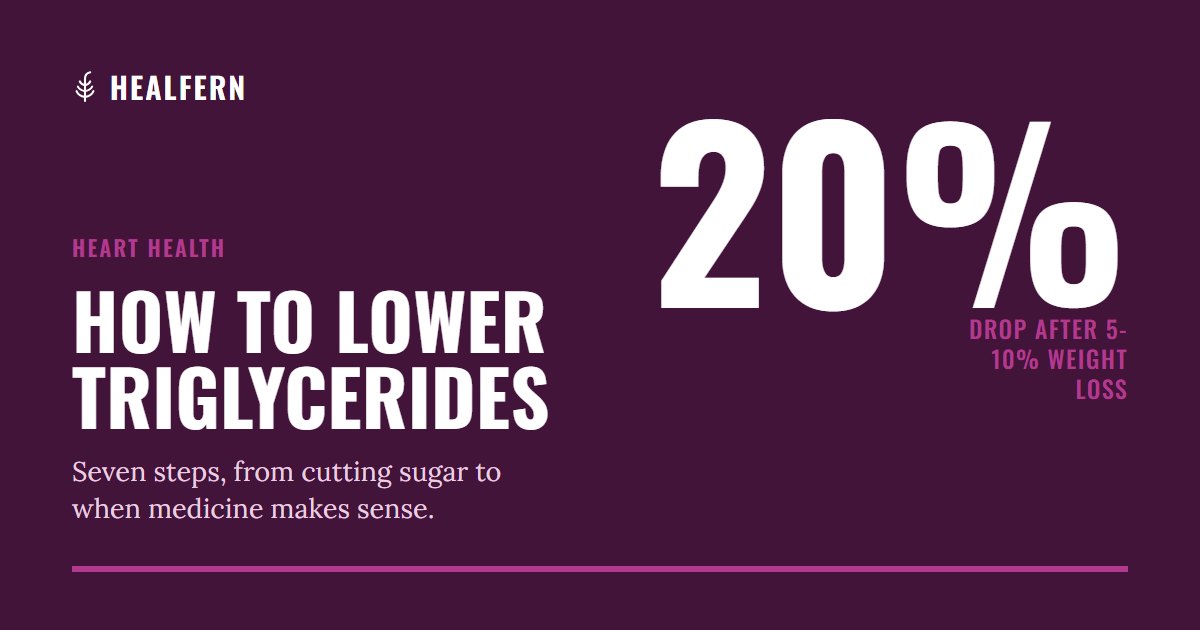
To lower triglycerides, start with weight loss, less added sugar and refined food, less alcohol and regular exercise. Losing 5% to 10% of body weight cut levels by about 20% in studies the American Heart Association reviewed. Fish oil capsules help less than prescription omega-3. Levels above 500 mg/dL raise the risk of pancreatitis and need a doctor's plan.
If you want to know how to lower triglycerides, the habits with the best data are weight loss, less added sugar, less alcohol and regular exercise, with medicine for levels that stay high. We read the NHLBI and MedlinePlus pages on triglycerides, the American Heart Association’s 2011 scientific statement and 2019 omega-3 advisory, five large drug and fish oil trials, and NIH pages on alcohol, activity and pancreatitis. Our research and fact-checking process explains how we pick sources.
The short answer: if you carry extra weight, losing 5% to 10% of it cut triglycerides by about 20% in the studies the AHA reviewed, and cutting sugar and alcohol adds to that.[6]
| What they are | The most common type of fat in the body, made partly from extra calories you do not burn[1] |
|---|---|
| Healthy level | Below 150 mg/dL for adults and below 90 mg/dL for children and teens[1] |
| How common high levels are | Up to one in four adults are affected[1] |
| Biggest lifestyle levers | Weight loss, less sugar and refined food, less alcohol, regular activity and healthier fats[2][6] |
| Fish oil | Prescription omega-3 at about 4 g a day cut levels 25% to 30%; supplements are not FDA-approved to treat high triglycerides[1][6] |
| Main short-term danger | Levels above 500 mg/dL can raise the risk of acute pancreatitis[1] |
| Who needs a doctor’s plan | Anyone with very high levels, or with diabetes, kidney, liver or thyroid disease, which can all raise triglycerides[1] |
What is a healthy triglyceride level?
A healthy fasting triglyceride level for an adult is below 150 mg/dL.[1] NHLBI calls 150 to 199 borderline high, 200 to 499 high, and anything above 500 very high. High triglycerides usually cause no symptoms at all, so a blood test is the only way to find out where you stand.[1][2]
| Category | Fasting level | What it means |
|---|---|---|
| Normal | Below 150 mg/dL | Healthy range[1] |
| Borderline high | 150 to 199 mg/dL | Time for lifestyle changes[1][2] |
| High | 200 to 499 mg/dL | Raises heart and stroke risk[1] |
| Very high | 500 mg/dL and above | Can raise the risk of acute pancreatitis[1] |
| Extremely high | Above 1,500 mg/dL | Can cause multifactorial chylomicronemia syndrome[1] |
Nonfasting numbers count too. NHLBI says levels measured without fasting that stay above 175 mg/dL for a long time can raise the risk of heart problems.[1] The 2018 AHA/ACC cholesterol guideline lists a persistent level of 175 mg/dL or more as a risk-enhancing factor that may favor a statin.[11]
Healthy adults should get a lipoprotein profile, which includes triglycerides, every 5 years.[1] Like high triglycerides, high blood pressure is often silent, which is why our guide to symptoms of high blood pressure is worth a look if you have not had a reading in a while.
How to lower triglycerides: 7 steps in order
The steps with the strongest evidence are weight loss, cutting added sugar and refined carbs, limiting alcohol and regular exercise.[2][6] Combined, these habits lowered triglycerides by 20% to 50% in the studies the American Heart Association reviewed. The list puts the biggest levers first and medicine last.[6]
- Get a baseline test. Ask whether you need to fast; many labs want 9 to 12 hours without food or drink.[3]
- Lose 5% to 10% of your weight if you carry extra. In the AHA review that cut triglycerides by about 20%.[6]
- Cut added sugar and refined foods. The AHA limit is about 6 teaspoons of added sugar a day for women and 9 for men.[6]
- Limit alcohol, and stop completely if your level is very high and your provider advises it.[1]
- Move most days. Aim for 150 to 300 minutes of moderate activity a week, plus muscle work at least 2 days.[16]
- Swap saturated fat for healthier fats and eat fish such as salmon, mackerel, herring and sardines.[2][5]
- Ask about medicine if levels stay high or reach 500 mg/dL, where the pancreas is at risk.[1]
NHLBI also lists quitting smoking, managing stress and getting enough sleep.[1] Many of these moves help blood pressure as well, which we cover in how to lower blood pressure naturally.
What foods lower triglycerides the most?
No single food drives triglycerides down much; what you cut matters more than what you add.[6] Less added sugar and refined food, healthier fats in place of saturated fat, and oily fish give the most reliable results. A Mediterranean-style diet was linked to 10% to 15% lower levels than a low-fat diet.[2][6]
| Change | Effect on triglycerides |
|---|---|
| Lose 5% to 10% of body weight | About 20% lower[6] |
| Mediterranean-style diet instead of low-fat | 10% to 15% lower[6] |
| Each gram of EPA plus DHA a day | 5% to 10% lower per gram[6] |
| Replace trans fat (1% of calories) with other fat | About 1% lower[6] |
| Fructose above 100 g a day | Rises with the dose[6] |
| About 1 oz of alcohol a day | 5% to 10% higher[6] |
Added sugar is a sensible first target, since MedlinePlus names eating more calories than you burn, especially from sugar, as a main cause.[2] The AHA suggests keeping added sugar under 100 calories a day for women and 150 calories for men.[6]
Plant sources of omega-3, known as ALA, have not shown consistent triglyceride drops in studies, so they do not stand in for fish.[6]
Does exercise lower triglycerides?
Yes, exercise lowers triglycerides, and it works best when your level starts above 150 mg/dL.[6] In the studies the AHA statement reviewed, most showed drops of 20% to 30% in that group, mainly when people also ate fewer calories. The effect is smaller when levels are already normal.[6]
The federal activity guidelines call for 150 to 300 minutes of moderate aerobic activity each week, such as brisk walking or fast dancing.[16] They add muscle-strengthening work, like lifting weights or push-ups, at least 2 days a week.[16]
Exercise also works through weight loss: each kilogram lost, about 2.2 pounds, lowered triglycerides by about 1.9% in the studies the AHA pooled.[6] Walking after dinner, a bike commute or a weekend hike all count toward the weekly total.
Is alcohol bad for triglycerides?
Yes, alcohol raises triglycerides, and the rise grows with the amount you drink.[6] The AHA statement estimated that about 1 ounce of alcohol a day matches a 5% to 10% higher level. If your triglycerides are very high, NHLBI says your provider may recommend stopping alcohol use altogether.[1][6]
A US standard drink holds about 0.6 fluid ounces, or 14 grams, of pure alcohol.[15] So 1 ounce of alcohol is a little under 2 standard drinks a day.
For people with very high levels, the AHA strongly recommended complete abstinence to lower the chance of pancreatitis.[6] MedlinePlus also lists excessive alcohol use as a cause of high levels, and alcohol use disorder appears on its list of conditions that raise them.[2][3]
Does fish oil lower triglycerides?
Fish oil does lower triglycerides, but store-bought capsules do less than prescription omega-3.[4] A 2020 review of 23 studies with 43,998 people found EPA and DHA cut triglycerides by about 15%. Prescription products at 4 grams a day lowered very high levels by 30% or more.[4][7]
Prescription omega-3 is made differently from supplements, and supplements are not FDA-approved to treat high triglycerides.[1][4] In people with very high levels, EPA plus DHA products raised LDL cholesterol, while EPA-only products did not.[7]
| Study | Who and how many | What was given | Result |
|---|---|---|---|
| Review cited by NCCIH, 2020 | 23 studies, 43,998 people | EPA and DHA | Triglycerides about 15% lower[4] |
| REDUCE-IT, 2019 | 8,179 statin users with triglycerides of 135 to 499 | Icosapent ethyl 4 g a day, median 4.9 years | Heart events 17.2% vs 22.0%; atrial fibrillation hospital stays 3.1% vs 2.1%[8] |
| STRENGTH, 2020 | 13,078 high-risk statin users | EPA plus DHA 4 g a day vs corn oil | No benefit, 12.0% vs 12.2%; stopped early[9] |
| Gencer meta-analysis, 2021 | 7 trials, 81,210 people | Omega-3 supplements | Atrial fibrillation risk 25% higher, 49% higher above 1 g a day[10] |
REDUCE-IT was funded by the maker of icosapent ethyl, and STRENGTH did not repeat its result. Neither trial tells you what a drugstore capsule will do.[8][9][4] If you already take a statin and are weighing supplements, our look at CoQ10 and statins covers a related question.
Why are my triglycerides high?
High triglycerides usually come from a mix of habits, health conditions, medicines and genes.[1] Eating more calories than you burn, especially from sugar, drinking too much alcohol, smoking and carrying extra weight are common drivers. Type 2 diabetes that is poorly controlled can push levels up as well.[2]
Health conditions that can raise triglycerides include:[1][3]
- Diabetes that is not well controlled
- Kidney disease or liver disease
- Thyroid disease
- Obesity
- Inherited conditions that run in families
Some medicines raise them too, including diuretics (water pills) and some drugs for breast cancer, HIV and, less often, high blood pressure.[1][3] This is why someone who eats well can still get a high result. If diet changes do little, ask your doctor whether a blood sugar or thyroid check, or a review of your medicines, makes sense.[1]
How long does it take to lower triglycerides?
There is no fixed timeline for lowering triglycerides, and none of the NIH or AHA sources we read gives one. Your doctor sets the retest date. What matters most for a fair comparison is testing the same way each time, and many labs ask you to fast 9 to 12 hours before the blood draw.[3]
In the PROMINENT drug trial, pemafibrate had lowered triglycerides by 26.2% when levels were checked at 4 months.[13]
People sometimes search for ways to lower triglycerides fast before a blood test. Following the fasting instructions gives an accurate number, and an accurate number is what guides treatment.[3] If a result comes back very high, the fast step is a call to your doctor, because levels above 500 mg/dL bring a risk of pancreatitis.[1]
What medicine lowers triglycerides?
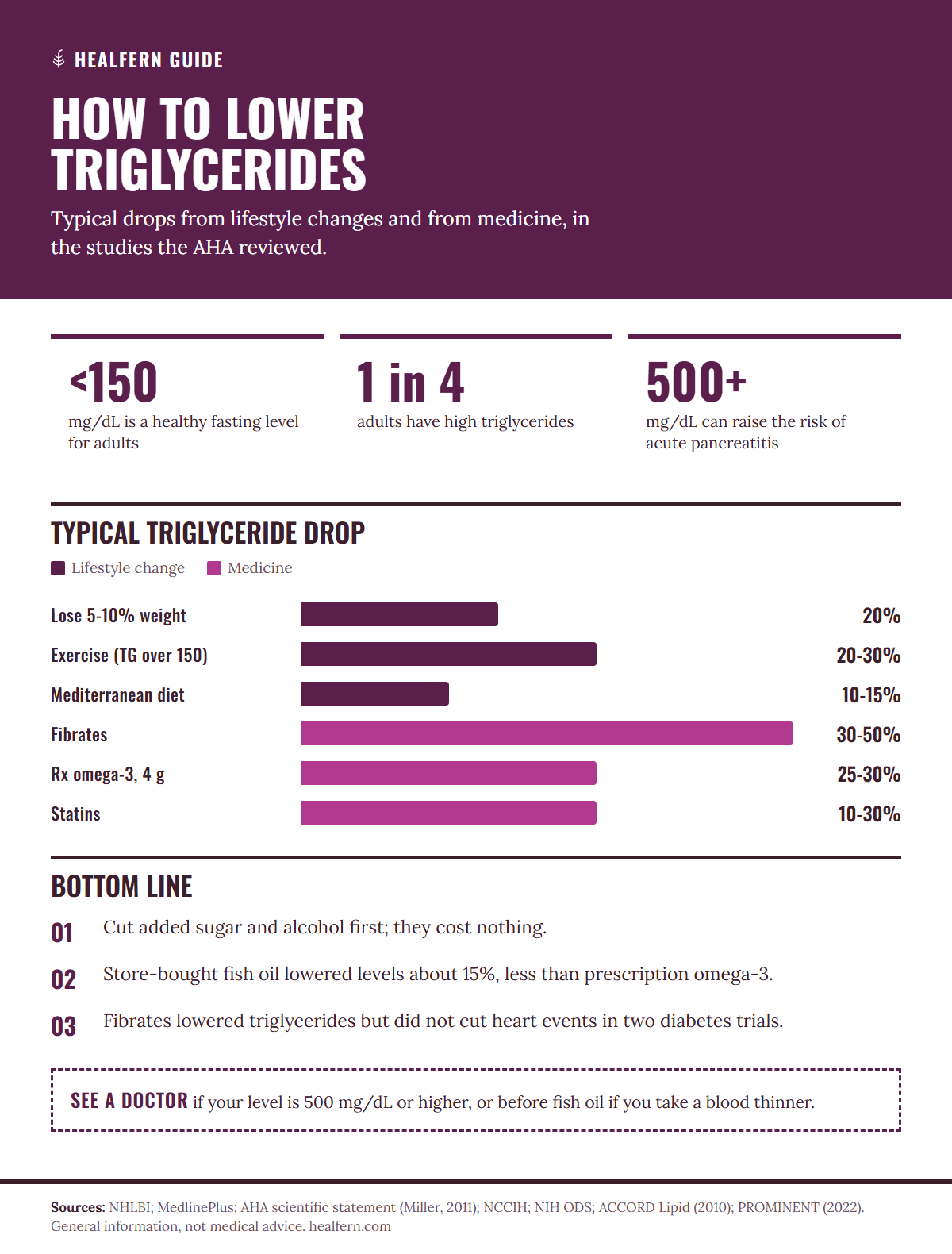
When lifestyle changes are not enough, doctors mostly use statins, fibrates and prescription omega-3.[1] Statins are the most common cholesterol medicine and lowered triglycerides 10% to 30% in the AHA review. Fibrates lowered them 30% to 50%, and very high levels may need more than one medicine.[1][6]
| Medicine | Typical drop |
|---|---|
| Fibrates | 30% to 50%[6] |
| Prescription omega-3 | 20% to 50%[6] |
| Immediate-release niacin | 20% to 50%[6] |
| Statins | 10% to 30%[6] |
| Ezetimibe | 5% to 10%[6] |
A lower number does not always mean fewer heart attacks. In ACCORD Lipid, adding fenofibrate to a statin in 5,518 people with type 2 diabetes did not significantly cut major heart events, at 2.2% vs 2.4% a year.[12] In PROMINENT, pemafibrate lowered triglycerides in 10,497 people with diabetes but did not reduce events.[13]
That is why the 2018 guideline treats lasting high triglycerides mainly as a sign of higher risk that can tip the decision toward a statin.[11] Supplements are not a replacement for any of these medicines.[1]
When are high triglycerides dangerous?
Very high triglycerides, above 500 mg/dL, can lead to acute pancreatitis, a painful swelling of the pancreas.[1] The AHA statement put the clearest risk at 1,000 mg/dL or more, yet only about 20% of people at those levels develop pancreatitis. Over the long term, high levels also raise heart disease and stroke risk.[1][6]
See a doctor right away if you have high triglycerides and any of these:[14]
- Severe or worsening pain in the upper belly, which may spread to your back
- Nausea and vomiting
- Fever or chills
- A fast heartbeat or shortness of breath
- Yellow skin or whites of the eyes
Fish oil and supplement safety
Omega-3 side effects are usually mild: an unpleasant taste, bad breath, headache, heartburn, nausea or diarrhea.[4] High doses may cause bleeding problems in people who take warfarin or other blood thinners.[5] Higher doses were also linked to more atrial fibrillation in the 2021 pooled analysis.[10]
Talk to your doctor before starting fish oil if you take a blood thinner, have a heart rhythm problem, are pregnant or have a scheduled surgery. Do not stop or swap a prescribed medicine for a supplement on your own.
What should you do this week?
Start with the changes that cost nothing and have the best data: less sugar, less alcohol and more movement.[2][6] Then book the test that tells you whether they worked. Use this list as a simple weekly plan, and bring it to your next appointment so your doctor can see what you changed.[1]
- Find your last lipid panel and note your triglyceride number and whether you fasted.[3]
- Check drink labels and cut sugary drinks first; keep added sugar near 6 to 9 teaspoons a day.[6]
- Set a weekly alcohol limit, or stop if your level is above 500 mg/dL.[1]
- Book 150 minutes of brisk walking for the week and 2 short strength sessions.[16]
- Put fish on the menu, such as salmon, sardines or mackerel.[5]
- Write down every medicine you take and ask whether any could raise triglycerides.[1]
- Ask your doctor when to recheck and whether medicine fits your risk.[11]
For more on keeping your heart and arteries healthy, browse our heart health guides.
Bottom line
For most people, the best first step to lower triglycerides is cutting added sugar and alcohol while losing a little weight.[6] Those changes cost little and carry little risk. A 5% to 10% weight loss alone cut levels by about 20%, and adding exercise and better fats can push the total drop higher.[6]
Fish oil capsules are a weaker tool than many people expect, and prescription omega-3 or a fibrate belongs in a doctor’s plan. If your level is above 500 mg/dL, treat it as a medical issue first and a diet project second, because pancreatitis is the near-term risk.[1][4]
Questions people also ask
Can you lower triglycerides in a month?
Possibly, but no NIH or AHA source we read sets a timeline. Drug trials such as PROMINENT checked results at 4 months. Cutting sugar and alcohol and losing some weight are the fastest lifestyle levers, and your doctor decides when to retest.
What lowers triglycerides the fastest?
For very high levels, medicine plus stopping alcohol under a doctor's care is the quickest route. Fibrates lowered triglycerides 30% to 50% in the AHA review. For milder levels, weight loss, less sugar and less alcohol come first.
Why are my triglycerides high but my cholesterol is normal?
Triglycerides and cholesterol are different fats, measured on the same panel. Sugar, alcohol, extra weight, poorly controlled diabetes, thyroid disease and some medicines can raise triglycerides on their own. Ask your doctor which of these fits you.
How can I lower triglycerides without medication?
Lose 5% to 10% of your weight if you carry extra, cut added sugar and refined foods, limit alcohol, and get 150 to 300 minutes of activity a week. Together these habits lowered triglycerides 20% to 50% in AHA-reviewed studies.
Do I need to fast before a triglycerides test?
Often, yes. MedlinePlus says you may need to fast, with no food or drink, for 9 to 12 hours before the blood draw. Your provider will tell you whether fasting is needed and about any other instructions.
Sources
- High Blood Triglycerides, NHLBI, National Institutes of Health
- Triglycerides, MedlinePlus, National Library of Medicine
- Triglycerides Test, MedlinePlus, National Library of Medicine
- Omega-3 Supplements: What You Need To Know, NCCIH, National Institutes of Health
- Omega-3 Fatty Acids: Fact Sheet for Consumers, Office of Dietary Supplements, NIH
- Triglycerides and Cardiovascular Disease: A Scientific Statement From the American Heart Association, Miller et al., Circulation, 2011
- Omega-3 Fatty Acids for the Management of Hypertriglyceridemia: A Science Advisory From the American Heart Association, Skulas-Ray et al., Circulation, 2019
- Cardiovascular Risk Reduction with Icosapent Ethyl for Hypertriglyceridemia (REDUCE-IT), Bhatt et al., New England Journal of Medicine, 2019
- Effect of High-Dose Omega-3 Fatty Acids vs Corn Oil on Major Adverse Cardiovascular Events (STRENGTH), Nicholls et al., JAMA, 2020
- Effect of Long-Term Marine Omega-3 Fatty Acids Supplementation on the Risk of Atrial Fibrillation, Gencer et al., Circulation, 2021
- 2018 AHA/ACC Guideline on the Management of Blood Cholesterol, Grundy et al., Circulation, 2019
- Effects of Combination Lipid Therapy in Type 2 Diabetes Mellitus (ACCORD Lipid), ACCORD Study Group, New England Journal of Medicine, 2010
- Triglyceride Lowering with Pemafibrate to Reduce Cardiovascular Risk (PROMINENT), Das Pradhan et al., New England Journal of Medicine, 2022
- Symptoms and Causes of Pancreatitis, NIDDK, National Institutes of Health
- Drinking Levels and Patterns Defined, NIAAA, National Institutes of Health
- Top 10 Things to Know About the Second Edition of the Physical Activity Guidelines for Americans, ODPHP, US Department of Health and Human Services
This article is general information, not medical advice. These statements have not been evaluated by the FDA, and supplements are not intended to diagnose, treat, cure or prevent any disease. Talk to your doctor or pharmacist before you start a supplement. How we research.