Most people with prediabetes have no symptoms. A few notice dark, velvety skin on the neck or armpits, many skin tags, or thirst and frequent urination when blood sugar runs higher. Only a blood test can tell: an A1C of 5.7% to 6.4% or fasting glucose of 100 to 125 mg/dL. In the DPP trial, 7% weight loss and 150 weekly minutes of activity cut diabetes risk 58%.
Prediabetes symptoms are easy to miss, because most people with prediabetes feel nothing at all. We read the NIDDK and MedlinePlus pages on prediabetes, the American Diabetes Association (ADA) Standards of Care 2026, the US Preventive Services Task Force screening advice and the Diabetes Prevention Program (DPP) trial papers.[1][2][7][9][11]
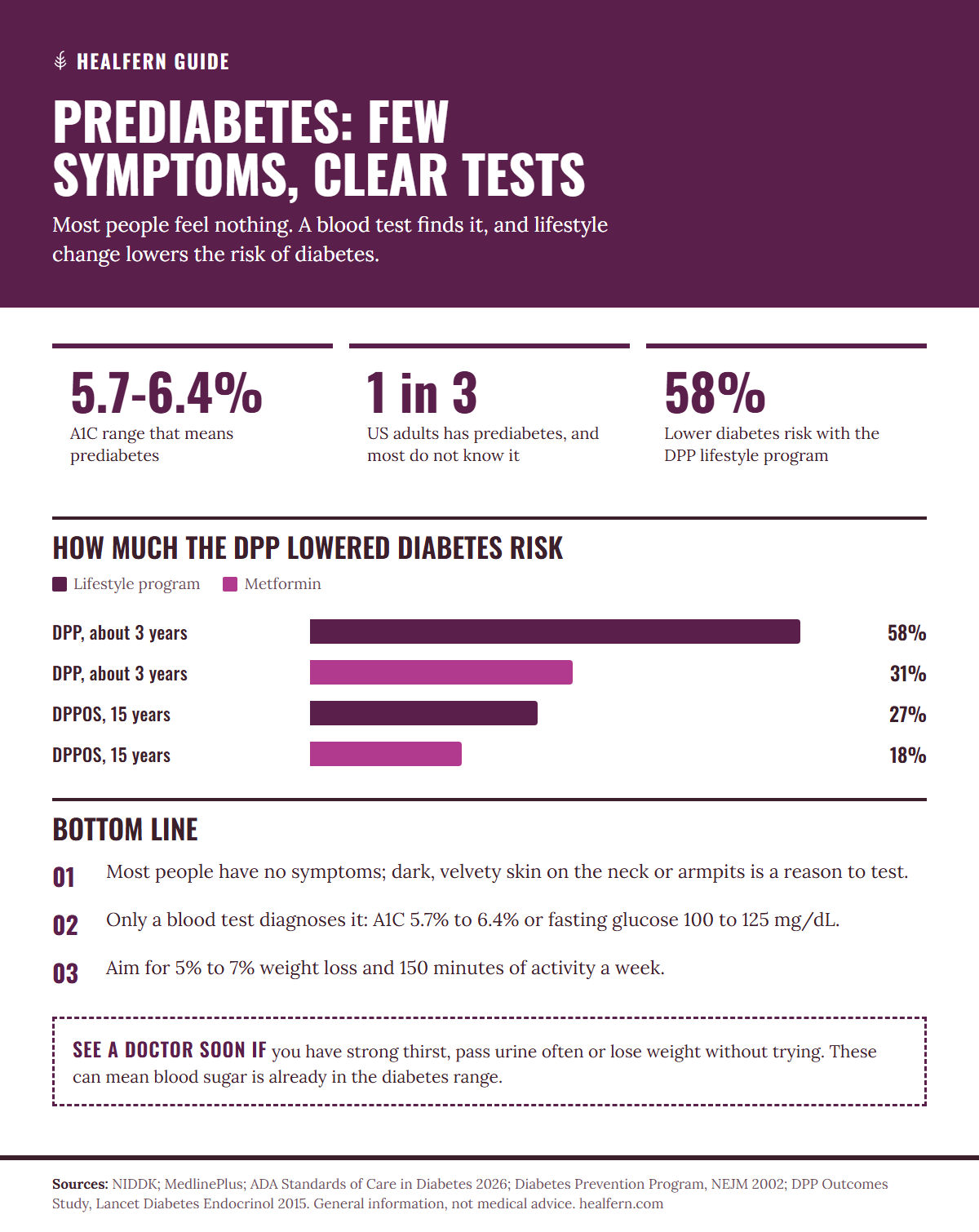
Prediabetes usually causes no symptoms, so a blood test such as an A1C of 5.7% to 6.4% is the only reliable way to know you have it.[1] About 97.6 million US adults had prediabetes in 2021, and in the DPP trial a lifestyle program cut the chance of type 2 diabetes by 58%.[1][11]
| What it is | Blood sugar higher than normal but not high enough to be type 2 diabetes[1] |
|---|---|
| Usual symptoms | None for most people; some get dark, velvety skin on the neck or armpits[2] |
| How common | About 1 in 3 adults[2] |
| How it is found | A1C 5.7% to 6.4%, fasting glucose 100 to 125 mg/dL, or a 2-hour glucose test of 140 to 199 mg/dL[7] |
| Main risk factors | Overweight, age 35 or older, family history, low activity, past gestational diabetes[1] |
| Best evidence for action | The DPP: about 7% weight loss and 150 minutes of activity a week lowered diabetes risk by 58%[11] |
| Retesting | At least once a year after a prediabetes result[8] |
What are prediabetes symptoms?
Most people have no prediabetes symptoms at all, which is why it is usually found on a routine blood test. NIDDK says people with insulin resistance and prediabetes “usually have no symptoms.” MedlinePlus adds that most people do not know they have it.[1][2] When signs do show up, they tend to be on the skin.
The signs that are linked to prediabetes include:
- Dark, thick, velvety skin on the back or sides of the neck, in the armpits or in the groin[2][10]
- Many small skin tags in those same areas[2]
- Repeated yeast infections, which the American Academy of Dermatology (AAD) says are worth asking about[10]
- In some people, the same symptoms as diabetes, such as thirst and passing urine more often[1]
None of these proves you have prediabetes. Plenty of people with skin tags have normal blood sugar, and plenty of people with prediabetes have clear skin. Any of them is still a good reason to get tested.
What are the signs of prediabetes on your skin and neck?
The best-known skin sign is acanthosis nigricans, a dark, velvety patch or band of skin, often on the back of the neck. The AAD says it “could be a sign of pre-diabetes” and may be the first sign someone has diabetes or prediabetes.[10] It can also show up in the armpits and groin.[10]
The patch is linked to insulin resistance, the problem that sits under most prediabetes. The ADA lists acanthosis nigricans as one of the conditions that should prompt a glucose test in an adult with overweight.[7]
Skin tags are small, soft growths that often hang from a tiny stalk. They are common and harmless, but the AAD says having many of them “may be a sign that you have type 2 diabetes,” and MedlinePlus links them to prediabetes too.[2][10]
Other skin problems tied to diabetes, such as shin spots, slow-healing sores and yellow bumps from high blood fats, are more typical of diabetes that has gone on for a while.[10] If you see them, ask for a test without waiting.
Does prediabetes cause frequent urination, thirst or tiredness?
Some people with prediabetes have symptoms like those of diabetes, but this is uncommon and usually means blood sugar is near the diabetes range. NIDDK lists the classic diabetes symptoms as passing urine often, strong thirst, hunger even after eating, blurred vision, fatigue, sores that do not heal and frequent infections.[1][3]
Type 2 diabetes symptoms can build so slowly, over several years, that people do not notice them.[3] So if you have these symptoms, do not assume you are only “pre.” Get a blood test, and see our guide to high blood sugar symptoms and when they need care for more detail.
Tingling, numbness or pain in the feet or hands is a later sign, usually of diabetes rather than prediabetes.[3] A 2012 Lancet review did find links between prediabetes and early nerve and kidney changes, but that evidence comes from observational studies.[14]
See a doctor right away if
- You have strong thirst, pass urine much more often and are losing weight without trying[3][7]
- You feel very tired with nausea, vomiting, belly pain, trouble breathing or fruity-smelling breath; this can be diabetic ketoacidosis, an emergency[3]
- You have a sore, cut or color change on your foot that is not healing[10]
- You have chest pain or sudden vision loss[3]
- You keep getting infections, such as urinary tract, skin or yeast infections[3]
NIDDK says anyone with diabetes symptoms should be tested, whatever their last result showed.[4]
What causes prediabetes, and who is at risk?
Prediabetes usually starts with insulin resistance, when muscle, fat and liver cells stop responding well to insulin. The pancreas tries to keep up by making more insulin. Over time it may not make enough, and glucose builds up in the blood.[1] Researchers think extra weight and low activity are major drivers.[2]
NIDDK lists these risk factors:[1]
- Overweight, obesity or a large waist
- Age 35 or older (children and teens can get it too)
- A parent, brother or sister with diabetes
- Being African American, American Indian, Asian American, Hispanic or Latino, or Pacific Islander
- Low physical activity and smoking, including e-cigarettes and secondhand smoke
- Past gestational diabetes or a baby who weighed 9 pounds or more
- PCOS, sleep apnea, Cushing’s syndrome, or long-term use of glucocorticoids, some antipsychotics or some HIV medicines
Waist size matters even at a normal weight. NIDDK puts the risk line at more than 40 inches for men and more than 35 inches for women who are not pregnant.[5] For women, PCOS and past gestational diabetes are the risk factors most often overlooked.[1]
How is prediabetes diagnosed?
Prediabetes is diagnosed with a blood test, not with symptoms. Doctors use the A1C test, the fasting plasma glucose test or the oral glucose tolerance test. One result in the prediabetes range is enough to diagnose it, and the ADA notes that risk rises steeply toward the top of each range.[7]
| Test | Normal | Prediabetes | Diabetes |
|---|---|---|---|
| A1C | Below 5.7% | 5.7% to 6.4% | 6.5% or higher[2][7] |
| Fasting glucose | 99 mg/dL or below | 100 to 125 mg/dL | 126 mg/dL or higher[2][7] |
| 2-hour glucose tolerance test | Below 140 mg/dL | 140 to 199 mg/dL | 200 mg/dL or higher[7] |
The fasting test needs at least 8 hours with nothing but water. You can eat before an A1C test, which reflects your average blood sugar over about 3 months.[4] A1C can be off in later pregnancy, some anemias and some hemoglobin variants, so NIDDK says it may miss prediabetes in some people.[1][4]
A home glucose meter cannot diagnose diabetes or prediabetes.[4]
Who should get tested for prediabetes, and how often?
The USPSTF recommends screening adults aged 35 to 70 who have overweight or obesity, and the ADA says everyone should start testing at 35. People with risk factors may need testing earlier. After a normal result, a repeat every 3 years is reasonable; after a prediabetes result, test every year.[7][8][9]
Here is how the ADA, USPSTF and NIDDK advice applies to common situations.
| If this fits you | Then |
|---|---|
| Age 35 or older | Get tested; repeat at least every 3 years if normal[7] |
| Any age, BMI 25 or higher (23 if Asian American) plus one more risk factor | Get tested now[7][9] |
| Past gestational diabetes | Test at least every 1 to 3 years[7] |
| Already told you have prediabetes | Test at least once a year[8] |
| Child or teen with overweight, from age 10 or puberty | Ask the pediatrician about testing[1] |
| Thirst, frequent urination or weight loss | Get tested soon, whatever your age[4] |
Medicare may cover diabetes tests for people with certain risk factors; other insurers vary.[4]
Can prediabetes be reversed?
Yes, many people can bring blood sugar back to the normal range, and the DPP trial showed lifestyle change works better than medicine. In the DPP, 3,234 adults at high risk aimed for 7% weight loss and 150 minutes of activity a week. Their risk of type 2 diabetes fell 58% over about 3 years.[6][11]
A 2012 Lancet review estimated that 5% to 10% of people with prediabetes progress to diabetes each year, while a similar share return to normal.[14] DPP participants who got back to normal, even for a while, had a 56% lower diabetes risk later.[13]
| Study | Who and how long | Lifestyle result | Metformin result |
|---|---|---|---|
| DPP, NEJM 2002 | 3,234 adults, average 2.8 years | 58% lower risk[11] | 31% lower risk[11] |
| DPP, age 60 and older | Same trial, older group | 71% lower risk[6] | Not reported here |
| DPPOS, Lancet 2015 | 2,776 adults, 15 years | 27% lower risk[12] | 18% lower risk[12] |
| DPPOS, ADA 2026 | 21 years | 24% lower risk[8] | Diabetes-free 2.5 years longer[8] |
The effect fades with time. At 15 years, 55% of the lifestyle group, 56% of the metformin group and 62% of the placebo group had diabetes.[12] Weight loss drove most of the benefit: each kilogram lost cut risk by 16%.[8]
What doctors use first
The ADA’s first step is referral to a diabetes prevention program aimed at 5% to 7% weight loss through a reduced-calorie eating pattern plus at least 150 minutes a week of moderate activity.[8] It names Mediterranean and lower-carbohydrate patterns as options, and our low glycemic foods list can help with meal planning.[8] Online and app-based programs count if they are certified.[8]
Metformin is the main medicine. The ADA says to consider it especially for adults aged 25 to 59 with a BMI of 35 or higher, a fasting glucose of 110 mg/dL or higher, an A1C of 6.0% or higher, or past gestational diabetes.[8] People on it long term should have vitamin B12 checked now and then.[8]
Do supplements help?
NCCIH says the evidence for chromium, cinnamon and berberine is weak, with small, mixed studies and “no clear conclusions.”[15] Our review of berberine for weight loss covers that research. Berberine may interact with medicines and should not be used in pregnancy or while breastfeeding.[15] No supplement replaces a prevention program or medical care.[15] NCCIH also notes that the FDA has warned about products sold as a natural diabetes cure or a replacement for diabetes medicine, which are marketed illegally.[15]
Is prediabetes dangerous if you ignore it?
Prediabetes is a warning state, and many people who leave it alone develop type 2 diabetes within 5 to 10 years. It also raises the chance of heart disease and stroke, according to MedlinePlus.[1][2] Not everyone progresses, though, and the risk can be lowered.[1]
NIDDK says some people with prediabetes already have changes in their blood vessels. Prediabetes often comes with high blood pressure, unhealthy cholesterol and triglyceride levels, metabolic syndrome and fatty liver disease.[1]
In the DPP follow-up, people who never developed diabetes had a 28% lower rate of damage to small blood vessels in the eyes, nerves and kidneys.[12] In the original trial, about 7 people had to join the lifestyle program to prevent one case of diabetes over 3 years, compared with about 14 on metformin.[11]
Check with your doctor before starting a new exercise plan if you have heart disease, and before any weight-loss medicine or supplement if you are pregnant or take other medicines.[8][15]
Bottom line
Most people never notice prediabetes symptoms, so waiting for a sign is a poor plan. Dark, velvety neck skin, many skin tags and repeated yeast infections are reasons to test, and an A1C or fasting glucose test settles the question.[2][10][7]
For most people with a prediabetes result, a structured lifestyle program is the better first step than a pill or supplement, because it beat metformin in the DPP and keeps working for years.[11][12] More guides sit in our blood sugar and diabetes section, and you can read how we research our health articles.
Practical checklist
- If you are 35 or older, or younger with overweight and another risk factor, ask for an A1C or fasting glucose test.[7]
- Check your neck, armpits and groin for dark, velvety skin, and mention it to your doctor.[10]
- Measure your waist; over 40 inches for men or 35 inches for women raises risk.[5]
- If you have prediabetes, ask about a CDC-recognized diabetes prevention program; Medicare covers it for eligible people.[6]
- Set a goal of losing 5% to 7% of your weight and moving 150 minutes a week.[8]
- Book a repeat test every year so a change is caught early.[8]
Questions people also ask
Is prediabetes the same as diabetes?
No. Prediabetes means blood sugar is above normal but below the diabetes cutoffs, such as an A1C of 5.7% to 6.4%. Diabetes starts at an A1C of 6.5% or a fasting glucose of 126 mg/dL or higher.
Can a home glucose meter tell me if I have prediabetes?
No. NIDDK says over-the-counter blood glucose meters cannot diagnose diabetes, and the same goes for prediabetes. You need a lab A1C, fasting plasma glucose or glucose tolerance test ordered by a health care professional.
Does prediabetes require medication?
Usually not at first. The ADA puts a lifestyle program aimed at 5% to 7% weight loss first. Doctors may add metformin for higher-risk adults, such as those with a BMI of 35 or more or past gestational diabetes.
Can children get prediabetes?
Yes. NIDDK says children and teens can develop insulin resistance and prediabetes, though risk rises with age. Doctors start testing children with overweight or obesity at age 10 or at puberty, whichever comes first.
Can prediabetes cause weight loss?
Unplanned weight loss is not a typical prediabetes sign. Combined with strong thirst and frequent urination, it is a classic symptom of high blood sugar and diabetes, so it calls for a prompt blood test.
Sources
- Insulin Resistance & Prediabetes, NIDDK, NIH, reviewed 2025
- Prediabetes, MedlinePlus, National Library of Medicine
- Symptoms & Causes of Diabetes, NIDDK, NIH
- Diabetes Tests & Diagnosis, NIDDK, NIH
- Risk Factors for Type 2 Diabetes, NIDDK, NIH
- Diabetes Prevention Program (DPP), NIDDK, NIH
- 2. Diagnosis and Classification of Diabetes: Standards of Care in Diabetes 2026, American Diabetes Association, Diabetes Care, 2026
- 3. Prevention or Delay of Diabetes and Associated Comorbidities: Standards of Care in Diabetes 2026, American Diabetes Association, Diabetes Care, 2026
- Prediabetes and Type 2 Diabetes: Screening, US Preventive Services Task Force, 2021
- Diabetes: 10 warning signs that can appear on your skin, American Academy of Dermatology
- Reduction in the incidence of type 2 diabetes with lifestyle intervention or metformin, New England Journal of Medicine, Diabetes Prevention Program Research Group, 2002
- Long-term effects of lifestyle intervention or metformin on diabetes development and microvascular complications over 15-year follow-up: the Diabetes Prevention Program Outcomes Study, Lancet Diabetes & Endocrinology, DPP Research Group, 2015
- Effect of regression from prediabetes to normal glucose regulation on long-term reduction in diabetes risk: results from the DPPOS, Lancet, Perreault et al., 2012
- Prediabetes: a high-risk state for diabetes development, Lancet, Tabak et al., 2012
- Diabetes and Dietary Supplements, NCCIH, NIH
This article is general information, not medical advice. These statements have not been evaluated by the FDA, and supplements are not intended to diagnose, treat, cure or prevent any disease. Talk to your doctor or pharmacist before you start a supplement. How we research.