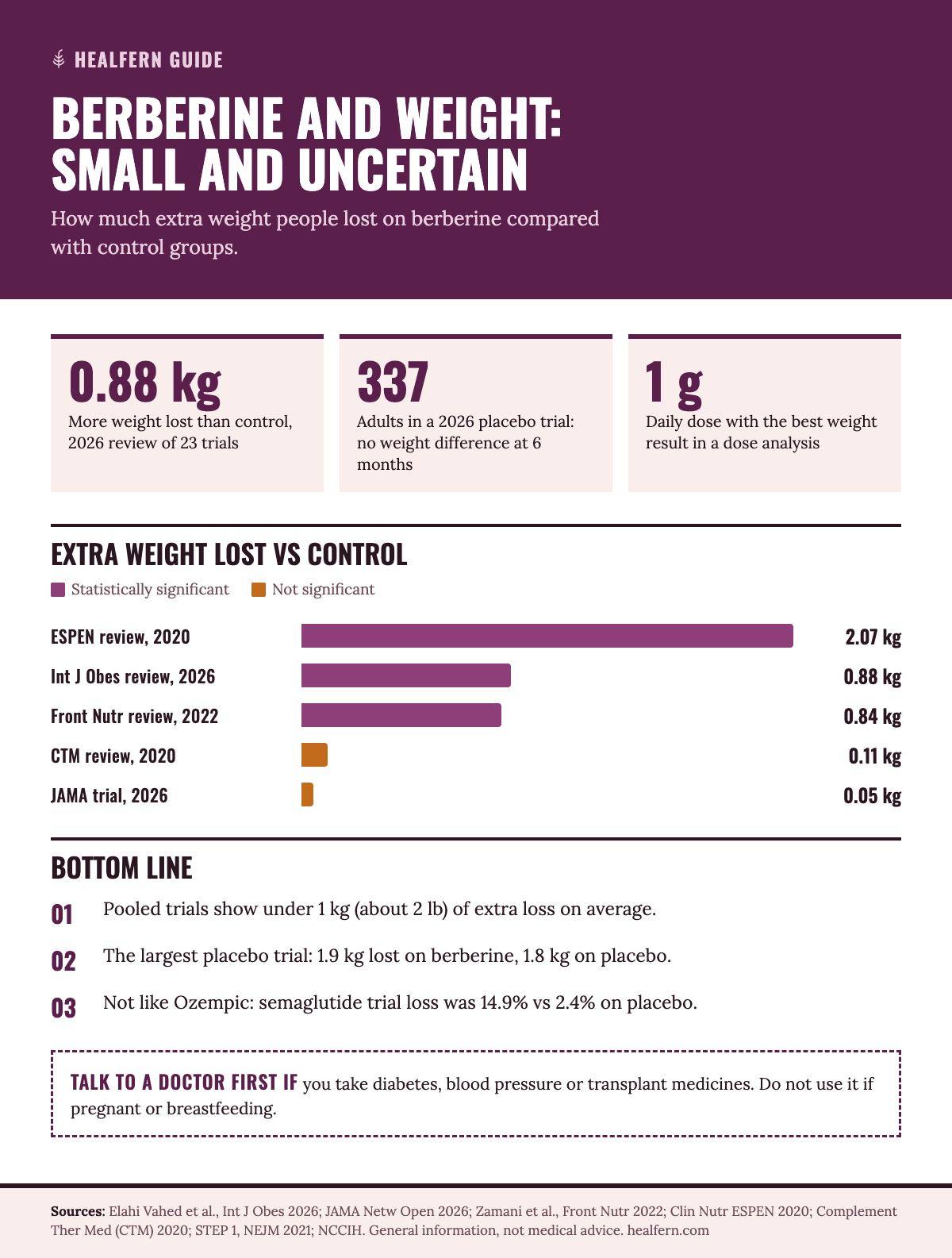
Berberine helps very little with weight loss. A 2026 review of 23 trials found people lost about 0.88 kg (roughly 2 pounds) more than control groups, and a 2026 trial of 337 adults found no difference from placebo after 6 months. Its clearer effects are on blood sugar and cholesterol. It causes stomach side effects and interacts with several medicines.

We read four meta-analyses of berberine and body weight, the largest placebo-controlled berberine trial in people with obesity (published in JAMA Network Open in 2026), two NCCIH fact sheets, a human drug interaction study and NIDDK’s guidance on treating obesity. We also read the STEP 1 semaglutide trial, because berberine is often sold as a natural stand-in for that drug.
The short answer: berberine may take off about 1 to 2 pounds on average in trials, and the best-run recent trial found no extra weight loss over placebo[3][4].
| What it is | A plant compound found in barberry, goldenseal, goldthread, Oregon grape and tree turmeric, long used in Ayurvedic and traditional Chinese medicine[1]. |
|---|---|
| Studied for | Blood sugar, cholesterol, body weight and other health outcomes[2]. |
| Amounts studied | 200 to 1,000 mg two to three times a day[1]. Many weight trials used 1 g a day in split doses[4][5]. |
| Best evidence on weight | A 2026 pooled analysis of 23 trials found 0.88 kg (about 1.9 lb) more loss than control[3]. A 2026 trial of 337 adults found no difference from placebo[4]. |
| Safety | Considered safe at studied doses. Nausea, diarrhea, bloating and constipation are the common side effects[1]. |
| Who should avoid it | Pregnant or breastfeeding people and infants; anyone on prescription medicines should ask a clinician first[1][10]. |
Does berberine help with weight loss?
A little, at best. Pooled trials show an average extra loss of under 1 kg (about 2 pounds) compared with control groups. The largest and best-controlled recent trial found no difference at all. Berberine is not a strong weight-loss tool, and the small average effect is uncertain.
The most recent pooled analysis, published in the International Journal of Obesity in 2026, combined 23 randomized trials. People taking berberine lost 0.88 kg more than control groups, and their waist measurement fell by about 1.3 units more[3]. Waist-to-hip ratio did not change[3].
A 2022 dose-response analysis in Frontiers in Nutrition found almost the same weight result: 0.84 kg more than control, with BMI down 0.25 points[5]. Those numbers are averages across trials that differ a lot in who took part, the dose and how carefully they were run.
Then there is the JAMA Network Open trial. It gave 337 adults with obesity and fatty liver either 1 g of berberine a day or a placebo for 6 months, with lifestyle advice for everyone. The berberine group lost 1.9 kg and the placebo group lost 1.8 kg, a gap of 0.05 kg[4]. Visceral (belly) fat and liver fat did not differ either[4].
What do the major berberine weight studies show?
They disagree. Two 2020 meta-analyses of 12 trials each reached opposite answers on body weight. One found about 2 kg of extra loss, while the other found no significant change. The newer 2026 pooled analysis lands in between, and the biggest single trial found nothing beyond placebo.
| Study | Who and how many | Dose and length | Weight result |
|---|---|---|---|
| Elahi Vahed et al., International Journal of Obesity, 2026[3] | 23 randomized trials in adults | Varied | 0.88 kg more loss than control; waist down; waist-to-hip ratio unchanged |
| JAMA Network Open trial, 2026[4] | 337 adults with obesity and fatty liver, no diabetes | 0.5 g twice a day, 6 months | 1.9 kg vs 1.8 kg on placebo; no real difference |
| Zamani et al., Frontiers in Nutrition, 2022[5] | Randomized trials in adults | Best result near 1 g a day | 0.84 kg more loss than control |
| Clinical Nutrition ESPEN review, 2020[6] | 12 trials | Varied | 2.07 kg more loss than control |
| Complementary Therapies in Medicine review, 2020[7] | 12 trials, 849 people (berberine or barberry) | Varied | 0.11 kg, not a significant change in weight or BMI |
| Hu et al., Phytomedicine, 2012[8] | Small pilot in adults with obesity | 500 mg three times a day, 12 weeks | About 5 lb average loss, no placebo comparison reported |
The 2020 review that found the 2.07 kg loss also reported small drops in BMI (0.47 points), waist size (1.08 cm) and C-reactive protein, a marker of inflammation (0.42 mg/L)[6]. The other 2020 review, which pooled berberine and barberry trials, found only a small drop in waist-to-hip ratio[7].
The 2012 pilot study reported an average loss of about 5 pounds over 12 weeks[8]. Without a placebo group, there is no way to know how much of that came from berberine and how much from simply being in a study.
Why do berberine weight studies disagree so much?
Because most of the trials are small, short and not built to measure weight. Many enrolled people with diabetes or fatty liver and tracked weight as a side outcome. The 2026 review authors asked future trials to report product purity and fix weak blinding and randomization[3].
Small trials and side outcomes
When a trial is designed around blood sugar or cholesterol, weight is often an afterthought. Small studies also swing more by chance, so a pooled average built from many of them can shift a lot when a few studies are added or removed. That helps explain how two reviews of 12 trials each, published the same year, landed on 2.07 kg and on no significant change[6][7].
Who was studied
NCCIH notes that the 46-study berberine review it summarizes (4,158 people with type 2 diabetes) drew mostly on studies of Chinese patients, and that some of those studies were of poor quality[1]. Results from one population may not carry over to others.
What was in the capsule
The 2026 review flagged that many trials did not report purity, potency or exact amounts[3]. If the product varies, so will the result. The JAMA trial avoided this by using a pharmaceutical-grade tablet, and it is also the trial that found no weight effect[4].
How does berberine work in the body?
Lab research suggests berberine switches on an energy-sensing enzyme called AMP kinase. That pushes cells to burn more glucose and fat and make less new fat. In people, the clearest effects show up in blood sugar, insulin resistance and cholesterol, not in body weight[1][4].
The JAMA trial authors describe this mechanism: activation of AMP kinase, more use of glucose and fatty acids, and less fat production in the liver[4]. NCCIH says berberine may lower blood glucose, reduce insulin resistance and improve how the body handles fats in people with type 2 diabetes[1].
A 2022 pooled analysis put numbers on those effects. Compared with control groups, berberine lowered A1C by 0.45 points, fasting glucose by 7.74 mg/dL and triglycerides by 23.70 mg/dL[5]. In the JAMA trial, LDL cholesterol fell 7.72 mg/dL more than with placebo, even though weight did not move[4].
One more wrinkle: very little berberine reaches the bloodstream. A 2026 review cites oral bioavailability of 0.68% in rats and low blood levels in people[11]. NCCIH makes a similar point about goldenseal, saying very little berberine may be absorbed when people take the herb by mouth[2]. Much of what berberine does may happen in the gut and liver, which is also why it can interact with medicines.
If your real goal is steadier blood sugar, our guide to the low glycemic foods list covers the food side, which has stronger support.
Is berberine really nature’s Ozempic?
No. The nickname is marketing. Semaglutide, the drug in Ozempic and Wegovy, produced about 15% weight loss in its main obesity trial. Berberine’s best pooled estimate is under 1 kg beyond control, and the strongest recent trial found no difference from placebo[3][4][14].
A 2026 review of berberine drug interactions notes that berberine has been popularized as “nature’s Ozempic”[11]. The numbers do not support the comparison.
| Measure | Berberine | Semaglutide 2.4 mg weekly |
|---|---|---|
| Main trial size and length | 337 adults, 6 months[4] | 1,961 adults, 68 weeks[14] |
| Weight change vs placebo | 1.9 kg vs 1.8 kg, no real difference[4] | 15.3 kg vs 2.6 kg[14] |
| Percent of body weight | Not reported as a main outcome[4] | 14.9% vs 2.4%[14] |
| Pooled average across trials | 0.88 kg more than control[3] | Not applicable |
| Regulation | Sold as a dietary supplement | Prescription medicine |
STEP 1 was funded by the drug’s maker, Novo Nordisk, and it also had side effects: nausea and diarrhea were the most common[14]. Whether a prescription weight-loss medicine makes sense for you is a decision to make with a clinician.
How much berberine is used in studies?
The trials we read used 900 mg to 1,500 mg a day, split into two or three doses. NCCIH describes 200 to 1,000 mg taken two to three times a day as the range used in clinical settings. A dose-response analysis found the best weight result near 1 g a day[1][5].
- JAMA Network Open trial: 0.5 g twice a day, after breakfast and dinner, for 6 months[4].
- Hu pilot: 500 mg three times a day for 12 weeks[8].
- Yin diabetes trial: 0.5 g three times a day for 3 months[9].
- Drug interaction study: 300 mg three times a day for 2 weeks[10].
More is not better here. The Frontiers in Nutrition analysis found 1 g a day was the most effective dose for weight, triglycerides and total cholesterol[5]. The JAMA trial authors chose 1 g a day because higher doses were linked to more stomach and bowel problems[4].
What is the best time to take berberine for weight loss?
No study has compared times of day for weight loss, so there is no proven best time. Trials split the daily amount into two or three doses taken with or right after meals. That pattern is the one with safety data behind it[4][8][9].
The JAMA trial gave doses after breakfast and after dinner[4]. The older trials used three doses a day, one per meal[8][9].
Splitting the dose fits what is known about berberine’s poor absorption: the body takes in very little at a time[11]. If you take a diabetes medicine, timing matters for a different reason. Berberine adds to blood-sugar lowering, so a clinician should help you plan doses to avoid lows[11].
What are the side effects of berberine?
The common side effects are digestive: nausea, diarrhea, bloating and constipation. They are usually mild to moderate. In one diabetes trial about a third of people had short-lived stomach problems, but in the 2026 trial side effects were about as common as with placebo[1][4][9].
Stomach and bowel effects
In the 2008 Yin trial, 20 people (34.5%) had passing digestive side effects at 0.5 g three times a day[9]. The 2026 JAMA trial, at 1 g a day, reported a similar rate of adverse events in the berberine and placebo groups[4]. That trial had a 30-day run-in, though, and people who could not tolerate berberine were dropped before the main study began[4], so the real-world rate may be higher.
Liver, kidneys and blood sugar
The Yin trial found no liver or kidney damage[9], and the 2012 Hu pilot found no harmful changes in blood, heart, liver or kidney tests[8]. Low blood sugar was about as common with berberine as with placebo in people without diabetes[4]. The risk rises when berberine is combined with diabetes medicines, and the same goes for blood pressure drugs[11].
Who should not take berberine?
Do not take berberine if you are pregnant or breastfeeding, and never give it to an infant. Talk with your clinician first if you take any prescription medicine, especially diabetes drugs, blood pressure drugs, cyclosporine or other medicines that need tight dosing[1][10][11].
Pregnancy, breastfeeding and infants
NCCIH says berberine should not be used during pregnancy or while breastfeeding and should not be given to infants. Exposure has been linked to a harmful buildup of bilirubin in infants, which can cause brain damage[1].
People on medicines
In a 2012 human study, 2 weeks of berberine at 300 mg three times a day reduced the activity of three liver enzymes, CYP2D6, CYP2C9 and CYP3A4. These enzymes break down many common drugs[10]. Blood levels of a test drug cleared by CYP3A4 rose by about 40%[10].
The clearest real-world example is cyclosporine, a transplant drug. Berberine raised cyclosporine exposure by 34.5% in kidney transplant patients[11]. The same review lists added risks of low blood sugar, low blood pressure and heart rhythm changes when berberine is taken with drugs that do the same[11].
Goldenseal, a common berberine source, also changed metformin. Blood levels of metformin fell about 25% in healthy adults who took goldenseal extract with it, enough to possibly weaken glucose control[2]. If you have diabetes, read our guide to high blood sugar symptoms and keep your doctor in the loop before adding any supplement.
What do doctors use first for weight loss?
Lifestyle change comes first: an eating plan that cuts calories, at least 150 minutes a week of moderate activity, and regular tracking and support. When that is not enough, doctors may add prescription weight-loss medicines, and for some people surgery. Supplements are not part of the standard plan[12].
NIDDK says losing 5% of your body weight over 6 months can be a good first goal. For a 200-pound person, that is 10 pounds[12]. Successful programs usually include 14 or more counseling sessions over 6 months, daily tracking of food and activity, and weekly weigh-ins[12].
Weight-loss surgery may be an option for people with a BMI of 35 or higher[12]. For a starting calorie number, see our guide on how many calories to eat to lose weight.
NCCIH’s view of supplements for diabetes applies here too. For a few products, berberine included, the evidence of benefit is weak, and the studies are small and too varied to reach clear conclusions[1].
How do you choose a berberine supplement if you still want to try it?
Look for a single-ingredient berberine product with the amount per capsule clearly listed, skip blends that promise fast weight loss, and avoid anything sold as a fat burner. The FDA warns that many weight-loss pills and teas are tainted with hidden drug ingredients[13].
Dietary supplements are not approved by the FDA before they are sold, and the rules for making them are less strict than for drugs[2]. NCCIH also notes that some goldenseal products contained herbs or ingredients not listed on the label, in addition to or instead of goldenseal[2]. The FDA says contaminated weight-loss products are sometimes falsely advertised as dietary supplements and often carry many positive reviews[13].
Product strength also varies by country. A 2026 review found that national limits on berberine in Europe differ by more than a factor of ten[11]. Our label reading guide explains what to check on any supplement facts panel.
What should you track if you try berberine?
Track your weight weekly, your waist monthly and any stomach side effects. If you have diabetes or prediabetes, also track blood sugar with your care team. Give it about 3 months, the length of several trials, and stop if nothing changes[8][9][12].
Weekly weigh-ins are part of the NIDDK program model, along with daily tracking of food and activity[12].
Measure your waist too. The 2026 pooled analysis found a small drop in waist size along with weight[3], although the JAMA trial found the same waist change with placebo[4].
Lab numbers may be where you see a change, if you see one. The JAMA trial found lower LDL cholesterol with berberine but no weight difference[4]. Ask your doctor whether to check cholesterol and A1C before you start and again after a few months.
Is berberine worth the cost for weight loss?
For weight loss alone, probably not. You would be paying every month for an average extra loss of about 1 to 2 pounds in pooled trials, and none in the strongest recent trial. Money spent on food changes or activity is better supported[3][4][12].
The case is a little stronger for people who mainly care about blood sugar or cholesterol, since that is where berberine’s effects are clearest[1][5]. Even then, NCCIH calls the evidence for diabetes weak, so treat it as an add-on to your care plan[1]. Our guide to cinnamon for blood sugar covers another popular option with similar limits.
Practical checklist before you take berberine
- Ask your doctor or pharmacist first if you take any prescription medicine, especially for diabetes, blood pressure or a transplant[10][11].
- Do not use it if you are pregnant, breastfeeding or trying to give it to a child or infant[1].
- Choose a single-ingredient product with mg per capsule listed; avoid fat-burner blends[13].
- Stay near studied amounts, about 1 g a day in split doses with meals; more is not better[4][5].
- Keep your eating and activity plan going; that is where most weight loss comes from[12].
- Stop if you get ongoing nausea, diarrhea or constipation, or your blood sugar runs low, and call your clinician[1][11].
- Recheck weight, waist and labs after about 3 months and decide whether it is earning its place[8][9].
More guides on this topic are in our blood sugar and diabetes section, and you can read how we research our articles.
Verdict: should you take berberine for weight loss?
Berberine is a real compound with measurable effects on blood sugar and cholesterol, but its effect on weight is small and shaky. Pooled trials show less than 1 kg on average, and the largest placebo-controlled trial found no extra loss at all[3][4].
Our judgment: do not buy berberine to lose weight. If you and your doctor want to try it for blood sugar or cholesterol, any weight change is a bonus. Check your medicines first, because berberine affects how the body clears several common drugs[10][11].
Questions people also ask
Does berberine help with weight loss?
Only a little, if at all. A 2026 review of 23 trials found about 0.88 kg more weight loss than control groups, while a 2026 trial of 337 adults taking 1 g a day for 6 months found no difference from placebo.
What is the best time to take berberine for weight loss?
No study has tested timing for weight loss. Trials split the daily amount into two or three doses taken with or after meals, such as 0.5 g after breakfast and dinner. If you take diabetes medicine, plan timing with your clinician.
What are the side effects of berberine?
The common ones are nausea, diarrhea, bloating and constipation. In a 2008 trial, 34.5% of people had short-lived stomach problems. Berberine can also add to the effects of blood sugar and blood pressure medicines.
Is berberine the same as Ozempic?
No. Semaglutide, the drug in Ozempic and Wegovy, led to 14.9% weight loss versus 2.4% on placebo over 68 weeks. Berberine's best pooled estimate is under 1 kg beyond control, and it is sold as a supplement, not a medicine.
How much berberine do studies use?
NCCIH describes 200 to 1,000 mg two to three times a day as the range used clinically. A dose-response analysis found the best weight result near 1 g a day, and higher doses bring more stomach side effects.
Who should not take berberine?
People who are pregnant or breastfeeding, and infants, should not take it. Anyone on prescription drugs, especially diabetes medicines, blood pressure drugs or cyclosporine, should talk with a clinician first because berberine changes how the body handles several medicines.
Sources
- Diabetes and Dietary Supplements: What You Need To Know, NCCIH, 2023
- Goldenseal, NCCIH, 2025
- The effect of berberine on obesity indices: a systematic review and meta-analysis, International Journal of Obesity, 2026
- Berberine and Adiposity in Diabetes-Free Individuals With Obesity and MASLD: A Randomized Clinical Trial, JAMA Network Open, 2026
- The effects of berberine supplementation on cardiovascular risk factors in adults: a systematic review and dose-response meta-analysis, Frontiers in Nutrition, 2022
- The effect of berberine supplementation on obesity parameters, inflammation and liver function enzymes: a systematic review and meta-analysis, Clinical Nutrition ESPEN, 2020
- Effects of berberine and barberry on anthropometric measures: a systematic review and meta-analysis of randomized controlled trials, Complementary Therapies in Medicine, 2020
- Lipid-lowering effect of berberine in human subjects and rats, Phytomedicine, 2012
- Efficacy of berberine in patients with type 2 diabetes mellitus, Metabolism, 2008
- Repeated administration of berberine inhibits cytochromes P450 in humans, European Journal of Clinical Pharmacology, 2012
- Berberine-Drug Interactions: Mechanisms, Clinical Relevance and Risk Stratification, a narrative review, Pharmaceuticals, 2026
- Treatment for Overweight and Obesity, NIDDK, 2023
- Tainted Weight Loss Products, FDA, 2025 (archived copy)
- Once-Weekly Semaglutide in Adults with Overweight or Obesity (STEP 1), New England Journal of Medicine, 2021
This article is general information, not medical advice. These statements have not been evaluated by the FDA, and supplements are not intended to diagnose, treat, cure or prevent any disease. Talk to your doctor or pharmacist before you start a supplement. How we research.