The acid reflux remedies with the best support are habits: finish eating at least 3 hours before bed, raise the head of your bed 6 to 8 inches, sleep on your left side, lose extra weight and quit smoking. Antacids work fast for occasional heartburn. Heartburn two or more times a week may be GERD and calls for a doctor, who often starts an 8-week PPI trial.
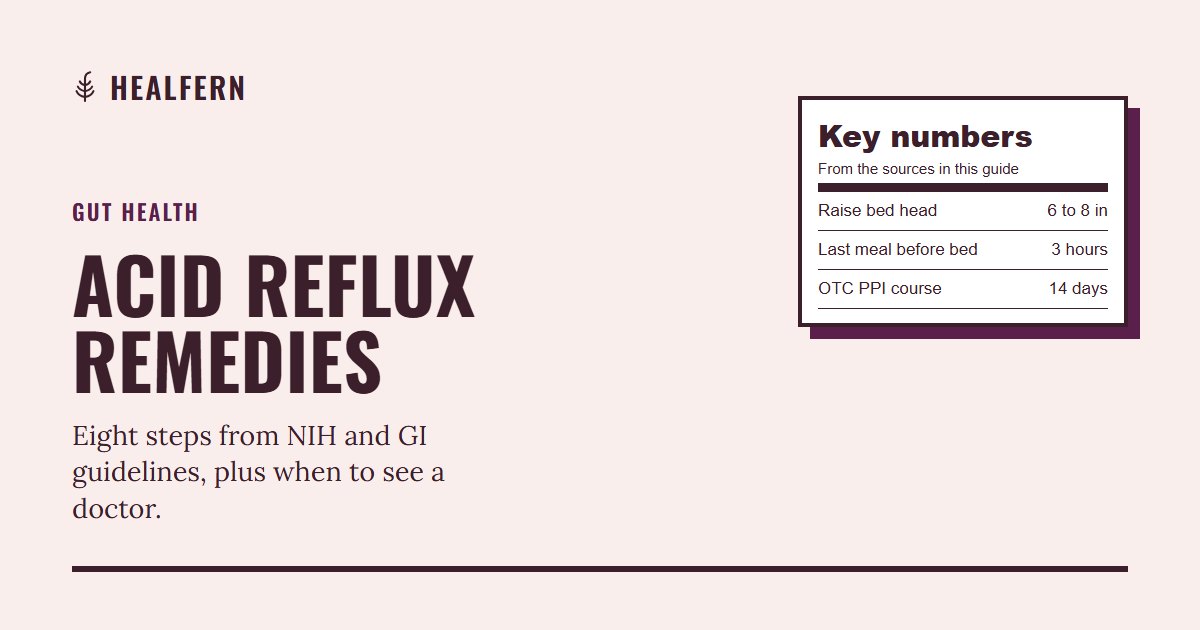
The acid reflux remedies with the best support are simple habits: eat earlier, raise the head of your bed, lose extra weight if you carry it, stop smoking and use the right over-the-counter medicine for short spells.[1][6] We read the NIDDK pages on acid reflux, the 2022 American College of Gastroenterology (ACG) guideline, two FDA safety notices, three clinical studies and NCCIH pages on ginger and peppermint. Our research process explains how we choose and check sources.
The short answer: finish eating at least 3 hours before bed and raise your head 6 to 8 inches at night. If heartburn still shows up two or more times a week, see a doctor about GERD.[3][1][5]
| What it is | Stomach contents coming back up into the esophagus; reflux that is frequent or damages the lining is GERD[2][5] |
|---|---|
| How common | About 20 percent of people in the United States have GERD[4] |
| First steps doctors suggest | Lose weight if needed, raise your head at night, quit smoking and change eating habits[1] |
| Meal timing | Eat at least 3 hours before you lie down or go to bed[3] |
| Fast relief | Antacids for mild symptoms, but not every day unless a doctor agrees[1][12] |
| Strongest medicine | Proton pump inhibitors (PPIs) heal the esophageal lining in most people with GERD[1] |
| See a doctor for | Trouble swallowing, vomiting blood, black stools, weight loss you cannot explain or chest pain[2] |
Acid reflux remedies: 8 steps to try first
The best-supported acid reflux remedies are habits that cut how often acid moves up: meal timing, a raised head at night, weight loss and quitting smoking. NIDDK lists these as the changes doctors suggest first.[1] Start with the steps that fit your routine and keep the ones that help.
- Stop eating 3 hours before bed. Eating at least 3 hours before you lie down may improve night symptoms.[3]
- Eat smaller meals and stay upright. MedlinePlus advises smaller meals, no lying down for 2 to 3 hours after eating, and loose-fitting clothes.[5]
- Raise the head of your bed 6 to 8 inches. Use a foam wedge or extra pillows under your head and upper back.[1]
- Sleep on your left side. Lying right side down increases reflux at night and after meals.[6]
- Lose weight if you are overweight. Women who lowered their BMI by 3.5 or more had 40% fewer frequent reflux symptoms in one study.[6]
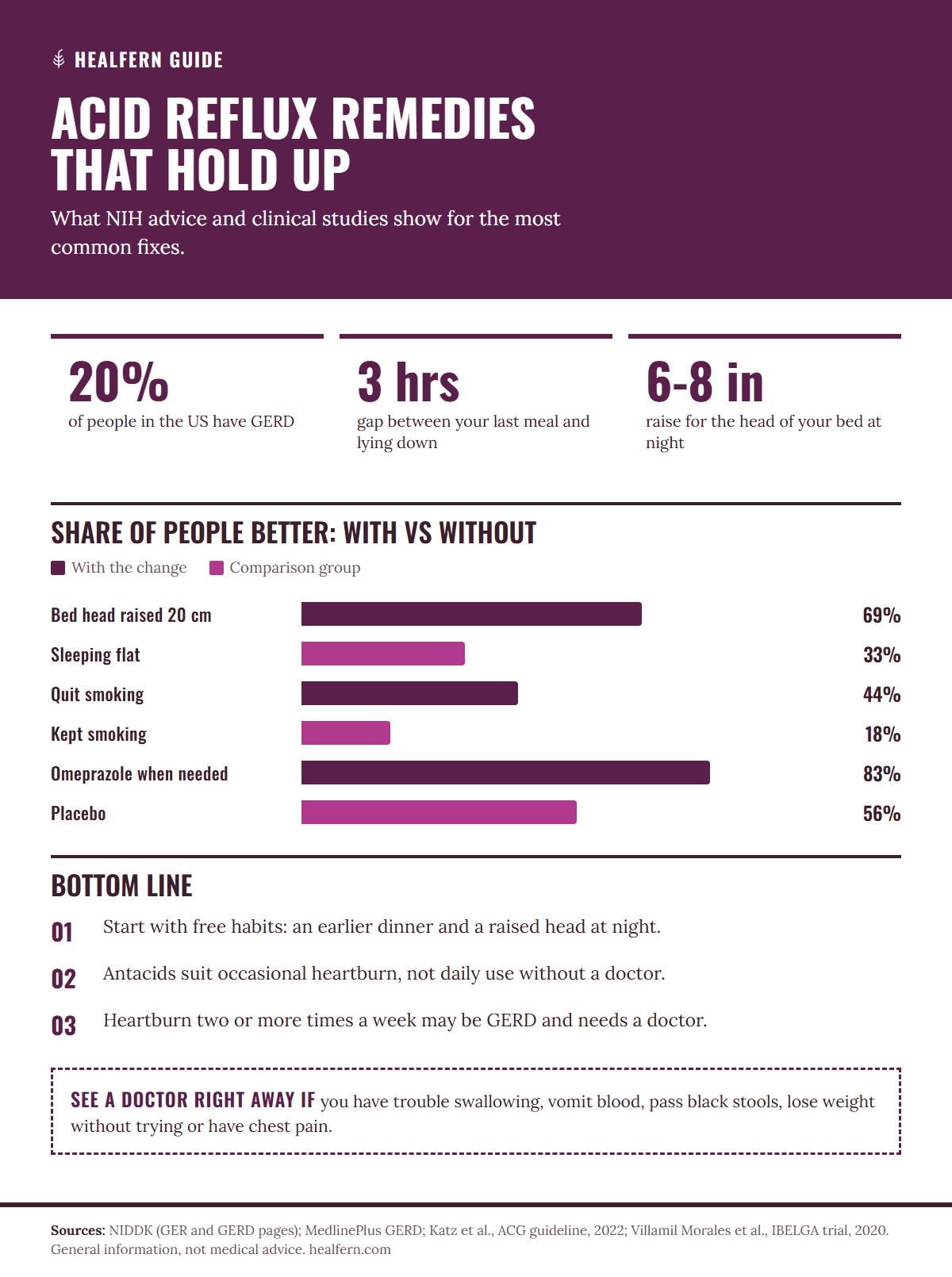
- Quit smoking. People who stayed off tobacco for a year had a 44% improvement in symptoms, against 18% in those who kept smoking.[6]
- Find your own trigger foods. Cut one suspect food at a time and see if symptoms ease.[3]
- Match the medicine to the problem. Use an antacid for an occasional flare, and an H2 blocker or a 14-day PPI course for frequent heartburn.[12][10]
What helps acid reflux fast?
An antacid is the fastest over-the-counter help, because it neutralizes acid already in your stomach. The American Academy of Family Physicians (AAFP) says antacids give fast, short-term relief, while H2 blockers usually start within an hour and last longer.[12] PPIs take a few days to work, so they do not suit a sudden flare.[12]
| Medicine | How fast | Best for | Watch for |
|---|---|---|---|
| Antacids (calcium, magnesium or aluminum) | Fast, short-term[12] | Mild, occasional heartburn[1] | Diarrhea or constipation; not daily without a doctor[1] |
| Alginates | No timing data in our sources | First-line with antacids in pregnancy[6] | Alginate content varies between products[6] |
| H2 blockers, such as famotidine | Usually within an hour[12] | Longer relief than antacids[12] | A bedtime dose lost effect after about a month in one study[6] |
| PPIs, such as omeprazole | Most work in a few days[12] | Heartburn more than 2 days a week[12] | OTC course is 14 days, up to 3 times a year[10] |
Do not take more than one antacid or acid reducer at a time unless a doctor says it is fine.[12] If you have kidney disease, ask a doctor before using antacids.[12]
What helps acid reflux at night?
At night you lose the help of gravity, so the best night remedies are an early last meal, a raised head and sleeping on your left side. NIDDK says eating at least 3 hours before bed may improve symptoms.[3] MedlinePlus also lists left-side sleeping and raising the head of the bed.[5]
These tips rest on small studies that point the same way. A 2016 review found that raising the head of the bed cut the time the esophagus spent exposed to acid while lying down from 21% to 15%. Late evening meals did the opposite.[7]
In the 2020 IBELGA trial, 39 people with GERD slept with the bed head raised 20 cm (about 8 inches) for 6 weeks. Of them, 69.2% improved their symptom scores by the target amount, against 33.3% when they slept flat.[8] Quality of life did not change, and 54% reported side effects, so the authors called for more research.[8]
If you take a PPI, the ACG advises taking it 30 to 60 minutes before a meal, not at bedtime.[6]
Which foods make acid reflux worse?
Foods commonly linked to reflux are citrus, tomatoes, alcohol, chocolate, coffee and other caffeine, high-fat foods, mint and spicy foods. NIDDK notes that triggers differ by person. Your doctor may suggest cutting certain foods to see whether symptoms improve.[3]
The ACG suggests avoiding trigger foods, but rates the evidence as low.[6] In lab studies, coffee, caffeine, citrus and spicy food had little or no effect on the valve between the stomach and esophagus.[6] A short food and symptom diary shows what bothers you, which a fixed list cannot.
We found no NIH source that names foods that relieve reflux. The food changes with the most support are smaller meals and an earlier dinner.[5][3] If gas and fullness come with your heartburn, our guide on how to reduce bloating covers gas and fullness.
Do natural remedies for acid reflux work?
Most popular natural remedies for acid reflux have little research behind them, and two of them, mint and ginger, can cause heartburn. NIDDK lists mint among foods linked to reflux symptoms.[3] NCCIH lists heartburn as a possible side effect of ginger taken by mouth.[13]
Peppermint oil capsules are often enteric-coated, which means they pass the stomach before they open, to lower the chance of heartburn.[14] Heartburn is still a listed side effect of oral peppermint oil.[14] If mint seems to set you off, skip peppermint tea and oil.
We also looked for usable research on baking soda and apple cider vinegar for reflux and found none we could cite, so we do not recommend them. Keep in mind that supplement makers, not the FDA, are responsible for checking the safety and labels of their products before sale.[13]
Fermented foods are a separate gut topic. Our guide to fermented foods for gut health explains what they can do; we found no reflux trials on them in our sources.
How strong is the evidence for each acid reflux remedy?
Weight loss and PPI medicine have the strongest support, while meal timing, a raised bed head and quitting tobacco rest on smaller studies. The ACG gives weight loss a strong recommendation.[6] It rates late-meal avoidance, quitting tobacco and raising the bed head as conditional, based on low-quality evidence.[6]
| Study | Who and how long | What was tested | Result |
|---|---|---|---|
| Ness-Jensen review, 2016[7] | 2 randomized trials of weight loss | Losing weight | Acid exposure fell from 5.6% to 3.7% and from 8.0% to 5.5% |
| IBELGA, 2020[8] | 39 people, 6 weeks per arm | Bed head raised 20 cm | 69.2% improved vs 33.3% sleeping flat |
| Smoking study cited by the ACG[6] | Smokers followed for a year | Quitting tobacco | 44% symptom improvement vs 18% |
| On-demand trial cited by the ACG[6] | People with nonerosive reflux, 6 months | Omeprazole 20 mg when needed | 83% in remission vs 56% on placebo |
| COMPASS, 2019[9] | 17,598 people, about 3 years | Pantoprazole 40 mg daily vs placebo | No safety difference except gut infections, 1.4% vs 1.0% |
Is acid reflux medicine safe to take every day?
Daily PPI use is generally safe when a doctor has confirmed you need it, but over-the-counter PPIs are meant for a 14-day course, up to 3 times a year.[10] NIDDK calls PPIs generally safe and effective, with uncommon side effects such as headache, diarrhea and upset stomach.[1]
PPIs may raise the chance of a C. diff gut infection.[1] In COMPASS, the largest trial on PPI safety, 17,598 people took pantoprazole or placebo for about 3 years. The only clear difference was gut infections, at 1.4% against 1.0%.[9] The ACG says studies linking PPIs to other harms have flaws and are not considered definitive.[6]
The FDA warns that prescription PPIs may cause low magnesium, in most cases after more than a year of use.[10] Fracture risk was highest with high doses or use for a year or more.[11] Ask a doctor before a PPI if you are older, postmenopausal or have had C. diff.[12]
Daily antacids also need a doctor’s input.[1] If a prescribed PPI controls your symptoms, ask your doctor about the lowest dose that works. Do not stop it on your own.[6]
What helps acid reflux during pregnancy?
About two-thirds of pregnant women get heartburn, and the ACG advises starting with lifestyle changes before any medicine. Heartburn can begin in any trimester.[6] When habits are not enough, antacids, alginates and sucralfate are the first-line medicines in pregnancy.[6]
Pregnancy is one of the factors that can weaken the valve at the bottom of the esophagus.[2] The night steps above, such as an earlier dinner and a raised head, carry no drug risk. NCCIH says ginger supplements in pregnancy may be safe, but ginger can also cause heartburn.[13] Check with your prenatal care provider before taking any medicine or supplement.
Can acid reflux be cured permanently?
Habits and medicine control acid reflux for most people, but symptoms often come back when treatment stops. The ACG reports that two-thirds of people with nonerosive reflux whose symptoms improved on PPIs relapse when they stop.[6] Surgery is an option when medicine does not work or you want to stop long-term medicine.[1]
For classic heartburn with no warning signs, the ACG recommends an 8-week trial of a once-daily PPI before a meal.[6] If it works, the next step is to try stopping it or using it only when needed.[6]
Fundoplication is the most common surgery for GERD. A surgeon wraps the top of the stomach around the lower esophagus to strengthen the valve. NIDDK notes that complications are more likely with surgery than with medicine.[1] For people with GERD and obesity, a doctor may suggest weight-loss surgery, most often gastric bypass.[1]
When should you see a doctor for acid reflux?
See a doctor if heartburn happens two or more times a week, does not improve after 2 weeks of over-the-counter medicine, or comes with warning signs.[5][12] Without treatment, GERD can lead to inflammation, a narrowed esophagus and Barrett’s esophagus.[4]
See a doctor right away if you have:
- Chest pain with shortness of breath, dizziness, or pain in your jaw or arm; call 911, because this can be a heart attack[5][12]
- Vomit that has blood in it or looks like coffee grounds[2]
- Stool that is black and tarry or contains blood[2]
- Trouble swallowing or pain when you swallow[2]
- Weight loss you cannot explain, loss of appetite or vomiting that will not stop[2]
Some medicines can cause reflux or make it worse. NIDDK names benzodiazepines, calcium channel blockers, some asthma medicines, NSAIDs and tricyclic antidepressants.[2] Do not stop any of them on your own; ask your doctor whether a change makes sense. A hiatal hernia can also raise the chance of GERD.[2] For people with trouble swallowing, weight loss or bleeding, the ACG recommends an endoscopy as the first test.[6]
Your acid reflux checklist
Use this list to put the remedies into practice: start with the free habits and save medicine for when they fall short. Each item comes from the NIH, MedlinePlus or AAFP advice above.[1][5][12] Work through it for a couple of weeks, then judge what changed.
- Eat dinner at least 3 hours before bed, and keep meals smaller.[3][5]
- Put a foam wedge or extra pillows under your head and upper back to raise it 6 to 8 inches.[1]
- Sleep on your left side and wear loose clothes.[5]
- Keep a two-column diary of foods and symptoms to find your own triggers.[3]
- Use one antacid or acid reducer at a time, and stop an OTC PPI after its 14-day course.[12][10]
- Book a doctor visit if heartburn has not improved after 2 weeks of OTC medicine.[12]
More guides on digestion live in our gut health section.
Bottom line
For most people, the first acid reflux fix to try is meal timing plus a raised head at night, because both cost nothing and NIH advice backs them.[3][1] Add weight loss or quitting smoking if they apply to you, since those changes had the largest effects in the studies we read.[6]
Antacids are fine for an occasional flare. Frequent heartburn, two or more times a week, deserves a doctor visit and often an 8-week PPI trial.[5][6] Mint and ginger, two common herbal fixes, can cause heartburn.[13][14]
Questions people also ask
Can acid reflux cause chest pain?
Yes. NIDDK lists chest pain as a possible GERD symptom, and heartburn itself is a burning feeling behind the breastbone. Chest pain with shortness of breath or pain in the jaw or arm needs emergency care, because it can signal a heart attack.
Can acid reflux cause a cough or a hoarse voice?
It can. MedlinePlus lists a dry cough, a hoarse voice and asthma-like symptoms as signs of GERD, and NIDDK notes that some adults with GERD never feel heartburn at all. A cough that lasts for weeks deserves a doctor visit.
Can acid reflux cause shortness of breath?
GERD can cause asthma-like symptoms and can make asthma worse, according to MedlinePlus. Shortness of breath that comes with chest pain, dizziness or arm pain is different: call 911, because these can be signs of a heart attack.
What is the difference between GER and GERD?
GER is acid reflux that happens once in a while, which is common. GERD is reflux that happens two or more times a week or damages the lining of the esophagus. GERD usually needs a doctor's plan rather than home steps alone.
Is acid reflux in the throat a different problem?
Not usually. Regurgitation means stomach contents rise into the throat or mouth, which can leave a sour taste. NIDDK lists it with heartburn as a common GERD symptom, so the same steps and the same doctor visit apply.
Sources
- Treatment for GER & GERD, NIDDK, National Institutes of Health
- Symptoms & Causes of GER & GERD, NIDDK, National Institutes of Health
- Eating, Diet, & Nutrition for GER & GERD, NIDDK, National Institutes of Health
- Definition & Facts for GER & GERD, NIDDK, National Institutes of Health
- GERD, MedlinePlus, National Library of Medicine
- ACG Clinical Guideline for the Diagnosis and Management of Gastroesophageal Reflux Disease, Katz PO et al., American Journal of Gastroenterology, 2022
- Lifestyle Intervention in Gastroesophageal Reflux Disease, Ness-Jensen E et al., Clinical Gastroenterology and Hepatology, 2016
- Impact of head of bed elevation in symptoms of patients with gastroesophageal reflux disease (IBELGA), Villamil Morales IM et al., Gastroenterologia y Hepatologia, 2020
- Safety of Proton Pump Inhibitors Based on a Large, Multi-Year, Randomized Trial of Patients Receiving Rivaroxaban or Aspirin, Moayyedi P et al., Gastroenterology, 2019
- FDA Drug Safety Communication: Low magnesium levels can be associated with long-term use of Proton Pump Inhibitor drugs (PPIs), US Food and Drug Administration, 2011
- FDA Drug Safety Communication: Possible increased risk of fractures of the hip, wrist, and spine with the use of proton pump inhibitors, US Food and Drug Administration, 2011
- Antacids and Acid Reducers: OTC Relief for Heartburn and Acid Reflux, American Academy of Family Physicians, 2025
- Ginger: Usefulness and Safety, NCCIH, National Institutes of Health
- Peppermint Oil: Usefulness and Safety, NCCIH, National Institutes of Health
This article is general information, not medical advice. These statements have not been evaluated by the FDA, and supplements are not intended to diagnose, treat, cure or prevent any disease. Talk to your doctor or pharmacist before you start a supplement. How we research.