
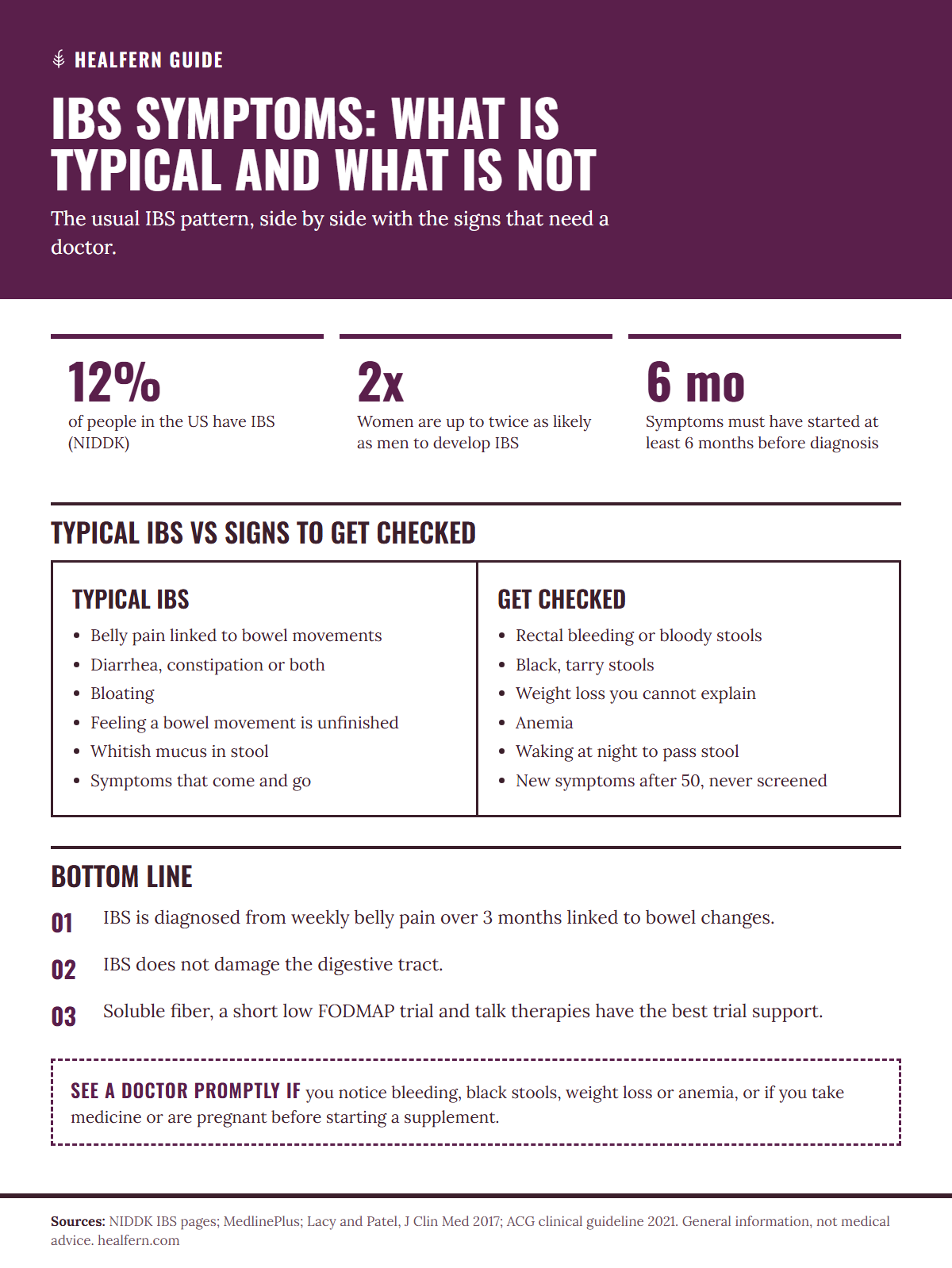
The main IBS symptoms are belly pain linked to bowel movements and a change in bowel habits: diarrhea, constipation or both. Bloating, a feeling of unfinished bowel movements and whitish mucus are common too. About 12 percent of people in the US have IBS. Bleeding, black stools, weight loss, anemia or night-time bowel movements point to something else and need a prompt check.
To map out IBS symptoms, we read the five NIDDK pages on irritable bowel syndrome, the 2021 American College of Gastroenterology (ACG) guideline, and meta-analyses that together cover more than 400,000 people.[1][2][3][9][15] Our research and fact-checking process explains how we pick sources.
The short answer: the core symptom of IBS is belly pain tied to bowel movements, with diarrhea, constipation or both, and about 12 percent of people in the United States have it.[1][2]
| What it is | A long-lasting disorder of gut-brain interaction that causes pain and bowel changes without visible damage to the digestive tract[1] |
|---|---|
| Main symptoms | Belly pain linked to bowel movements, plus diarrhea, constipation or both[2] |
| Other symptoms | Bloating, a feeling that a bowel movement is unfinished, and whitish mucus in the stool[2] |
| How common | About 12 percent of people in the US; women are up to twice as likely as men to develop it[1] |
| How it is diagnosed | A symptom pattern at least once a week for 3 months, which started at least 6 months ago[3][8] |
| First steps in care | Diet changes such as more soluble fiber or a short low FODMAP trial, plus stress care, then medicine matched to the main symptom[4][9] |
| Get checked soon for | Rectal bleeding, black or tarry stools, weight loss or anemia[3] |
What are IBS symptoms?
The two main IBS symptoms are belly pain linked to bowel movements and a change in your bowel habits, which may be diarrhea, constipation or both. NIDDK also lists bloating, the sense that a bowel movement is not finished, and whitish mucus in the stool as common signs.[2]
The pain may come with a bowel movement, or arrive alongside a change in how often you go or how your stool looks.[3][8]
Many people with IBS also live with other long-term problems. NIDDK names fibromyalgia, chronic fatigue syndrome, chronic pelvic pain, indigestion, GERD, anxiety and depression as conditions that often show up alongside it.[1] You can find more on digestion in our gut health guides.
The three main types of IBS
Doctors sort IBS by the kind of stool you have on days when your bowel movements are not normal. The cutoff is “more than a quarter” of those stools.[1]
| Type | Hard or lumpy stools | Loose or watery stools |
|---|---|---|
| IBS with constipation (IBS-C) | More than a quarter | Less than a quarter[1] |
| IBS with diarrhea (IBS-D) | Less than a quarter | More than a quarter[1] |
| Mixed IBS (IBS-M) | More than a quarter | More than a quarter[1] |
Your type matters because the medicines for diarrhea and constipation are different.[4] A global review of 57 studies found diarrhea-type IBS was the most common type under the newest Rome IV criteria, at 31.5% of people with IBS.[15]
What does IBS feel like?
IBS usually feels like belly pain or discomfort that rises and falls with your bowel habits, often with a full, gassy, bloated feeling. NIDDK says some people with IBS feel pain from normal amounts of gas in the bowel, because the signals between the brain and gut seem to work differently.[2]
Other people feel food moving through too fast, which leads to urgent, loose stools, or too slowly, which leads to hard stools and straining.[2] Some notice that certain foods set off symptoms. Foods high in FODMAPs, a group of carbohydrates that are hard to digest, include apples, pears, onions, garlic, beans, milk and wheat.[5]
Bloating is one of the most common complaints. If that is your main problem, our guide on how to reduce bloating covers food and habit changes in more detail.
Can IBS symptoms come and go?
Yes. NIDDK calls IBS a chronic disorder that often lasts for years, but the symptoms may come and go.[2] Many people have good weeks and bad weeks. That pattern is one reason doctors look at symptoms over months rather than days before they name IBS.[3]
Quiet spells and flares are both part of the usual course. A new kind of symptom deserves more attention, such as bleeding or weight loss, which is not part of IBS.[2][3]
What are IBS symptoms in women?
Women get the same core IBS symptoms as men, but IBS is more common in women and often flares around periods. NIDDK says women are up to twice as likely to develop IBS, and a 2020 global analysis found IBS in 12.0% of women compared with 8.6% of men.[1][2][15]
NIDDK notes that women with IBS often have more symptoms during their periods.[2] Chronic pelvic pain is also on its list of conditions that commonly overlap with IBS, which can make the source of lower belly pain harder to sort out.[1]
In a 2017 meta-analysis of people who had food poisoning or another bowel infection, women were about twice as likely as men to develop IBS afterward (odds ratio 2.2).[14]
People younger than 50 are more likely to develop IBS than older adults, and MedlinePlus says it is most often found in people younger than 45.[1][6] New bowel symptoms after 50 in someone who has never had colon cancer screening are a warning sign that calls for a closer look, whatever your sex.[8]
Alosetron, a medicine for severe diarrhea-type IBS, is approved only for women and comes with special warnings.[4]
What causes IBS symptoms?
Doctors do not know the exact cause of IBS, but experts think several problems combine, mainly a mix-up in how the brain and gut work together. NIDDK lists food moving too fast or too slow, extra-sensitive gut nerves, bacterial infections, bacterial overgrowth in the small intestine, food intolerances and genes.[2]
That is why NIDDK groups IBS with the disorders of gut-brain interaction.[1] The label describes a real, physical problem: the gut and the nerves that control it are out of step.
NIDDK lists several things that raise the risk: having a family member with IBS, stressful or difficult events in childhood such as abuse, and a severe infection of the digestive tract.[1]
A 2017 meta-analysis pooled 45 studies of 21,421 people who had a bowel infection. About 10.1% had IBS 12 months later, and their risk was 4.2 times higher than that of people with no recent infection.[14] Risk was higher after infections caused by parasites than after bacterial ones, and higher in people who took antibiotics or had anxiety or depression at the time, though the studies varied a lot.[14]
How is IBS diagnosed?
Doctors usually diagnose IBS from your symptom pattern, using the Rome IV criteria, rather than from one test. You need belly pain at least once a week over the last 3 months, linked to at least two of three bowel features, with symptoms that first started at least 6 months ago.[3][8]
The three features are pain related to bowel movements, a change in how often you go, and a change in how your stool looks.[3] Without belly pain, a review of the Rome criteria says an IBS label does not fit.[8] The rules are narrow enough that a 2020 review found IBS in 3.8% of adults using Rome IV, compared with 9.2% using the older Rome III rules.[15]
NIDDK says that in most cases doctors do not need tests.[3] When something points elsewhere, they may order blood tests, stool tests, a hydrogen breath test, an upper endoscopy to look for celiac disease, or a colonoscopy.[3] For people with diarrhea symptoms, the ACG guideline backs a blood test for celiac disease and a stool test called fecal calprotectin.[9]
What your symptom pattern may mean
| If you have | What it suggests | Next step |
|---|---|---|
| Weekly belly pain for 3 months linked to bowel changes, no warning signs | Fits the IBS pattern[3][8] | Book a routine visit and bring a symptom diary |
| Bowel changes with no belly pain | Does not meet Rome IV for IBS[8] | Ask your doctor about other bowel conditions |
| Mostly loose or watery stools | Possible IBS-D; celiac disease needs ruling out[9] | Ask about a celiac blood test and fecal calprotectin |
| Bleeding, black stools, weight loss or anemia | Points to a problem other than IBS[3] | See a doctor promptly |
| New symptoms after 50, never screened for colon cancer | A warning sign in the Rome review[8] | Ask about colon cancer screening |
Can IBS symptoms mimic colon cancer?
IBS and colon cancer can share signs such as a change in bowel habits, but IBS itself does not damage the digestive tract or lead to other health problems. NIDDK lists specific signs that point away from IBS, and those signs are the reason to get checked rather than wait.[2][3]
A change in bowel habits on its own can come from many causes. What raises concern is the company it keeps: bleeding, weight loss, anemia, or a family history of serious bowel disease.[3][8] MedlinePlus also stresses that IBS does not harm the intestines.[6]
See a doctor right away if you notice
- Bleeding from the rectum or bloody stools[3]
- Stools that are black and tarry[3]
- Weight loss you cannot explain[3][8]
- Anemia found on a blood test[3]
- Waking at night to pass stool[8]
- A lump you can feel in your belly[8]
- A family history of colon cancer, celiac disease or inflammatory bowel disease[3]
- New bowel symptoms after age 50 with no past colon cancer screening[8]
Any one of these signs tells your doctor that tests, often a colonoscopy, are needed before IBS can be named with confidence.[3][8]
How do you treat IBS symptoms?
Treatment for IBS symptoms starts with diet and lifestyle changes, then adds medicine matched to your main symptom. NIDDK lists more fiber, a low FODMAP trial, regular activity, less stress and better sleep, and warns that you may have to try a few treatments before one helps.[4]
MedlinePlus says most people can control their symptoms with diet, stress management, probiotics and medicine.[6] The best mix depends on your IBS type, so knowing whether you mostly have hard stools, loose stools or both helps your doctor choose.[1][4]
What doctors try first
NIDDK suggests 22 to 34 grams of fiber a day for adults, raised by 2 to 3 grams a day so gas does not get worse. Soluble fiber tends to help more than other types.[5] The ACG guideline recommends a limited trial of a low FODMAP diet, and NIDDK advises following it for a few weeks before adding foods back one by one, ideally with a dietitian.[5][9]
For diarrhea-type IBS, NIDDK lists loperamide, rifaximin, eluxadoline and alosetron. For constipation-type IBS, it lists fiber supplements, laxatives, lubiprostone, linaclotide and plecanatide.[4] For pain, doctors may use antispasmodics or low doses of certain antidepressants.[4] The ACG also suggests gut-directed psychotherapy for overall symptoms.[9]
What the trials show
| Approach | Studies | People | Result |
|---|---|---|---|
| Fiber (Moayyedi, 2014) | 14 trials | 906 | Helped overall; soluble fiber such as psyllium helped 1 extra person in 7, bran showed no clear benefit[11] |
| Low FODMAP diet (Black, 2022) | 13 trials | 944 | Ranked first of the diets tested; adding foods back was not studied[10] |
| Peppermint oil (Alammar, 2019) | 12 trials | 835 | Better overall relief (1 extra person in 3) and less pain (1 in 4)[13] |
| Peppermint oil, 2021 trial | 1 trial, 6 weeks | 133 | No clear difference from placebo[7] |
| Probiotics (2020 review) | 35 studies | 3,452 | May ease pain, bloating and gas; strains and results varied[7] |
| Talk therapies (Black, 2020) | 41 trials | 4,072 | CBT and gut-directed hypnotherapy beat control care; many trials at high risk of bias[12] |
Supplement safety
No supplement treats or cures IBS. NCCIH notes that the ACG does not find enough strong evidence to recommend probiotics, and NIDDK says researchers are still studying them.[4][7] Our piece on fermented foods for gut health looks at food sources of live microbes.
Peppermint oil can cause heartburn, reflux, belching and burning around the anus, and people with GERD or a hernia may need to avoid it.[7] Prebiotic doses above 20 grams a day can cause side effects.[7] Talk with your doctor before starting any supplement if you are pregnant, take prescription medicine, or have another long-term condition.
How can you track IBS symptoms at home?
A simple symptom diary is the most useful thing you can bring to a doctor, because IBS is diagnosed from your pattern over months. Writing down pain, stool type, food, periods and stress for a few weeks shows your likely IBS type and any red flags faster than memory can.[3][8]
- Log each bowel movement and note whether the stool was hard or lumpy, normal, or loose and watery. This is how doctors sort IBS-C, IBS-D and IBS-M.[1]
- Rate your belly pain each day and note whether it came with a bowel movement or a change in your stools.[8]
- Write down meals and drinks, and mark high-FODMAP foods such as onions, garlic, beans, apples and milk.[5]
- Mark the days of your period if you menstruate, since symptoms often rise then.[2]
- Note sleep, stress and exercise, which NIDDK lists as part of IBS care.[4]
- Circle any warning sign, such as blood or black stools, and call your doctor instead of waiting for your visit.[3]
Practical checklist
- Add fiber slowly, by 2 to 3 grams a day, toward 22 to 34 grams.[5]
- Pick soluble fiber such as psyllium over wheat bran.[11]
- Try a low FODMAP diet only for a few weeks, then add foods back with a dietitian’s help.[5][10]
- Stay active, sleep well and use a stress plan that suits you.[4]
- If you try peppermint oil, use coated capsules and stop if heartburn starts.[4][7]
- Ask whether CBT or gut-directed hypnotherapy is available near you.[9][12]
Bottom line
IBS symptoms center on belly pain that tracks with your bowel habits, plus diarrhea, constipation or both. The condition is common, long-lasting and uncomfortable, but it does not damage the gut.[1][2] Bleeding, black stools, weight loss, anemia and night-time bowel movements are not typical of IBS and need a prompt check.[3][8]
For most people, a few weeks of symptom notes and a visit to a primary care doctor is a better first step than buying a supplement, because the diagnosis rests on your pattern and on ruling out warning signs. After that, soluble fiber, a short low FODMAP trial and a talk therapy have the strongest trial support.[9][10][11][12]
Questions people also ask
Can IBS cause weight loss?
IBS itself is not expected to cause weight loss. NIDDK lists weight loss as a sign that you may have a health problem other than IBS, so unexplained weight loss with bowel symptoms should be checked by a doctor soon.
What is the difference between IBS and IBD?
IBS causes pain and bowel changes without visible damage to the digestive tract. Inflammatory bowel disease, which includes Crohn's disease and ulcerative colitis, involves inflammation of the bowel. Doctors look for IBD when there is bleeding, weight loss, anemia or a family history.
Can IBS symptoms change over time?
Yes. IBS often lasts for years and symptoms may come and go, so good and bad stretches are common. A clear change in your usual pattern, especially after 50 or with bleeding, is a reason to see your doctor rather than assume it is IBS.
Can IBS wake you up at night?
Waking at night to pass stool is not typical of IBS. A review of the Rome criteria lists night-time bowel movements as a warning sign that calls for further tests, alongside bleeding, weight loss and anemia. Mention it to your doctor.
Can stress make IBS symptoms worse?
Stress can play a part, because IBS involves the way the brain and gut work together. NIDDK lists stress reduction as part of treatment, and trials show CBT and gut-directed hypnotherapy can ease symptoms. The pain and bowel changes are real physical symptoms.
Sources
- Definition & Facts for Irritable Bowel Syndrome, NIDDK, National Institutes of Health
- Symptoms & Causes of Irritable Bowel Syndrome, NIDDK, National Institutes of Health
- Diagnosis of Irritable Bowel Syndrome, NIDDK, National Institutes of Health
- Treatment for Irritable Bowel Syndrome, NIDDK, National Institutes of Health
- Eating, Diet, & Nutrition for Irritable Bowel Syndrome, NIDDK, National Institutes of Health
- Irritable Bowel Syndrome, MedlinePlus, National Library of Medicine
- Irritable Bowel Syndrome: What You Need To Know, NCCIH, National Institutes of Health
- Rome Criteria and a Diagnostic Approach to Irritable Bowel Syndrome (Lacy, Patel), Journal of Clinical Medicine, 2017
- ACG Clinical Guideline: Management of Irritable Bowel Syndrome (Lacy et al.), American Journal of Gastroenterology, 2021
- Efficacy of a low FODMAP diet in IBS: systematic review and network meta-analysis (Black et al.), Gut, 2022
- The effect of fiber supplementation on IBS: a systematic review and meta-analysis (Moayyedi et al.), American Journal of Gastroenterology, 2014
- Efficacy of psychological therapies for IBS: systematic review and network meta-analysis (Black et al.), Gut, 2020
- The impact of peppermint oil on IBS: a meta-analysis of the pooled clinical data (Alammar et al.), BMC Complementary and Alternative Medicine, 2019
- Prevalence, risk factors, and outcomes of IBS after infectious enteritis (Klem et al.), Gastroenterology, 2017
- Global prevalence of IBS according to Rome III or IV criteria (Oka et al.), Lancet Gastroenterology & Hepatology, 2020
This article is general information, not medical advice. These statements have not been evaluated by the FDA, and supplements are not intended to diagnose, treat, cure or prevent any disease. Talk to your doctor or pharmacist before you start a supplement. How we research.