Most bloating eases with simple changes: skip gum and fizzy drinks, eat smaller meals slowly, and cut back on the foods that ferment in your gut, such as beans, some fruits and sugar alcohols. People with IBS have the best evidence for a short low FODMAP diet. Probiotics are not advised for bloating. Daily bloating with pain or weight loss needs a doctor.
We read the National Institute of Diabetes and Digestive and Kidney Diseases (NIDDK) pages on gas and bloating, the 2023 American Gastroenterological Association (AGA) practice update on bloating, the 2021 American College of Gastroenterology (ACG) guideline on irritable bowel syndrome, and the trials behind the fixes people try most. Our research method explains how we pick and grade sources.
The short answer: most bloating eases when you swallow less air, eat smaller meals more slowly, and cut back on the specific foods that ferment in your gut, and ongoing bloating with pain or bowel changes needs a doctor to look for a cause.
| What it is | A feeling of fullness or swelling in the belly. When the belly visibly grows, doctors call it distention.[2] |
|---|---|
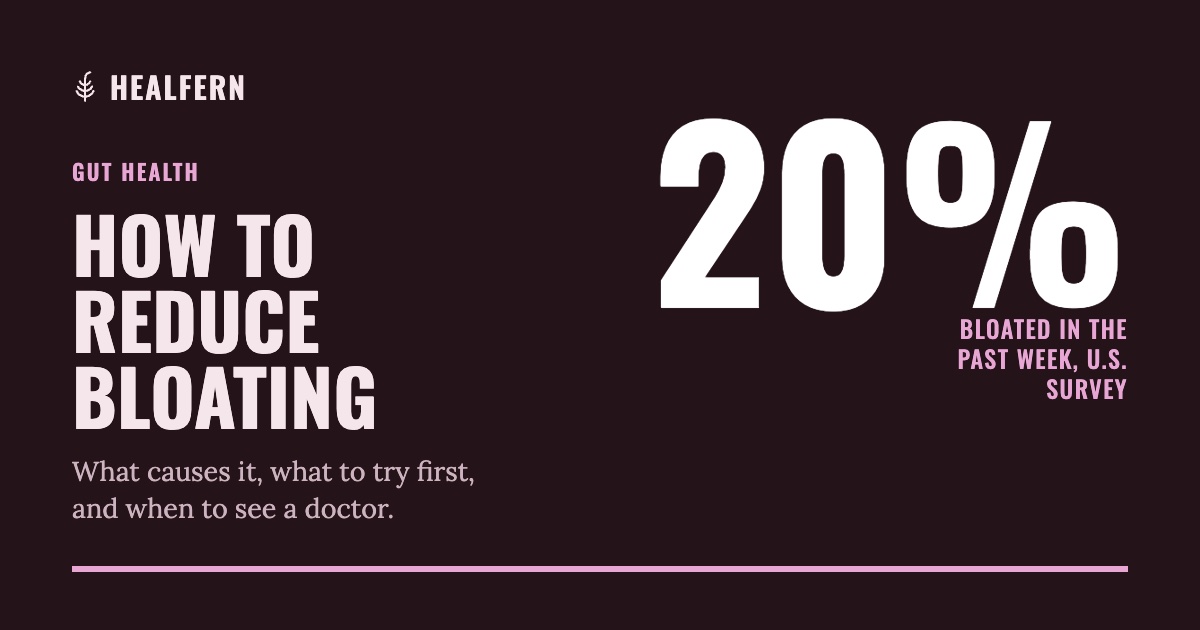
| How common | 16% to 31% of people have bloating; about 20% of adults in a large U.S. survey had it in the past week.[1] |
| Common causes | Swallowed air, gut bacteria fermenting carbohydrates, constipation, IBS, lactose intolerance and overeating.[2][5] |
| First steps | Skip gum and fizzy drinks, eat slowly, eat smaller meals, and keep a food and symptom diary.[3][4] |
| Best evidence | A low FODMAP diet for people with IBS: 13 randomized trials, 944 patients.[8] |
| Supplements studied | Enteric-coated peppermint oil for IBS (limited evidence). The AGA advises against probiotics for bloating.[10][7] |
| See a doctor if | Bloating comes with pain, blood in the stool, vomiting or weight loss, or happens daily for more than a few weeks.[5][14] |
What causes bloating?
Bloating usually comes from gas, and gas gets into your gut in two ways: you swallow air, and bacteria in your large intestine break down carbohydrates your small intestine did not fully digest.[2] Some people feel bloated with a normal amount of gas because their gut is more sensitive.[1]
Having some gas is normal. People pass gas 8 to 14 times a day on average, and up to 25 times a day still counts as normal.[2] Only about half of people who feel bloated also have a belly that visibly swells.[2]
MedlinePlus lists the common causes as swallowing air, constipation, reflux (GERD), irritable bowel syndrome (IBS), lactose intolerance and trouble digesting other foods, overeating, small bowel bacterial overgrowth, weight gain, and oversensitive gut nerves.[5] Some medicines cause it too, including the diabetes drug acarbose and products that contain lactulose or sorbitol.[5]
Less often, bloating points to celiac disease, a problem with the pancreas, fluid in the belly, or a tumor, including ovarian cancer.[5] That is why bloating that changes suddenly or keeps getting worse deserves a checkup.
Who gets bloating most, and does it fade with age?
Bloating is common everywhere, hits women about twice as often as men, and becomes less common as people get older. Those are the main findings of the largest survey to date, which asked more than 51,000 adults in 26 countries about their gut symptoms.[15]
That 2023 analysis came from the Rome Foundation Global Epidemiology Study, published in the journal Gastroenterology. After excluding people with a likely organic cause, nearly 18% of respondents said they had been bloated at least once a week over the past 3 months. The range ran from 11% in East Asia to 20% in Latin America.[15]
Two patterns stood out. Prevalence dropped in older age groups, and women were roughly twice as likely as men to report bloating.[15] The authors did not test why, so treat the age trend as an observation, not a promise that bloating will go away on its own.
Bloating also travels with pain. More than half of the people who reported weekly stomach pain, nausea or belly pain also reported weekly bloating. In the statistical model, belly pain was the strongest link, with an odds ratio of 2.90.[15]
If your bloating comes with regular pain, you are in the group most likely to have a disorder of gut-brain interaction such as IBS, and the diet and behavioral steps below are built for that group.[15][7] If you are a man, or over 60, and bloating is new, that goes a little against the usual pattern, which is one more reason to mention it to your doctor.[5]
How can you reduce bloating with eating habits?
Swallow less air and eat smaller amounts at a time. NIDDK suggests skipping gum, hard candy, fizzy drinks and straws, not talking while you eat, eating slowly while sitting down, and having smaller, more frequent meals instead of a few large ones.[3][4] These steps cost nothing and carry no risk.
Smoking and loose dentures also make you swallow more air. If you smoke, NIDDK suggests asking your doctor about quitting, and if you wear dentures, having your dentist check the fit.[3]
Fatty meals can add to bloating as well.[4] Big meals stretch the stomach, and overeating is on the MedlinePlus list of common causes.[5]
A food and symptom diary helps more than guessing. Write down what you eat and drink and when you feel bloated. NIDDK says the diary helps a doctor or dietitian spot which foods are behind your symptoms.[4]
Foods that often cause gas include:[4]
- Apples, peaches, pears and fruit juices
- Broccoli, cauliflower, cabbage, kale and other cruciferous vegetables
- Beans, peas and lentils
- Milk, ice cream and yogurt, for people who do not digest lactose well
- Whole wheat and other whole grains
- Drinks with high-fructose corn syrup, such as soft drinks, sports drinks and energy drinks
- Sugar-free candy and gum with sweeteners ending in “-ol”, such as sorbitol, xylitol, mannitol, erythritol and maltitol
You do not need to cut all of these. Your diary will show which ones bother you.
Which diet changes help bloating most?
For people with IBS, a short trial of a low FODMAP diet has the strongest evidence of any diet change. For everyone else, the first moves are cutting back on your own trigger foods, trying lactose-free dairy if milk bothers you, and adjusting fiber slowly.[4][8][9]
The low FODMAP diet
FODMAPs are carbohydrates that are hard to digest.[4] A 2022 network meta-analysis in the journal Gut pooled 13 randomized trials with 944 people with IBS. The low FODMAP diet ranked first for overall symptoms and for bloating, and it beat standard dietary advice for bloating or distention.[8] The authors noted that most trials took place in specialist clinics and did not test the reintroduction phase.[8]
The ACG recommends “a limited trial” of the diet for IBS.[9] NIDDK describes trying it for a few weeks, then slowly adding foods back to see which ones you tolerate.[6] The AGA says a gastroenterology dietitian should ideally oversee it, because the diet is restrictive.[7]
Fiber: helpful or a trigger?
It can be either. Too much fiber at once causes gas.[4][6] MedlinePlus notes that insoluble fiber such as bran can add to bloating, while soluble fiber supplements such as psyllium are usually better tolerated.[5]
NIDDK says adults need 22 to 34 grams of fiber a day and suggests adding it 2 to 3 grams a day so your gut can adjust.[6] If constipation is part of your bloating, treating it often helps.[5]
Lactose and fructose
If dairy sets you off, NIDDK lists lactase products as one option for lactose intolerance.[3] For fructose intolerance, it suggests cutting back on fructose, especially high-fructose corn syrup.[4]
Could lactose, gluten or constipation be behind your bloating?
Often, yes. Three everyday causes hide behind a lot of bloating: lactose malabsorption, celiac disease, and plain constipation. Each has a specific fix that works better than cutting random foods, and the first two can be confirmed with simple tests rather than guesswork.[18][19][16]
Lactose: you probably do not need to quit dairy
Lactose malabsorption means your small intestine cannot break down all the lactose in milk, so bacteria ferment it instead and you get gas, bloating or diarrhea. NIDDK estimates about 68% of people worldwide and about 36% of people in the United States have it.[18] It is more common in African American, American Indian, Asian American and Hispanic or Latino families, and least common in people of European descent.[18]
Having malabsorption is not the same as being intolerant. Only people who get symptoms count as lactose intolerant, and most of them can handle some lactose.[18] NIDDK says research suggests many people can take 12 grams of lactose, about the amount in 1 cup of milk, with no or mild symptoms.[17]
So most people can keep some dairy. Drink small amounts with meals, add dairy back a little at a time, favor yogurt and hard cheeses such as cheddar or Swiss, which carry less lactose, or use lactose-free milk, which NIDDK says is just as nutritious.[17] If you cut all dairy, watch your calcium and vitamin D.[17] Lactose also hides in bread, cereal, processed meats, protein powders and some medicines, so check ingredient lists for milk, whey, curds or dry milk solids.[17]
Celiac disease: bloating plus other clues
Celiac disease is an immune reaction to gluten that damages the small intestine. Bloating, gas, diarrhea, constipation and belly pain are all on NIDDK’s symptom list, and the damage can cause a secondary lactose intolerance.[19] The clues that point beyond ordinary bloating are the ones outside the gut: fatigue, joint pain, an itchy blistering rash, canker sores, headaches or infertility.[19]
Symptoms usually improve on a gluten-free diet and return with even small amounts of gluten.[19] Do not start that diet on your own, though. The AGA update puts a celiac blood test early in the workup for chronic bloating,, so ask for the test before you change what you eat.[7]
Constipation: fiber and fluids together
If stool moves slowly, gas gets trapped behind it, and constipation is on the MedlinePlus list of common bloating causes.[5] NIDDK’s advice is to get 22 to 34 grams of fiber a day from whole grains, beans, fruit, vegetables and nuts, add it a little at a time, and drink enough water so the fiber can do its job.[16] Foods with little fiber, such as chips, fast food and many frozen meals, make constipation worse.[16] Older adults often fall short on fiber because they lose interest in food, so a dietitian can help plan meals.[16]
Does exercise or breathing help bloating?
Gentle movement may help gas move along, but the evidence is small. In a 2006 lab study of 8 people with bloating, the gut held on to 45% of an infused gas load at rest and only 24% during mild pedaling, and symptoms eased during exercise.[13]
That is a tiny study, so treat a walk after meals as a low-risk thing to try.
Some people whose bellies visibly swell after meals have a reflex problem called abdominophrenic dyssynergia: the diaphragm pushes down and the belly wall relaxes when it should do the opposite. The AGA lists diaphragmatic breathing as a treatment for it.[7]
A 2024 randomized trial in Barcelona tested biofeedback for this. Forty-two patients with meal-triggered visible distention had three sessions over 4 weeks, learning to move the diaphragm while watching a signal from belts on the chest and belly. Distention scores fell by 66% in the biofeedback group of 19, with no such change in the placebo group.[12] It is one trial at a specialist center, but it fits the AGA advice.
The gut and brain also affect each other. The AGA lists hypnotherapy and cognitive behavioral therapy as options for bloating.[7] If stress is a big part of your picture, our look at L-theanine for anxiety covers what that supplement can and cannot do.
Why do you bloat before your period?
Bloating is one of the most common symptoms of premenstrual syndrome (PMS), along with breast tenderness, constipation or diarrhea and food cravings. It starts in the second half of the cycle, 14 or more days after the first day of the last period, and usually clears 1 to 2 days after bleeding begins.[20]
The cause is not settled. MedlinePlus says changes in brain hormone levels may play a role, but this has not been proven, and women with PMS may respond differently to those hormones.[20] Symptoms often get worse in the late 30s and 40s as menopause approaches.[20]
The advice overlaps a lot with the general bloating steps above. MedlinePlus suggests drinking plenty of water, skipping soft drinks, alcohol and caffeine, eating frequent small meals rather than large ones, and limiting salt and sugar, which helps with fluid retention as well as bloating.[20] Regular aerobic exercise through the month, and more of it in the PMS weeks, is also recommended.[20]
Doctors may suggest vitamin B6, calcium or magnesium, and for severe fluid retention a diuretic.[20] We did not find trial data specific to bloating for those supplements, so treat them as something to discuss with your provider rather than a proven fix. If PMS does not ease with self-care, or symptoms stop you from functioning, MedlinePlus says to make an appointment.[20] Our women’s health guides cover related topics.
Do peppermint oil, probiotics or gas pills help?
Peppermint oil has some evidence, mostly for overall IBS symptoms and pain rather than bloating alone. Probiotics are not recommended for bloating by the AGA. Simethicone and charcoal are sold for gas, but we found no strong trials for bloating to cite.[10][7][5]
NCCIH reports that a 2022 review of 10 studies with 1,030 participants found enteric-coated peppermint oil beat placebo for overall IBS symptoms and abdominal pain, with more side effects, mostly mild reflux and indigestion.[10] A 2021 trial of 133 people found peppermint oil and placebo improved symptoms by the same amount, and the ACG endorsement rests on low-quality evidence.[11]
On probiotics, the AGA is direct: “Probiotics should not be used to treat abdominal bloating and distention.”[7] A 2022 review of 10 studies in 757 people with constipation-type IBS found probiotics did not reduce bloating.[11] Prebiotic fiber supplements can cause gas and bloating at high doses, above 20 grams a day.[11]
MedlinePlus mentions simethicone and charcoal capsules as drugstore options for gas, and warns that charcoal turns stool black.[5] If apple cider vinegar is on your list, our separate review covers what its trials did and did not test.
| Approach | Study and size | Length and dose | Result |
|---|---|---|---|
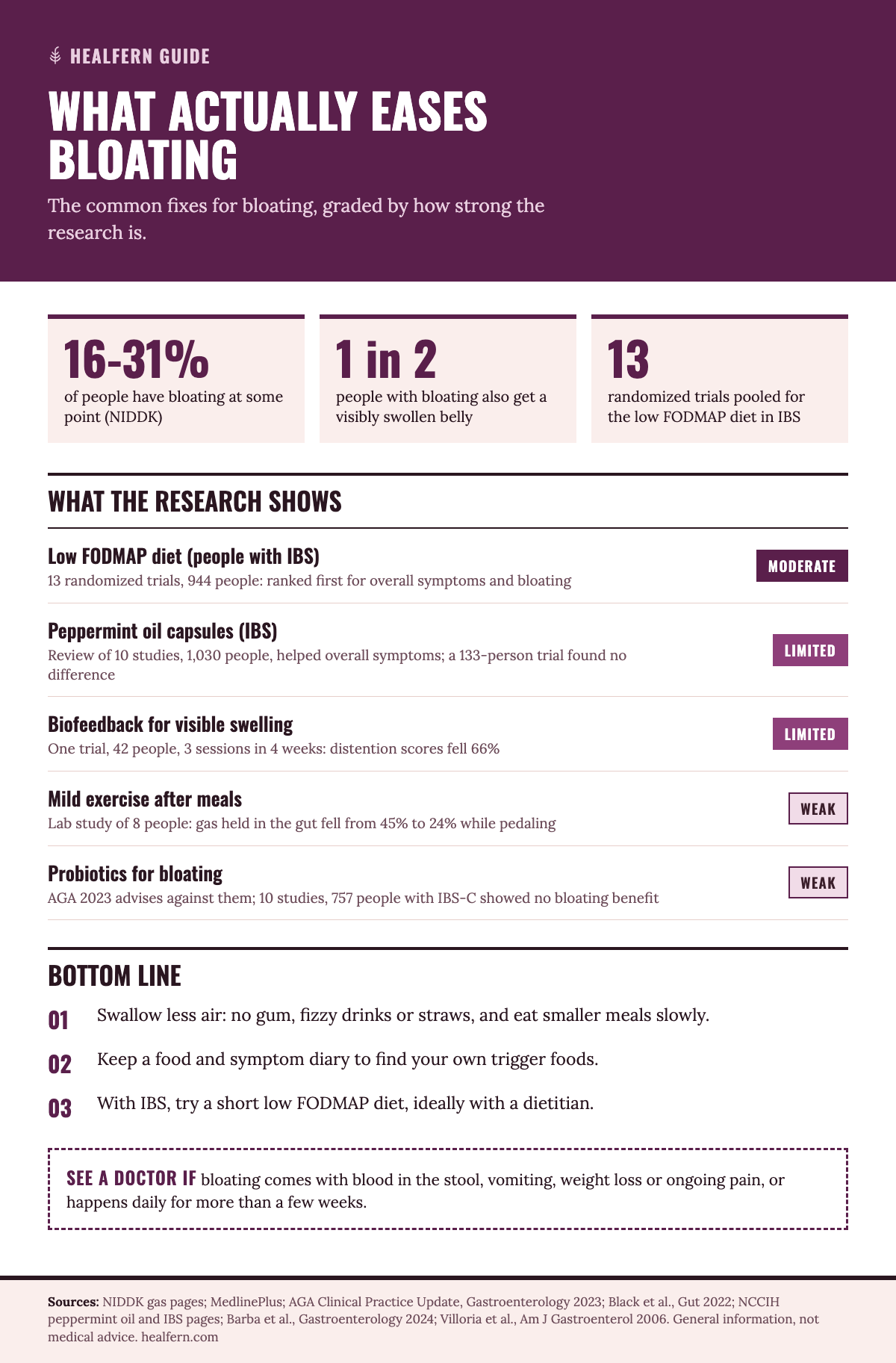
| Low FODMAP diet (IBS) | Network meta-analysis, 13 trials, 944 people[8] | Varied by trial | Ranked first for overall symptoms and bloating; beat standard diet advice for bloating |
| Peppermint oil (IBS) | Review of 10 studies, 1,030 people[10] | Enteric-coated capsules | Better than placebo for overall symptoms and pain; more mild side effects |
| Peppermint oil (IBS) | Single trial, 133 people[11] | 6 weeks | Same improvement as placebo |
| Probiotics (constipation-type IBS) | Review of 10 studies, 757 people[11] | Varied products | Better stool consistency, no effect on bloating or pain |
| Biofeedback (visible distention) | Randomized trial, 42 people[12] | 3 sessions over 4 weeks | Distention scores down 66%; no change with placebo |
| Mild exercise | Lab study, 8 people[13] | Pedaling during a gas infusion | Gas retained fell from 45% to 24% |
When is bloating a reason to see a doctor?
See a doctor if bloating bothers you often, changes suddenly, or comes with abdominal pain, constipation, diarrhea or weight loss.[2] Bloating that happens daily for more than a few weeks, especially with early fullness or pelvic pain, should be checked, because ovarian cancer symptoms are often vague.[14]
See a doctor right away if you have:[5]
- Blood in your stool or black, tarry stools
- Vomiting
- Unplanned weight loss
- Heartburn that keeps getting worse
- Abdominal pain that does not settle
Supplements carry their own cautions. Peppermint oil can cause heartburn, nausea, abdominal pain and dry mouth, and NCCIH says people with a hernia or GERD should not take it, especially at high doses.[10][11] Probiotics have a history of apparently safe use, but few studies have tracked side effects in detail.[11]
NIDDK advises talking with your doctor before you use supplements or probiotics for gas.[3] That matters most if you are pregnant, take prescription medicines, or have a long-term condition.
What do doctors try first for chronic bloating?
Doctors start by looking for a cause they can treat. The AGA update suggests ruling out celiac disease with a blood test, checking for carbohydrate intolerance with diet changes or breath tests, and testing for small intestinal bacterial overgrowth only in a small group of at-risk patients.[7]
Scans and scopes are kept for people with alarm signs, worsening symptoms or an abnormal exam.[7]
Doctors use the Rome IV criteria to diagnose bloating and distention that have no other cause.[7] IBS is a frequent finding: about 12 percent of people in the United States have it.[11]
Treatment then follows the cause:[7]
- Constipation medicines when constipation is part of the problem
- Pelvic floor testing and biofeedback when bloating comes with difficult bowel movements
- Central neuromodulators (certain antidepressants) to calm an oversensitive gut
- Gut-directed hypnotherapy or cognitive behavioral therapy
- A low FODMAP diet run by a gastroenterology dietitian
For IBS, the ACG also recommends specific prescription drugs for the constipation and diarrhea types.[9] A supplement does not replace this workup. More on digestion is in our gut health guides.
What should you track to know if a fix is working?
Track three things for at least a few weeks: what you ate, how bloated you felt and when, and whether your belly visibly swelled. A diary beats memory, and it is what a doctor or dietitian will ask for first.[4][20] Change one thing at a time so you can tell what helped.
For PMS-related bloating, MedlinePlus recommends a daily log for at least 3 months, recording the type of symptom, how severe it was and how long it lasted, because that pattern is how PMS is confirmed.[20] The same 3-month window is a fair test for any bloating plan.
A workable sequence looks like this:
- Weeks 1 to 2: cut gum, fizzy drinks and straws, slow down at meals, and keep the diary. Note whether bloating is daily or tied to certain foods or days of your cycle.[3][4][20]
- Weeks 3 to 4: test the single food group your diary points to most, such as dairy or sugar alcohols, and nothing else.[4][17]
- Weeks 5 to 8: if constipation shows up in the diary, raise fiber by 2 to 3 grams a day with extra water.[6][16]
- After 8 weeks: if nothing has moved and you fit the IBS picture, ask about a dietitian-led low FODMAP trial with a planned reintroduction phase.[7][8]
Two signs mean the plan is working: fewer bloated days in the diary, and less visible distention after meals. Two signs mean to stop and see a doctor instead: new pain, or any red flag from the list above.[5][14] Bring the diary to that visit; it shortens the workup.[4]
A bloating checklist you can start this week
- Stop chewing gum and drinking fizzy drinks for a while and see if bloating changes.[3]
- Eat sitting down, slowly, in smaller portions.[4]
- Keep a food and symptom diary and bring it to your doctor or dietitian.[4]
- Check labels on sugar-free foods for sorbitol, xylitol, mannitol, erythritol and maltitol.[4]
- Raise fiber by 2 to 3 grams a day, favoring soluble sources like oats and psyllium.[5][6]
- Take a short walk after meals; it is low risk even though the evidence is thin.[13]
- If you try peppermint oil, choose enteric-coated capsules and skip it if you have reflux. Our label reading guide shows what to check.[10][11]
- Book a visit if bloating is daily for more than a few weeks or comes with any red flag above.[14]
Verdict
Most bloating comes down to swallowed air and fermenting food, so the habits that reduce both are where to start. For people with IBS, a dietitian-guided low FODMAP trial has the best evidence, and peppermint oil is a reasonable add-on with limited support.[3][8][10]
Our judgment call: skip probiotics for bloating. The AGA advises against them, and the trial data on bloating are weak.[7][11] If bloating is daily for weeks, changes suddenly, or comes with pain or weight loss, see a doctor before you try anything off the shelf.
Questions people also ask
How can I reduce bloating fast?
Skip gum, fizzy drinks and straws, eat slowly while sitting down, and choose a smaller meal. A short walk may help gas move, though the study behind that idea included only 8 people. Simethicone is sold for gas, but strong trial data for bloating are lacking.
What foods cause the most bloating?
Common culprits are beans and lentils, broccoli, cabbage and cauliflower, apples, pears and peaches, dairy for people with lactose intolerance, whole wheat, drinks with high-fructose corn syrup, and sugar-free products sweetened with sorbitol, xylitol or other sweeteners ending in -ol.
Do probiotics help with bloating?
The evidence says probably not. The 2023 American Gastroenterological Association update advises against probiotics for bloating and distention, and a 2022 review of 10 studies in people with constipation-type IBS found no effect on bloating.
Does peppermint oil help bloating?
Peppermint oil has some evidence for overall IBS symptoms and belly pain. A review of 10 studies with 1,030 people found benefit over placebo, but a 2021 trial of 133 people found no difference. People with reflux should avoid it.
When should I worry about bloating?
See a doctor if bloating comes with blood in the stool, black stools, vomiting, weight loss, worsening heartburn or ongoing pain. Bloating that happens daily for more than a few weeks, with early fullness or pelvic pain, should also be checked.
Is a low FODMAP diet good for bloating?
For people with IBS, yes, it has the best evidence of any diet. A 2022 analysis of 13 trials with 944 people ranked it first for bloating. It is meant as a short trial, ideally with a dietitian, followed by adding foods back.
Sources
- Definition & Facts for Gas in the Digestive Tract, NIDDK, reviewed 2021
- Symptoms & Causes of Gas in the Digestive Tract, NIDDK, reviewed 2021
- Treatment for Gas in the Digestive Tract, NIDDK, reviewed 2021
- Eating, Diet, & Nutrition for Gas in the Digestive Tract, NIDDK, reviewed 2021
- Abdominal bloating, MedlinePlus, National Library of Medicine, reviewed 2026
- Eating, Diet, & Nutrition for Irritable Bowel Syndrome, NIDDK, reviewed 2017
- AGA Clinical Practice Update on Evaluation and Management of Belching, Abdominal Bloating, and Distention: Expert Review (Moshiree et al.), Gastroenterology, American Gastroenterological Association, 2023
- Efficacy of a low FODMAP diet in irritable bowel syndrome: systematic review and network meta-analysis (Black et al.), Gut, 2022
- ACG Clinical Guideline: Management of Irritable Bowel Syndrome (Lacy et al.), American Journal of Gastroenterology, American College of Gastroenterology, 2021
- Peppermint Oil: Usefulness and Safety, NCCIH, updated 2025
- Irritable Bowel Syndrome: What You Need To Know, NCCIH
- Thoracoabdominal Wall Motion-Guided Biofeedback Treatment of Abdominal Distention: A Randomized Placebo-Controlled Trial (Barba et al.), Gastroenterology, 2024
- Physical activity and intestinal gas clearance in patients with bloating (Villoria et al.), American Journal of Gastroenterology, 2006
- Ovarian cancer, MedlinePlus, National Library of Medicine, reviewed 2024
- Prevalence and Associated Factors of Bloating: Results From the Rome Foundation Global Epidemiology Study (Ballou et al.), Gastroenterology, 2023
- Eating, Diet, & Nutrition for Constipation, NIDDK, reviewed 2018
- Eating, Diet, & Nutrition for Lactose Intolerance, NIDDK, reviewed 2018
- Definition & Facts for Lactose Intolerance, NIDDK, reviewed 2018
- Symptoms & Causes of Celiac Disease, NIDDK, reviewed 2020
- Premenstrual syndrome, MedlinePlus, National Library of Medicine, reviewed 2020
This article is general information, not medical advice. These statements have not been evaluated by the FDA, and supplements are not intended to diagnose, treat, cure or prevent any disease. Talk to your doctor or pharmacist before you start a supplement. How we research.