Probiotics are live microbes, such as certain Lactobacillus and Bifidobacterium strains, that can give a health benefit in adequate amounts. Prebiotics are compounds such as inulin that your helpful gut bacteria feed on. Most healthy adults do better starting with fiber-rich plant foods. The American Gastroenterological Association backs probiotics in only three settings, and people with weak immune systems should ask a doctor first.
Prebiotics vs probiotics comes down to one idea: probiotics are live microbes you swallow, and prebiotics are the fibers and related compounds those microbes feed on. We read the NCCIH page on probiotics, the expert definitions from the International Scientific Association for Probiotics and Prebiotics (ISAPP), the 2020 American Gastroenterological Association (AGA) guideline, a Cochrane review, a review of inulin trials and USDA food data. Our research process explains how we pick and check sources.
The short answer: most healthy adults gain more from eating plant foods rich in fiber than from a probiotic pill, and the AGA supports probiotics in only 3 clinical settings.[4]
| Feature | Prebiotics | Probiotics |
|---|---|---|
| What it is | A substance your gut microbes use selectively, with a proven health benefit[3] | Live microorganisms that give a health benefit in adequate amounts[2] |
| Common examples | Inulin, fructooligosaccharides (FOS) and galactooligosaccharides (GOS)[3] | Lactobacillus and Bifidobacterium bacteria, and the yeast Saccharomyces boulardii[1] |
| Food sources | Chicory root, Jerusalem artichoke, garlic, onions, leeks, asparagus, bananas and barley[11] | Yogurt and other fermented foods with live cultures[1] |
| Typical amounts | At least 3 g a day for most gut prebiotics; trials used 5 to 20 g of inulin[3][9] | Varies by strain; one children’s review found 5 billion CFU or more a day worked better[8] |
| Best evidence | Inulin reliably raises Bifidobacterium in adults[9] | Lower risk of antibiotic-associated and C. difficile diarrhea[1][4] |
| Main side effect | Gas, especially at high doses[3] | Usually mild, such as gas or bloating[8] |
| Who should be careful | People with IBS who react to FODMAP foods[10] | People with weak immune systems, very ill patients and premature infants[1] |
What is the difference between prebiotics and probiotics?
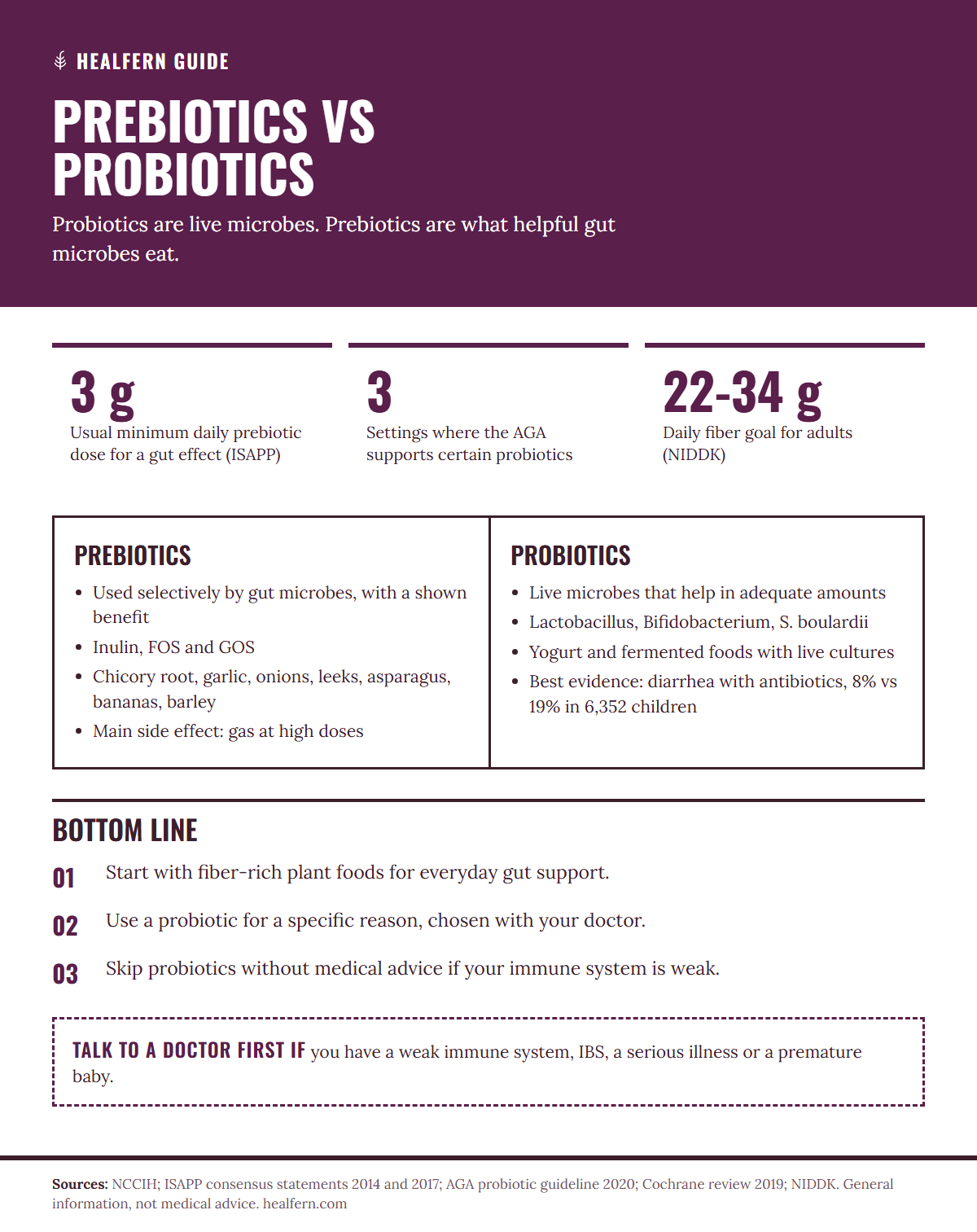
A probiotic is a live microbe that helps your health when you take enough of it, while a prebiotic is food for the helpful microbes already in your gut. The probiotic definition comes from the FAO and WHO, and an ISAPP expert panel kept it in 2014.[2] ISAPP updated the prebiotic definition in 2017.[3]
The 2017 panel defined a prebiotic as “a substrate that is selectively utilized by host microorganisms conferring a health benefit.”[3] So gut bacteria have to use it selectively, and someone has to show a health benefit. Plain fiber that feeds every microbe the same way does not meet the bar.
Probiotics are also more specific than labels suggest. NCCIH notes that if one kind of Lactobacillus helps with a problem, another kind may not.[1] The AGA says effects depend on the exact strain or mix of strains, not just the species.[4]
A food with live cultures is not automatically a probiotic. ISAPP keeps live cultures in fermented foods outside the probiotic label unless a health benefit has been shown.[2] Our guide to fermented foods for gut health and what the research shows covers yogurt, kefir and sauerkraut in more detail.
Prebiotics vs probiotics: which is better for gut health?
For most healthy adults, prebiotic foods are the better first step, because the fiber that feeds gut bacteria also counts toward a daily fiber goal of 22 to 34 grams.[10] Probiotics make more sense for specific, short-term uses, such as while taking antibiotics, and ideally with a doctor’s input.[4]
Fiber-rich plants deliver prebiotic compounds along with other nutrients, and most adults can build them into meals they already eat. The AGA, by contrast, found that the evidence for probiotics in most digestive conditions “is greatly lacking.”[4]
Probiotics do have uses. NCCIH lists promising results for antibiotic-associated diarrhea, C. difficile diarrhea, colic in breastfed infants and some other uses.[1] But in most cases, researchers still do not know which strains help, how much to take, or who benefits most.[1]
If you want everyday gut support, start with plants. If you have a clear medical reason, ask your doctor about a strain that was tested for that problem.
What foods have prebiotics and probiotics?
Prebiotics come from plants such as chicory root, Jerusalem artichoke, garlic, onions, leeks, asparagus, bananas and barley, while probiotics come from yogurt and other fermented foods with live cultures.[3][1] The main prebiotic compounds studied in these plants are inulin and FOS, with GOS also well researched.[3]
The table below shows total fiber from USDA FoodData Central. It counts all fiber, not prebiotic content alone, so use it as a rough guide to how much each food adds to your day.[11]
| Food | Total fiber per 100 g | Note |
|---|---|---|
| Lentils, boiled | 7.9 g | Also a FODMAP food[11][10] |
| Barley, pearled, cooked | 3.8 g | Easy swap for rice[11] |
| Banana, raw | 2.6 g | Simple snack[11] |
| Garlic, raw | 2.1 g | Small amounts per meal[11] |
| Asparagus, raw | 2.1 g | Also a FODMAP food[11][10] |
| Leeks, raw | 1.8 g | Good in soups[11] |
| Onions, raw | 1.7 g | Also a FODMAP food[11][10] |
| Jerusalem artichoke, raw | 1.6 g | Known inulin source[11][3] |
| Chicory root, raw | 1.5 g | Main source of commercial inulin[11][3] |
On the probiotic side, look for yogurt or kefir labeled with live and active cultures. Keep in mind that a live culture is not the same as a tested probiotic strain.[2]
Do probiotic supplements actually work?
Some probiotic strains work for a few specific problems, but the AGA’s 2020 guideline found too little evidence to recommend them for most digestive conditions.[4][5] It supports certain formulas in only 3 settings: preventing C. difficile infection during antibiotics, preventing a serious bowel disease in premature infants, and managing pouchitis.[4]
The AGA found too little evidence to recommend probiotics for Crohn’s disease, ulcerative colitis, irritable bowel syndrome (IBS) or treating C. difficile infection.[4] It recommends against probiotics for children with acute infectious gastroenteritis.[4] The panel chair said that people taking probiotics for Crohn’s, colitis or IBS “should consider stopping.”[4]
The strongest numbers come from antibiotic use. A 2019 Cochrane review pooled 33 trials in 6,352 children. Diarrhea from antibiotics hit 8% of children on probiotics and 19% of those without them.[8]
| Review | Who was studied | What was tested | Result |
|---|---|---|---|
| Cochrane, 2019[8] | 33 trials, 6,352 children on antibiotics | Probiotics vs control | Diarrhea in 8% vs 19%; 1 case avoided for every 9 children treated |
| Outpatient review, 2017[1] | 17 studies, 3,631 adults and children | Probiotics with antibiotics | About half the risk of diarrhea; moderate quality |
| C. difficile analysis, 2017[1] | 31 studies, 8,672 patients | Probiotics with antibiotics | Moderately certain lower risk of C. difficile diarrhea |
| IBS review, 2018[1] | 53 studies, 5,545 people | Many strains and mixes | Possible help for symptoms; no firm conclusions |
| Inulin review, 2020[9] | 9 studies in adults | 5 to 20 g of inulin a day | More Bifidobacterium; no clear rise in short-chain fatty acids |
Do prebiotic supplements work, and how much do you need?
Prebiotic powders such as inulin do shift gut bacteria in adults, but most need at least 3 grams a day to have any effect, and proof of wider health benefits is still thin.[3][9] Products with less than that should not be called prebiotics unless a lower dose was shown to work.[3]
A 2020 systematic review found 9 human studies of inulin in adults, 7 of them randomized and placebo controlled. Doses ran from 5 to 20 grams a day.[9] The most consistent change was a rise in Bifidobacterium, a group of bacteria often linked with gut health.[9]
Lab studies had predicted that inulin would raise short-chain fatty acids, which are compounds gut bacteria make from fiber. In people, the bacterial changes were not linked with higher levels of these acids.[9]
More is not always better here. ISAPP notes that too much prebiotic can cause unwanted effects such as excess gas.[3] If you try a powder, start low and raise it slowly. NIDDK suggests adding fiber by 2 to 3 grams a day to help prevent gas and bloating.[10]
Which helps constipation more, prebiotics or probiotics?
Neither has strong proof for constipation, but more fiber is the usual first step, and a few probiotic strains showed modest benefit in reviews.[10][1] NIDDK says fiber may ease constipation in IBS because it makes stool soft and easier to pass.[10]
For probiotics, NCCIH describes a 2014 review of 14 studies with 1,182 adults that found some benefit, especially for Bifidobacterium lactis.[1] A 2017 review of 9 studies with 778 older adults found a small but meaningful benefit, mostly with Bifidobacterium longum.[1] Reviews in children disagreed with each other.[1]
For prebiotics, earlier reports linked inulin with more frequent stools in people with constipation.[9] That fits with fiber advice in general, but we did not find a large pooled review of prebiotics for constipation to quote here.
If gas and a swollen belly are the bigger problem, a sudden jump in fiber or a prebiotic powder can make it worse at first.[10] Our guide on how to reduce bloating, with causes and fixes that work, walks through the common triggers.
What are synbiotics and postbiotics?
A synbiotic is a product that combines live microbes with a substance gut microbes use, and a postbiotic is a preparation of inactivated microbes or their parts that gives a health benefit.[6][7] Both terms come from ISAPP consensus panels, in 2020 and 2021.[6][7]
ISAPP defines a synbiotic as “a mixture comprising live microorganisms and substrate(s) selectively utilized by host microorganisms that confers a health benefit on the host.”[6] The panel described two kinds. A complementary synbiotic is simply a probiotic plus a prebiotic. A synergistic synbiotic pairs a microbe with a substrate chosen to feed that same microbe.[6]
NCCIH uses the simpler version: synbiotics combine probiotics and prebiotics.[1] On a label, a product that adds inulin to a probiotic capsule is usually making this kind of claim.
Postbiotics are newer. ISAPP defines them as “a preparation of inanimate microorganisms and/or their components that confers a health benefit on the host.”[7] The microbes are no longer alive, which separates postbiotics from probiotics. The panel wrote the definition because the term was being used in research and on products without a shared meaning.[7]
Should you take a prebiotic, a probiotic or both?
Most people do not need either supplement, and the right choice depends on your situation. Use the table below as a starting point for a talk with your doctor or pharmacist, not as a prescription.[4][1]
| If this is you | A reasonable first step | Why |
|---|---|---|
| Healthy adult who wants better gut health | Eat more fiber-rich plants and work up toward 22 to 34 g of fiber a day | Food sources supply prebiotics plus other nutrients[10][11] |
| Taking antibiotics | Ask your doctor whether a specific, tested probiotic makes sense | The best evidence for probiotics is in this setting[8][4] |
| Living with IBS | Talk to your doctor or a dietitian before adding prebiotic powders | Many prebiotic foods are FODMAPs that can trigger symptoms[10] |
| Living with Crohn’s or ulcerative colitis | Keep your prescribed treatment and ask before using probiotics | The AGA found too little evidence and suggests patients consider stopping them[4] |
| Weak immune system or seriously ill | Do not start a probiotic without your care team | The risk of harm is higher in this group[1] |
| Parent of a premature baby | Only use a probiotic if the neonatal team prescribes it | The FDA warned of severe, sometimes fatal infections in 2023[1] |
Who should not take probiotics or prebiotics?
People with weakened immune systems, people who are seriously ill and premature infants face the highest risk from probiotics, so they should use them only under medical care.[1] Prebiotics are lower risk but often cause gas, and they can trigger symptoms in people with IBS.[3][10]
NCCIH says probiotics have a long history of apparently safe use in healthy people, but few studies have tracked side effects in detail.[1] Possible harms include infections, harmful substances made by the microbes and the transfer of antibiotic resistance genes to other gut bacteria.[1]
In 2023, the FDA warned health care providers that premature infants given probiotics can develop severe, potentially fatal infections.[1] The Cochrane review saw no serious side effects in healthy children, but noted reports of serious events in very ill or immunocompromised children, including those with central venous catheters.[8]
Some probiotic products have contained microbes other than those on the label.[1] Many are sold as dietary supplements, which do not need FDA approval before they are sold.[1]
For prebiotics, the main issue is comfort. Garlic, onions, asparagus, artichokes, beans and lentils are all on the NIDDK list of FODMAP foods that some people with IBS limit.[10] If you are pregnant, take medicines or have a long-term condition, check with your doctor before starting either supplement.[1]
What do doctors use first for gut symptoms?
Doctors usually start with diet changes, such as more fiber or a trial of the low FODMAP diet, along with standard medical treatment for the cause they find.[10] Probiotics are added only for specific uses with evidence, and they never replace care for a diagnosed condition.[4]
For IBS, NIDDK lists three diet changes a doctor may suggest: more fiber, avoiding gluten, or a low FODMAP diet for a few weeks, often with help from a dietitian.[10] Soluble fiber, found in beans, fruit and oat products, seems to help IBS symptoms more than insoluble fiber.[10]
For conditions such as Crohn’s disease and ulcerative colitis, treatment includes medicines and sometimes surgery, and a probiotic does not replace them.[1] NCCIH advises against using probiotics as a reason to put off seeing your provider about any health problem.[1]
You can find more of our checked articles in our gut health guides.
Your prebiotics and probiotics checklist
- Add one fiber-rich plant food to each meal, such as lentils, barley, onions or a banana.[11]
- Raise fiber slowly, by about 2 to 3 grams a day, to limit gas.[10]
- Aim for 22 to 34 grams of fiber a day in total.[10]
- On a prebiotic label, look for the compound and the dose; at least 3 g a day is the usual floor for a gut effect.[3]
- On a probiotic label, look for the full strain name, not just the species, since effects are strain specific.[4]
- Check the live microbe count, often listed in CFU, and match it to a dose that was tested.[8]
- Ask your doctor before taking a probiotic if you have a weak immune system, a central line or a serious illness.[1]
- Bring every supplement you take to your next appointment so your doctor can review it.[1]
Bottom line
Probiotics are live microbes, and prebiotics are what helpful gut microbes eat. Inulin and similar prebiotics do raise Bifidobacterium in adults, and some probiotic strains lower the risk of diarrhea from antibiotics.[9][8] Beyond those uses, the evidence is thin, and the AGA backs probiotics in only 3 settings.[4]
For most people, eating more fiber-rich plants is the better first step, because it costs little and counts toward your daily fiber goal. Save probiotics for a specific reason, chosen with your doctor, and skip them if your immune system is weak unless your care team says otherwise.[1]
Questions people also ask
Do I need a probiotic after antibiotics?
Not always. A Cochrane review of 33 trials in children found diarrhea in 8% of those given probiotics and 19% of those who were not. The AGA supports certain probiotics to lower C. difficile risk during antibiotics, so ask your doctor which strain fits.
Are probiotic supplements approved by the FDA?
Most are not. Many probiotics are sold as dietary supplements, which do not need FDA approval before they reach stores. NCCIH also notes that some products have contained microbes other than those listed on the label, so quality varies.
Are prebiotics and probiotics safe for kids?
Healthy children in the Cochrane trials had no serious side effects from probiotics. The AGA recommends against probiotics for children with acute infectious gastroenteritis, and the FDA warned about severe infections in premature infants. Ask your pediatrician before starting either one.
Can I give my dog prebiotics or probiotics?
The ISAPP prebiotic definition applies to animals as well as people, but doses and products differ by species. We did not review pet trials for this guide, so ask your veterinarian before giving a dog any human supplement.
Is it better to get prebiotics from food or a powder?
Food is the simpler start for most people. Plants such as lentils, barley, onions and bananas add fiber toward the 22 to 34 gram daily goal. Powders need at least 3 grams a day to work, and higher doses can cause gas.
Sources
- Probiotics: Usefulness and Safety, National Center for Complementary and Integrative Health (NIH)
- ISAPP consensus statement on the scope and appropriate use of the term probiotic (Hill et al.), Nature Reviews Gastroenterology and Hepatology, 2014
- ISAPP consensus statement on the definition and scope of prebiotics (Gibson et al.), Nature Reviews Gastroenterology and Hepatology, 2017
- AGA does not recommend the use of probiotics for most digestive conditions, American Gastroenterological Association, 2020
- AGA Clinical Practice Guidelines on the Role of Probiotics in the Management of Gastrointestinal Disorders (Su et al.), Gastroenterology, 2020
- ISAPP consensus statement on the definition and scope of synbiotics (Swanson et al.), Nature Reviews Gastroenterology and Hepatology, 2020
- ISAPP consensus statement on the definition and scope of postbiotics (Salminen et al.), Nature Reviews Gastroenterology and Hepatology, 2021
- Probiotics for the prevention of pediatric antibiotic-associated diarrhea (Guo et al.), Cochrane Database of Systematic Reviews, 2019
- The effects of inulin on gut microbial composition: a systematic review of evidence from human studies (Le Bastard et al.), European Journal of Clinical Microbiology and Infectious Diseases, 2020
- Eating, Diet, and Nutrition for Irritable Bowel Syndrome, National Institute of Diabetes and Digestive and Kidney Diseases
- FoodData Central, SR Legacy: total fiber for chicory root, Jerusalem artichoke, garlic, onion, leek, asparagus, banana, barley and lentils, USDA Agricultural Research Service, checked October 2026
This article is general information, not medical advice. These statements have not been evaluated by the FDA, and supplements are not intended to diagnose, treat, cure or prevent any disease. Talk to your doctor or pharmacist before you start a supplement. How we research.